Korea's 3 Children's-Product KC Types: Which Fits Your Item
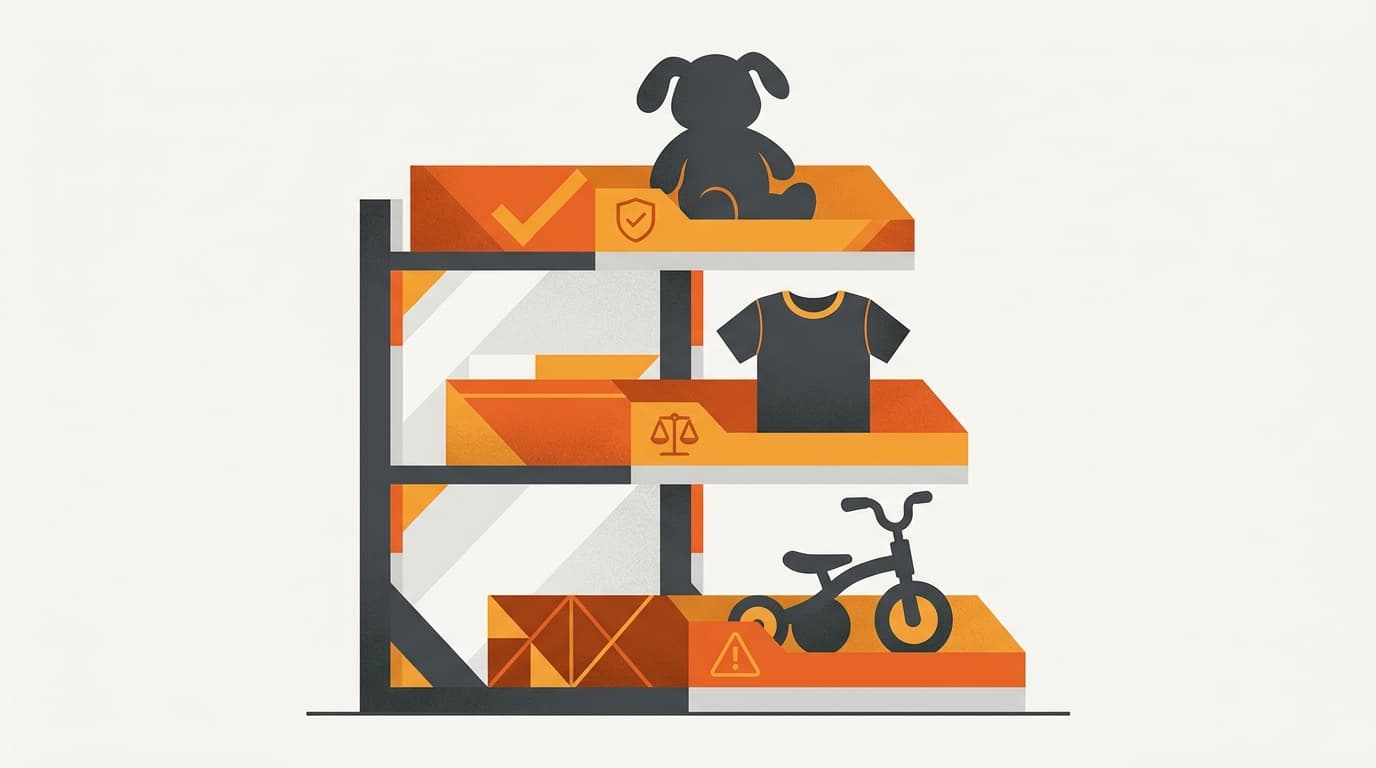
Once your item is classified as a children's product in Korea, it does not face one uniform certification. Korea's children's-product safety law sorts it into one of three conformity-assessment types — safety certification (안전인증), safety confirmation (안전확인), or supplier's confirmation of conformity (공급자적합성확인) — chosen by the item's risk level, not by the fact that it is "for children." A high-risk item like a car seat lands in the heaviest tier with factory auditing; a plush toy and a child's t-shirt usually sit in lighter tiers. Getting the tier right up front is the difference between over-spending on certification you never needed and launching under an insufficient track.
That last point is the costliest mistake we see. Brands assume "children's product = one certificate," scope a single path for the whole catalog, and then discover mid-launch that a ride-on item needed a factory audit their supplier never scheduled — or that a garment they routed through third-party certification could have self-declared. The regime is administered by the Korean Agency for Technology and Standards (KATS / 국가기술표준원) under the Special Act on the Safety of Children's Products (어린이제품 안전 특별법), and the statute and its enforcement rules are readable in Korean on the national law portal at law.go.kr.
Before you reach this question at all, your item has to actually be a children's product — a separate test based on age and reasonably foreseeable use. If you are not yet sure yours qualifies, start with whether your product is a "children's product" under Korean law and why Korea sweeps in adult-looking items. This post picks up where those leave off.
The regime uses three tiers, not one
The children's-product safety regime is its own track, separate from the general electrical and consumer KC system — but it borrows the same structural idea: conformity is assessed at three levels of rigor, keyed to how much harm the product could plausibly cause. The general KC system splits into three obligations the same way, which we walk through in KC safety certification and which of Korea's three tiers fits your product. The children's-product regime mirrors that logic with its own list of designated categories and standards.
Conformity-assessment type is the assessment path a children's product must follow before it can be sold in Korea. There are three — safety certification, safety confirmation, and supplier's confirmation of conformity — and the correct one is fixed by the product's designated category and safety standard, not chosen by the seller.
The practical takeaway: you do not pick your tier for convenience. KATS's designated-category list decides it. Your job is to identify which category and standard your item maps to, then follow the assessment path that category carries.
Type 1 — Safety Certification (안전인증): the highest-risk tier
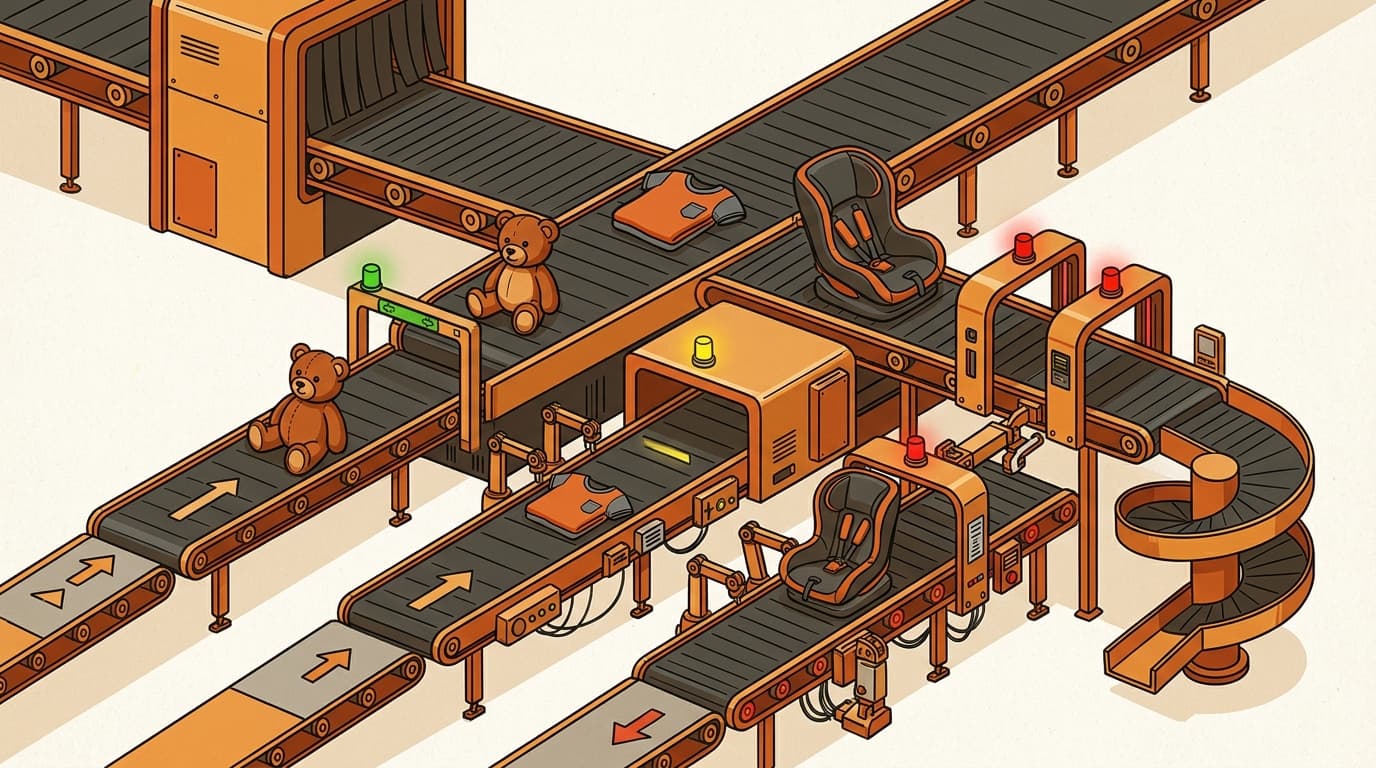
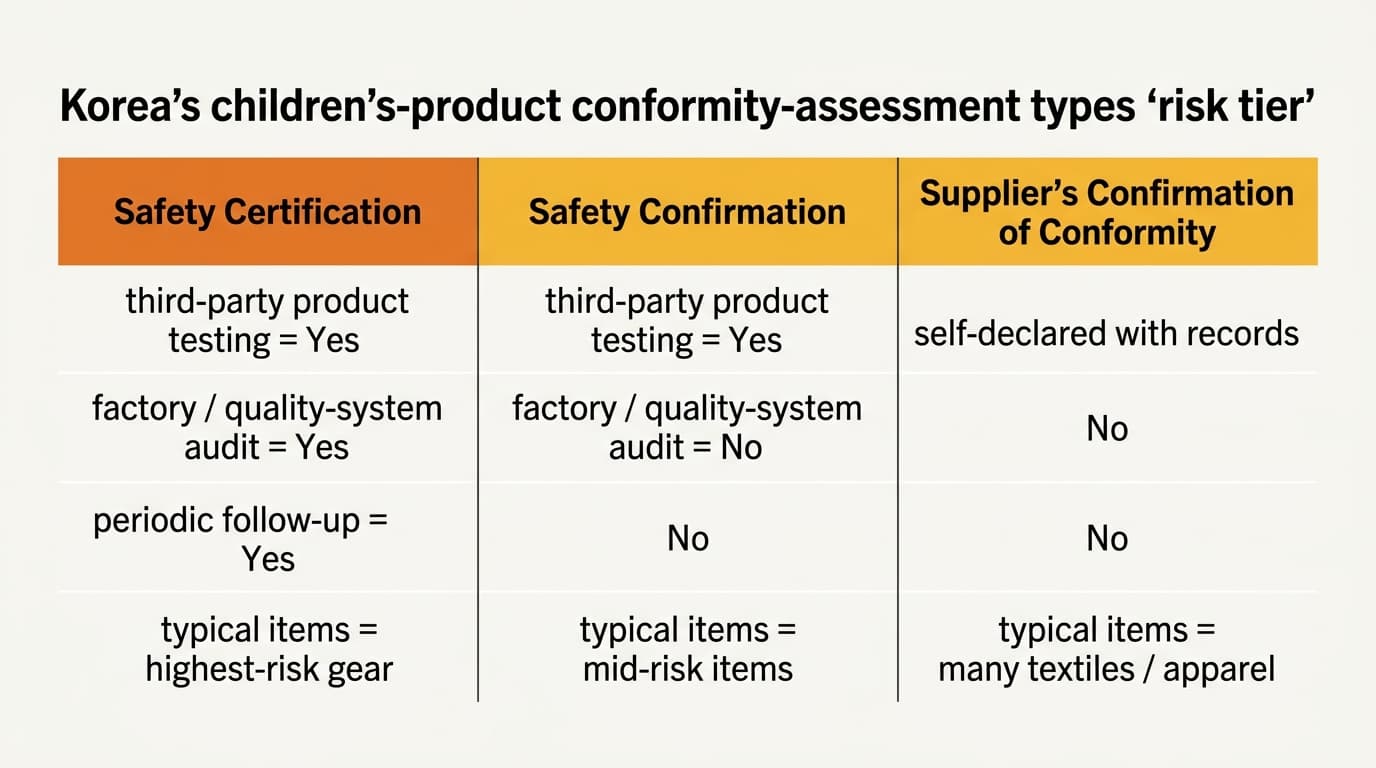
Safety certification is reserved for the highest-hazard children's items. It is the most involved of the three, and it requires two things rather than one.
- Third-party product testing against the applicable safety standard, performed by a designated certification body.
- Factory and quality-system assessment of the manufacturing site, also by a designated body, with periodic follow-up thereafter.
That factory component is what makes this tier different from the others. It is not enough to prove a single sample passes; the certifier evaluates whether the production process can consistently produce conforming units, and revisits that over time. High-hazard gear — the kind of item where a defect can cause serious injury — tends to land here.
The operational consequence is scheduling. If your item falls into safety certification, your overseas factory becomes part of the certification itself, which means audit windows, corrective-action cycles, and documentation from the production side have to be lined up early. This is the tier where a launch quietly slips by months because nobody booked the factory assessment when they booked the product test.
Type 2 — Safety Confirmation (안전확인): mid-risk, tested and filed
Safety confirmation covers mid-risk items. It keeps the independent-testing requirement but drops the factory audit.
Here, a designated testing body tests the product against its applicable safety standard, and the responsible party files (registers) the test result with the authorities. There is no ongoing factory assessment and no periodic quality-system follow-up of the kind Type 1 carries. You prove the product itself conforms, you register that proof, and you keep it current if the standard or the product changes.
For planning purposes, this is meaningfully lighter than safety certification. You still pay for and wait on third-party lab testing to the correct Korean standard — that is not optional — but you avoid the factory-audit scheduling that dominates the Type 1 timeline.
Type 3 — Supplier's Confirmation of Conformity (공급자적합성확인): self-declared, still accountable
Supplier's confirmation of conformity is the lightest tier, and it covers lower-risk everyday children's goods — many textiles and apparel items among them. The responsible party self-declares conformity based on testing to the applicable standard and keeps the records; no third-party certificate is issued.
Do not misread "self-declared" as "unregulated." The obligation is real and the liability is real — it simply sits with the Korea-side responsible party rather than with an external certifier. You still have to test to the correct standard, hold the supporting documentation, and be able to produce it if asked. What you avoid is the issuance of a formal third-party certificate and the front-loaded process that comes with the heavier tiers.
This is why a child's t-shirt and a car seat, both unambiguously children's products, can sit in completely different worlds. One self-declares on documented testing; the other pulls the factory into a full audit with periodic follow-up.
“The most expensive children's-product error is not failing a test — it is scoping the wrong tier and discovering it after inventory is already in transit.”
Isaac Lee — CEO, Kontactic
Why each SKU family has to be classified on its own
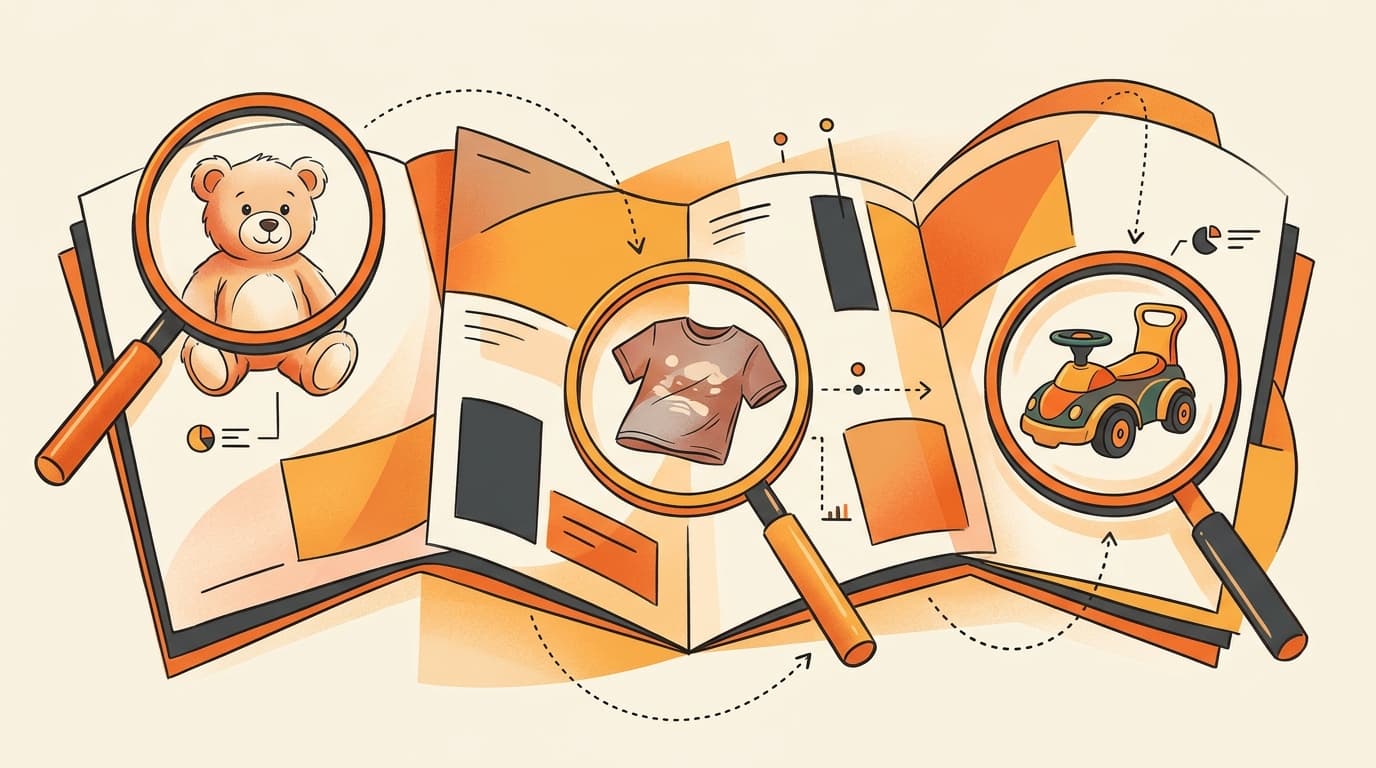
Because the sorting is by product category and its designated standard, a single brand's catalog can span all three types at once. A plush toy, a child's garment, and a ride-on or gear item are three different categories with three different standards — and potentially three different assessment paths. You cannot certify them as a batch.
Treating "children's products" as one line item on your launch plan is the classic misstep. Classify each SKU family against its own category and standard before you commit to a certification path — otherwise the heaviest item in your catalog silently sets the whole timeline, or the lightest track gets applied to an item that needed more.
This SKU-by-SKU discipline is the same principle behind mapping each SKU to the right Korean regulation and screening every SKU for Korea certification before it ships. For children's products specifically, the classification question is doubled: first, does the item count as a children's product at all, and second, once inside, which of the three tiers does its category assign.
The KC mark and label are required in every tier
Whichever type applies, the outcome on the shelf is similar: the KC mark and the accompanying label have to appear in Korean with the required identifying information. The tier changes how you earn the right to display the mark — not whether you display it.
Equally important, the record-keeping and legal responsibility rest with the Korea-side certificate or declaration holder, not with the overseas factory alone. In Type 1 the factory is drawn into the assessment, but the party accountable in Korea for holding the certificate, maintaining records, and answering to KATS is the domestic responsible party. That accountability structure is consistent across all three tiers.
Common questions
Is a "children's product" always one certification type? No. Once an item is inside the children's-product regime, KATS routes it into one of three conformity-assessment types by risk level. Different items in the same catalog can land in different tiers.
Which children's items need the heaviest tier? High-hazard gear — the kind of item where a defect can cause serious injury — tends to require safety certification (안전인증), which adds a factory and quality-system audit with periodic follow-up on top of product testing.
Can apparel be self-declared? Many textile and apparel items fall under supplier's confirmation of conformity (공급자적합성확인), where the Korea-side responsible party self-declares based on documented testing to the applicable standard. The liability still sits with that party.
Where can I verify which tier my item falls in? The governing law, 어린이제품 안전 특별법, and its enforcement rules are published on the national law portal at law.go.kr, and KATS (국가기술표준원) maintains the designated categories and standards. Confirm your item's category and its assigned assessment type against those official sources before you commit to a path.
Not sure which tier your children's product needs?
Tell us what you sell, and we'll help you classify each SKU family to the right Korean assessment path before you ship. Talk to Kontactic.
About the author
Korean and global e-commerce operators with 15+ years of cross-border experience, led by CEO Isaac Lee — KOTRA-certified consultant and official lecturer for Seoul City and the Korea Customs Service. We run Korea market entry for Western brands every day; this blog documents what we learn in the field.
More about Kontactic →Related Articles
Rocket Growth: Why Outbound and Return Locations Matter?
Rocket Growth stores and ships inventory, but sellers still need outbound and return records before product registration; each has a distinct seller-side role.
Korean HS Code: Can You Reuse US/EU HS Codes? Not Always
A US or EU HS code is a useful starting point, not a portable Korean classification. Learn how Korea’s HSK affects duty, FTA treatment, and import controls.

Korean Biocide Approval: Why Coupang Claims Still Count
No. Korean biocide approval cannot be avoided by hiding a “kills bacteria” claim from the bottle; a Coupang listing can still evidence intended biocidal use.