KC Safety Certification: Which of Korea's 3 Tiers Fits Your Product
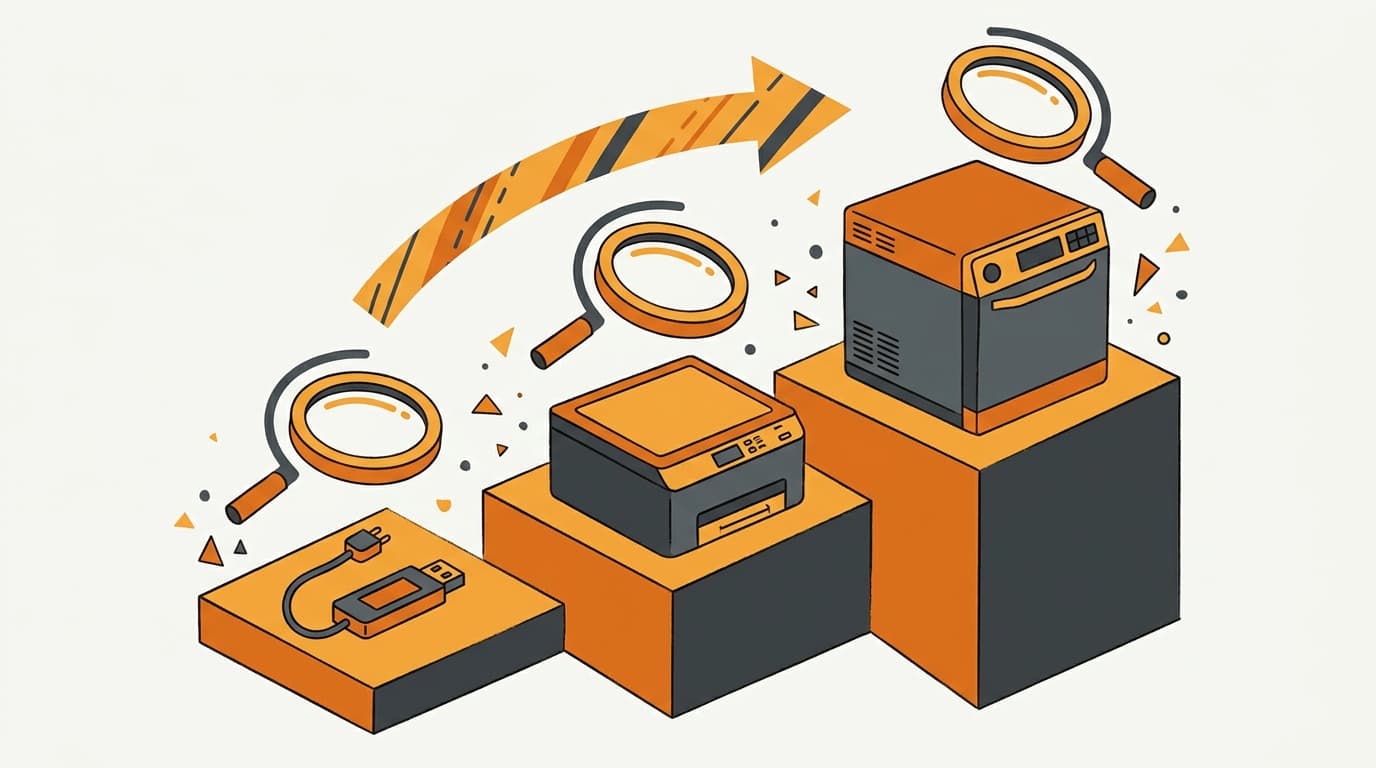
Your electrical product falls into one of three KC safety tiers, and the tier — not your brand's judgment — decides your testing cost, timeline, and whether a factory audit is involved. Korea's Electrical Appliances and Consumer Products Safety Act (전기용품 및 생활용품 안전관리법) sorts electrical goods into Safety Certification (안전인증), Safety Confirmation (안전확인), and Supplier's Declaration of Conformity (공급자적합성확인) based on the product's designated category and risk level. A USB charger might only need a self-declaration; a high-power monitor needs accredited lab testing; a top-tier item adds a factory audit that can take weeks and requires your manufacturer to cooperate.
Getting this wrong is expensive in both directions. Over-scope, and you pay for third-party testing a low-risk accessory never needed. Under-scope, and you import a higher-tier product on a self-declaration — where it can be held at customs or trigger enforcement in-market. Identifying the tier belongs at the planning stage, before purchase orders and freight, because it is the single input that makes a launch timeline realistic.
The one law, one regulator behind all three tiers
All three tiers live under the same statute — the Electrical Appliances and Consumer Products Safety Act — administered by the Korean Agency for Technology and Standards (KATS / 국가기술표준원). This is the "KC" you see on adult electrical goods: power supplies, appliances, IT hardware, lighting.
It is worth separating this from the other KC track that trips up electronics brands. Radio and wireless conformity (EMC and RF) sits under a different law, the Radio Waves Act, administered by the RRA — not KATS. A device with a wireless module can therefore owe obligations under both regimes at once, which is a common source of surprise. We cover that split in detail in our breakdown of whether a wireless device needs both KC safety and EMC. For this article, stay focused on the safety side: the three tiers below are all about electrical and physical safety, not radio emissions.
KC safety certification is not one process. It is a three-tier gradient under a single law, where a product's designated category and risk level determine which tier applies — and each tier carries a different testing burden, timeline, and cost.

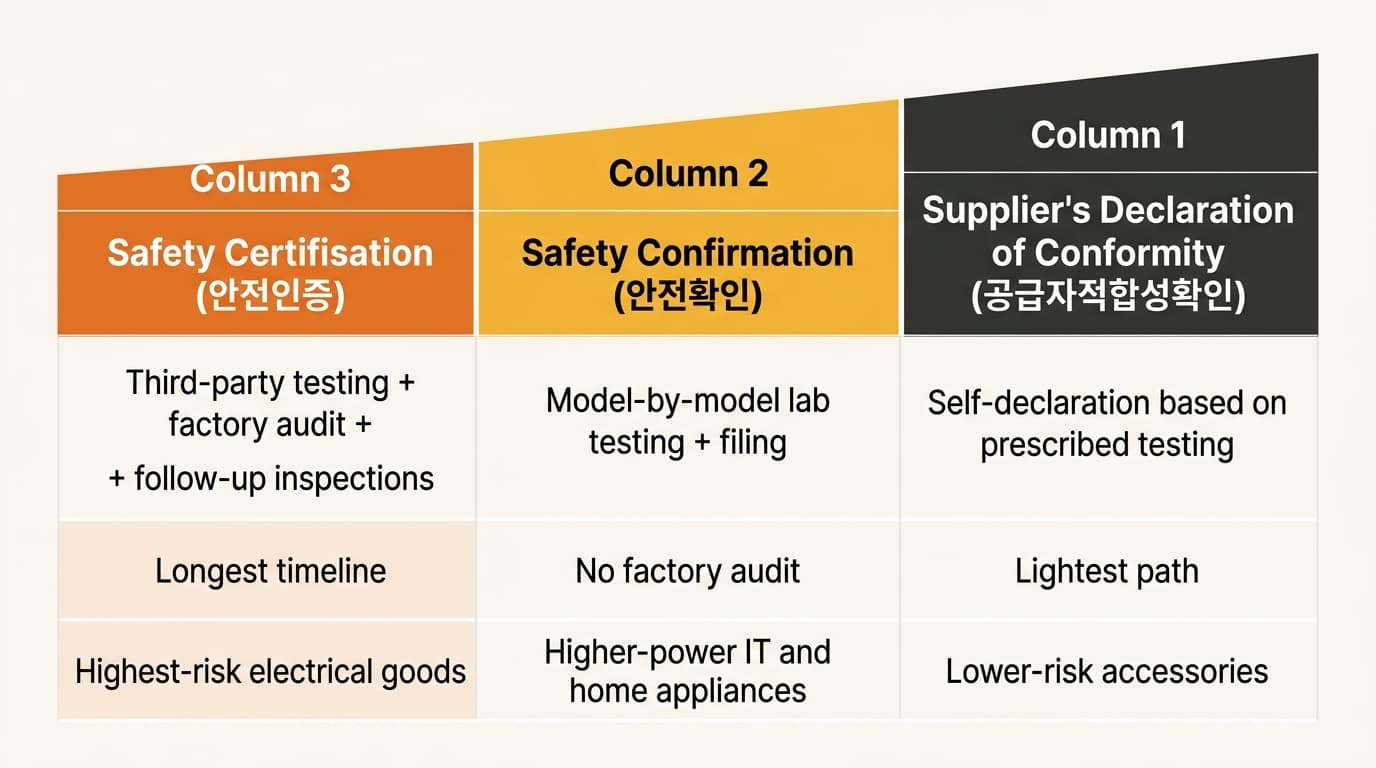
Tier 1 — Safety Certification (안전인증): testing plus a factory audit
The heaviest tier applies to the highest-risk electrical goods, and it is the only one that reaches back to the factory. Safety Certification requires third-party product testing at an accredited body and an audit of the manufacturing site, followed by periodic follow-up inspections to confirm the factory still produces to the certified condition.
Two things make this tier the longest and most demanding. First, the factory audit means your manufacturer has to actively cooperate — provide documentation, host or arrange the review, and remain subject to follow-up. If your supplier is a contract manufacturer several tiers removed from you, coordinating that cooperation is often the slowest part of the whole entry, not the lab work. Second, because the certification is tied to the factory as well as the product, changes on the manufacturing side can require re-review.
If your product is a high-power appliance or a product type Korea treats as carrying real hazard to the user, assume this tier until the official category listing tells you otherwise — and build the manufacturer's availability into your timeline from day one.
Tier 2 — Safety Confirmation (안전확인): model-by-model lab testing, no factory audit
The middle tier is where much higher-power IT hardware and home appliances land — think larger displays, PCs, and printers. Safety Confirmation requires testing at an accredited test lab, followed by a filing/registration with the authorities. There is no factory audit, which removes the manufacturer-cooperation bottleneck of Tier 1.
The catch is the phrase "model-by-model." Each distinct model must be tested and filed on its own. A brand bringing in three sizes of a monitor, or a printer line with several SKUs, cannot assume one test covers the range — the testing (and its cost) can multiply across the lineup. When you scope a Tier 2 product, scope it per model, not per product family, or your budget and calendar will be off from the start.
Tier 3 — Supplier's Declaration of Conformity (공급자적합성확인): the lightest path
The lightest tier lets the importer or manufacturer self-declare conformity based on prescribed testing, without third-party certification or a factory audit. This is where lower-risk accessories sit: USB cables, USB chargers, wired earphones and headphones, powered keyboards and mice, and similar peripherals.
"Lightest" is doing real work in that sentence — it means the least process, not no process. You still have to hold the prescribed test evidence, complete the self-declaration correctly, and carry the KC mark and labeling. It is the tier most brands hope their product qualifies for, and often the reason a USB- or battery-powered accessory is cheaper and faster to bring in than an equivalent mains-powered device. We looked at a related case — when a foreign EMC report can support a Korean declaration for USB and battery devices — and the same logic of matching evidence to the lightest sufficient path applies here on the safety side.
Do not assume your product is Tier 3 because it is small or inexpensive. Tier is assigned by designated category, power, and function — a low-cost mains-powered device can sit in a higher tier than a pricier USB accessory. Verify against the official category listing before you book a lab.
Every tier still carries a KC mark and labeling obligation
No tier is exempt from marking. Whether your product is Tier 1 or Tier 3, it must display the KC mark and the required label information — certification type, certification/registration number, the importer's name for imported goods, and the model name. For imported goods specifically, the importer's name on the label is not optional, because that is the party Korean authorities hold accountable.
This matters because "lightest tier" is sometimes misread as "no obligation." It is not. A self-declared USB charger that ships without a compliant KC label is still non-compliant, even though its testing burden was minimal. The mark is the visible proof that the tier-appropriate work was done.
Get the tier wrong and it shows up at customs
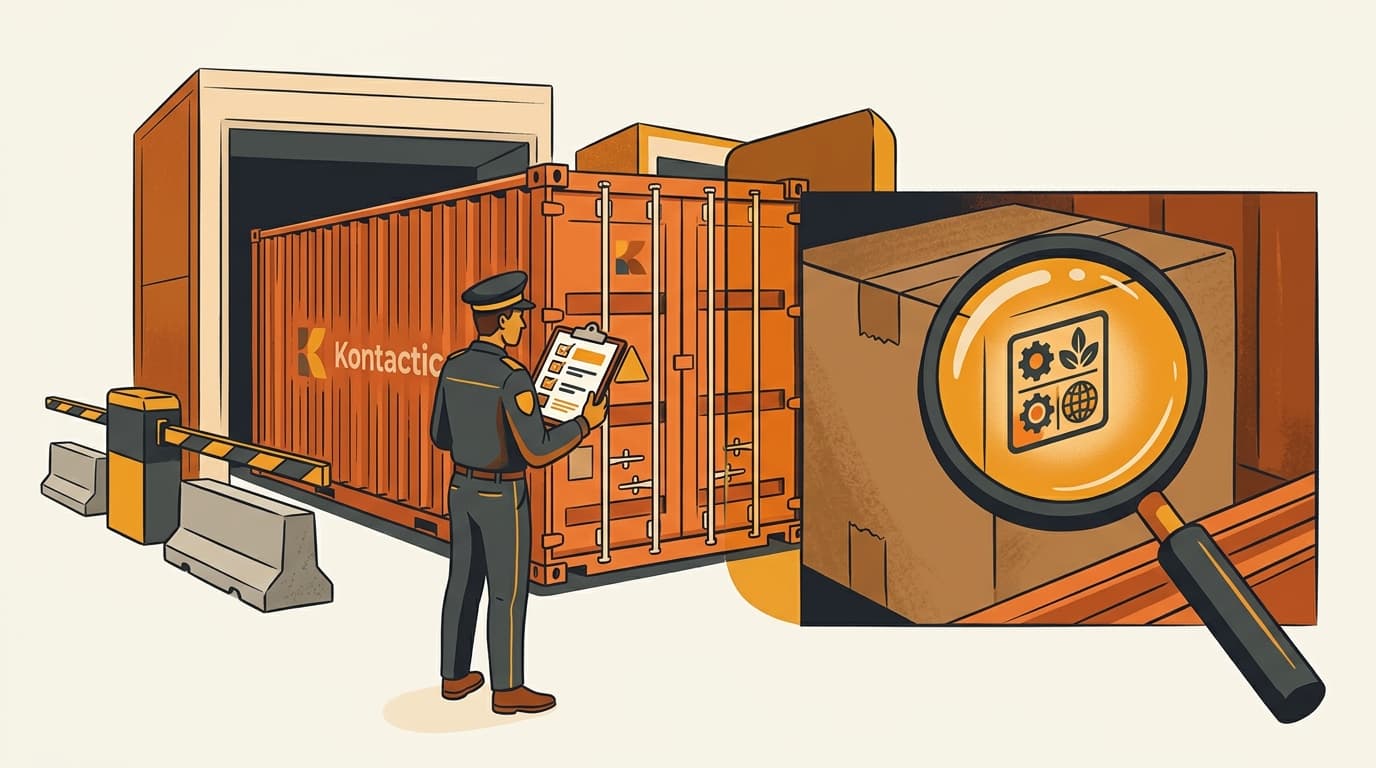
Uncertified or mis-tiered electrical goods can be held or refused at import, and selling without the required certification exposes the importer — the accountable party on the label — to enforcement. This is the concrete reason tier identification is a planning-stage decision, not a post-purchase discovery.
Consider the failure mode. A brand assumes a device is Tier 3, self-declares, ships a container, and finds at the border that the product's designated category actually requires Tier 2 lab testing. Now the cargo is stuck while testing is arranged retroactively — testing that should have started weeks before the purchase order. The freight cost was real, the inventory is frozen, and the launch date slips. The cheaper path is always to confirm the category first.
How to identify your tier before you commit
Work in this order, and settle each step before spending on the next.
- Find the product's designated category, not its shelf category. Korea assigns tier by how it classifies the device — by power, function, and hazard — not by what you call it. Verify against the official product-category listing under the Electrical Appliances and Consumer Products Safety Act; the statute text and its enforcement rules are published on the national law portal (law.go.kr), and KATS maintains the category guidance.
- Match the category to its tier. Once you know the designated category, the tier follows: third-party certification plus factory audit, model-by-model confirmation, or supplier's self-declaration.
- Scope per model where Tier 2 applies. If you land in Safety Confirmation, count your distinct models — each one is a separate test and filing.
- Confirm whether the same device also needs the EMC/RF track. A single device can owe both KC safety and Radio Waves Act EMC/RF obligations. Check both before you lock a timeline.
- Only then book a lab and place the purchase order. With the tier confirmed, your cost and timeline are grounded in the real obligation rather than a guess.
If you want the cost-and-timeline side of this in operator's terms, our guide to KC certification cost and timeline walks through what testing typically runs and where the calendar actually goes.
Common questions
Is KC certification one process or several? Several. Under the Electrical Appliances and Consumer Products Safety Act, KC safety splits into three tiers — Safety Certification (안전인증), Safety Confirmation (안전확인), and Supplier's Declaration of Conformity (공급자적합성확인) — each with a different testing burden.
Who decides which tier my product falls into? Korea does, through the product's designated category and risk level under the law administered by KATS. Your own judgment of "how risky it looks" does not set the tier; the official category listing does.
Does the lightest tier mean I skip the KC mark? No. Every tier requires the KC mark and label information — certification type, number, importer name for imports, and model name. The self-declaration tier reduces the process, not the marking obligation.
Can one device need both KC safety and EMC certification? Yes. Safety sits under the Electrical Appliances and Consumer Products Safety Act (KATS); EMC and RF sit under the Radio Waves Act (RRA). A wireless device can require both, so check each track separately.
Not sure which KC tier your product lands in?
Tell us what you're shipping and we'll help you confirm the designated category and tier before you commit to a lab or a purchase order.
About the author
Korean and global e-commerce operators with 15+ years of cross-border experience, led by CEO Isaac Lee — KOTRA-certified consultant and official lecturer for Seoul City and the Korea Customs Service. We run Korea market entry for overseas brands every day; this blog records what we learn in the field.
More about Kontactic →Related Articles
Coupang Product IDs: One ID Cannot Cover Every Variant
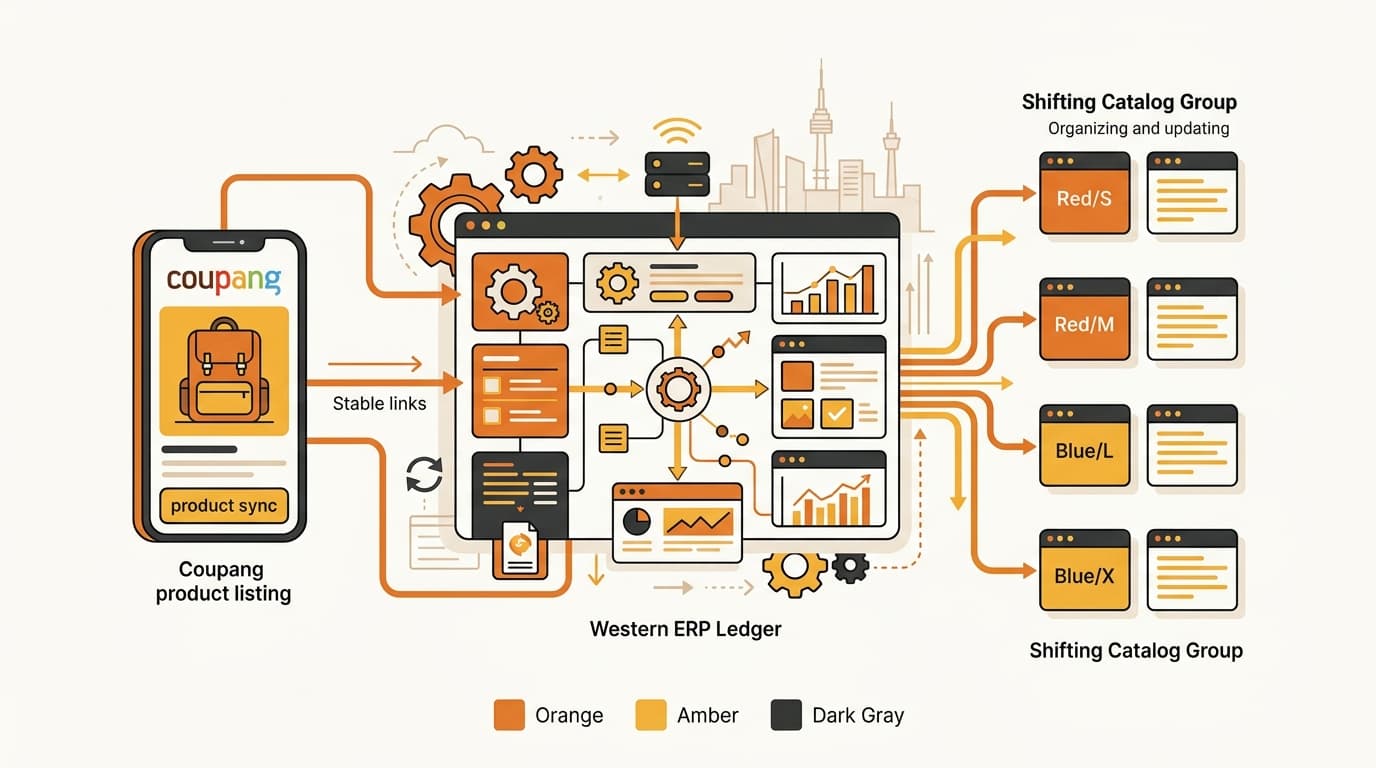
One Coupang product ID cannot cover every ERP variant; keep your brand SKU as the main key and map listing, option, edit, and order values to each SKU.
Coupang Rocket Growth Stock: Can an ERP Set It via API?
An ERP cannot set Coupang Rocket Growth stock through the Open API; replenishment starts when Coupang physically receives a new inbound shipment of stock.
Korea FTA Duty: US/EU Warehouse Shipping Is Not Enough
A US or EU warehouse does not prove FTA origin in Korea. The importer must verify production, transit, and documents before claiming a lower customs duty rate.