
How to Localize Product Pages for Korean E-commerce
A localized Korean product detail page (PDP) is a roughly 20,000-pixel vertical, mobile-first sales page written in Korean commercial grammar — not a translation of your existing PDP.
It stacks hero imagery, lifestyle scenes, comparison blocks, certification badges, ingredient or spec tables, reviews, and FAQ into one long scroll designed for Coupang and Naver SmartStore conversion. Getting the PDP right matters, but it sits on top of three operational decisions — entity, importer of record, and KC certification — that most localization guides quietly skip.
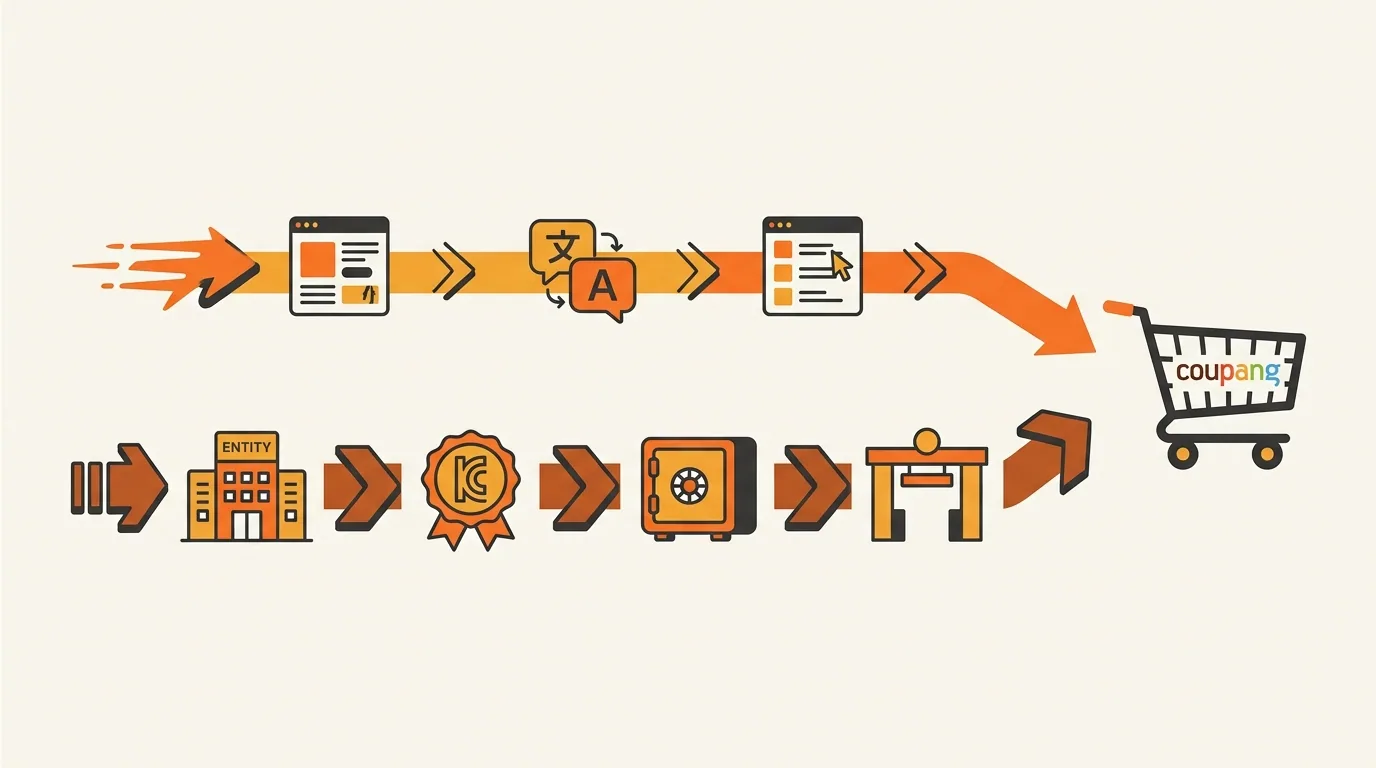
This guide walks the full stack. We will start with what a Korean PDP actually contains, then look at the trust signals Korean shoppers expect, then move to the decisions underneath: who imports, who sells, and what gets certified. Finally, we will separate the parts you can move on this quarter from the parts that need real local infrastructure.
What a Korean PDP Actually Is
If you have only sold on Shopify, Amazon, or a DTC site in Europe, the first surprise is the length. A Coupang or Naver SmartStore PDP is not a product card. It is closer to a long-form landing page — typically around 20,000 pixels tall — built almost entirely as stacked images optimized for vertical mobile scrolling.
The grammar is consistent across categories:
- A hero image with the product name, key claim, and a price-anchor visual.
- A "why now" block — a problem statement or use-case the product solves.
- Lifestyle scenes that show the product in a Korean home, kitchen, or bag.
- Specs, ingredients, or compatibility laid out in tabular blocks.
- Comparison panels against generic alternatives.
- Trust signals: certifications, awards, lab test screenshots, press logos.
- Reviews and creator quotes, often with Korean names and profile photos.
- Shipping, returns, and CS info — usually near the bottom, not the top.
- An FAQ that answers the questions Coupang's review section will otherwise ask.
The reason for this density is not aesthetic. It is the way Korean marketplaces resolve trust. A shopper on Coupang or Naver compares three or four listings in the same category within the same five-minute session. The PDP that answers every objection in the scroll wins. Anything that requires the buyer to click out, search, or guess loses.

Trust Signals Korean Shoppers Actually Read
Translated copy is the entry ticket, not the differentiator. Korean buyers — especially on Coupang, where Rocket delivery sets the baseline expectation — scan for signals that the seller is local, accountable, and legitimate. A few that matter more than most foreign brands assume:
- A Korean business registration number displayed on the PDP. This is required for SoRs selling locally and is a passive but constant trust cue.
- Customer service phone and hours in Korean. A 1588-prefix number reads as local; an email-only address reads as foreign and slow.
- Certification marks where the category requires them — KC for electrical and many consumer goods, 식약처 (MFDS) registration for food and cosmetics, 사료관리법 numbers for pet food.
- Korean-name reviews and creator endorsements, ideally with timestamps from the last 90 days.
- Clear return policy in Korean, reconciled with Coupang's own return rules.
Foreign brands underinvest in the certification block specifically. They treat the KC mark as a back-office formality and forget to surface it visually on the PDP — which is exactly where Korean shoppers look for it. A clean certification panel halfway down the page often does more work than another lifestyle render.
Translation Is the Smallest Part
By the time you have hired a Korean copywriter, you have solved maybe 15% of the localization problem. The harder parts are:
- Visual grammar. The font weights, image-to-text ratio, color palettes (saturated reds and pastels still dominate beauty; cool neutrals dominate appliances), and the rhythm of headline-then-image-then-headline blocks are conventions, not preferences. Breaking them reads as foreign.
- Claim structure. Korean PDPs lead with the claim and then prove it three times through ingredient close-ups, test data, and influencer quotes. This depth-first pattern is the norm; a Western hero image plus three bullets reads as incomplete.
- Mobile cadence. Around 70%+ of Korean e-commerce traffic is mobile, and a Korean PDP is read with the thumb in motion. Block heights, contrast, and image weight are tuned for one-handed scrolling — not desktop preview.
For background on why these long pages exist at all, the visual grammar of Korean e-commerce product pages is a useful frame: they are solving a different commerce problem than a Western PDP, and the structure follows the constraint.
The Decisions Underneath the PDP
This is where most localization guides stop. The harder operational question is what entity the PDP lives under and who is legally selling the product. Three paths foreign brands take into Korea:
1. Cross-border with no local entity and no IoR. You sell from your home-country store, the Korean buyer is technically the importer, and the order ships under the USD 150 de minimis threshold where it qualifies. PDPs are limited to whatever your DTC site supports. You cannot get Rocket delivery, Coupang ranking is weak, and KC certification is not strictly required for personal-import shipments. This validates demand but caps it.
2. Local sale through an Importer of Record and Seller of Record partner. A Korean entity imports the goods DDP, files VAT, and lists on Coupang as the SoR — for example, Kontactic's own entity under our Spark service. You ship inventory in, the partner handles import, payment processing, and Korean-language CS, and remits net proceeds. PDPs run under the partner's seller account but the brand and listing are yours. This is the fastest local-sales path; you do not need to register a Korean company.
3. Your own Korean entity (유한회사). You incorporate locally, hold the IoR and SoR roles yourself, and run operations either in-house or through a managed services partner. You retain full control of the Coupang account, ad spend invoicing, and bank flows — at the cost of a 1–3 month entity setup, a corporate bank account that foreign founders increasingly struggle to open, and ongoing accounting and payroll obligations.
The control tradeoff is real. Path 2 gets you live in weeks but the seller account is not yours. Path 3 gives you the account and the cash flow but takes months and requires resident-director arrangements that have tightened in 2026. There is no objectively right answer — it depends on how much Korea revenue you expect in year one and how much operational headroom you have.

KC Certification and Product Compliance
The other decision that most PDP-localization articles undersell is KC 인증 — Korea's category-specific safety certification. If your product plugs into a wall, transmits a radio signal, contacts children, or contains a battery above a threshold, you almost certainly need KC. Cosmetics need MFDS Functional review for any whitening, anti-aging, or sunscreen claim. Food needs MFDS import declaration. Pet food needs sector-specific registration.
A few operational realities:
- KC testing typically runs 4–8 weeks and USD 2,000–6,000 per SKU for common categories — sometimes much more for complex electronics.
- Foreign EMC and safety test reports can sometimes be reused, but that depends on the specific KC standard and is decided case by case.
- The certificate is issued to a Korean entity — either yours or your IoR partner's. If you switch IoRs later, the certificate generally does not travel cleanly.
- The KC mark and certification number need to appear on the product label, the outer packaging, and the PDP. Missing it on any of the three creates a Coupang takedown risk.
KC interacts directly with PDP work. You cannot finalize the certification block of your PDP — the panel that shows the mark, number, and category — until the certificate is issued. So if your launch plan puts PDP design before KC scoping, you will redesign the PDP. We see this happen often enough that we now sequence KC scoping in the first two weeks of any Spark engagement.
A localized PDP that omits the required certification block is not a "minor compliance gap." On Coupang, it is grounds for listing removal — and re-approval can take days during which the listing earns zero revenue.
What You Can Move Fast vs. What Needs Infrastructure
A useful way to plan is to sort the work into two buckets.
Can move fast — measured in days to a few weeks:
- Korean translation of product copy, specs, and claims.
- Basic PDP design at roughly 20,000 vertical pixels per SKU. Kontactic prices PDPs at USD 300 per SKU as a Spark add-on, which is a reasonable market benchmark.
- Coupang text-only product listings, which are included in Spark at no extra cost.
- Setting up a Korean CS phone line and operating hours.
- Initial Naver SmartStore listing, if you already have a Korean SoR in place.
Needs infrastructure — measured in months:
- Korean entity registration, corporate bank account, and tax ID. Plan 2–4 months end to end, longer if your structure triggers additional bank KYC.
- KC certification for in-scope categories — typically 4–8 weeks per SKU once you have a Korean entity to hold the certificate.
- Coupang Rocket Growth onboarding, which depends on having an active SoR account, a Korean business number, and product barcodes that match what arrives at the warehouse.
- A VAT filing rhythm. Korea applies a flat 10% VAT on local sales — which equals roughly 1/11 of VAT-inclusive Gross Sales Revenue — and that has to be filed by a registered Korean entity or its tax representative.
- Settlement and repatriation. Coupang's default settlement is roughly 60 calendar days from sale; brands that want faster cash flow can look at weekly or fast settlement options.
The mistake we see most often is brands trying to compress the second bucket into the timeline of the first. Translation gets done in three weeks, the PDP is rendered, the agency hands over a Coupang account — and then nothing ships because KC is unfinished or the bank account is still in review. Sequencing matters as much as quality.
A Reasonable Sequencing for a 4–6 Month Launch
For a brand with proven cross-border demand and a single hero SKU, a pragmatic sequence looks like:
- Weeks 1–2. Decide the entity path — IoR/SoR partner or your own entity. Scope KC certification per SKU.
- Weeks 2–8. Start KC testing in parallel with PDP scripting and visual direction. Translate base copy.
- Weeks 6–10. Render the PDP at full 20,000-pixel length. Build out trust block, certification panel placeholder, and FAQ.
- Weeks 8–14. Receive KC certificate, finalize the certification panel, ship first DDP inventory to Korea.
- Weeks 12–18. Coupang listing live, Rocket Growth inbound, soft launch. Layer in PPC once organic baseline is measurable.
The PDP is in there, but it is one workstream of five — and it cannot ship cleanly until the entity and certification work has resolved. That is the part competitor guides leave out.
One Last Thing: The PDP Is Not a Deliverable, It Is a Test
In practice, the first version of a Korean PDP is rarely the final one. Korean shoppers respond to specific claims, specific images, and specific comparison framings. The PDP that converts at month one is usually 60–70% of the PDP that converts at month six, with the difference being the panels you rebuild after watching Coupang Q&A and review data come in.
That is why we treat the PDP as a living asset and price localization advisory at USD 400 per month — not as a project. The first render is necessary. The iteration is what compounds.
If you are early in this process and trying to figure out whether to enter through an IoR partner or set up your own entity, the Spark vs Flame vs Blaze decision is the right frame. The PDP work is similar across all three; the entity and control tradeoffs are not.
Planning a Korea PDP launch?
If you want a second opinion on entity path, KC scope, or PDP sequencing before you commit budget, send us the SKU list and target channels. We will tell you what is fast, what is slow, and what to do first.
About the author
Korean and global e-commerce operators with 15+ years of cross-border experience, led by CEO Isaac Lee — KOTRA-certified consultant and official lecturer for Seoul City and the Korea Customs Service. We run Korea market entry for Western brands every day; this blog documents what we learn in the field.
More about Kontactic →Related Articles

Korean HS Code: Can You Reuse US/EU HS Codes? Not Always
A US or EU HS code is a useful starting point, not a portable Korean classification. Learn how Korea’s HSK affects duty, FTA treatment, and import controls.

Korean Biocide Approval: Why Coupang Claims Still Count
No. Korean biocide approval cannot be avoided by hiding a “kills bacteria” claim from the bottle; a Coupang listing can still evidence intended biocidal use.
Can You Sell a Children's Product With KC Pending?
An in-scope children's product cannot be sold in Korea while KC is pending; complete the applicable Korean safety route before sales, not after stock arrives.