
Sell Skincare in Korea Without a Korean Entity: IoR Path
A small European skincare brand can start selling locally in Korea without forming a Korean entity by working with an Importer of Record (IoR) and Seller of Record (SoR) partner. The partner's Korean company imports your goods, lists them on Coupang under its own seller account, collects payment in Korean won, and remits the net proceeds to you. You ship DDP to Korea and keep control of pricing, your brand, and what happens to unsold stock — and you're paid for what sells.
What "without setting up a company" actually means
A foreign skincare brand can reach Korean consumers in two ways: cross-border, or through a local partner. They are not the same.
The first is cross-border. You keep your Shopify or Amazon listings as-is and accept Korean buyers who find you through search or proxy services. You ship parcels individually from Europe. You pay no Korean VAT because each buyer imports as a personal shipment. The revenue is real but the conversion economics are poor — shipping is slow, returns are effectively impossible, and cross-border orders almost always understate what a local business could do. Coupang's own cross-border program, Coupang Global Fulfillment (CGF), removes some of that friction: the brand lists on Coupang from its own cross-border seller account, stock sits in a CGF warehouse outside Korea, and Coupang delivers in 3–5 days and pays the brand directly. Our Direct service runs that store for brands shipping from the US, Europe, Japan, mainland China or Hong Kong.
The second is local sales through an IoR/SoR partner. Your goods clear Korean customs under someone else's import authority and sell on Coupang under their seller account. To the Korean consumer, the experience is identical to buying from any other domestic seller: next-day delivery, KRW pricing, Korean-language support, and a returns flow that actually works. To you, it looks like a managed service: you ship, you get listed, you get paid.
The IoR/SoR path gives you local unit economics without the 10–14 week entity setup or the bank-account and KYC friction non-resident founders now face.

How Importer of Record and Seller of Record work for cosmetics
Every commercial shipment entering Korea needs a registered importer. That is the IoR — the entity that files with Korea Customs Service, pays duties and VAT at the border, and carries legal responsibility for the goods being lawfully importable. If you don't have a Korean entity, you cannot be your own IoR. Here is a longer explainer of what the IoR role covers.
For cosmetics specifically, the IoR also needs to be registered as a cosmetics importer with the Ministry of Food and Drug Safety (MFDS) under the Korean Cosmetics Act. A partner offering IoR services for skincare should already hold this registration; if they don't, you do not have a real IoR — you have a freight forwarder.
Seller of Record is the companion concept on the retail side. On Coupang, the seller listed on the product page is the entity that issues the tax invoice, collects VAT, and is legally responsible for the sale. In the non-entity path, that seller is your partner's Korean company, not you. Depending on the partner, you may work in a dedicated seller account that the partner's entity holds, or receive only reporting, settlements, and an operating relationship.
Product-level compliance — ingredient claims, labeling, KC or MFDS requirements specific to your formula — is normally your responsibility under the IoR agreement, and you indemnify the IoR. The IoR takes on the importer's legal role; it does not underwrite whether your hero serum's claims are legal in Korea.
Coupang setup and seller onboarding when you don't have an entity
This is the part most competitor articles skip entirely. Coupang is Korea's dominant e-commerce platform, and if you are selling skincare locally, you are almost certainly selling on Coupang first. Listing a product there is not a self-service flow for a foreign brand.
Under the non-entity path, onboarding looks like this:
- Your partner's existing Main Seller Account is already in good standing with Coupang — KYC cleared, bank account linked, business registration verified. You do not repeat any of that.
- You supply product data: SKUs, barcodes, ingredients, claims, photography, and — critically — Korean-language copy or the raw English source for localization.
- The partner creates the listings under their seller account. Coupang's category taxonomy for cosmetics is specific (e.g., separate nodes for toner, essence, serum, ampoule, cream), and putting a product in the wrong node meaningfully hurts search impressions.
- Pricing is set in KRW. The partner accounts for Coupang's selling commission, Rocket Growth fees, VAT, and the remittance flow before landing on a take price.
If you want to understand the broader mechanics, we have a full guide to how foreign brands sell on Coupang, including the three main paths to market. The point worth repeating here: a skincare brand going live through an IoR/SoR partner typically reaches first-sale in weeks, not quarters, because the seller account and the import pipeline already exist.
Localized PDP and Korean-language conversion
Listing a product and converting on it are different problems. The default text-based Coupang listing — translated title, bullet specs, a plain description — will get indexed and will take some sales, but Korean skincare shoppers are trained by every domestic K-beauty brand to scroll a long, graphically dense product detail page (PDP). We are talking about a 20,000-pixel vertical — an editorial layout with ingredient panels, before/after diagrams, clinical claims presented as charts, usage flows, and founder or formulation stories.
A Western brand that ports its English Shopify creative directly onto Coupang will convert, but at a fraction of the rate a properly localized PDP achieves. This is less about translation quality and more about visual information density and the sequencing of trust signals Korean shoppers expect.
“A Korean PDP for skincare is not a translated landing page. It is a long-form editorial that a buyer reads top-to-bottom before adding to cart.”
Kontactic editorial team — Commerce Operations
In practice, we treat the basic localized text listing as table stakes and the long-form PDP as the actual conversion asset. The full PDP is a separate per-SKU project in every Kontactic service. It starts at USD 300 per SKU and typically covers your hero three to five SKUs first, not your entire catalog.

Rocket Growth, fulfillment, and returns
Rocket Growth (로켓그로스) is Coupang's third-party fulfillment program — effectively Korea's equivalent of FBA. Your inventory sits inside Coupang's warehouses, which unlocks the Rocket badge, next-day delivery, and Coupang's own returns flow. For a skincare brand that has not dealt with domestic Korean logistics before, this is the single biggest operational leverage point.
The flow under the non-entity path:
- You ship DDP (Delivered Duty Paid) to Korea. You cover freight, insurance, duties, and import VAT at the border.
- Goods clear customs under the IoR's import authority and land at a 3PL warehouse.
- From there, inventory is inbounded to Rocket Growth. This transfer is a distinct step with its own labeling, case-pack, and inbound appointment rules.
- A skincare SKU with the wrong outer carton or barcode placement will be rejected at receiving.
- Once live in Rocket Growth, Coupang handles pick, pack, ship, and returns end-to-end.
Returns deserve a line of their own. Korean consumer protection law is strict, Coupang's returns policy is generous, and return rates on cosmetics through Rocket Growth are not trivial. A realistic operating model builds this in from day one — not as a surprise cost in month three. We have written more about the decision framework between cross-border and Rocket Growth if you want to go deeper.

What foreign skincare brands usually underestimate
A few things come up on nearly every kickoff we do with a European skincare brand. None of them are secrets; they are simply absent from most "how to enter Korea" guides.
The outer carton, not the formula, is usually what delays you. MFDS-compliant labeling in Korean, the correct barcode format, and Rocket Growth's case-pack specs have to all agree. Brands show up with export-market cartons built for loose EU distribution and discover a relabeling job they didn't budget for.
Coupang's algorithm rewards early momentum. A new listing with no reviews and no velocity gets buried, regardless of product quality. Paid acquisition at launch is less about brand-building and more about kickstarting the ranking flywheel. This is why we push operational readiness before ad spend — turning on ads before your PDP and Rocket Growth inventory are ready just wastes budget.
"Premium Western skincare" is a real tailwind, but it is not a discount on execution. Korean consumers pay premium for trusted foreign brands, but they expect a domestic-quality buying experience in return: Korean CS, Korean PDPs, Rocket delivery, clean returns. A brand that lands in Korea looking like a cross-border afterthought gives back its own positioning.
VAT is not a line item you can forget. Local sales are VAT-inclusive at 10%. The VAT portion works out to 1/11 of gross sales revenue. Your IoR/SoR partner files and remits this, but your take price has to absorb it or your margin story collapses.
When the non-entity path is not enough
The IoR/SoR model suits a brand that wants local sales without committing to a Korean company. It is not the right fit for a brand that wants its own Coupang seller account, its own KRW banking, its own marketing team in Seoul, and full control of the P&L. Those brands are better served by their own Korean entity — from day one if they choose, or later, once the remittance lag and the shared seller account become material frictions.
At Kontactic, selling on Coupang under our entity (Spark Subscription) is open only to Coupang-approved sellers in mainland China. A European skincare brand can work with us in three other ways, chosen by need rather than in a fixed order: Direct, where we run your own Coupang cross-border store with no Korean entity; Spark Project, where our entity imports for a defined project, such as supply to Korean retailers or a pop-up; or Blaze, full operations on your own Korean entity.
Talk to Kontactic about a non-entity Korea launch
If you are a European skincare brand evaluating a low-friction start in Korea, we can walk you through the options — Direct, Spark Project, or Blaze — the Coupang onboarding timeline, and what a realistic first-six-months P&L looks like.
About the author
Korean and global e-commerce operators with 15+ years of cross-border experience, led by CEO Isaac Lee — KOTRA-certified consultant and official lecturer for Seoul City and the Korea Customs Service. We run Korea market entry for overseas brands every day; this blog records what we learn in the field.
Meet the Kontactic team →Related Articles
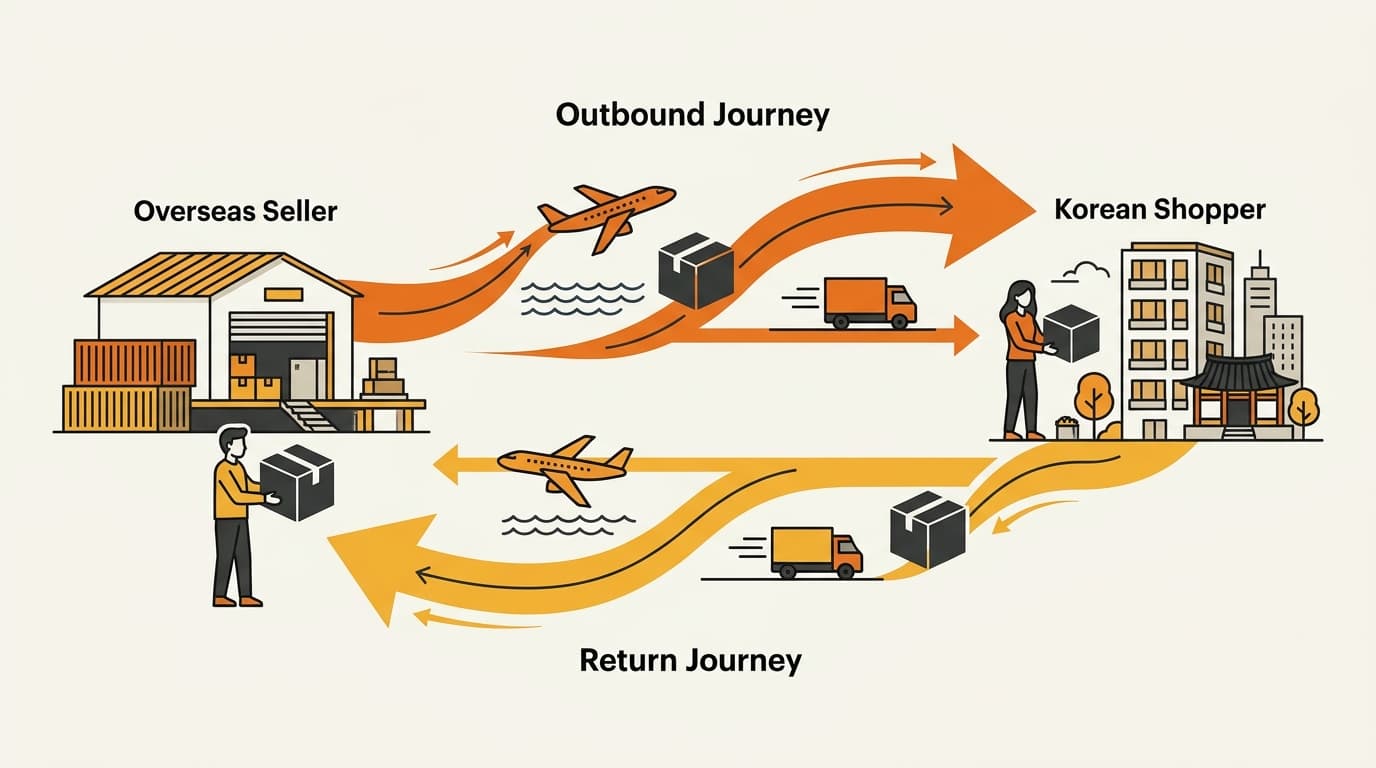
Can Coupang Buyers Pay Two Charges With Free Shipping?
On Coupang, free shipping can still leave the buyer paying two return charges: the original delivery cost and the cost of sending the parcel back to the seller.
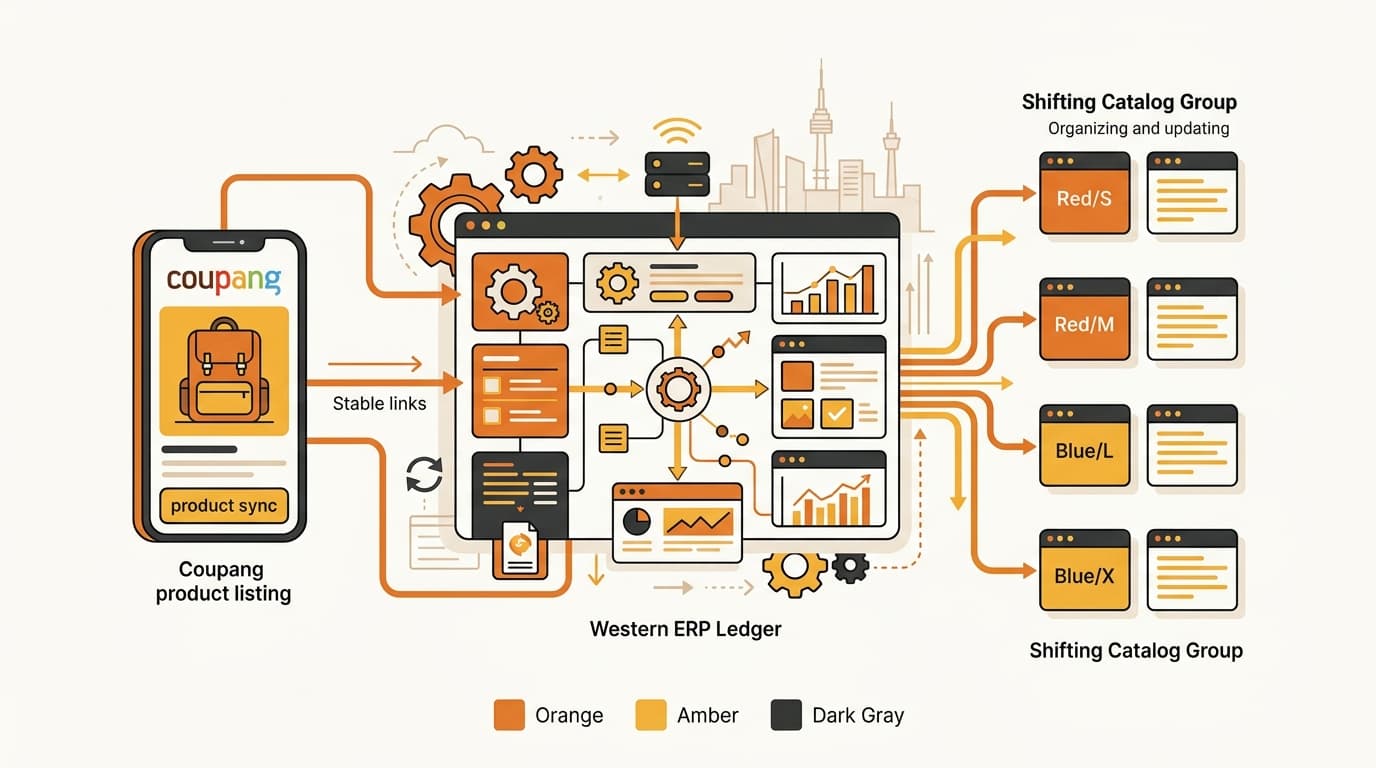
Coupang Product IDs: One ID Cannot Cover Every Variant
One Coupang product ID cannot cover every ERP variant; keep your brand SKU as the main key and map listing, option, edit, and order values to each SKU.

Coupang Rocket Growth Stock: Can an ERP Set It via API?
An ERP cannot set Coupang Rocket Growth stock through the Open API; replenishment starts when Coupang physically receives a new inbound shipment of stock.