Coupang Settlement Timelines: Monthly vs Weekly vs Fast
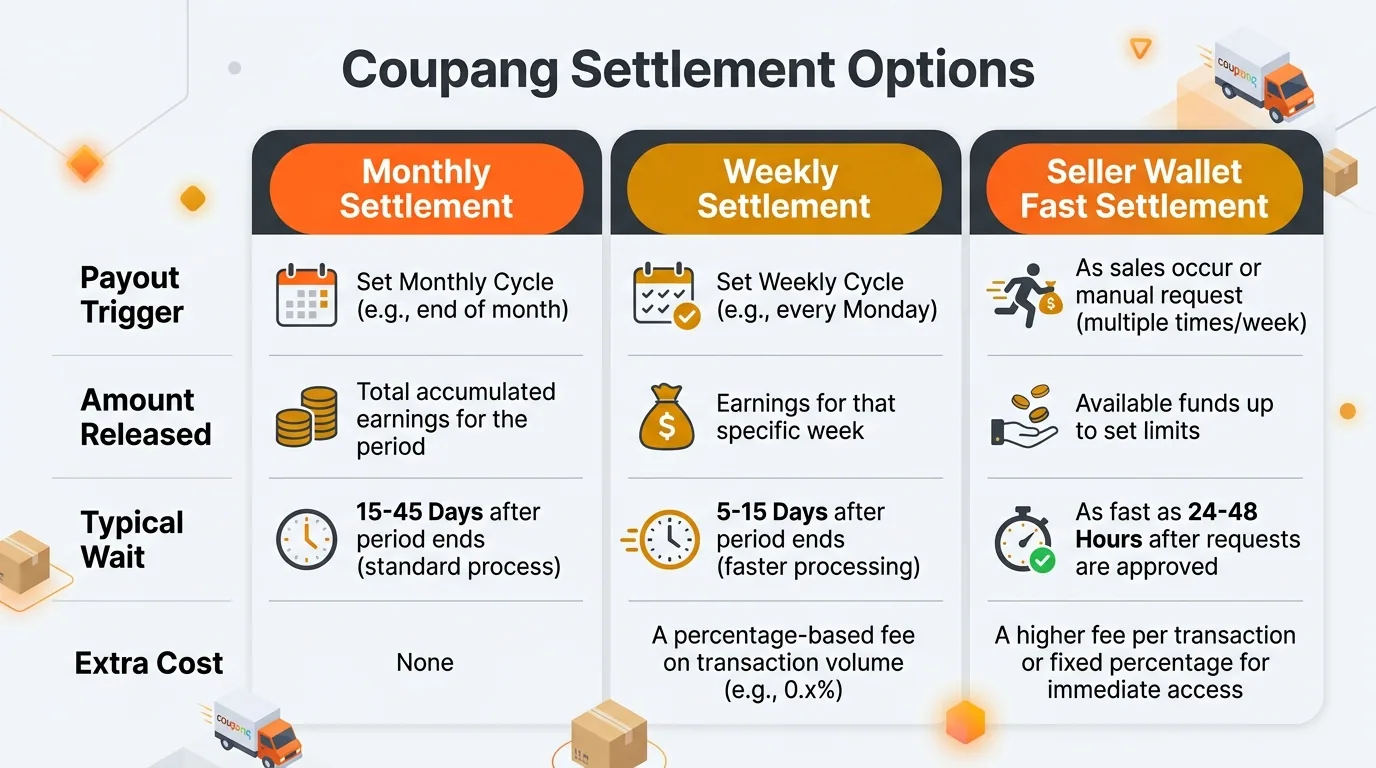
Coupang offers three settlement options: monthly (the default, 40–60 calendar days), weekly (70% on a faster cadence, 30% in the following month's payout), and Seller Wallet fast settlement (up to 90% advanced within hours, against a ~0.31%/30-day financing fee). Monthly is cleanest; fast settlement is fastest but carries a cost. Here is how each one works and when to use it.
If you are already selling on Coupang, settlement timing is one of the quietest cash flow drains in the model. New foreign sellers tend to focus on commission rates and Rocket Growth fees and miss the fact that the marketplace is, effectively, holding their money for almost two months. This post walks through the three settlement modes, the worked math on each, and where the fast settlement option does and does not make sense.
A note up front: Coupang's official documentation on fast settlement is obfuscated. The figures below match current program terms as of writing, but verify them in Coupang Wing before building them into a forecast.
How Coupang's monthly settlement works
Monthly settlement is the default, and it is what most sellers use. The mechanic is simple in shape but slow in practice.
Coupang aggregates every confirmed sale from the 1st to the last day of a calendar month. That month's settlement is then paid out on the 20th business day of the following month, into the bank account tied to your Coupang seller account.
A worked example. If you make a sale on March 1, that sale rolls into your March settlement bucket. The March bucket is paid on the 20th business day of April — which, depending on the calendar, can land around April 28. In calendar-day terms, that is close to 60 days from the original sale. February is shorter, but it pushes the 20th business day deeper into the next month, so the wait can run longer, not shorter.
Monthly settlement. Coupang pays you on the 20th business day of the month following the sale month. A March 1 sale typically settles around late April — roughly 50 to 60 calendar days later.
The trade-off is clarity. You receive one consolidated transfer per month with one consolidated settlement report, which makes reconciliation against your bank account straightforward. For sellers on Spark Subscription — our IoR & SoR model for Coupang-approved sellers in mainland China, where Kontactic's entity collects and remits — this is the default cadence we work with, because the report is clean enough to pass through to the brand without ambiguity.
Weekly settlement: 70% now, 30% later
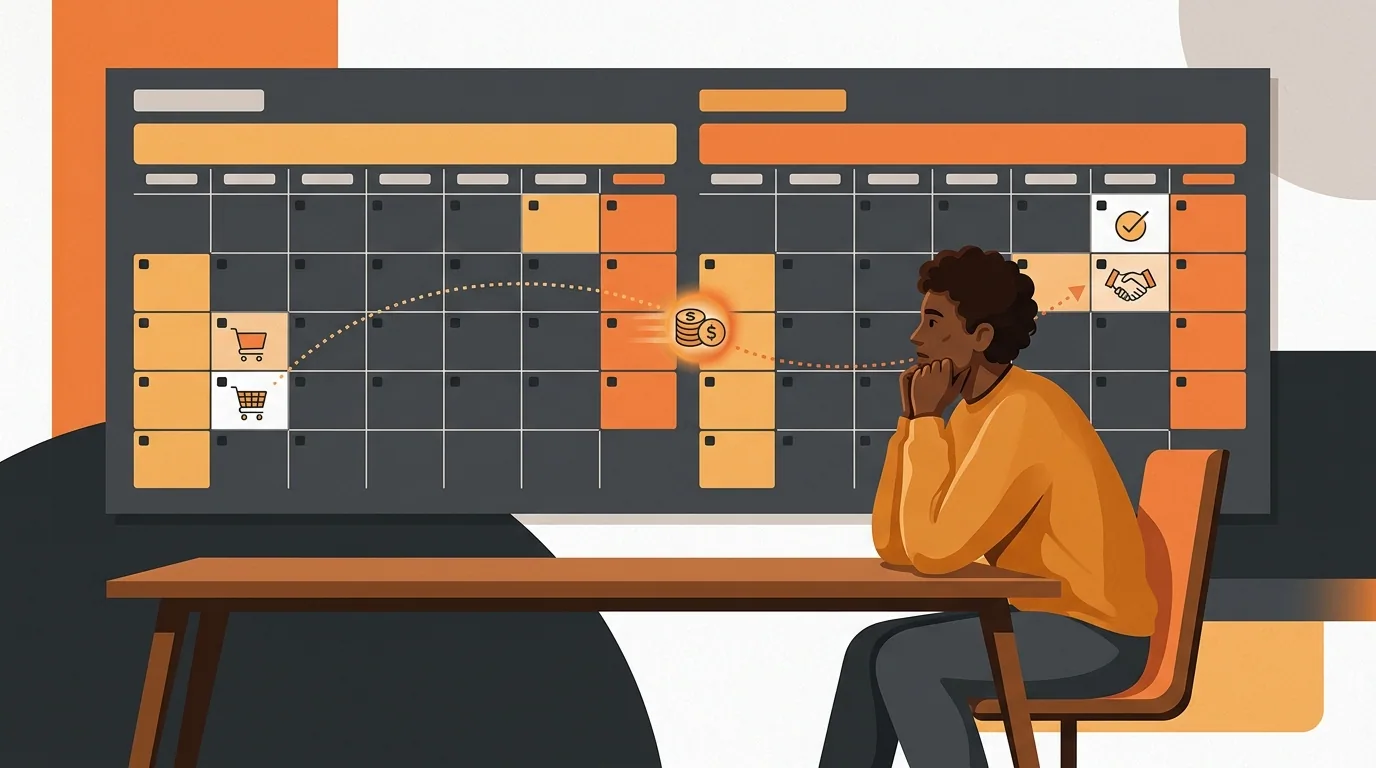
Coupang's weekly settlement option is less popular and, frankly, less clean. The headline — "weekly" — is misleading. You do not receive 100% of each week's sales every week.
Weekly settlement releases 70% of the week's sales on a faster cadence. The remaining 30% trails into the following month's payout. So instead of one consolidated monthly transfer, you get a stream of partial weekly payments plus a reconciling balance later.
The cash flow improvement is real, but the bookkeeping cost is also real. Each weekly transfer carries less context than a monthly settlement report. You cannot fully close a month's books on the early payments alone, since the 30% reconciliation arrives later. Most sellers — including foreign brands operating through a Korean limited company (유한회사) — choose monthly for this reason.
If you are evaluating weekly settlement, look up the current eligibility criteria and the exact cutoff dates inside Coupang Wing before committing. The terms have changed over time and the published rules are not always exhaustive.
Seller Wallet fast settlement: how the advance actually works
The third option is the one most foreign sellers have not heard of: Seller Wallet fast settlement (셀러월렛 빠른정산). This is structurally different from monthly or weekly settlement. It is not a faster Coupang payout — it is a third-party bank advance against your Coupang receivables.
Once a customer confirms receipt of the order, you can receive up to 90% of revenue almost immediately into the Seller Wallet, rather than waiting for the standard settlement cycle. Coupang has partnered with a bank to provide this advance; the bank takes a small financing fee in return for fronting the cash.
Two things to be precise about:
- The 90% is of revenue, not net proceeds. Coupang's selling commission, Rocket Growth (로켓그로스) fulfillment fees, and any PPC advertising spend you have run are still deducted afterwards.
- The financing fee is roughly 0.31% per 30 days of the advanced amount, charged by the partner bank. The actual rate is set on an annual basis; 0.31% is the per-30-day equivalent the program currently advertises.
A worked example. Suppose your gross revenue on a batch of orders is 1,000,000 KRW. Fast settlement advances 90% of that, or 900,000 KRW, to your Seller Wallet. From that 900,000 KRW, Coupang then deducts its platform commission, Rocket Growth storage and delivery fees, any PPC ad spend, and the bank's ~0.31%/30-day financing fee. What lands in your operating account is the residual.
When fast settlement is worth the fee
The 0.31%/30-day fee is small in isolation — but it is charged on the advanced portion, on every cycle, and it stacks against your already-thin marketplace margin. In our experience the math works for sellers in two specific situations:
- You are inventory-constrained and growth-constrained at the same time. You can redeploy the cash into Coupang Rocket Growth (로켓그로스) inbound or PPC and earn more than the financing fee. This is most common in the first 3–6 months after a foreign brand goes local on Coupang, when unit economics shift toward higher volume but working capital has not caught up.
- You are bridging a known funding gap. A delayed wire from headquarters, a seasonal inventory build, a PPC push timed to a Coupang promotion. Fast settlement is reasonable bridge financing for a defined window.
Fast settlement is not a good idea as a permanent operating mode. The fee compounds, the reporting gets harder to reconcile, and you lose the clean monthly cadence that makes it easy to spot anomalies in your settlement report. We tend to recommend brands default to monthly, and switch on fast settlement deliberately for specific campaigns or stockouts.
Cash flow implications for foreign brands
For a Western brand entering Korea, settlement timing is a line item that almost never appears in the entry plan but always shows up in the second quarter.
If you are shipping DDP (Delivered Duty Paid) into Korea, paying for Rocket Growth inbound, running PPC, and waiting up to 60 days for your first month's settlement, your working capital requirement is meaningfully larger than your monthly cost of goods. See the separate post on why operational readiness has to come before ad spend; settlement timing is the same lesson on the cash side. The brands that struggle most are the ones that scaled PPC aggressively in month one and then ran out of runway in month two waiting for the first payout to clear.
Two practical points:
- Plan for a 60-day cash conversion cycle on Coupang by default. That is the working assumption, not the worst case. Holidays and short months can push it longer.
- Do not rely on fast settlement to cover an undercapitalized launch. The fee is small, but the optionality is best preserved for moments when you actually need it — not as a permanent crutch.
If you are still in the discovery phase and trying to decide whether Rocket Growth or cross-border is the right starting model, settlement timing is one more factor to weigh: if you start with Rocket Growth, make sure you have the working capital to absorb the cycle from day one.

Common questions
How long does Coupang take to pay sellers? For monthly settlement — the default — Coupang pays on the 20th business day of the month following the sale month. That can be 40 to 60 calendar days from the original order, depending on the calendar.
What is Coupang Seller Wallet fast settlement? It is an early-payment program offered through a partner bank. After a customer confirms an order, up to 90% of the revenue is advanced to your Seller Wallet, against a financing fee of roughly 0.31% per 30 days on the advanced amount. Coupang's commission, Rocket Growth fees, and ad spend are still deducted afterwards.
Should I switch from monthly to weekly settlement? For most foreign brands, no. Weekly settlement releases 70% on a faster cadence and 30% with the next month — the cash flow benefit is modest and the reporting is harder to reconcile. Monthly settlement gives you one clean transfer and one clean report.
Is the 90% the amount I receive in my bank account? No. The 90% is of gross revenue. From that figure, Coupang deducts its platform commission, Rocket Growth fulfillment costs, your PPC ad spend, and the partner bank's financing fee. Net cash to your account is the residual.
Where can I confirm the current terms? Inside Coupang Wing, under settlement settings. Coupang's public-facing pages on fast settlement are not always exhaustive, and the per-30-day rate and 90% advance ratio can change. Check the current terms before relying on these figures for forecasting.
Talk to Kontactic about Coupang operations
Forecast your Coupang cash flow with an operator who runs it daily
If you are weighing monthly, weekly, or fast settlement against your working capital plan, we can walk through the actual numbers for your category. Get in touch and we will share what we see across the Coupang accounts we operate.
About the author
Korean and global e-commerce operators with 15+ years of cross-border experience, led by CEO Isaac Lee — KOTRA-certified consultant and official lecturer for Seoul City and the Korea Customs Service. We run Korea market entry for overseas brands every day; this blog records what we learn in the field.
Meet the Kontactic team →Related Articles

Q1 2026 Coupang–Naver Shift: Your Channel Strategy
Coupang's Q1 2026 trust shock slowed growth, but Naver SmartStore captured real volume. Foreign brands should plan a two-channel model from day one in 2026.

Who Pays for What in Korea: Operating Costs Explained
Inventory, ads, platform fees, VAT — every Korea entry model puts these costs on the client. Here is exactly how funding flows when our entity imports and sells for you (Spark) and when you own the Korean entity (Blaze).

Selling Grills in Korea: Three Required Certifications
A cooking grill sold locally in Korea usually needs three separate certifications — electrical safety, EMC, and food-contact registration. Here is how each works.