
Korean Corporate Bank Accounts: The Last Wall Foreign Founders Hit
Opening a Korean corporate bank account is the step where most foreign-owned entity setups quietly fail. The Korean Corporate Registry will issue your company. The tax office will issue your business license. Then you walk into a bank, and the bank says no — or it opens an account with a daily transfer limit so low you cannot actually run a business through it. Founders usually discover this last, after the legal and registration fees are already spent.
This is a Kontactic Journal post. We are in the middle of incorporating several client entities right now, and the bank-account stage is — as it always is — the part of the process that has nothing to do with how good your company is and everything to do with relationships and trust history.
Why the Korean banking step has gotten harder for everyone
Korean banks have tightened corporate-account onboarding significantly over the past few years. The driver is not foreign-investor risk specifically. It is voice phishing (보이스피싱), money laundering, and account-rental fraud — categories that hit Korean residents and Korean corporations too. The result is that opening a regular corporate account, even for a Korean citizen running a small Korean limited company, is materially harder than it was five years ago.
For a non-resident foreigner trying to open a corporate account on behalf of a newly registered Korean limited company (유한회사), that baseline difficulty compounds. You are non-resident. The entity is brand new. There is no operating history. The branch officer's incentive is to say no, because the downside of approving an account that later turns out to be problematic is much larger than the downside of declining a legitimate one.
The bank step is sequenced after you have already paid for entity formation, registration, and seal/credential issuance. By the time you find out the bank will not give you a usable account, you are not at decision zero. You are at decision N, with sunk cost behind you.

The under-100M KRW limited company is the path most affected
Most foreign brands we help do not come to Korea through the foreign direct investment (외국인투자, the "FDI" or 외투법인) route. They come through a regular Korean limited company (유한회사) with capital below KRW 100M. That path is lighter, faster, and far more practical for a brand that wants to sell on Coupang, hold a Korean business registration, and act as its own Importer of Record — none of which requires FDI status.
But the under-100M KRW limited company is also the structure banks treat with the most suspicion when the shareholder is a non-resident foreigner. There is no FDI capital injection from a designated foreign-exchange bank to anchor the relationship. There is no Korean-resident director to sit across the desk. From the bank's vantage point, you are a thin file.
For context on why this entity path still makes sense despite the friction, see: why setting up a Korean entity as a non-resident foreigner got harder — and how to actually get it done.
The second problem: the daily transfer limit
Suppose you do open an account. Most foreign-owned new corporate accounts in Korea are issued with a default outbound transfer limit of around KRW 1.3M per day — roughly USD 700 at current rates, in Isaac's framing on the call. That is the standard friction-control setting banks apply to new and "thin-file" accounts across the system, not a punitive measure aimed at foreigners specifically.
You cannot run a Coupang-scale e-commerce operation on KRW 1.3M of daily outbound transfer. You cannot pay a 3PL invoice. You cannot remit to a supplier. You cannot even reliably move VAT to the tax office in a busy quarter.
The official path to lifting the limit is straightforward in principle and absurd in practice. You file one full quarter of value-added tax returns, you remit actual VAT to the National Tax Service, and you bring the filing documents and proof of real business activity back to the bank. Then you can request a limit increase.
The chicken-and-egg is obvious: you cannot generate the VAT filings without doing real business, and you cannot do real business through an account capped at KRW 1.3M per day. Even Korean-national founders run into this. It is not a foreigner-specific problem; it is just a problem foreigners are less prepared for.

How relationship banking actually changes the outcome
The reason this matters as a category of operational risk is that the workaround is not a regulatory trick. It is institutional trust.
In our experience, the only durable way to open a usable Korean corporate bank account for a non-resident-foreigner-owned limited company is for an established Korean entity — one with a clean operating history, real VAT filings, and a long-running relationship with a specific bank — to vouch for the new client. That is what relationship banking means in this context. The bank is not approving the new client on the strength of the new client's documents. It is approving the new client because someone they already trust is standing behind the introduction.
“The bank trusts us, so our clients sit under our trust umbrella. They count on us to set up proper entities and bank accounts for clients who are trustworthy under our name.”
Isaac Lee — CEO, Kontactic
Through that introduction process, accounts can be opened at one of the top three Korean commercial banks without the default transfer cap — Isaac's working figure on the call was a daily transfer ceiling of up to USD 5M, far above anything a normal Korea-entry e-commerce business will need.
We are not naming the bank publicly. The relationship is the whole point, and the relationship is something Kontactic protects deliberately.
What this means for your sequencing
If you are a foreign brand evaluating whether to incorporate in Korea, the Korean corporate bank account question should not be a footnote. It belongs at the top of your due-diligence list, alongside KC certification readiness and your IoR plan. The reason is simple: operational sequencing matters more than most founders expect. See operational readiness before ad spend for the broader argument.
A practical sequence to follow before signing with any incorporation agency:
- Confirm in writing that the agency can deliver an opened, usable corporate bank account — not just an introduction or a "we will try" — at a named tier of Korean bank.
- Confirm whether the account will come with the default KRW 1.3M daily cap, or whether the agency's relationship lifts that cap at opening.
- Confirm what happens if the bank declines the application after the entity is already formed. Most agencies do not have a clean answer to this.
- Understand who the Importer of Record will be while you wait, and whether your operations stall during the wait.
- Understand the funding flow under the model you are choosing — because if your bank account is capped, the funding flow breaks.
We see this most often with brands that already opened one Korean entity through another agency, hit the bank wall, and now want to spin up a second clean entity to actually trade. That is an expensive way to learn the lesson.

Common questions about the Korean corporate bank account step
Is the Korean corporate bank account problem only an issue for non-resident foreigners? No. Korean nationals also face stricter onboarding and the same default daily transfer caps on new corporate accounts. The friction is systemic. It is just that foreigners hit it harder and discover it later in the process.
Can I open the bank account myself if I fly to Korea? Sometimes. Physical presence helps. But the default transfer cap will almost always still apply, and the lift-the-cap process still requires a full quarter of VAT activity through that account. A short-trip strategy does not solve the operational problem.
Does this apply to FDI (외투법인) entities? Less so. FDI entities have a designated foreign-exchange bank involved from day one as part of the capital injection process, which gives the bank file context. But FDI is a heavier, slower path that most consumer-brand market-entry projects do not actually need. For a comparison of entity models in a specific category, see skincare brand entry options; the framing applies more broadly.
What if I just use a Coupang IoR partner instead of forming an entity? That is a legitimate path and avoids the bank problem entirely, because the IoR partner's entity is the one transacting. The two paths are compared in Rocket Growth vs cross-border selling. The Korean corporate bank account issue is one of the strongest practical arguments for not rushing into your own Korean entity before you need one.
Talk to us before you incorporate
Planning a Korean entity? Let's pressure-test the bank step first.
If you are evaluating incorporation in Korea — or you have already started and the bank step is stuck — we can walk through your specific situation and tell you whether our banking relationship can solve it. Reach out and we will set up a call.
About the author
Korean and global e-commerce operators with 15+ years of cross-border experience, led by CEO Isaac Lee — KOTRA-certified consultant and official lecturer for Seoul City and the Korea Customs Service. We run Korea market entry for Western brands every day; this blog documents what we learn in the field.
More about Kontactic →Related Articles

Korea Payment Reconciliation Made Traceable by Kontactic
Kontactic's Korea payment reconciliation links payments, invoices, and allocations; confirmed and provisional matches stay separate, with adjustments preserved.
Product-Link Intake for Coupang: A Traceable Handoff
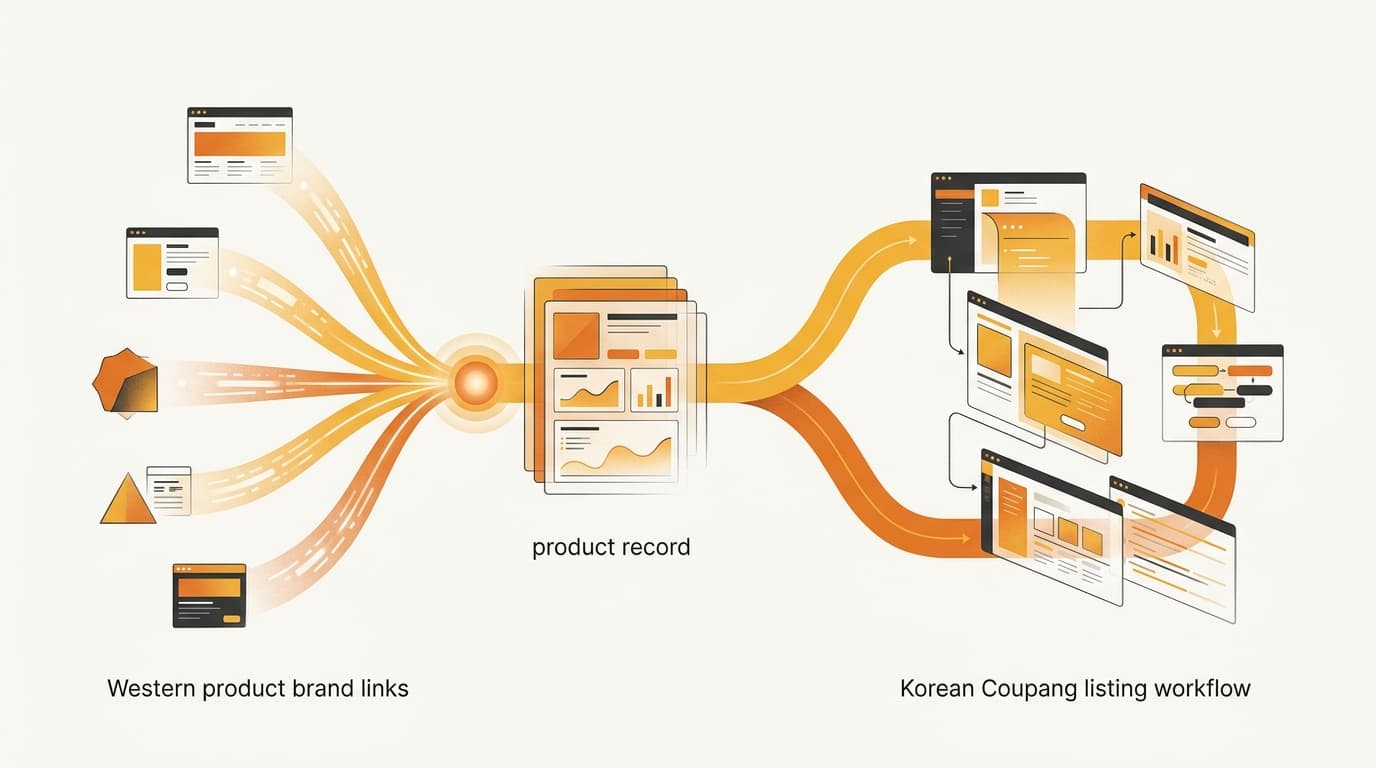
Kontactic Seller Center gives product-link intake a reviewable source record and a handoff into Coupang listing work before Korean copy or creative production starts.

Coupang Image Gallery: How Kontactic Builds Each Set
Kontactic Seller Center builds each Coupang image gallery as one set: 1 primary image plus up to 9 supporting 1:1 tiles, all connected to the page builder.