
Add or Remove a Signatory From a Korean Bank Account
To add or remove a signatory from a Korean corporate bank account, get company approval first. Prepare the bank’s forms and company documents. Then complete the bank’s identity checks. The bank then changes account access.
An authorized signatory can operate the account only within the permissions the company and bank grant. Adding that person does not make them a shareholder, director, or company owner.
List the bank permissions to change
An authorized signatory, also called an authorized signer, is a person the bank accepts to give instructions for a company account. They may sign payment instructions, approve transfers, or use online banking.
A Korean bank may treat these as separate permissions:
- Signing instructions at a branch.
- Approving transfers and local payments.
- Using corporate internet banking.
- Holding the bank’s one-time password device (OTP) or using a Korean digital certificate (공동인증서) to access online banking.
- Using a corporate card.
- Approving foreign-currency transfers or other higher-risk payments.
- Receiving account alerts or payment notifications.
Do not ask only to add a person’s name. Ask the bank which permissions it will change and which require separate forms.
For example, a finance manager may become a branch signatory but not the online-banking administrator. An employee who leaves may be removed from the account but still hold the company’s OTP or digital certificate. The change is incomplete until the bank cancels or reassigns those tools.
If the director is abroad, online banking creates a second question. Read how a Korean corporate OTP can be used when the director is abroad before giving an employee a security device or certificate.

Approve the change before contacting the bank
Start with the company’s current bank file. Check the Korean business registration certificate (사업자등록증), the Korean corporate registry extract (법인등기사항전부증명서), the company’s articles, and the last bank authority form, if you have it.
Then confirm who can approve the change. In many cases, the registered representative or a person the bank already accepts must sign the request. The outgoing signatory usually cannot remove their own authority simply by sending an email. The company must give the bank a clear instruction from an accepted company representative.
Prepare a written company resolution or authorization letter. The document should identify:
- The company’s legal name and business registration number.
- The bank and account to be changed.
- The full name and identity details of the person being added or removed.
- The exact permissions the new person receives.
- Any payment or approval limit the company wants to set.
- The date the authority starts or ends.
- The person who may submit the request to the bank.
The bank may have its own wording or ask for meeting minutes instead. Ask the account branch whether the company needs director or shareholder approval under its articles and the bank’s account agreement.
If the company is also appointing a new registered representative, the Korean corporate registry may need an update. A bank form cannot replace that corporate filing.
If the representative is outside Korea, ask whether the bank accepts a power of attorney. Confirm whether it needs an original, notarization, an apostille or legalization, and a Korean translation. A scanned signature may not be enough. The bank decides which format it accepts.
Prepare the Korean bank document packet
Ask the account branch for its current list before anyone travels. Banks can request different forms. A foreign-owned company may face extra identity or business-purpose checks.
Prepare these groups of documents as a starting point:
Bank forms. Ask for the form to add or remove an account signatory. Ask separately about internet-banking user changes, OTP changes, corporate-card changes, and payment-limit changes. One form may not cover all of them.
Company identity documents. The bank may ask for the business registration certificate and a recent corporate registry extract. It may also compare the company address, registered representative, business number, and registered activities with its existing file.
Company approval documents. Bring the signed resolution or authorization letter. If the bank uses a registered corporate seal, bring the corporate seal and the corporate seal certificate (법인인감증명서). Some banks may accept a different company seal, but confirm this before the appointment.
Personal identity documents. The registered representative, new signatory, and anyone attending for the company should bring the identification the bank accepts. A foreign person may need a passport and a foreign registration card or another Korean identity document. Ask the bank exactly what it will accept.
Power-of-attorney documents. If an employee or agent will attend for the representative, bring the bank-approved power of attorney and any supporting identity documents. Do not assume that an internal company letter gives an employee authority to change a bank account.
Existing security items. Ask whether the bank needs the old corporate card, OTP, digital certificate, account seal, or another security item. Do not share passwords or hand an active security device to another person without the bank’s instructions.
Check every name and number before the appointment. The legal company name, address, representative, seal, passport spelling, and business registration number must match the bank’s requirements. A mismatch can stop the request even when the company’s resolution is correct.
If the account receives overseas money or pays suppliers in another currency, keep that question separate from the signatory change. A bank may check the payment purpose, documents, fees, and transaction limits. See Can a Korean corporate bank receive USD and pay in KRW? for that separate banking issue.

Know who must sign and who must attend
The bank decides the final attendance requirement. Confirm this practical pattern with the branch:
| Person | What the bank may require | Why it matters |
|---|---|---|
| Registered representative or current authorized company officer | Company signature, seal, and sometimes an in-person visit | Confirms that the company approved the change |
| New signatory | Identification, a signature sample, and often an in-person visit | Lets the bank complete its identity check |
| Person being removed | Often not needed to approve the company’s request, but the bank may ask for cards or security devices | The company revokes authority; the bank closes related access |
| Employee or agent | Attendance only if the bank accepts a power of attorney | The bank must know why this person can submit documents |
The new signatory may need to sign a specimen signature, meaning the signature the bank will compare with later instructions. A foreign signatory may need extra identity checks. Ask whether the person must attend the branch in Korea or whether the bank accepts a properly completed power of attorney.
At the appointment, ask the bank to review each access type separately. Confirm the account signatory list, internet-banking users, OTP holders, digital certificates, corporate cards, payment limits, and notification contacts. The bank may update the signatory list but leave an old online user active. Ask the bank to remove that user too.
If an employee has left suddenly or you suspect misuse, contact the bank before preparing a normal change request. Ask the bank to suspend the relevant access first. In an ordinary staff change, keep the old authority active only until the bank confirms that the new person can work. In a security incident, protecting the account comes first.
How long does the change take, and what does it cost?
There is no single Korea-wide time or fee for adding or removing a corporate account signatory. The branch may finish a fully prepared change in one appointment. A foreign representative, missing originals, name mismatches, new security devices, or a compliance review can add time.
Treat any timing given by a branch as an estimate, not a promise. Before booking travel, ask these questions:
- Which forms does this branch require?
- How recent must the corporate registry extract be?
- Which people must attend in person?
- Are original documents, Korean translations, notarization, or an apostille required?
- Will the bank change internet banking, OTP, digital certificates, cards, and alerts at the same appointment?
- Is there a fee for the change or for replacement security items?
- When will the new person’s online access work?
The bank sets its own charges. The signatory change, replacement OTP, corporate card, digital certificate, courier delivery, translation, notarization, and apostille can be separate cost items. Do not use a fee quoted by another bank as your budget for this request.
If the registered representative is also changing, add the cost and time for the separate Korean corporate registry work. If only the bank’s list of account users changes, the company is not automatically changing its registry. Keep those two tasks on separate checklists.
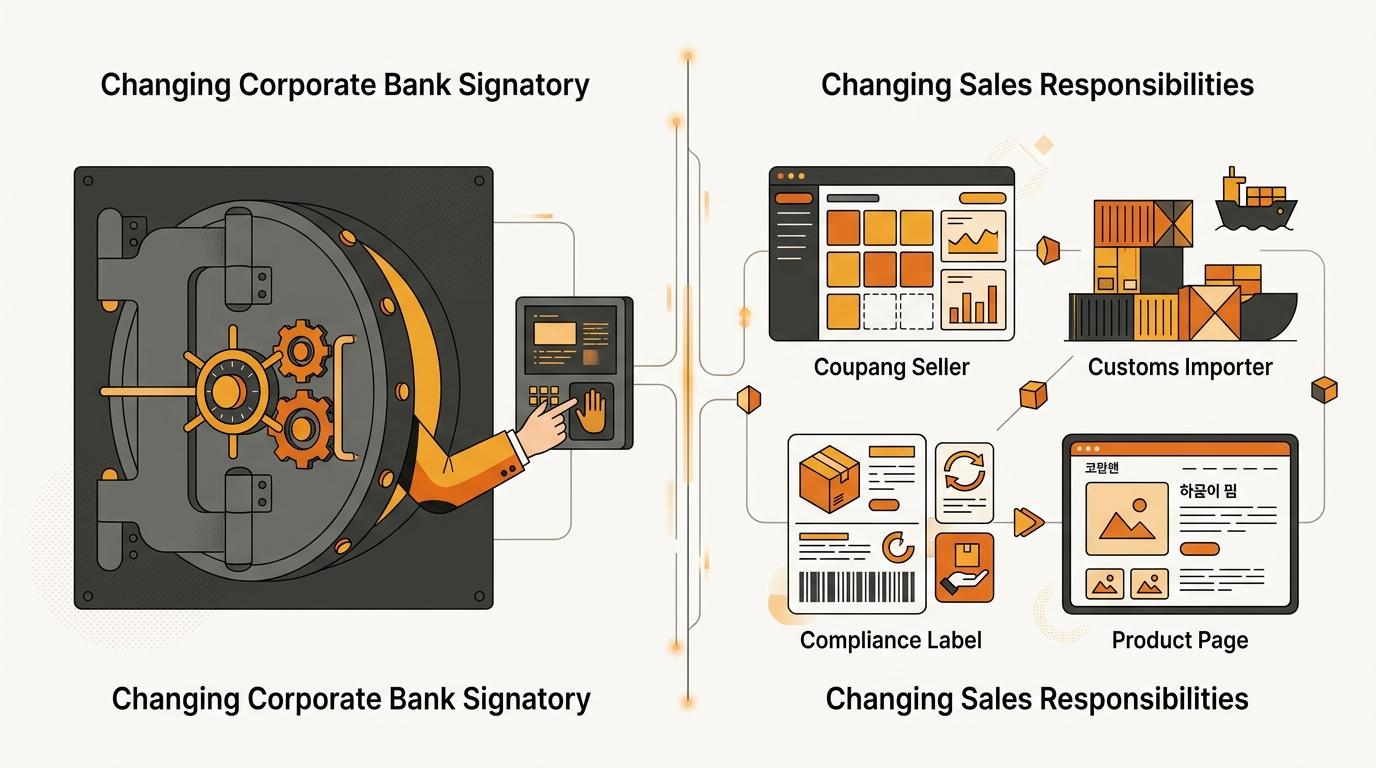
What this change does not update in Coupang or import operations
Changing the account user helps the finance team. It does not create the Korean entity, approve Coupang onboarding, or change the legal seller.
Coupang seller and settlement. The legal seller named in the Coupang account remains unchanged. Adding a finance manager to the company bank account does not transfer the seller account. If the company changes its payout account, registered representative, or seller contact, Coupang may require a separate update and supporting documents.
Importer of Record and customs. The Importer of Record (IoR) is the party responsible for the Korean import. The Seller of Record (SoR) is the legal seller to the customer or trade buyer. A partner’s Korean entity may import and sell the goods. Changing a finance user on your account does not make your company the Importer of Record or Seller of Record.
Keep those roles tied to the named legal entity. Read Who Is the Importer of Record When You Sell on Coupang? before treating bank access as import authorization.
Product compliance checks and Korean listing work remain separate from bank access. See KC Certification and Coupang: A Korean Entity? and How to Localize Product Pages for Korean E-commerce for those separate tasks.
Close the change with a control check
Before the bank appointment, write one line for every person: add, remove, or keep. Beside the name, list the permissions: branch signing, online banking, OTP, digital certificate, corporate card, foreign-currency payments, and alerts.
At the bank, confirm these items before leaving:
- The new person appears on the account authority list.
- The removed person no longer has the requested account permissions.
- Online-banking users match the new company approval.
- Old OTPs, digital certificates, cards, and payment tokens are cancelled or returned.
- Payment limits and approval levels match the company resolution.
- Alerts go to the correct finance or management contact.
- The bank gives you a confirmation, updated user list, or other proof of the change.
After the appointment, have the new signatory test the approved access through the bank’s normal login and approval method. Do not test by sending an unnecessary payment. Check whether the old user can still log in, approve payments, or receive alerts. If the bank has not disabled old access, contact the branch again.
Finally, update the company’s internal payment list. Tell payroll, suppliers, customs staff, fulfillment partners, and the Coupang account owner only when their payment contact, payout account, or authorized contact actually changed. If the company changed only the bank signatory, do not submit a false change to the importer, seller, or product-compliance file.
The safe sequence is simple: company approval, bank verification, digital-access check, then a separate review of sales and import roles. That order keeps a new finance operator useful without giving a bank change more legal effect than it has.
Need help mapping a Korean account change?
Contact Kontactic to review the bank-access change alongside your Korean entity, Coupang, import, and operating responsibilities.
About the author
Korean and global e-commerce operators with 15+ years of cross-border experience, led by CEO Isaac Lee — KOTRA-certified consultant and official lecturer for Seoul City and the Korea Customs Service. We run Korea market entry for overseas brands every day; this blog records what we learn in the field.
Meet the Kontactic team →Related Articles

Korean Import Duty and VAT: Which Price Counts?
Korean import duty and VAT normally use the parent-company price, not Coupang’s retail price; freight, insurance, and some royalties can change the tax due.

What Happens to Unsold Stock After a Korea Pop-Up Store?
After a Korea pop-up, unsold stock must be sold locally, returned, re-exported, or disposed of at the brand’s cost. Choose the route before the event.

Can One Korean Importer Sell to Several Buyers?
Yes—one Korean importer can clear a shipment and resell it to several Korean buyers. Set the seller, tax invoice, labels, and compliance roles before it ships.