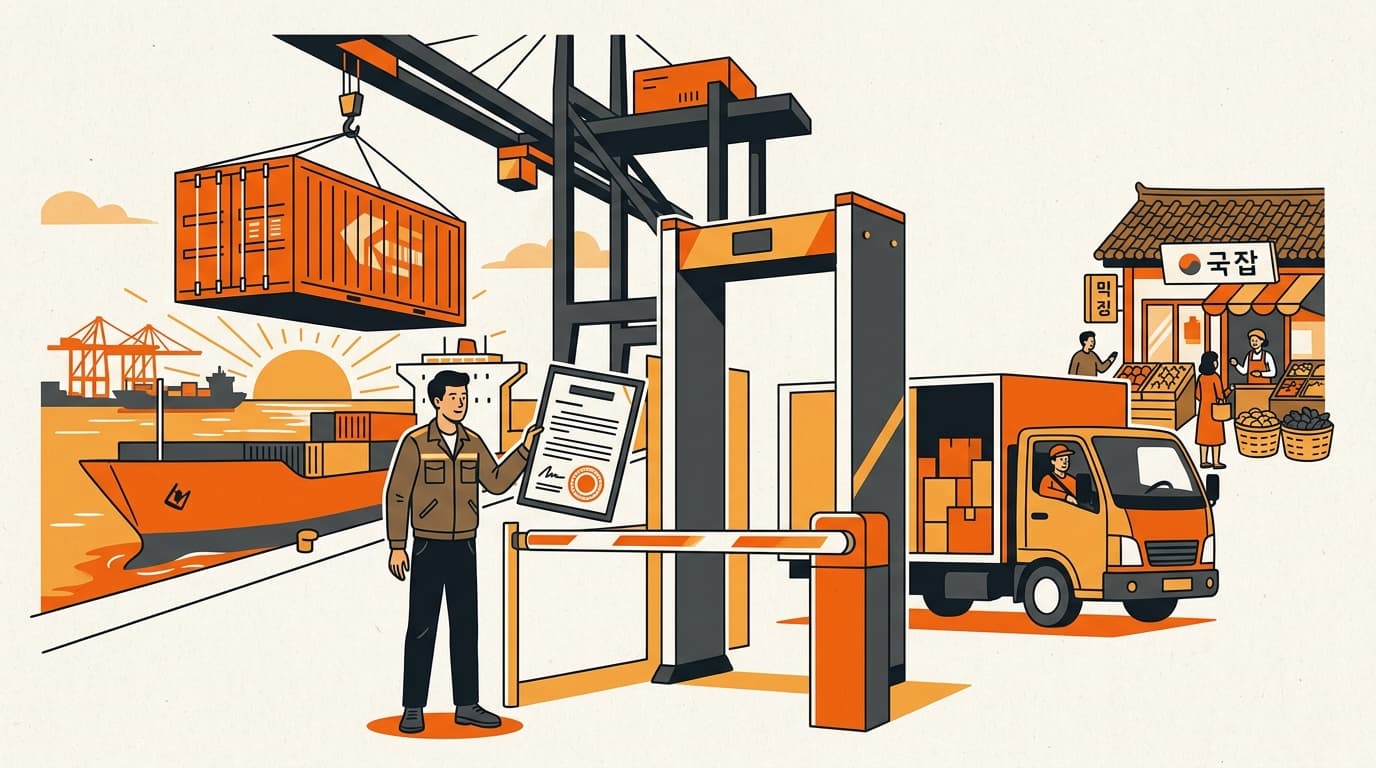
Who Is the Importer of Record When You Sell on Coupang?
When your brand sells locally on Coupang, the Importer of Record (IoR) must be a party with legal standing in Korea — a Korean entity or a licensed import agent acting as IoR — that files the import declaration to the Korea Customs Service and is held accountable for it. Coupang, the marketplace, is not your Importer of Record. Neither is your freight forwarder. Getting this wrong doesn't just delay clearance; it can leave no compliant party responsible for duty, import VAT, and product-safety obligations.
This is the single most common misread we see from Western brands with proven Korean cross-border demand. You've been shipping direct to Korean shoppers for a year, customs "just worked," and you assume that once you go local, some partner in the chain absorbs the same role. Going local moves you into a different legal category entirely. Here is what actually happens, and who has to be named.
The short answer: a Korea-resident party files the declaration
For any commercial import into Korea, the customs declaration names a specific importer, and the Korea Customs Service holds that named party accountable for three things: the goods' tariff classification, their declared customs value, and payment of import duty and import VAT.
That named party has to have legal standing in Korea. In practice, that means one of two things: a Korean business entity that you own, or a licensed operator acting as your Importer of Record. A marketplace listing does not create importer status, and being the brand owner abroad does not either. The declaration needs a resident, legally identifiable party — someone the Customs Service can actually pursue if the classification is wrong or the duty goes unpaid.
Importer of Record (IoR): the entity responsible for importing goods into Korea — filing the customs declaration and serving as the registered importer accountable for classification, declared value, and payment of import duty and VAT. For a foreign brand selling locally, the IoR is either your own Korean entity or a licensed operator, never the marketplace.
We've written a fuller primer on what an Importer of Record in Korea actually is if you want the ground-level definition first. This piece is narrower: it answers who that party can and cannot be once you're selling on Coupang.
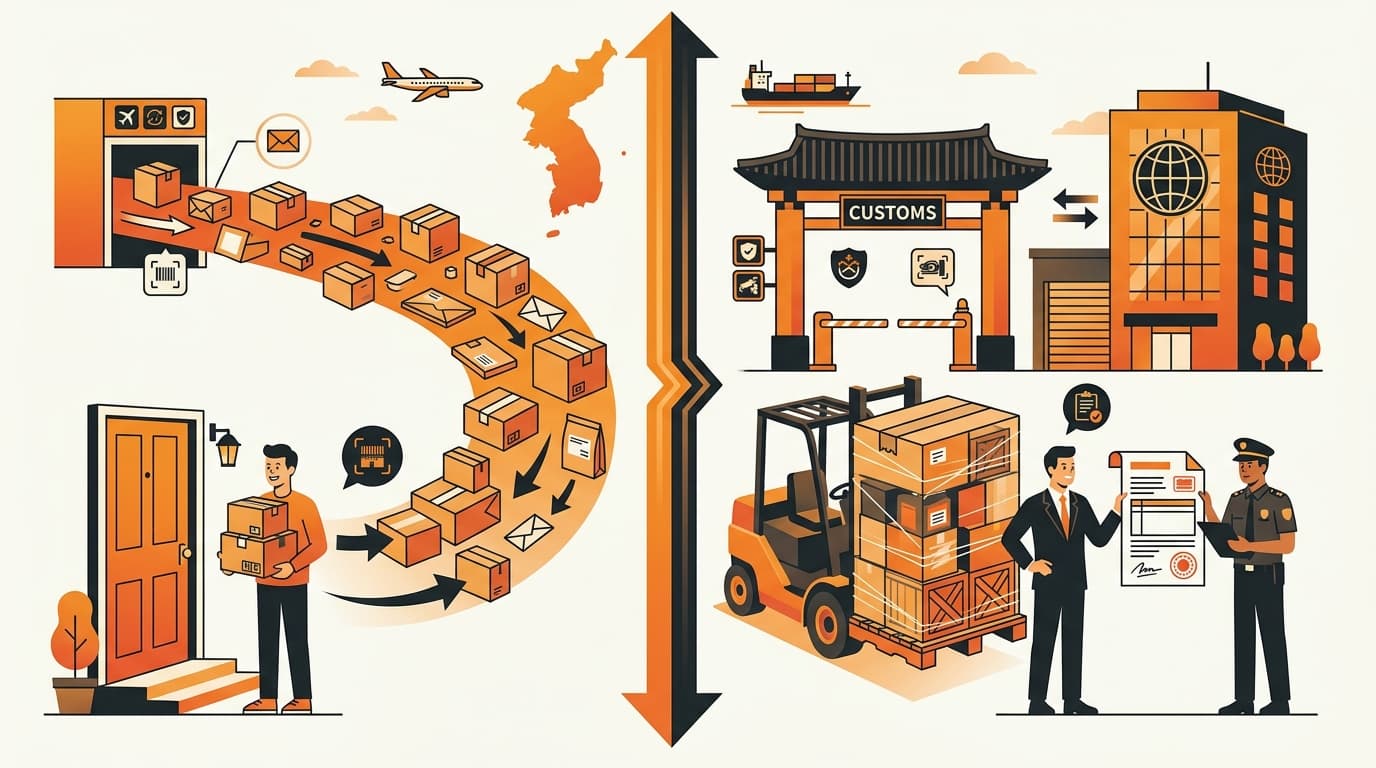
Why cross-border clearance felt invisible — and local clearance won't
The reason customs "just worked" cross-border is that the importer was your customer. When you ship a single parcel direct to a Korean consumer, the goods typically clear under a personal-use path, and the individual buyer is effectively the party importing for their own use. Under Korea's de minimis threshold, low-value personal shipments can clear duty-free, which is exactly why the whole thing felt frictionless to you as the seller. You never saw a declaration because the declaration wasn't yours.
A local commercial import is the opposite. Now the goods clear to a business importer, in bulk, for resale. Full duty and import VAT attach, and so do the product-safety obligations that ride on the importer's shoulders. There is no personal-use exemption for commercial inventory headed to a warehouse. The party clearing that cargo is doing so as a commercial entity, and Korean law treats it accordingly.
“Cross-border felt frictionless because the importer was your customer. Going local means the importer has to be you — or someone standing in for you.”
Kontactic — Managed Market Entry Operator
This is the split most guides gloss over. If you've only ever shipped cross-border, your mental model of Korean customs is built on a path you are about to leave.
Duty and import VAT: who the assessment lands on
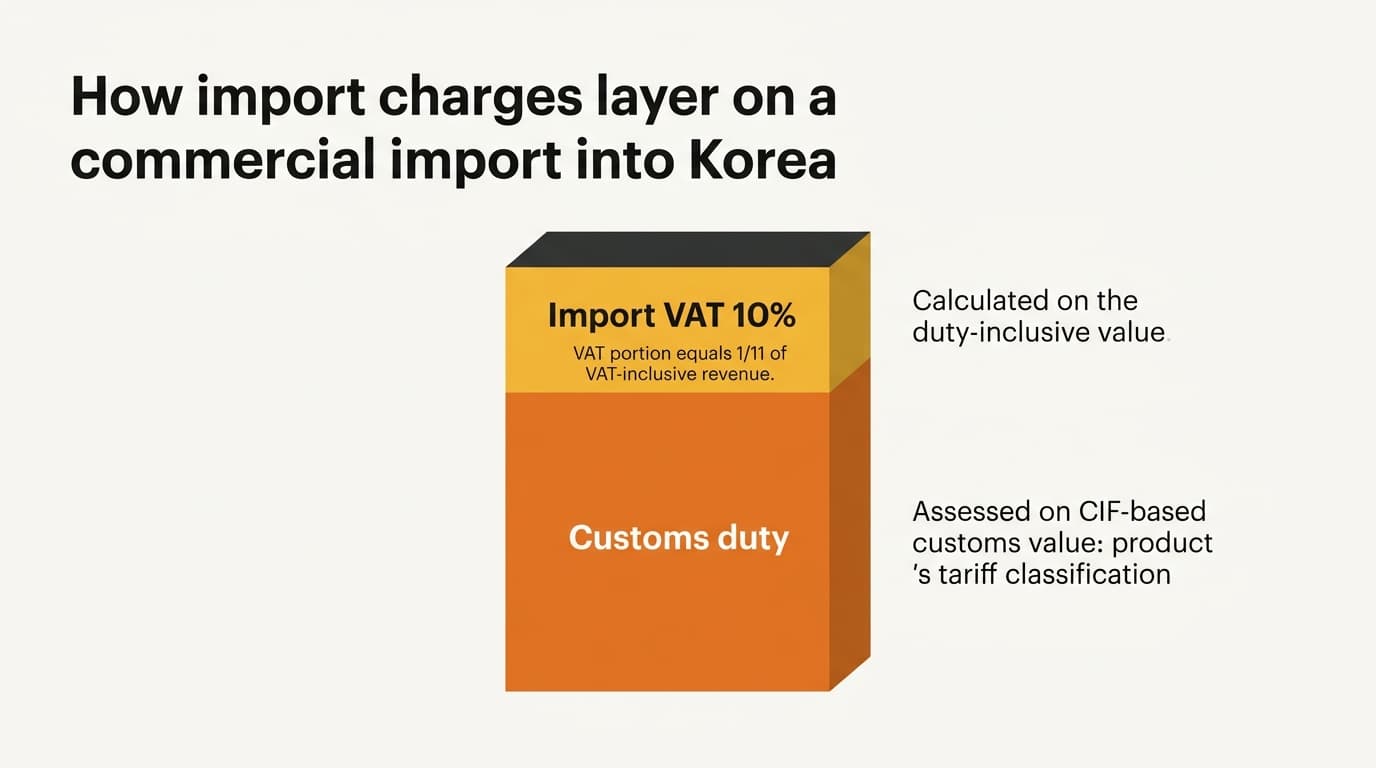
Import charges layer on the named importer, not on Coupang and not on the forwarder. Conceptually, customs duty is assessed on the customs value of the goods — a CIF-based value that includes cost, insurance, and freight — using the tariff classification (HS code) that applies to the product. Import VAT is then generally calculated on that duty-inclusive value.
We're staying qualitative on rates here on purpose, because the duty rate depends on your specific HS classification and any applicable trade agreement, and that's a per-SKU determination you should verify against the Korea Customs Service tariff schedule rather than a blog. What is fixed is the VAT rate.
Korea's VAT (부가가치세) is 10%. On the import side it's generally assessed on the duty-inclusive customs value; on the sales side it's baked into your VAT-inclusive Coupang revenue, where the VAT portion works out to 1/11 of the gross. The party that pays import VAT and files it is your named importer — which is one reason the entity-vs-agent choice affects your VAT recovery position.
The practical takeaway: whoever is your Importer of Record is the party the Customs Service assesses, the party that must fund the duty and import VAT at clearance, and the party positioned to recover input VAT downstream. That's a real financial function, not a formality. If you're unsure who fronts those charges before an importer is even named, we've covered exactly who pays Korea import duties on your first shipment.
IoR status is a product-safety question too, not just a tax one
This is the part that turns a customs question into a compliance risk. Under Korea's product-safety laws, the importer is frequently the legally responsible party for certification and Korean-language labeling — not the manufacturer abroad, and not the marketplace.
If your product falls under a KC certification regime, or under labeling rules enforced by regulators such as KATS or the MFDS (식약처), the accountable holder of those obligations is typically the importer that brought the goods in. So an undefined or absent IoR doesn't just stall a shipment at the border — it creates a gap where no compliant party is on the hook for KC certification or the Korean disclosure label. That gap is worse than a delay, because it can surface after the product is already listed and selling.
This is why mapping the importer is inseparable from mapping compliance. Before cargo ships, the obligation for each SKU has to sit with a named, resident party. If you want to see how that mapping works in practice, we've documented how we map each SKU to the right Korean regulation.
If your IoR is undefined, no one is legally holding your KC certification or Korean labeling obligation. That is a compliance gap, not a paperwork delay — and it can force a listing offline after you've already made sales.
The misconception: forwarders and brokers are agents, not your importer
Freight forwarders and customs brokers file paperwork and facilitate clearance. They do not become the legally accountable importer in your place. This is the single correction worth internalizing.
A customs broker can prepare and submit the import declaration on your behalf. A forwarder can move the cargo and coordinate the entry. But both act as agents — they file for a principal, and the principal named on the declaration is the importer the Customs Service holds accountable. When something goes wrong with classification, valuation, or duty, the liability tracks to the named importer, not to the agent who typed it in.
Coupang sits even further from the role. Coupang is the marketplace where the goods are sold; it is not in the import chain as your importer, and nothing in Coupang's official seller or developer documentation makes the platform your Importer of Record. Assuming otherwise is the mistake that leaves inventory clearing under no defined commercial importer at all.

Your two real options for naming an importer
For a Western brand going local, there are two paths, and the choice affects liability, VAT recovery, and how your Coupang account is set up.
- Establish your own Korean entity. You register a Korean limited company (유한회사), and that entity acts as the Importer of Record and, typically, the Seller of Record on Coupang. Liability, VAT recovery, and the marketplace account all sit under a company you own.
- Engage a licensed IoR / SoR operator. A resident operator acts as Importer of Record and Seller of Record on your behalf, clearing the goods and selling on its own account. You skip entity formation, but the operator holds the importer position — so the terms of that arrangement determine who carries liability and how proceeds settle back to you.
Neither is "better" in the abstract; they trade off differently on control, cost, speed, and where liability lands. The one thing both have in common is that a named, Korea-resident party takes the importer role. That is non-negotiable for commercial imports. If you're weighing the broader model choice, our guide to selling on Coupang as a foreign brand walks through how the importer decision fits the rest of the setup.
Common questions
Can Coupang be my Importer of Record? No. Coupang is the marketplace where goods are sold, not the party that clears your commercial inventory through customs. Nothing in Coupang's official seller or developer documentation assigns the platform importer-of-record status.
Does my freight forwarder become the importer? No. Forwarders and customs brokers file and facilitate clearance as agents. The importer named on the declaration is the accountable principal, and liability for classification, value, and duty tracks to that named importer.
Was I the importer when I shipped cross-border? Usually not. Personal-use cross-border parcels typically clear with the individual consumer as the importing party, often under the de minimis path. That's why it felt invisible — the declaration wasn't yours. A commercial local import reverses that.
Where can I verify the rules myself? Import declaration and duty rules sit with the Korea Customs Service; statute text is on law.go.kr; KC certification and labeling obligations trace to regulators such as KATS and the MFDS (식약처). Verify your specific HS classification and duty rate against the official tariff schedule rather than any summary.
Does the IoR choice affect my VAT? Yes. The named importer pays import VAT at clearance and is the party positioned to recover input VAT — which is one concrete reason the entity-vs-operator decision isn't only about liability.
Not sure who your Korean importer of record should be?
Map your IoR and SoR — entity or operator — and the downstream duty, VAT, and product-safety obligations before you ship. Talk to Kontactic about going local on Coupang.
About the author
Korean and global e-commerce operators with 15+ years of cross-border experience, led by CEO Isaac Lee — KOTRA-certified consultant and official lecturer for Seoul City and the Korea Customs Service. We run Korea market entry for Western brands every day; this blog documents what we learn in the field.
More about Kontactic →Related Articles
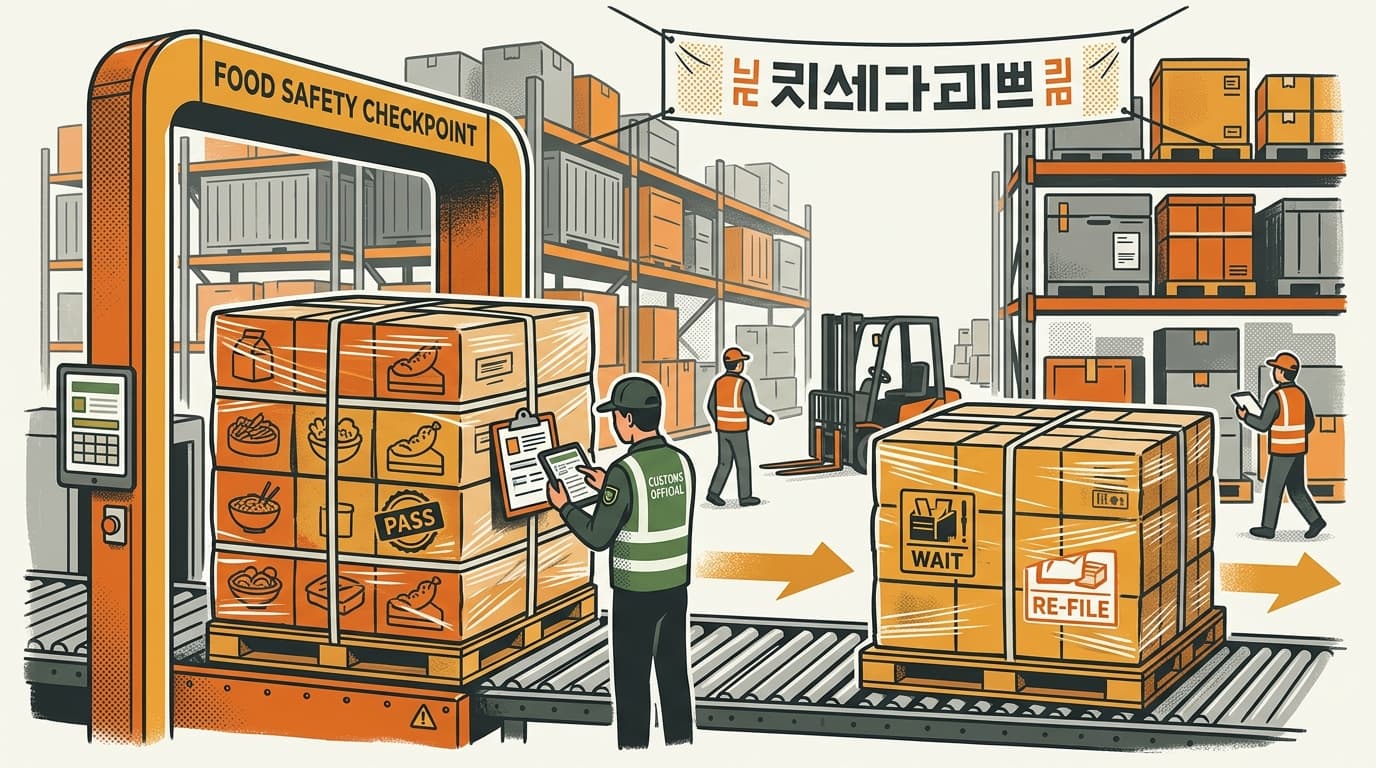
Korea Food Import Declaration: File Every Shipment
Korea food import declaration rules apply to one shipment only, so MFDS requires a new declaration for every reorder and later checks may delay stock in Korea.
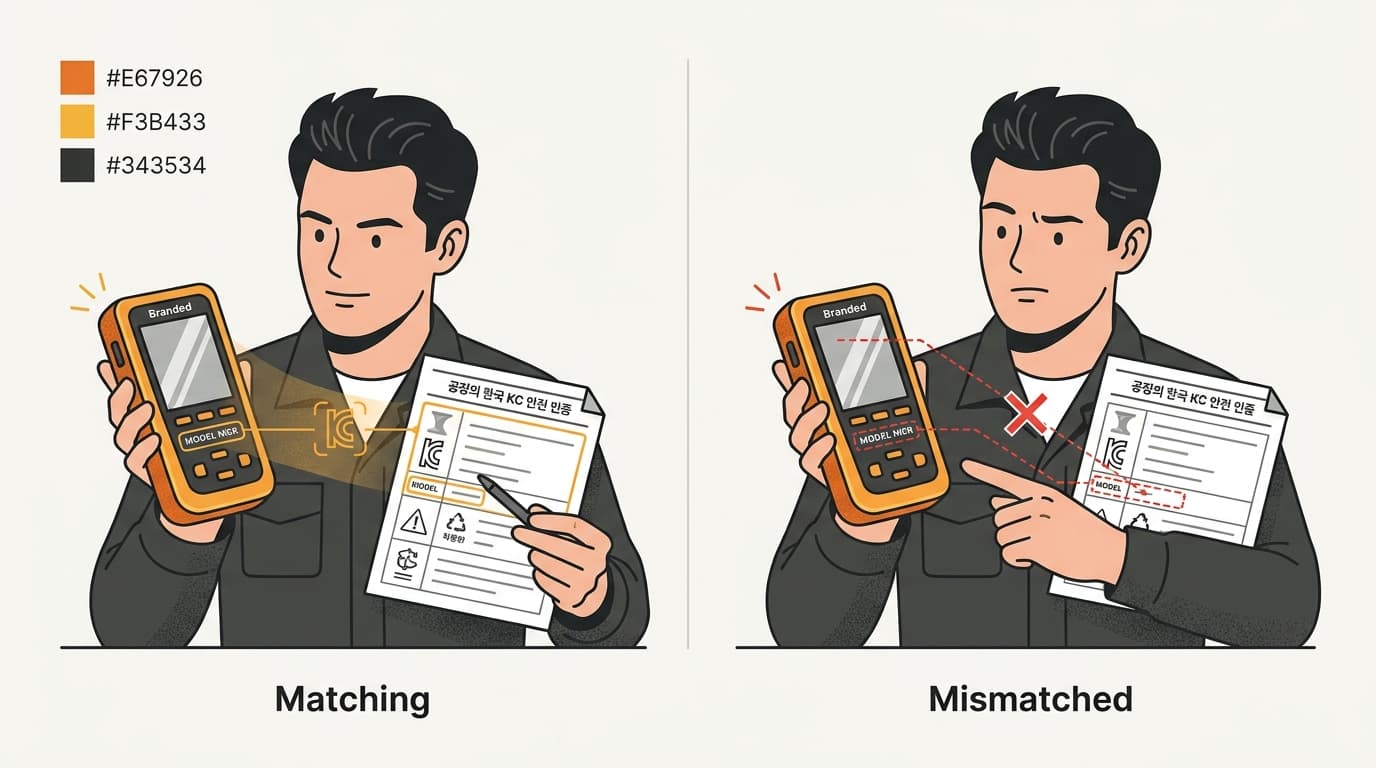
Can a Factory's KC Certificate Cover Your Brand?
Factory KC paperwork covers your private-label product only when the approved model, factory, and version match. Wireless products need a separate RRA check.
Can You Reject a Coupang Exchange? Only Two Reasons
Coupang exchange rejection is limited to SOLDOUT or WITHDRAW. Learn when each code applies—and what to do when a seller simply prefers a refund instead.