
Can an Employee Use a Corporate OTP When the Director Is Abroad?
Yes, an employee can often run routine Korean corporate-bank tasks while the foreign director is overseas. But the employee should not use the director’s OTP or joint certificate: the bank must register the employee as an authorized corporate-banking user and issue or delegate access under its own rules.
If by use you mean taking the director’s physical OTP, password, or certificate file, the answer is no. Do not build the company’s banking controls around shared credentials.
A separate employee user is the safe starting point. Never treat the director’s OTP, PIN, login, or joint certificate as a company-wide password.
What the bank is actually allowing
A corporate OTP and a joint certificate do different jobs.
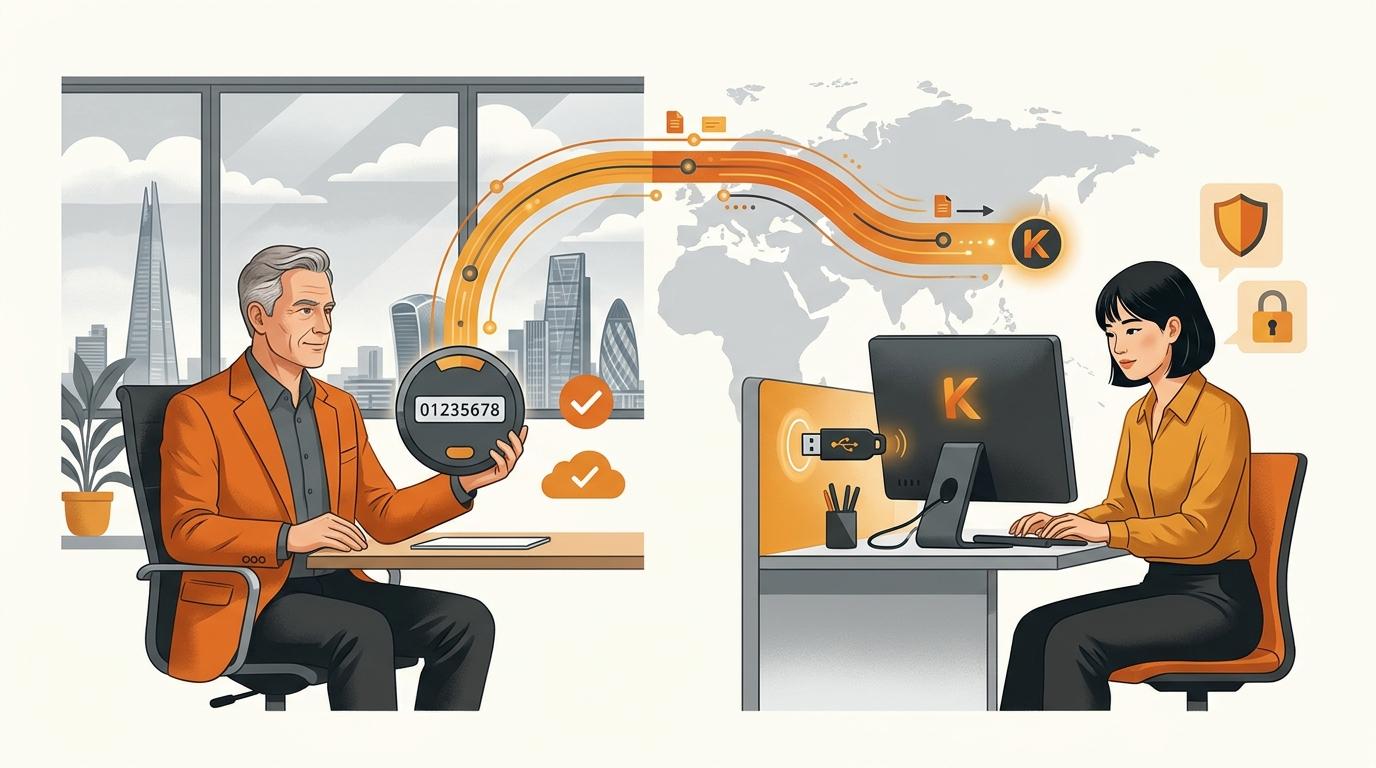
A corporate OTP is a one-time password device or app. It produces a code for a login, payment, or other banking action. A joint certificate (공동인증서) is a digital credential used to authenticate a user or sign in to a bank or another Korean service. A bank may call its banking version a corporate financial certificate.
Neither tool makes an employee a director. The Korean company owns the account. The employee only receives the access that the company and the bank approve.
| Tool | What it does | Safe question to ask the bank |
|---|---|---|
| Corporate OTP | Confirms a login or transaction with a one-time code | Can the employee receive a separate OTP or another approved approval method? |
| Joint certificate | Authenticates the user or company for a digital service | Can the bank delegate corporate financial certificate use to this named employee? |
| User role | Sets what the employee can view, prepare, or approve | Which actions require the registered representative or another approver? |
The safe model has three parts. The employee has a named user account. The bank issues or formally delegates the OTP and certificate access under that user. The company writes down which payments the employee may handle.
The unsafe model is different. The director sends an OTP, PIN, password, or certificate file to an employee. The employee logs in as the director. No one can tell from the login who actually approved the payment. That may also conflict with the bank’s conditions for electronic financial services.
Woori Bank’s official corporate certificate page describes delegation of corporate financial certificate use to a person who meets the bank’s conditions. That shows that delegation can be available. It does not mean every Korean bank uses the same user roles or accepts the same documents.
If the certificate is also needed for Hometax or another Korean government service, ask about that separately. Bank access and tax-portal access may use different registrations.
Set up employee access before the director leaves
The easiest time to set this up is while the registered representative can answer the bank’s questions and attend a branch if needed.
1. List the tasks the employee will handle
Be specific. A useful list might include paying an approved Korean supplier, paying freight and import charges, funding Coupang advertising, or uploading a payment request for review.
Put higher-risk tasks on a separate list. These usually include adding a new beneficiary, sending an overseas wire, changing a transaction limit, adding a new bank user, closing an account, or reissuing an OTP or certificate.
Do not ask the bank for broad access when the employee only needs to pay regular invoices.
2. Ask the bank how its corporate user system works
Ask the branch or corporate banking desk these questions before signing forms:
- Can the company register a named employee as a separate corporate internet-banking user?
- Will the employee receive a separate OTP, or does the bank use a company-level device?
- Can the bank delegate corporate financial certificate use to that employee?
- Can the employee view balances, prepare payments, approve payments, or do all three?
- Does the employee need a Korean phone number or a particular device for authentication?
- Which actions still require the representative director?
Some banks use a company-level OTP. If so, ask how the bank identifies the person using it and what approval steps apply. Do not simply hand the device to staff and assume that technical access equals approved access.
3. Have the right person sign the authority
The representative director (대표이사), or another person already registered as an authorized signatory, normally signs the bank mandate and employee authorization. A director who is not the registered bank signatory may not be enough.
Ask the bank whether the employee signs a separate user agreement or receipt. Keep a copy of every form with the company’s banking documents.
4. Test the access before departure
The employee should log in, check the account view, prepare a payment, and confirm the bank’s approval step before the director leaves Korea. If the company is comfortable doing so, run a small approved payment rather than waiting for the first urgent tax, freight, or supplier deadline.
Also check the certificate expiry date, OTP replacement process, bank alerts, payment cut-off times, and the bank contact for a locked user. This test often finds a missing Korean phone number or a certificate installed on the wrong computer.
A sensible company policy looks like this:
| Company task | Suggested control |
|---|---|
| Prepare a payment and attach the invoice | Employee prepares it |
| Pay a regular approved invoice within a set limit | Employee handles it if the bank allows it |
| Add a beneficiary or send a new overseas wire | Director or a second approver reviews it |
| Change a limit, add a user, or reissue a credential | Registered signatory and bank handle it |
| Close the account or change the representative | Registered signatory follows the bank’s formal process |
These are company controls, not promises about what a particular bank’s website can do. The bank’s user agreement and approval settings control the actual access.
Documents, signatures, attendance, timing, and cost
There is no single Korea-wide document list. The branch’s current checklist takes priority, especially for a foreign-owned company.
A bank may ask for some or all of the following:
- Korean business registration certificate
- Korean corporate registry certificate
- Corporate seal and corporate seal certificate, if the bank uses them
- Passport or identity document for the representative director
- Identity document for the employee
- Employment certificate or other proof that the employee works for the company
- Power of attorney or company authorization signed by the representative
- Foreign shareholder, parent-company, ownership, or beneficial-owner information
- A short explanation of the company’s business and expected payments
- Korean phone and device details for the banking user
The representative director usually signs the account agreement and the authority allowing the employee to use corporate banking. The employee normally presents their own identity document and signs the bank’s user terms when the bank requires it.
The representative director may need to appear in person for the first account opening, a major change, a transaction-limit change, or a new user. Some branches may let an authorized employee complete part of the process with a power of attorney. There is no general rule that an overseas director can complete every step by email.
If the director is already abroad, ask the exact branch whether it accepts a power of attorney signed overseas. The bank may ask for notarization, an apostille or legalization, Korean translation, or another form of identity check. Do not prepare these documents from a generic internet checklist and assume the bank will accept them.
Opening the account, registering corporate internet banking, and issuing an OTP or certificate are separate steps. A bank may complete employee-user registration during a branch appointment after it accepts the documents, but foreign ownership and Know Your Customer checks can add questions and delay the process. Start before the director’s flight.
There is also no defensible Korea-wide typical price. Ask the bank for its current fee schedule for corporate internet banking, OTP issue or replacement, certificate issue or replacement, domestic transfers, overseas wires, and any account or branch fees. Add the cost of notarization, legalization, translation, or courier service if the bank requires those documents. A company-setup or administration fee quoted by a service provider is separate from the bank’s own fees.
For the wider account-opening problem, see Korean Corporate Bank Accounts: The Last Wall Foreign Founders Hit. The same principle applies: confirm the bank’s practical settings before the director leaves, not after a payment is urgent.

If the director is already overseas
Start with the bank, not with the director’s login details.
If the employee is already a registered user, keep using that user within the approved limits. Save the invoice, payment purpose, and written approval with each important payment. Do not expand the employee’s access just because the director is unavailable.
If no employee user exists, ask the branch or corporate banking support team whether it can:
- Register the employee through an overseas-signed power of attorney.
- Accept a remote identity check for the representative director.
- Require the director to return to Korea before adding the user.
- Use another person already registered as an authorized signatory.
The bank may refuse the first two options. That is a bank decision, not a problem an employee should solve by using the director’s credentials.
If an OTP is lost or a certificate expires, contact the bank and follow its reissue process. Do not email the director’s certificate file to a shared inbox. Do not put the OTP, PIN, or password in a team chat. If an urgent company payment cannot be made, ask the bank and the company’s accountant for an approved alternative. Do not move company money through an employee’s personal account without professional advice and proper company approval.
Bank access is not the Korea market-entry path
Foreign brands often face this question while deciding whether to sell cross-border or import stock into Korea. The banking answer changes with that choice.
With Direct, the brand sells cross-border on Coupang through Coupang Global Fulfillment (CGF; Korean shoppers call it 로켓직구). Stock stays in a CGF warehouse outside Korea. Coupang delivers to Korean customers in 3–5 days as personal imports and pays the brand directly. Direct is for brands shipping from the US, Europe, Japan, mainland China, or Hong Kong. In that model, the brand does not need a Korean company’s OTP to run the Korean sale. How to Sell on Coupang as a Foreign Brand: Complete Guide explains the wider choice between cross-border and local selling.
When the brand’s own Korean entity imports and sells, bank delegation becomes part of daily operations. The entity pays, remits, and signs its own contracts. An operating agent can prepare payment requests and remittance papers without taking access to the entity’s bank account or signing in its name. That is the control split in Kontactic’s Blaze model. If another Korean company is the importer and legal seller, its account and user permissions follow that company’s rules instead.
Coupang seller onboarding is separate from bank access. An employee may assemble company documents, prepare seller-center tasks, and coordinate product files, but an OTP does not replace the entity’s seller approval or the representative’s authority. A Korean product page is also a separate job. The employee or localization team can prepare Korean copy, product images, and product-information disclosures without receiving the director’s banking certificate. See How to Localize Product Pages for Korean E-commerce.
The same distinction matters when stock moves into local fulfillment such as Rocket Growth. The employee may pay an approved freight invoice, import charge, warehouse bill, advertising invoice, or return expense. The bank credential does not make that employee the importer, seller, or owner of the return decision. Coupang customer service and returned-stock handling still need their own owner and instructions. Who Handles Returns Under Coupang Rocket Growth? covers that separate responsibility.

A control plan for a foreign-owned Korean company
A small company can keep this practical without giving one person unlimited access.
First, give the employee a separate bank user and the bank-approved OTP or certificate method. Second, set a written approval rule. For example, the employee may pay recurring approved invoices, while the director reviews new beneficiaries, overseas wires, unusual amounts, and limit changes.
Third, attach the payment request to the supplier invoice, amount, currency, purpose, and written approval. A simple payment log is enough if it identifies who prepared the payment and who approved it. The director can review the bank statement and payment alerts from overseas without asking for the employee’s password.
Fourth, remove access when the employee changes role or leaves. Ask the bank to revoke the user, cancel the OTP, and revoke or replace the certificate as required. Review access again when the representative director, phone number, office, or bank account changes.
This is one of the recurring tasks after incorporation. Korean Entity Administration: What Happens After Setup? gives more context on the filings, renewals, and local tasks that continue after the company exists.
Questions to send the bank before the director flies
Send the bank a short written list and keep the answer with the company documents:
- Can we register this named employee as a separate corporate internet-banking user?
- Will the employee receive a separate OTP or another approved transaction method?
- Can the employee use a corporate financial certificate or joint certificate under delegated authority?
- What can the employee view, prepare, approve, or change?
- Which transactions require the representative director in person?
- Can the bank accept a power of attorney signed while the director is overseas?
- Does that document need notarization, legalization, an apostille, or Korean translation?
- What are the current issue, replacement, transfer, and account fees?
- How long should the company allow for KYC review and user activation?
- How does the company revoke access when the employee leaves?
The practical answer is simple: an employee can be the day-to-day operator, but only the bank can decide which digital actions that user may take. Set up separate registration, signed authority, bank-issued access, a test payment, and written approval limits before relying on the arrangement.
Need a Korea banking control plan?
If your director is overseas, Kontactic can help map the entity, bank access, Coupang setup, and local operating tasks before you delegate them. Contact us to discuss the setup.
About the author
Korean and global e-commerce operators with 15+ years of cross-border experience, led by CEO Isaac Lee — KOTRA-certified consultant and official lecturer for Seoul City and the Korea Customs Service. We run Korea market entry for overseas brands every day; this blog records what we learn in the field.
Meet the Kontactic team →Related Articles

Securities Acquisition Filing in Korea: Funding Steps
Funding a Korean company may require a securities acquisition filing before payment; see the documents, timing, costs, and separate Coupang approvals.

Korea Setup Fee: What Costs Extra After Year One?
Korea setup fee: USD 3,000 includes first-year bookkeeping; after year one, bookkeeping, phone bills, taxes, and office-address renewals are separate costs.

Korea Mail-Order Registration: Documents You Need
What documents do you need for Korea mail-order registration? Use this checklist for the business certificate, ID, payment proof, timing, and filing cost.