
Can a Korean Corporate Bank Receive USD and Pay in KRW?
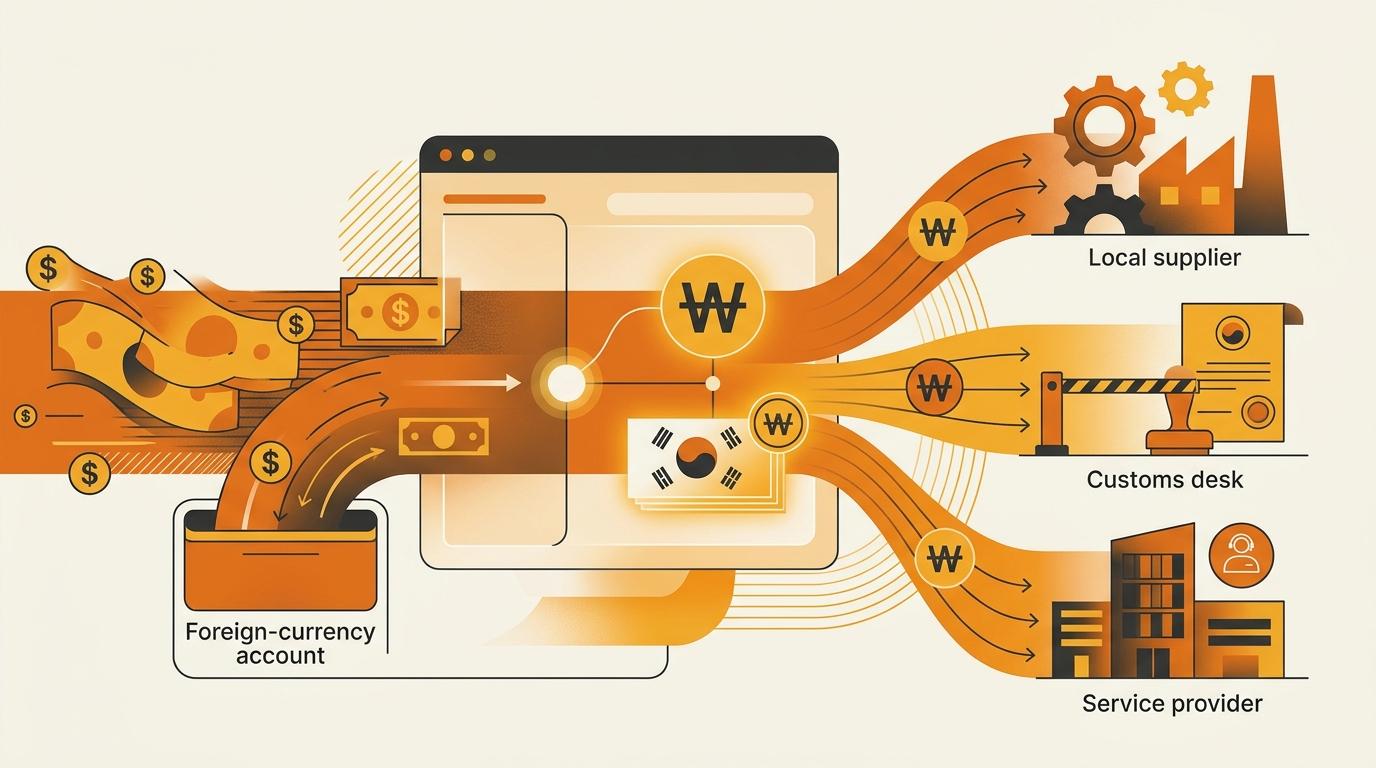
Yes—usually. A Korean company can receive US dollars (USD) in a foreign-currency deposit account. It can also ask the bank to convert the incoming wire to South Korean won (KRW) and use the won to pay Korean bills. The bank still decides whether the account can hold USD, which documents it needs, what limits apply, and what it charges.
The USD-to-KRW process starts with the account type
Start with the account setup, not the advertised exchange rate. A KRW-only corporate account does not automatically mean the company can keep USD in that account.
The official Easy Law guide for financial transactions in Korea says foreign nationals may open deposit or money trust accounts in Korea. It covers accounts in foreign currency and Korean won. That guide does not promise the same terms for every foreign-owned company. The bank still performs its own company checks.
The Bank of Korea's foreign-exchange guidance says payments and receipts for current transactions—ordinary business payments—are generally allowed. Banks can still ask why the money is moving and how much the transaction covers.
In practice, the process has five parts:
- Choose how the bank will handle USD. Ask whether it will credit USD to a foreign-currency deposit account or convert the incoming USD and credit the KRW account. If you want to keep USD until a later date, confirm that the account can hold it.
- Get exact wire instructions. Ask for the company's legal name, account number, bank address, SWIFT code (the bank's international routing code), intermediary-bank details, and payment reference. A spelling difference between the company registration and the wire can create extra questions.
- Match the transfer to its purpose. Tell the bank what the money is for. It may be operating funding from a parent, a customer's invoice payment, a shareholder contribution, or a loan. Prepare the document that explains the actual purpose.
- Convert only the amount you need. Ask how the company starts the conversion, when the exchange rate is fixed, and whether the bank charges a separate conversion fee. Do not assume the entire USD balance converts automatically.
- Pay Korean bills from the KRW balance. These may include supplier invoices, customs charges, tax payments, fulfillment bills, or advertising costs. Save the incoming-wire notice, conversion receipt, invoice, and local payment confirmation together.
For example, a foreign parent may send operating funds to its Korean subsidiary. The subsidiary should keep a funding agreement or written explanation with the wire notice. It should use the same description in its accounting. It should not describe a shareholder loan as customer sales simply because both payments arrive in USD.
Receiving USD and converting it to KRW is a banking task. It does not decide who is the importer, who is the Coupang seller, or whether a product may be sold in Korea.
Prepare company and payment documents before the first wire
Prepare two document packets: one for the company and one for the incoming payment. The exact list depends on the bank, account product, ownership structure, and transfer purpose.
The company packet may include:
- Korean business registration certificate
- Korean corporate registry extract
- Passport or other identification for the legal representative
- Corporate seal and seal certificate, if the bank uses them for the account forms
- Information about the foreign parent and the people who own the company
- A power of attorney or company authorization if someone other than the legal representative will sign
The payment packet may include:
- A contract, invoice, or settlement statement
- A written explanation of parent-company funding, a loan, a capital contribution, or a reimbursement
- The sender's company details and relationship to the Korean company
- Import and customs papers when the payment funds inventory
- Tax or service invoices for local business expenses
When inventory is involved, the bank may also ask for import and customs papers. This guide to Korean tax and import paperwork covers the related documents for imported goods.
Not every bank asks for every item. Ask the branch or corporate-banking team for its current list before anyone signs or sends original documents.
For a foreign-owned company, opening the account can take more work than converting the currency. This guide to Korean corporate bank accounts for foreign founders explains why a new account may have transfer limits. It also explains why the bank asks questions before the first transfer.
After the first payment, keep the incoming-wire advice, conversion receipt, invoice, and local payment confirmation together. This practical guide to matching Korean payments, invoices, and allocations shows how to match one USD receipt with several KRW payments.
Who signs, how long it takes, and what it costs
Plan for the Korean company's legal representative to take part in the first account opening. The bank may require that person to sign the account agreement, online-banking forms, and foreign-exchange documents. It may also require an in-person identity check.
Some banks may accept an employee or proxy. The bank decides which power-of-attorney, company-seal, and identity documents that person must provide. Do not assume that a third party can open the account just because they work for the company.
There is no single Korea-wide timeline for opening a foreign-owned corporate account or receiving the first USD wire. Treat these as separate milestones:
- The bank accepts the company documents.
- The account and online banking become usable.
- The bank accepts, credits, and converts the first USD transfer.
A foreign owner, a new company, an unusual transfer, or missing purpose documents can add review. Ask the bank to confirm what must be complete before each milestone.
There is also no single standard cost. Ask for the bank's written fee schedule for:
- Incoming international-wire fees
- Any correspondent or intermediary-bank deduction
- The difference between the bank's USD buying and selling rates
- A separate currency-conversion commission, if any
- Outgoing KRW transfer fees
- Corporate online-banking or account-maintenance fees
The amount that reaches the Korean account may be lower than the amount sent if an intermediary bank deducts a charge. A remittance platform's advertised rate is not a reliable budget for a Korean corporate bank account. Get the Korean bank's own rate and fee details for the exact transfer type.
Do not send a large USD wire until the bank confirms the receiving-company details, payment purpose, supporting documents, and any incoming-transfer limit.
If the payment will fund advertising before a platform payout, see this guide to who funds Coupang ad spend before the first payout. It treats that as a separate cash-flow question.
Account ownership depends on who receives the money
Match the account holder to the Korean entity that receives the funds or pays the Korean bills. A cross-border sale may not need a Korean corporate account; the overseas seller may receive the sale proceeds directly. If another Korean entity will import goods or sell locally, confirm which entity owns the account and signs the supporting documents. The bank account does not decide who imports, who sells, or whether a product may be sold in Korea.
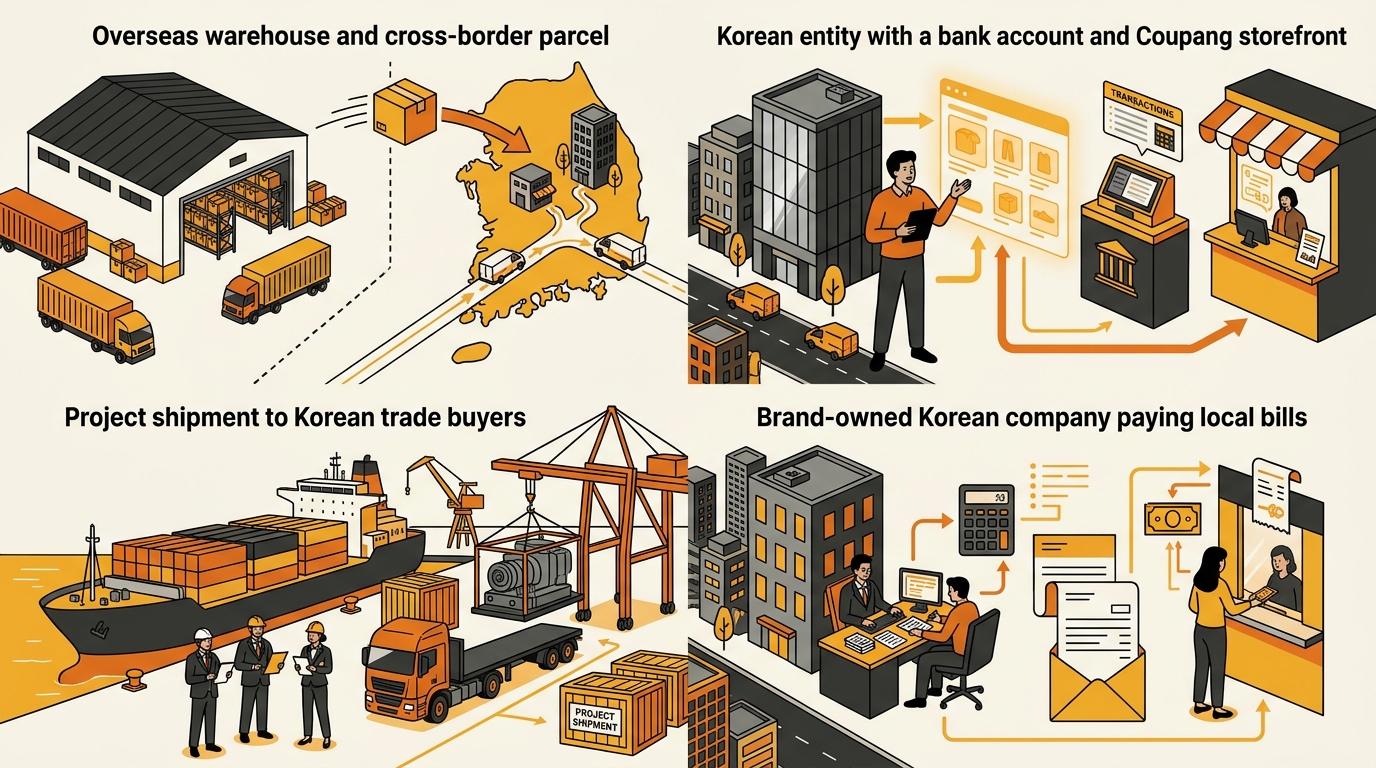
These bank documents do not replace separate product or page checks. See the explanation of KC certification and Coupang's Korean-entity question and the guide to localizing product pages for Korean e-commerce for those topics.

Ask the bank these questions before you send USD
Get clear answers from the corporate-banking team before sending money:
- Can this exact Korean corporate account receive USD from the proposed sender?
- Will the bank keep the money in USD, or convert it to KRW on arrival?
- What exact company name should the sender enter for the receiving company? Which SWIFT code (the bank's international routing code), intermediary-bank details, and payment reference should it use?
- Which document should explain the transfer's purpose: an invoice, written funding explanation, loan document, capital-contribution document, or settlement statement?
- Which incoming-wire, intermediary-bank, outgoing KRW, online-banking, account-maintenance, and currency-conversion fees apply?
- What transfer limits apply to this account, and when can the bank review or change them?
- Which wire notices, conversion receipts, invoices, and local payment confirmations should the finance team keep or send to the bookkeeper?
Use the answers to choose the account before sending money. The legal name on the account, wire, and purpose document should match the Korean entity receiving or spending the funds. If the sale is cross-border, confirm separately whether a Korean corporate account is needed.
Plan your Korea payment setup
Need to match a Korean bank account with your seller, importer, and local payment responsibilities? Contact Kontactic to discuss the setup.
About the author
Korean and global e-commerce operators with 15+ years of cross-border experience, led by CEO Isaac Lee — KOTRA-certified consultant and official lecturer for Seoul City and the Korea Customs Service. We run Korea market entry for overseas brands every day; this blog records what we learn in the field.
Meet the Kontactic team →Related Articles

What to List in Korean E-Commerce Incorporation Articles
What to list in Korean e-commerce articles of incorporation: online sales, importing, distribution, and fulfillment your company will actually perform.

Coupang Inbound: Three Checks Before Shipping
Before shipping stock for Coupang inbound, Kontactic Seller Center runs a SKU through three review stages and saves the result in English, Chinese, and Japanese.

Korean Dividend Withholding Tax for Foreign Parents: 22%
Korean dividend withholding tax is usually 22% for a foreign parent. Learn how treaty relief, company approval, tax documents, and bank checks affect payment.