
Korea Mail-Order Registration: Documents You Need
After Korean business registration, a company that sells online to Korean consumers normally needs a separate mail-order sales report (통신판매업 신고). Prepare the current Korean business registration certificate, the report application, and the filer’s ID. Add a purchase-safety service confirmation (구매안전서비스 이용확인증) when the payment setup uses online escrow. A business registration number alone is not the mail-order report.
Business registration identifies the company for tax administration. The mail-order sales report identifies the registered seller that takes online orders. Keep both documents in the same company file.
The document checklist after business registration
Use one core packet and one conditional packet. This keeps you from sending every document used during incorporation when the local office only needs proof of the company and its online selling setup.
-
Current Korean business registration certificate (사업자등록증). Use the latest certificate issued by the National Tax Service. Check the legal name, business registration number, main office address, and representative. These details should match the information on the mail-order application and the seller account. If the address or representative changed, correct the business registration first or ask the local office how to handle the mismatch.
-
Mail-order sales report application (통신판매업 신고서). This is the form for the second filing. English-language websites may call it an e-commerce, online sales, or digital marketing registration. The Korean filing is the mail-order sales report (통신판매업 신고). Prepare the company contact details and the online store or marketplace information that the form asks for. The exact fields can differ by filing channel.
-
Identification for the representative or person filing. Start with the representative’s ID for an in-person filing. If a foreign representative files, ask the office which identity document it accepts. A passport may not be enough if the company has a separate Korean identity document.
-
Purchase-safety service confirmation (구매안전서비스 이용확인증), if the payment setup uses online escrow. This document shows that the online payment setup uses a purchase-safety or escrow service. Marketplaces, payment providers, or banks may issue it. The company name on this confirmation should match the name on the business registration certificate. If they differ, correct the confirmation or application before filing.
-
Corporate registry and authority documents. Keep a recent corporate registry extract (법인등기사항증명서) available for a Korean company. The office may verify the company electronically, but a manual filing or correction request can still ask for a copy. If an employee or outside agent files, add a power of attorney (위임장) signed by the company representative and the agent’s identification.
-
Lease or sector permit documents only when the authority asks for them. For business registration, the National Tax Service’s business-registration document checklist lists an ID, an application, a lease, and any required permit or declaration. That is not a universal attachment list for the later mail-order report. Still, keep the lease and any product-sector permit ready if the registered address, business activity, or regulated category cannot be checked from the current company documents.
The application may ask for details instead of separate documents. Prepare the store URL, phone number, payment method, and online channel name. Write these details on one sheet before filing. The same spelling and phone number should appear across the application, the payment confirmation, and the marketplace account.

Why business registration does not finish online selling
The two filings serve different purposes. Korean business registration tells the tax authority that the company exists as a registered business. The mail-order sales report tells the local authority that this registered business takes orders through a distance-selling channel.
That is why a Korean company can have a valid business registration number and still be asked for its mail-order sales report certificate (통신판매업 신고증). One document does not replace the other. The company’s online sales and main office determine where you file, not the owner’s nationality.
Choose the local office from the company’s registered main office. Do not choose it only because a warehouse, fulfillment center, or foreign owner is located somewhere else. If the company moved, confirm which address must be updated before filing.
Before submitting, check the Korean business registration details against the prepared address and representative. After filing, handle tax, licensing, and import work separately. For those tasks, see what happens after a Korean entity is set up.
Who files, where it goes, and how long it takes
The company is the applicant. The foreign shareholder does not automatically have to appear in Korea just because the company is foreign-owned.
You normally have two practical ways to file:
- Online submission: Use the available Korean government filing channel, commonly Government24, when the company and the person submitting can use the required authentication. The exact online fields and attachment rules can change.
- In-person submission: Visit the city, county, or district office responsible for the company’s main office. Bring the application, current business registration certificate, identification, and any conditional documents shown by that office.
The representative can file personally. An authorized employee or agent can often file when the office accepts a power of attorney. The agent should carry their own ID and the signed authorization. Ask in advance whether the office wants the representative’s company seal, a corporate registry extract, a Korean translation, or another form of proof. Do not assume that a foreign-language authorization will be accepted without review.
For timing, plan on several business days rather than same-day issuance. Many local filing channels use a processing window of about three days for a complete ordinary application, but the responsible office controls the actual calendar. A missing purchase-safety confirmation, an address mismatch, or a correction request can extend the process.
For cost, separate three items:
- The public filing charge: The application may show no separate filing fee.
- Local registration license tax (면허세): A local tax can apply, and the amount depends on the registered address and current local tax schedule. Ask the filing office for the amount and whether it recurs under the current notice.
- Agent or preparation fees: Translation, a power of attorney, document handling, and filing support are private service costs. They are not the government charge.
There is no single national price that a foreign owner should use for every Korean address. Ask for the public tax, any filing fee, and any service fee as separate lines before approving a quote.

Choose local Korean sales or cross-border before you file
The filing depends partly on which entity takes the customer’s order. Decide this before you ask a payment provider for a purchase-safety confirmation.
Local sale through a Korean company means the Korean entity is the seller that operates the local online channel. If the Korean company takes local orders, include it in the filing. Its business registration details, mail-order report, seller account, settlement information, and consumer contact details should describe the same legal seller.
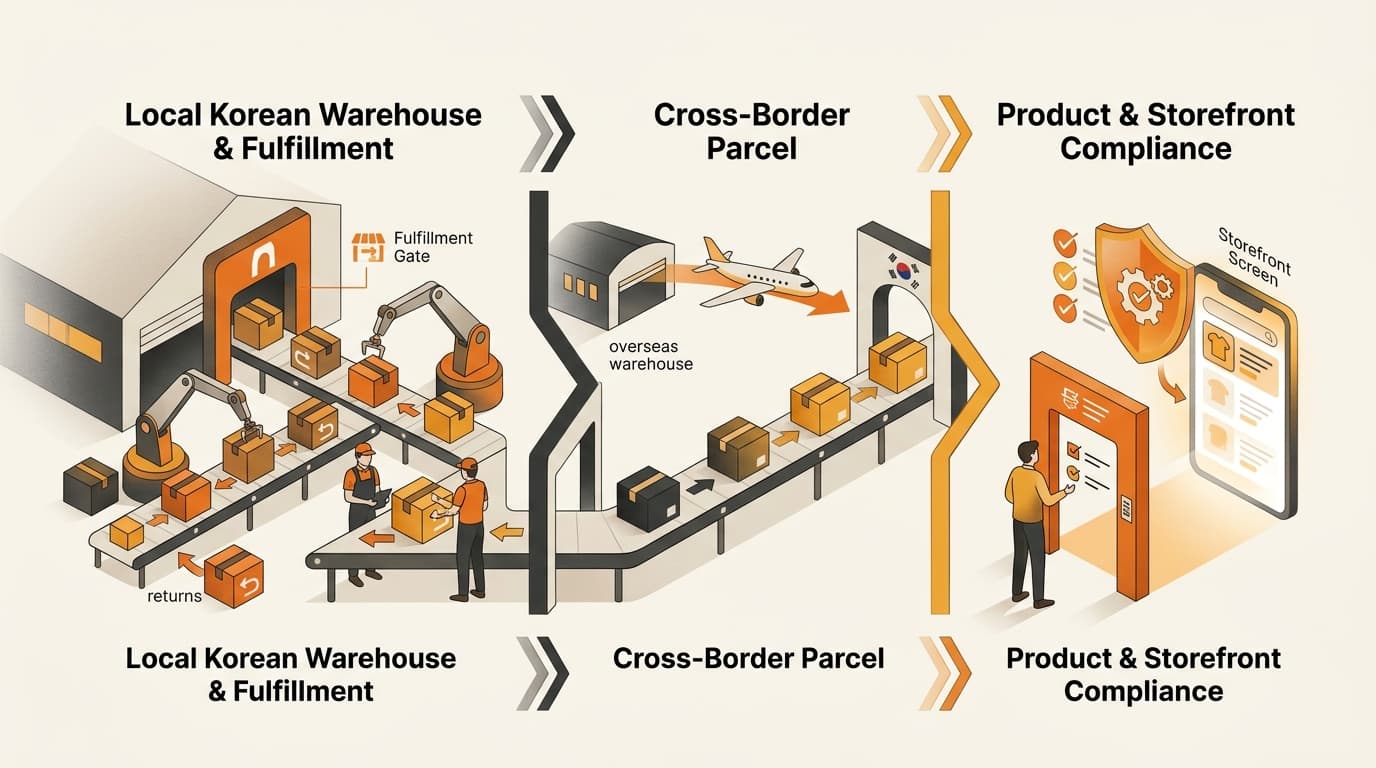
Cross-border sale through Coupang Global Fulfillment (CGF) is different. For a CGF order, the overseas brand is the cross-border seller and exporter on its Coupang seller account. Coupang stores stock outside Korea. It handles customs, delivery, returns, and Korean-language support.
If the overseas brand takes the CGF order, confirm with Coupang which entity it is setting up as the seller before you prepare the mail-order report. Do not mix a local Korean company filing and a cross-border account in one checklist. The complete guide to selling on Coupang as a foreign brand explains the difference between the local-entity and cross-border paths.
What the mail-order report does not approve
The mail-order report does not replace product-specific approvals, Korean labels, or marketplace onboarding documents. For separate questions, use these guides: See why foreign CE, FCC, and UL documents cannot simply replace Korean KC, This guide to Korean-language labeling, and Rocket Growth outbound and return locations.
Before filing, match the company name, number, address, and representative across the application and supporting documents. Save the issued report with the business registration certificate.
Need to prepare the Korea filing packet?
Contact Kontactic to discuss the Korean entity details, mail-order report checklist, and the local or cross-border selling path that fits your operation.
About the author
Korean and global e-commerce operators with 15+ years of cross-border experience, led by CEO Isaac Lee — KOTRA-certified consultant and official lecturer for Seoul City and the Korea Customs Service. We run Korea market entry for overseas brands every day; this blog records what we learn in the field.
Meet the Kontactic team →Related Articles

Can I Upload Korean Registration Paperwork as One PDF?
Upload Korean registration paperwork as one PDF: Seller Center separates pages, matches review items, and keeps the tax payment confirmation with the packet.

Yuhan-Hoesa Documents: Notary, Apostille or Translation?
Not every foreign document needs all three. Learn when a Korean yuhan-hoesa filing may need notarization, an apostille or legalization, and Korean translation.

Can I Upload Coupang Labels for Several Variants?
Yes. Coupang inbound groups can accept variant label files in one upload. During correction, Seller Center refreshes the list so newly eligible variants join.