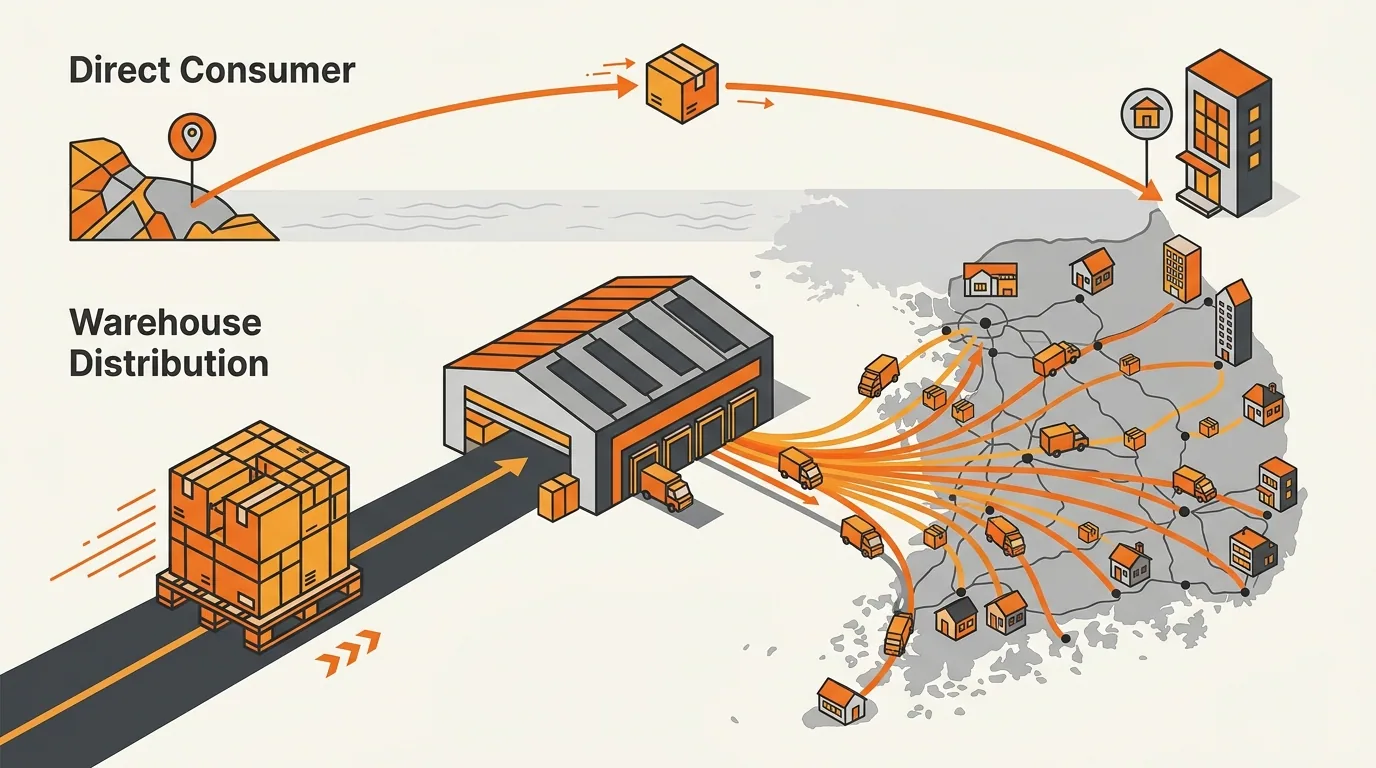
Local vs Cross-Border Korea Fulfillment: Cost Math
For a foreign brand with proven Korean demand, local fulfillment is usually cheaper per delivered unit than continuing to ship cross-border — but only after you absorb a stack of fixed costs that have nothing to do with freight: Importer of Record (IoR), KC certification, Coupang setup, Rocket Growth fulfillment fees, and a Korean-language returns operation. The right question isn't "which shipping label is cheaper." It's "at what monthly order volume does the local stack pay for itself, and what does your margin look like on the other side?"
This article walks through the real cost drivers, the operational responsibilities you inherit when you localize, and the volume threshold where the math typically flips.
What the search is really asking
The literal query — is it cheaper to fulfill Korea orders locally or keep shipping internationally — comes up most often when a brand has been quietly accumulating Korean customers through its Shopify store, Amazon Global, or a forwarder, and the per-order shipping bills no longer look small.
In our experience, that founder isn't shopping for a courier. They've already done that. They're trying to decide whether to commit to Korea as a market — register an entity or use a partner's, get KC certified where required, list on Coupang, hold inventory in-country, and start running a Korean-language storefront. The shipping question is a proxy for the localization question.
If you've never mapped your cross-border volume against a local model, cross-border orders almost always understate the actual Korean opportunity, because the friction of paying overseas in USD with 10–14 day delivery suppresses demand on Coupang-trained consumers.

Cross-border: what's actually in your unit cost
Cross-border looks cheap on a spreadsheet because each shipment is variable and there are no fixed local costs. In practice, the unit economics are punishing once volume is real:
- International courier fees. DHL/FedEx/EMS rates for a single small parcel to Korea typically run several times what domestic Korean delivery costs.
- Duties and import VAT paid by the customer. Korean de minimis thresholds are low and inconsistent across categories. Buyers regularly get hit with surprise customs invoices on arrival.
- Cart abandonment from price shock and lead time. Korean consumers compare to next-day Coupang delivery. A 10-day promise with a USD checkout converts at a fraction of the rate a local listing does.
- No platform presence. You are not on Coupang search, not eligible for Rocket badges, and not earning the trust signals Korean shoppers look for.
Cross-border is the right model for testing demand and for low-volume categories where compliance costs would never amortize. It is not a steady-state operating model for a brand doing 100+ Korean orders a month.
Local fulfillment: the four costs the SERP never explains
Top results on this query are written for individual shoppers comparing couriers. They don't describe what a brand actually inherits when it switches to local fulfillment. Four cost categories matter.
1. Importer of Record and customs responsibility
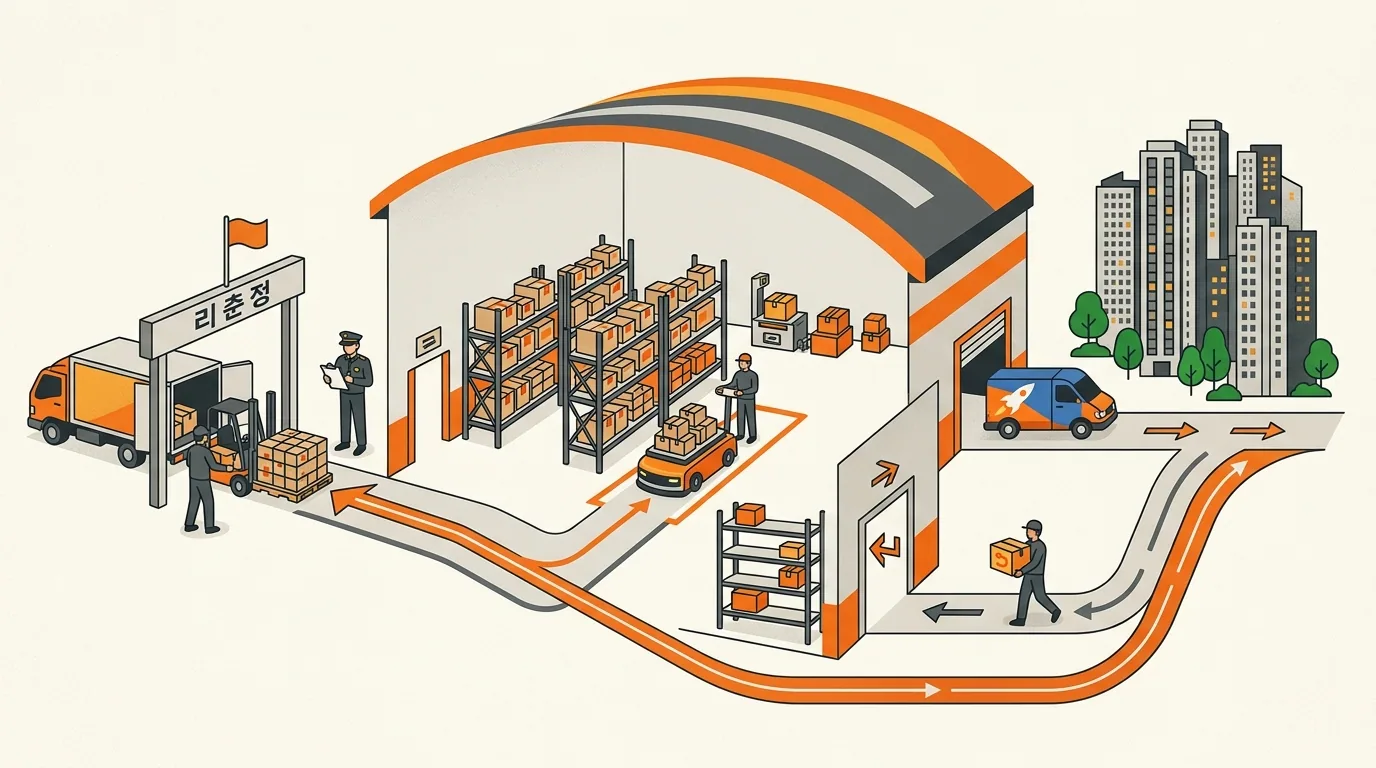
When goods clear Korean customs, someone has to be the legal importer — the entity that files the import declaration, pays duties and 10% import VAT, and answers to Korea Customs Service for product compliance. That entity is the Importer of Record.
You have two options:
- Use your own Korean entity (a 유한회사, limited company) as IoR. Gives you full control and recoverable input VAT, but you carry entity formation, banking, and tax filings yourself.
- Use a partner's entity as IoR. Faster — typically 8–12 weeks to first sale — but the partner's entity is the legal seller and recipient of Coupang settlements, which then flow to you net of fees.
The IoR also bears the customs risk if a shipment is held, mislabeled, or fails a category check. This is not a clerical role.
2. Coupang setup and seller onboarding
Coupang is the channel where local fulfillment pays back. Onboarding is not a self-serve sign-up for foreign brands:
- A Korean business registration number is required to open a seller account. Without an entity (your own or a partner's), you cannot list.
- KYC has tightened. Coupang now verifies the seller entity's bank account, tax registration, and beneficial ownership before activating Rocket Growth eligibility.
- Listings must be in Korean — title, bullets, spec table, and ideally a full Product Detail Page (PDP) optimized for the ~20,000px vertical format Korean shoppers expect.
- Settlement runs on Coupang's calendar, not yours. The default is the 20th business day of the following month, which means your first sale doesn't fund inventory replenishment for close to 60 days.
A founder evaluating this transition often underestimates the cash-flow gap between landing inventory and receiving the first settlement.
3. KC certification and product compliance
KC 인증 is Korea's category-specific safety certification regime. Whether you need it depends on your HS code and use case, not your country of origin.
Common triggers we see:
- Anything with a battery, wireless module, or AC power — KC electrical safety and EMC.
- Children's products, food-contact items, cosmetics with functional claims — separate regimes (KC for kids' goods, MFDS for cosmetics and food).
- Pet food, supplements, and certain household chemicals — APQA or MFDS registration on top of customs.
Certification has a real cost and a real timeline. It is usually the single largest fixed cost in the localization decision, and skipping it isn't an option — uncertified goods get held at customs. KC certification and Coupang interact in ways that aren't obvious from the outside; Coupang will require your KC certificate number on the listing for relevant categories.
4. Rocket Growth fulfillment and returns
If you're going local, Rocket Growth (로켓그로스) is almost always the right fulfillment layer. It puts your inventory inside Coupang's network, qualifies your listings for the Rocket badge, and gives you next-day delivery without operating a warehouse.
But Rocket Growth is not free, and three Coupang policy changes in 2025 made the returns side noticeably more expensive:
- Return handling fees are now itemized and harder to dispute.
- A KRW 50,000 evidence threshold shifted the burden of proof on damaged-on-arrival claims.
- The CVR (쿠팡확인요청) process gives Coupang final say on contested returns.
In practice, you should model Rocket Growth fulfillment + storage + returns at a meaningfully higher cost than equivalent US/EU 3PL benchmarks. The trade is that you get the conversion rate that comes with the Rocket badge — which is what makes the localization decision work.
The volume threshold where the math flips
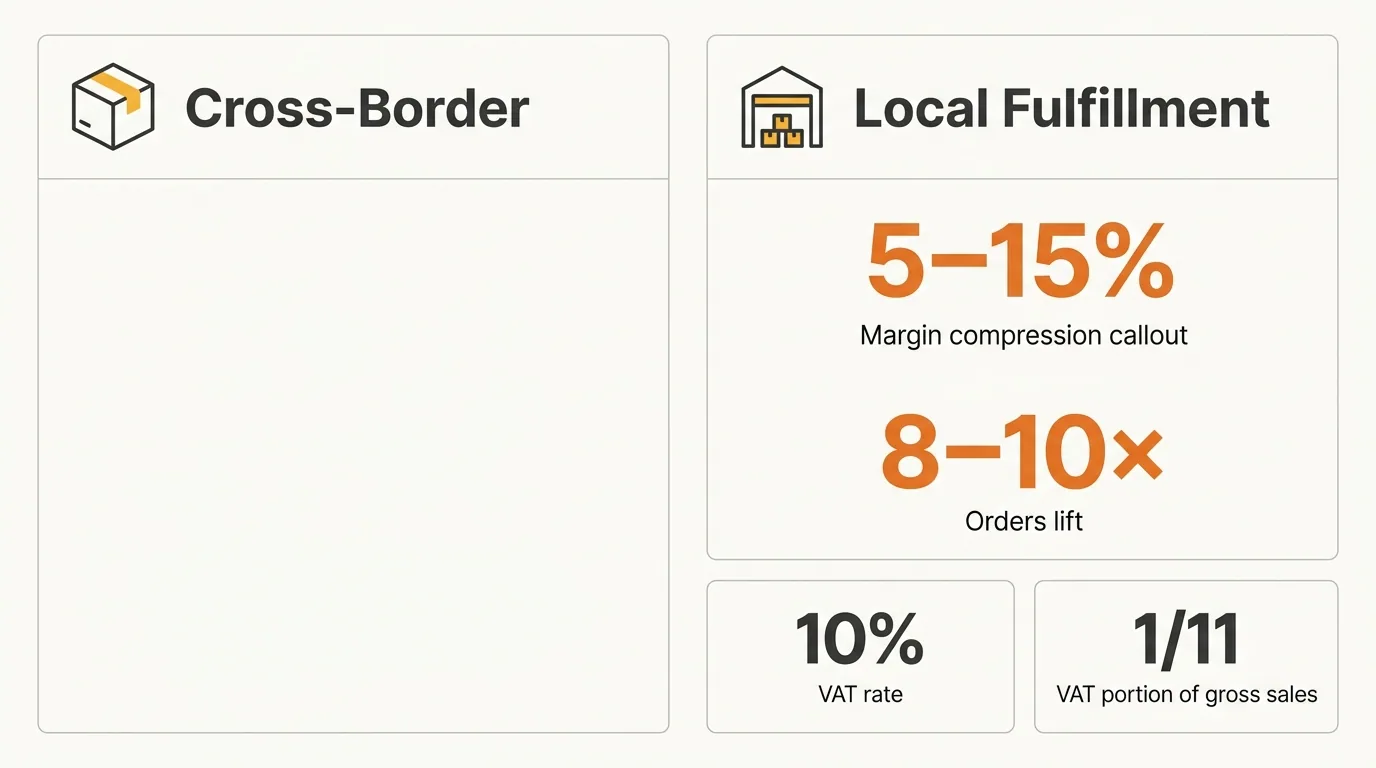
We've written before that switching to Coupang local fulfillment via IoR and Rocket Growth typically compresses per-unit margin by 5–15% but lifts orders 8–10×. That's the headline trade.
The intuition is straightforward. Cross-border has wide unit margins (you charge the customer for international shipping and duties) but tiny volume. Local fulfillment has thinner unit margins (Coupang commission, Rocket Growth fees, ~10% VAT, ad spend) but Korean consumers actually buy.
A few rules of thumb we use when scoping:
- Under ~50 cross-border orders per month: stay cross-border. The fixed costs of localization (KC, entity or IoR retainer, PDP production, initial inventory) won't amortize.
- 50–100 orders per month and growing: start scoping KC and Coupang in parallel. Localization is a 4–7 month project; you want to be ready when volume justifies it.
- 100+ orders per month with positive trajectory: localization is almost always the cheaper per-unit model within the first 6–12 months of local operation, and substantially cheaper after that.
These are starting points, not promises. Categories with high KC burden (consumer electronics, kids' goods) push the threshold up. Categories with already-portable compliance (some cosmetics, accessories) push it down.
"Cheaper" only means something at a volume. Cross-border is cheaper per unit at 5 orders a month. Local is cheaper per unit at 500. The localization decision is really a bet that you can move from the first number to the second within 12 months.
VAT is part of the price, not a surcharge
One number that consistently surprises foreign founders: Korean VAT is 10%, and on Coupang it is inclusive in the displayed price. You don't add it at checkout. From the gross revenue Coupang reports, the VAT portion is 1/11 (approximately 9.09%) and is owed to the Korean tax authority.
This matters for the cross-border vs. local comparison because in cross-border, your customer pays import VAT at the border, sometimes by surprise. In local, you've already priced it in. The customer experience is cleaner, but your headline price-per-unit will look ~9% lower than the cross-border equivalent unless you reprice for the local market.
A practical decision framework
The honest answer to the search query depends on three variables, in this order:
- Where is your monthly Korean order volume today, and what is its trajectory? Static demand below ~50 orders/month rarely justifies localization. Growing demand above 100/month almost always does.
- What's your category's compliance burden? KC, MFDS, APQA — these set the floor on the fixed cost of localization. A non-regulated apparel item is a different conversation than a battery-powered grooming device.
- What's your tolerance for the operational tail? Coupang seller management, Korean-language customer service, returns disputes, and monthly settlement reconciliation are real ongoing work — either you build it, or a Korean operating partner runs it for you.
If you answer those honestly and the answers are "100+ and growing, manageable compliance, willing to outsource operations," local fulfillment is almost certainly cheaper for you per delivered unit, and the gap widens with every month of volume.
What this looks like in real numbers
We avoid publishing single-figure cost tables because they mislead more than they help — KC scope, freight terms, and product weight bands move the answer significantly. But the shape of the comparison is consistent:
- Cross-border landed cost per order is dominated by international courier fees and customer-paid duties.
- Local landed cost per order is dominated by Coupang commission, Rocket Growth fulfillment, returns reserve, and amortized KC + setup costs.
- Once monthly volume is steady at three figures, the local landed cost per order is typically a fraction of the cross-border equivalent, even before the 8–10× order lift kicks in.
The cheap-shipping-from-Amazon hacks that fill the top of the SERP for this query don't apply to a brand. They apply to an individual shopper buying one item. For a brand with real demand, the cheaper model is the one that can actually scale.
Scope your Korea fulfillment switch
If you're at the volume where cross-border is starting to feel expensive, we can model your specific KC, Coupang, and Rocket Growth economics against your current shipping bill. Get in touch to walk through it.
About the author
Korean and global e-commerce operators with 15+ years of cross-border experience, led by CEO Isaac Lee — KOTRA-certified consultant and official lecturer for Seoul City and the Korea Customs Service. We run Korea market entry for Western brands every day; this blog documents what we learn in the field.
More about Kontactic →Related Articles
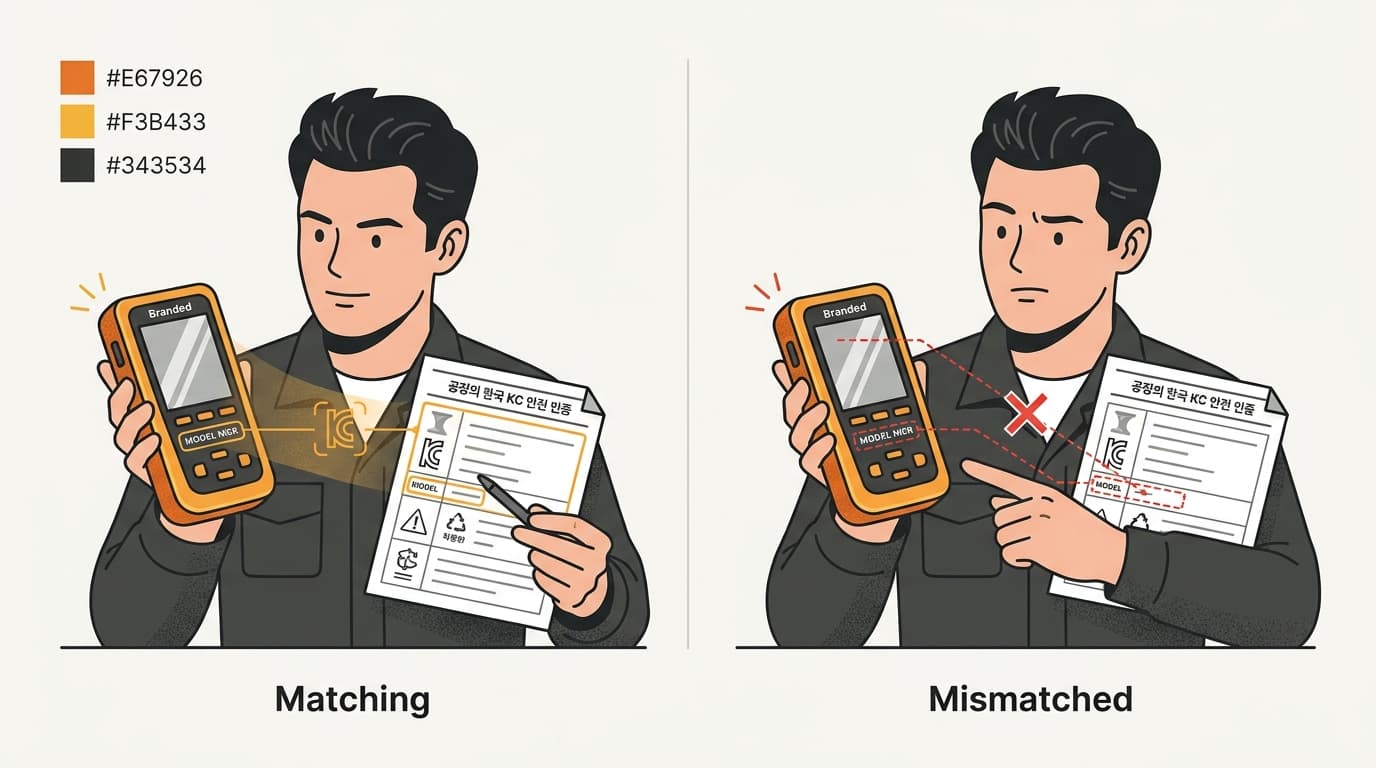
Can a Factory's KC Certificate Cover Your Brand?
Factory KC paperwork covers your private-label product only when the approved model, factory, and version match. Wireless products need a separate RRA check.
Can You Reject a Coupang Exchange? Only Two Reasons
Coupang exchange rejection is limited to SOLDOUT or WITHDRAW. Learn when each code applies—and what to do when a seller simply prefers a refund instead.
Coupang Order Lines: One Line Is Not One Unit
A Coupang order line can represent a generated quantity option, so your connector must map it to a base SKU and physical quantity before stock movement.