
Three Coupang Policy Changes That Reset Rocket Growth Margins
Three Coupang policy changes in 2025 — Rocket Growth (로켓그로스) return collection and restocking fees, a lowered evidence-required threshold, and the Coupang Verification Request (쿠팡확인요청, CVR) burden-of-proof process — have quietly reset the unit economics of selling on Rocket Growth. The headline math hasn't moved much. The work needed to defend that math has.
This post is for operators who already believe Coupang is their channel. We are not relitigating whether to be on Rocket Growth. We are looking at what the 2025 policy stack does to your real margin once disputes, returns, and CVR responses are priced into COGS.
The 2025 policy stack, in order
Three changes landed inside a single year. None of them was framed as a margin event. Together they are.
January 2025 — Return collection and restocking fees. Coupang began charging Rocket Growth sellers for return collection and restocking. Previously, "free returns" sat largely on Coupang's side of the ledger for Rocket Growth SKUs. As of January, those costs flow back to the seller per return event, layered on top of the existing Rocket Growth fee schedule.
July 30, 2025 — Evidence threshold lowered. Coupang dropped the evidence-required threshold from KRW 100,000 to KRW 50,000 for inbound discrepancy and CVR-eligible cases. In practice this means roughly twice as many disputes per month now sit above the line where the seller must produce proof to recover anything.
The CVR (쿠팡확인요청) process itself. CVR is the formal channel a seller uses to claim Coupang-fault — for inbound quantity discrepancies, customer-fault returns mislabeled as defective, or transit damage attributable to the platform. The structural fact about CVR is that the burden of proof sits with the seller. Photos and video are not "nice to have." They are the case file. No file, no recovery.
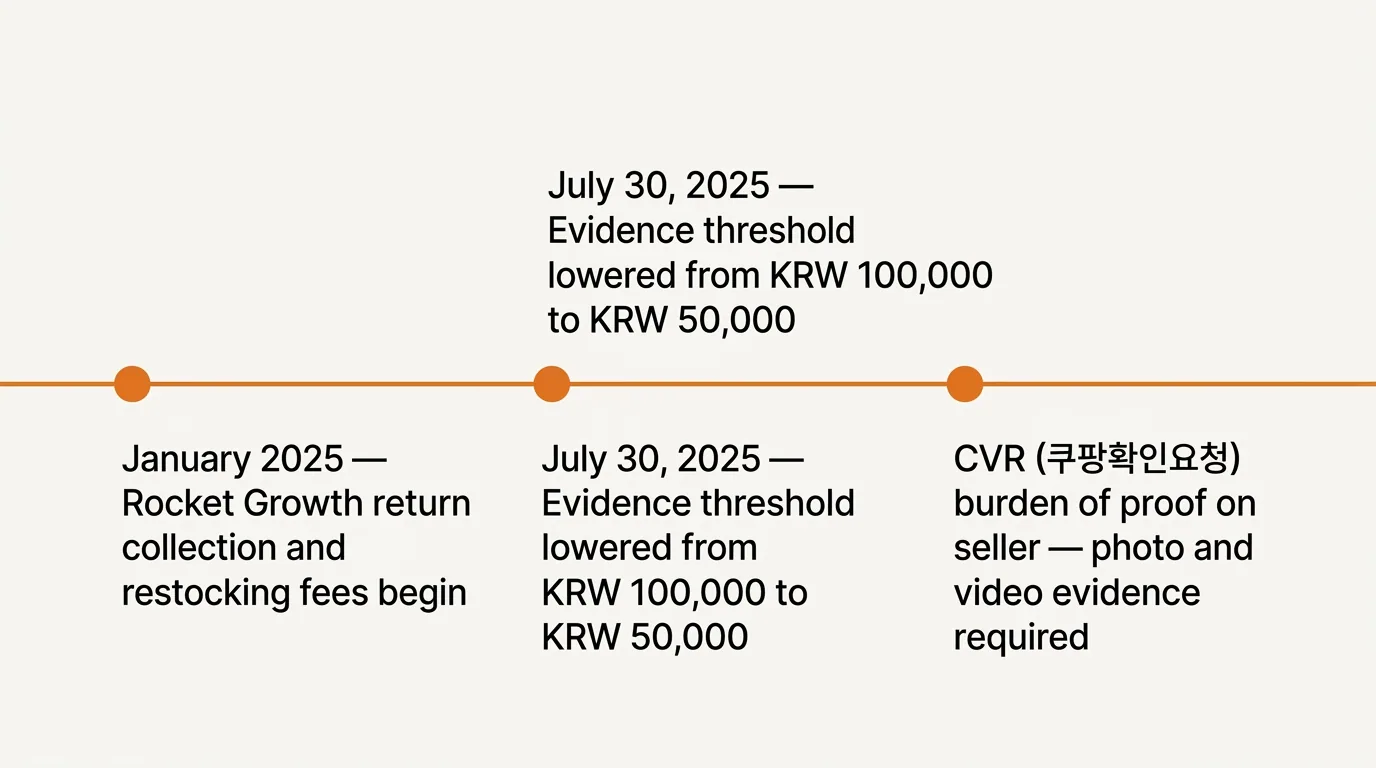
Stacked together, the effect is asymmetric. The cost of small return events went up. The threshold for needing evidence went down. The mechanism for recovering Coupang-fault losses requires structured proof the seller has to produce in a hurry. Each change in isolation is digestible. Compounded across a year of orders, the trio meaningfully changes per-unit profitability for sellers who weren't already running tight inbound and CS documentation.
CVR (쿠팡확인요청, Coupang Verification Request) is Coupang's formal seller dispute channel for inbound quantity discrepancies, customer-fault returns, and transit damage. The seller initiates the claim and bears the burden of proof — typically photo and video evidence captured at origin and at the receiving dock.
What hasn't changed: the headline switch math
The directional case for switching from cross-border to local Rocket Growth still holds. Per-unit margin typically compresses by a single-digit to low-double-digit percentage when you take on Korean platform fees, Rocket Growth handling, and local VAT — and order volume typically multiplies several times because of Rocket badge eligibility, KRW pricing, and same-day or next-day delivery. We've written the underlying math elsewhere in how Coupang IoR and Rocket Growth change your Korea margins and in our broader Rocket Growth versus cross-border decision framework.
What has changed is the variance around that headline. Pre-2025, the bad-month scenario was an inventory write-down or a slow-moving SKU. Post-2025, the bad-month scenario also includes a stack of contested returns, an inbound quantity dispute on a full container, and a CVR queue that can quietly leak several percentage points of revenue if nobody is responding inside 24 hours.
Documentation operations is now a unit-economics line
The practical consequence is unglamorous. Documentation operations — the discipline of producing, storing, and retrieving evidence on a known SLA — is now a COGS line. Not a CX line, not an ops-quality nice-to-have. A direct deduction from per-unit contribution if you don't fund it.
Three common dispute categories make this concrete:
- Inbound quantity disputes. Seller ships 100 units. Coupang's receipt log records 98. With no pre-shipment count video and no inbound dock footage at the Korean 3PL, the missing two units are written off. At low ASP this is noise. At KRW 80,000 ASP across thousands of inbound units a year, it is not.
- "Box damage" return claims on high-AOV items. A customer returns a high-value SKU citing box or product damage. Without origin packing video and inbound condition photos, the seller cannot challenge the return classification, and post-January 2025 they also pay return collection and restocking on top of the lost sale.
- Rocket Growth competitive abuse. Competitors mass-purchase a seller's SKU and return units en masse as "defective." The listing can go offline for inspection for weeks, return-related fees accrue, and the seller has no defense unless the inbound condition of those units is independently documented.
None of these are new in spirit. All of them are more expensive in 2025 than they were in 2024.
How Coupang's reimbursement matrix actually pays out
Coupang's reimbursement framework for damaged or lost units is tiered by item status — typically unopened, top, good, mid, and unsellable — and rates differ by fault attribution: customer-fault, seller-fault, or Coupang-fault. The matrix is not the problem. The problem is that fault attribution defaults toward the seller in the absence of evidence.
In practice this means two SKUs with identical damage rates can post very different recovery percentages depending only on whether the seller's local operator is producing CVR-grade evidence packages. The matrix rewards the operator who can prove "unopened, Coupang-fault" and punishes the operator who can only assert it.
This is also why competitive abuse hurts disproportionately. Even if Coupang ultimately attributes some portion of a mass-return event correctly, the listing downtime during inspection, plus the return collection and restocking fees that accrued in the meantime, are not made whole. The seller's defense is procedural — producing inbound and packaging evidence fast enough that abuse cases don't reach the inspection stage in the first place.
Where inbound discrepancies actually come from
Most inbound quantity disputes are not Coupang receipt errors. They trace back to master data hygiene on the seller's side, before the truck rolls.
The recurring failure modes:
- Units-per-carton drift. Supplier changes inner-pack count from 24 to 20 without updating the SKU master. The Korean 3PL receives the truck against the old config and the receipt log books the old number.
- Carton-per-pallet config changes. A new pallet pattern looks identical from outside, but holds fewer cartons. Without a refreshed packing spec, dock-side counting starts from a wrong assumption.
- Supplier-side communication gaps. Lot or batch labeling changes upstream that the local operator only learns about when the goods arrive. By that point, anything the receiving dock flags is the seller's problem to prove against.
If your inbound paperwork — units per carton, cartons per pallet, dimensions, weight, lot/batch — isn't standardized between the supplier, the freight forwarder, the Korean 3PL, and the Coupang inbound flow, you will lose CVR cases you should have won. This is also where consolidation services interact with the picture: brands using Coupang's Direct LCL service from China still need their own master data discipline at the supplier, because the consolidation step does not normalize what was wrongly labeled at origin.
Four concrete defenses, in order
The point of the defenses below is not to win every CVR case. It is to make disputing a disciplined seller unprofitable for bad actors and to be ready when CVR is triggered for legitimate reasons. Sequence matters; each step assumes the prior one is in place.
1. Pre-shipment carton and pallet count video at origin
Before the truck leaves the supplier, capture a continuous video showing carton count, pallet build, and shrink-wrap close-out. Stamp the file with a date and PO reference. This single artifact resolves the majority of "you shipped 100, we received 98" arguments before they reach CVR.
2. Inbound dock video and photo log at the Korean 3PL
When goods arrive at the partner 3PL receiving the inbound for Coupang, repeat the documentation on the receiving side: arrival condition of pallets, breakdown sequence, carton counts, exception photos for any damage. This bracket — origin video plus dock video — is what lets you assert Coupang-fault credibly when the receipt log diverges from your shipping manifest.
3. Standardized master data exchange with the supplier
Build a one-page spec exchanged with every supplier and refreshed every shipment: units per inner pack, units per carton, cartons per pallet, pallet dimensions and weight, lot or batch numbering scheme, and labeling location on the carton. This is unglamorous and it prevents the most expensive class of disputes — the ones that root-cause to your own paperwork drift, not to Coupang.
4. A CVR response SLA the local operator commits to
Pick a number — for many operations it is 24 to 48 hours from dispute notification to compiled evidence package — and write it down. The operator who responds to CVR cases on a known SLA recovers materially more than the one who batches them weekly. This is also where local Korean-language CS capacity matters; CVR is not a process you run from a different time zone in English.

What this means for 2026 unit-economics modeling
If you are modeling Rocket Growth for next year, two adjustments belong in the spreadsheet that may not have been there for 2024:
- A return-cost line per order, not per return event. Apply your category's expected return rate against the post-January 2025 collection and restocking fee structure, and carry it as a per-order deduction. For high-AOV apparel, beauty, and electronics, this is no longer a rounding error.
- A documentation operations cost line. Whether you build it in-house or assign it to a local operator, someone is producing origin video, dock photos, and CVR evidence packages on an SLA. Price that capacity. Then price the recovery it generates against the dispute volume your category sees, and you'll have a real net number rather than a hopeful one.
For the broader question of which costs sit on which side of the relationship under different operating models, our breakdown of who pays for what in Korea operating costs lays out the funding flows. And if you are still calibrating cash-flow timing into all of this, Coupang settlement timelines are the other variable that turns dispute volume into a working-capital problem rather than just a margin problem.
Common questions
Does CVR apply to cross-border (Rocket Direct) listings the same way? No. The CVR process and the 2025 fee changes discussed here apply to Rocket Growth (로켓그로스) — the model where the seller has imported into Korea and is using Coupang's 3PL. Cross-border models have different dispute mechanics and different fee exposure.
Is the KRW 50,000 threshold a hard cutoff? It is the threshold above which the seller is generally expected to produce evidence to support a CVR claim. Below it, treatment is more streamlined. The practical effect of the July 30, 2025 change is that more case volume now sits in the "evidence required" bucket than before.
Can a foreign seller respond to CVR cases directly? Technically the seller account holder can. In practice, CVR is a Korean-language, fast-turnaround process with platform-specific evidence formatting. Foreign brands without local Korean operations capacity tend to under-recover, which is a different kind of margin leak than competitive abuse but lands in the same place. This is also related to the broader pattern in how Coupang item matching can trigger trademark complaints — many platform-side processes assume a local respondent.
Are the 2025 changes likely to keep moving in the same direction? We don't speculate on Coupang policy roadmap. The honest read is that the platform holds platform-side power and has been steadily transferring more friction to the seller side over the last 18 months. Building a documentation operation that is policy-direction-agnostic is more useful than betting on the next change going your way.
Talk to Kontactic about Rocket Growth margin protection
If you are modeling 2026 Rocket Growth unit economics or rebuilding your CVR response process after a bad quarter, we can walk through what a CVR-ready inbound and CS operation actually looks like in practice.
About the author
Korean and global e-commerce operators with 15+ years of cross-border experience, led by CEO Isaac Lee — KOTRA-certified consultant and official lecturer for Seoul City and the Korea Customs Service. We run Korea market entry for Western brands every day; this blog documents what we learn in the field.
More about Kontactic →Related Articles
Can Coupang Handle Every Korean Buyer Inquiry? No—Seller Duties
Coupang may handle platform and fulfillment contacts, but sellers still own product questions, cancellations, returns, exchanges, and order exceptions.

Rocket Growth: Why Outbound and Return Locations Matter?
Rocket Growth stores and ships inventory, but sellers still need outbound and return records before product registration; each has a distinct seller-side role.
Korean HS Code: Can You Reuse US/EU HS Codes? Not Always
A US or EU HS code is a useful starting point, not a portable Korean classification. Learn how Korea’s HSK affects duty, FTA treatment, and import controls.