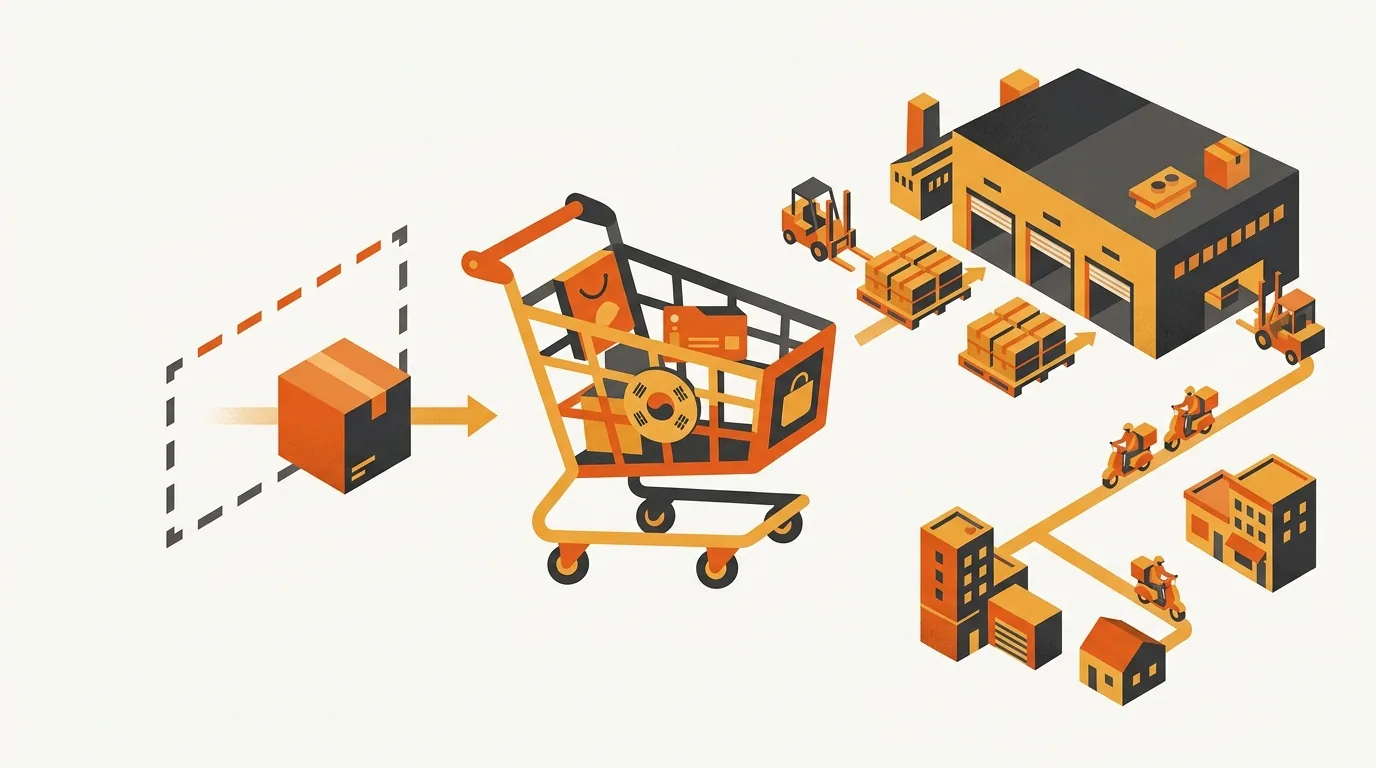
How Coupang IoR and 3PL Change Your Korea Margins
Switching to Coupang local fulfillment typically lowers per-unit margin by 5–15% — VAT, Coupang commission, and 3PL fees all appear on the cost stack. It also typically lifts top-line orders 8–10×, because delivery speed, returns, and Korean-language presentation stop being the bottleneck. The overall economics get stronger, not weaker.
Here's exactly what moves on the margin line, and when the trade is worth making.
What the two models actually look like
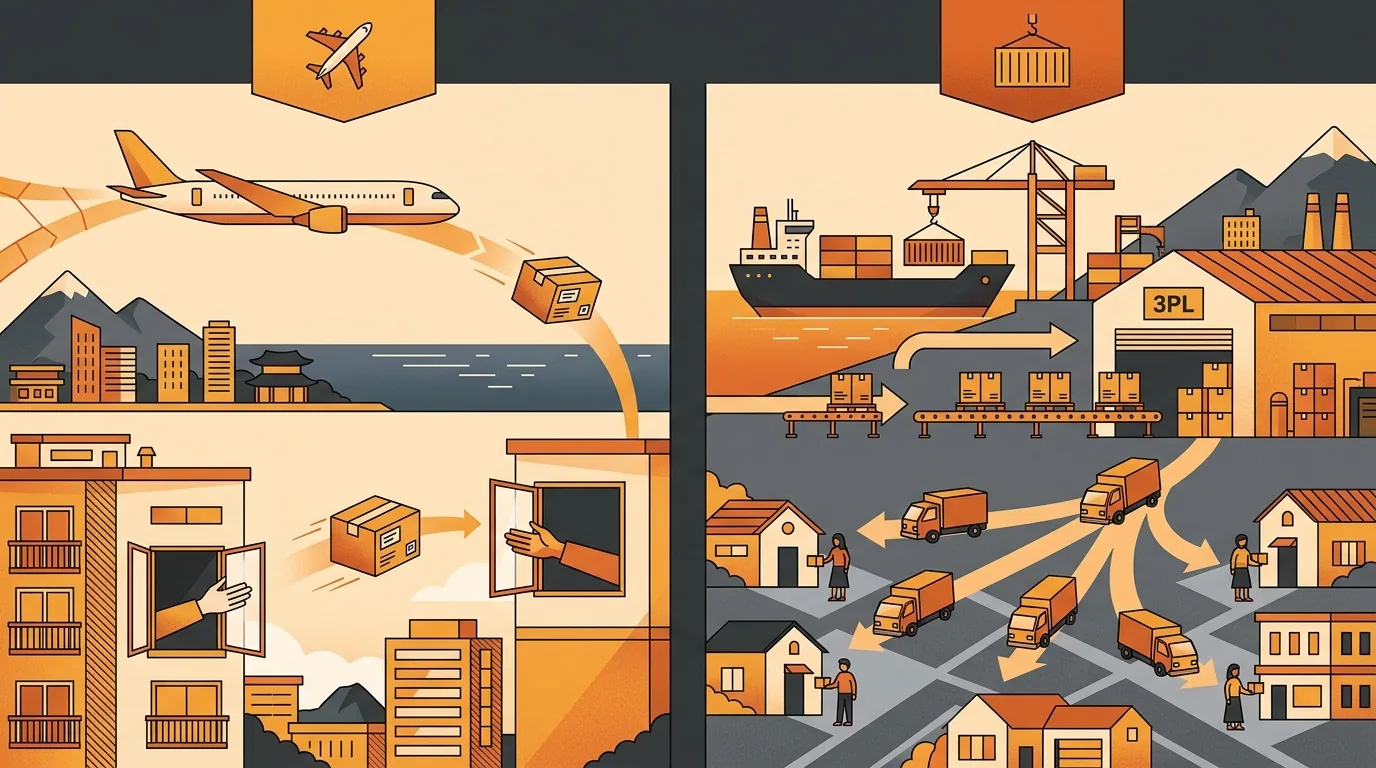
Cross-border direct shipping means a Korean consumer orders from your US or EU storefront, you ship a single parcel by international courier, and the buyer is the importer on the customs declaration. Below Korea's de minimis threshold the buyer often pays no duties or VAT on the parcel; above it, they get hit with both, plus a brokerage fee. You keep your home-market margin minus international shipping, payment processing, and the occasional refused parcel.
Selling locally on Coupang via IoR + 3PL is structurally different. You ship bulk inventory DDP (Delivered Duty Paid) into Korea. A Korean entity — either yours or a partner's, like ours under Spark Subscription (for Coupang-approved sellers in mainland China) — clears customs as the Importer of Record, becomes the Seller of Record on Coupang, and uses Rocket Growth (로켓그로스) to fulfill orders within Korea. Your unit economics now include Korean VAT, Coupang's commission, and warehouse fees, but your conversion rate, average order value, and order volume tend to be materially higher.
Where margin actually moves
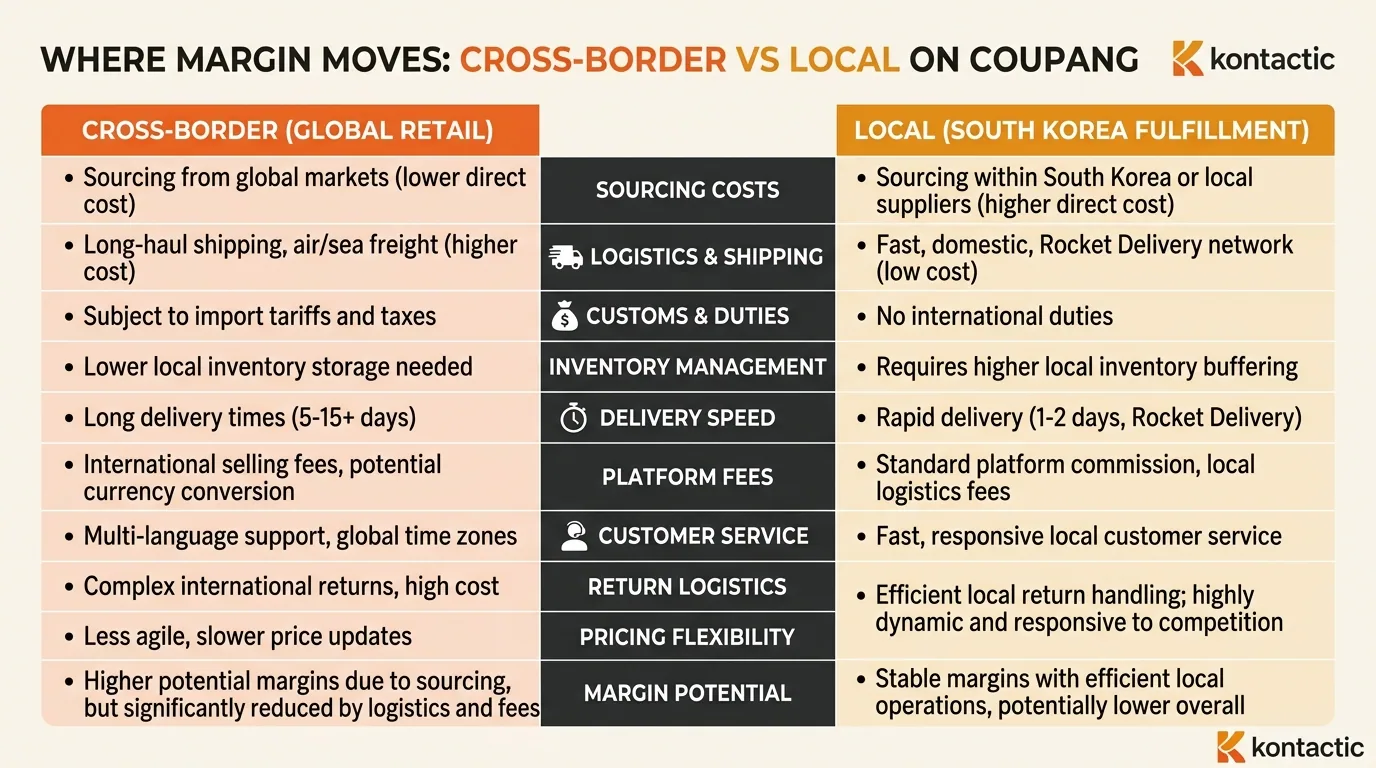
When founders ask "what's the margin impact?" they usually mean: which line items appear, disappear, or change size between the two models.
Korea VAT (부가가치세). Korea applies a 10% VAT on goods sold domestically.
Import duties. Cross-border, duties are levied per parcel, often paid by the buyer, and frequently a friction point that kills repeat purchase. Locally, duties are paid once on the bulk DDP shipment. Rates depend on the HS code and any free trade agreement coverage (the Korea–US FTA and the Korea–EU FTA reduce many lines to zero, but not all). In practice, predictable bulk duty is much easier to price into margin than parcel-by-parcel surprises.
Coupang Platform Fees. This line doesn't exist in the cross-border model. On Coupang, the platform deducts a selling commission from sales proceeds. The exact rate depends on category. This is a real cost that has to be modeled into your wholesale-to-retail spread.
Other Platform Expenses (Rocket Growth fees). Rocket Growth charges for storage, fulfillment/delivery handling, returns handling, and other operating fees. These vary by SKU dimensions and turnover. They replace the international parcel cost you were paying per cross-border order — and per unit, they are almost always lower.
Returns. Cross-border returns are a quiet margin killer: many brands either refuse returns or eat the international return shipping. Korean consumers expect easy domestic returns. On Coupang, returns are handled within the country and charged as a per-case fee. Higher return rates hurt, but you stop losing customers who try once and never come back because the return was painful.
Coupang setup and seller onboarding (the part most articles skip)
You can't just "list on Coupang" from a foreign address with a foreign card. Coupang's seller registration requires a Korean business registration number (사업자등록번호), a Korean bank account for settlement, and KYC documentation tied to a Korean entity.
For local sales, foreign brands have two paths:
- Use a partner's entity. The partner's Korean entity is the importer and seller and holds the seller account. At Kontactic this is Spark Subscription, for Coupang-approved sellers in mainland China: you run your listings in a dedicated seller account held by our entity, and we handle import, VAT, settlement, and Korean-language phone CS.
- Stand up your own Korean entity (유한회사) and your own Coupang seller account. This is the Blaze path. You get full account control, but you also own the entity formation, banking, tax filings, and ongoing KYC — with Kontactic running the day-to-day as your operating agent if you choose.
If you would rather stay cross-border but still sell on Coupang, Coupang's cross-border program, Coupang Global Fulfillment (CGF), lets you sell from your own cross-border seller account; Kontactic runs that store through Direct for brands shipping from the US, Europe, Japan, mainland China or Hong Kong.
Neither is "better" in the abstract. The question is whether you have enough Korean revenue confidence to justify the entity overhead, and whether you want operational control or operational delegation. We've written more on this trade-off in our decision framework for Rocket Growth vs. cross-border selling.
Operational and service costs
Rocket Growth, fulfillment, and returns
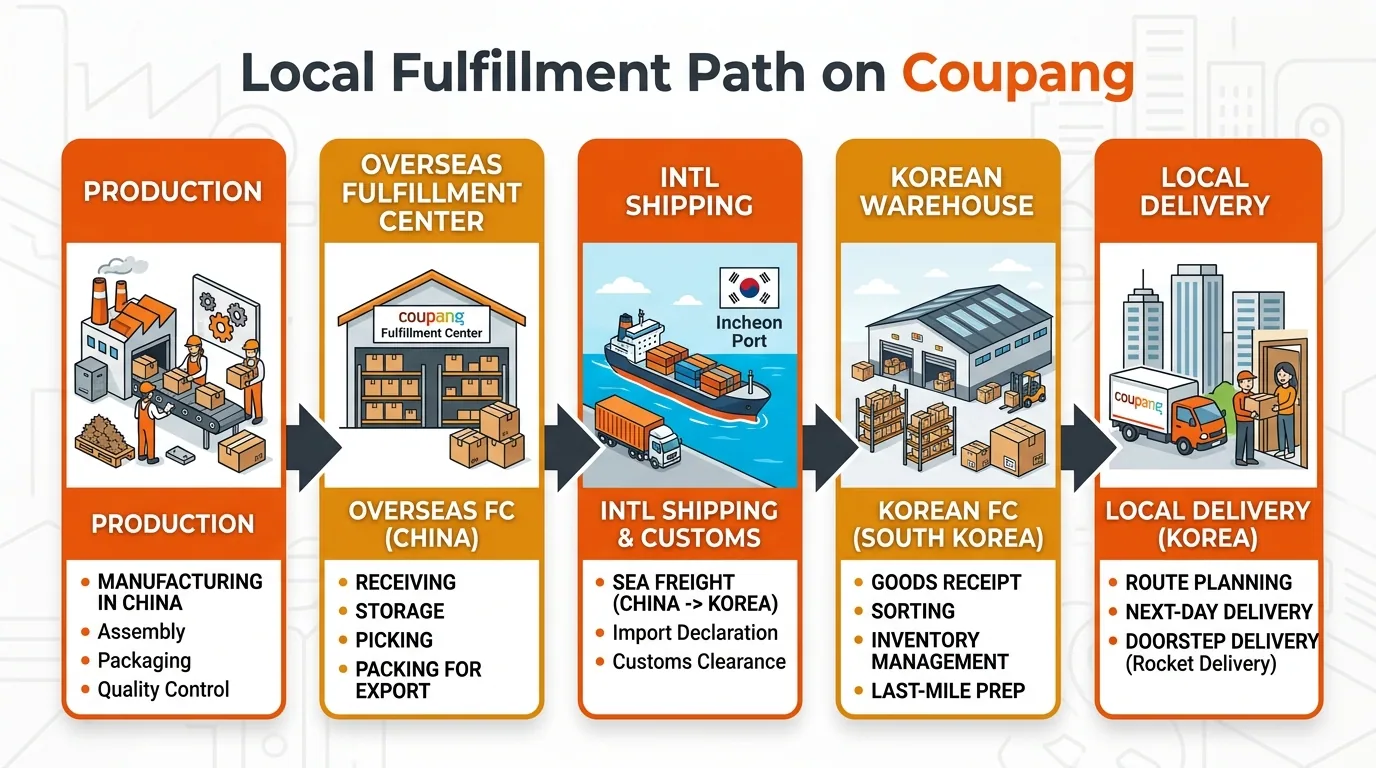
Rocket Growth is Coupang's third-party logistics service that enables same-day and next-day delivery — a baseline expectation for Korean e-commerce. If you're not in Rocket Growth, you are competing against sellers who are, and you will lose the buy box on identical SKUs. The Rocket Growth operation works as follows:
- You ship bulk inventory to a Coupang receiving center (usually via a partner 3PL that handles inbound preparation).
- Coupang stores, picks, packs, and delivers from its own fulfillment network.
- Returns flow back into the same network. Coupang processes them, charges a per-case handling fee, and credits or restocks based on condition.
The margin impact isn't just the fees. It's that delivery speed and return ease lift conversion rates by enough to absorb the cost. Cross-border orders take 5–14 days and rarely allow easy returns. Rocket Growth orders arrive next day. Korean consumers price that difference into their willingness to pay.
Localized PDP and Korean-language conversion
A standard Coupang Product Listing — translated title, description, specifications, basic Coupang SEO — gets you on the platform. It does not, by itself, convert at the rate Korean buyers expect.
Korean e-commerce conversion is driven by the Product Detail Page (PDP) — a long-form, image-heavy, roughly 20,000-pixel-tall visual page that walks the buyer through the product story, specs, comparisons, and social proof. PDPs are a graphic design deliverable, not a translation deliverable.
A clean translation of your US site is not a Korean PDP. Korean buyers scroll, expect lifestyle imagery interleaved with specs, and look for trust signals (certifications, reviews, brand history) before they buy. A weak PDP can suppress conversion enough to make the entire local economics question moot.
In Kontactic's pricing, Korean PDPs are a separate service starting at USD 300 per PDP, whichever model you use; Coupang ads are their own budget line too. Neither is required to start, but skipping them at scale is usually the wrong call. We've written about why brands underestimate this in our note on operational readiness before ad spend.
KC certification and product compliance
This is the biggest unmodeled cost in most "should we go local" spreadsheets. Many product categories require KC Certification (KC 인증) — Korea's mandatory category-specific safety certification — before they can be sold domestically. Cross-border parcel shipping below de minimis often dodges this. Local sales on Coupang do not.
Examples of categories that commonly trigger KC requirements:
- Electrical and electronic devices (KC electrical safety, EMC)
- Children's products
- Cosmetics and personal care (separate MFDS registration)
- Food and food-contact items (MFDS registration)
- Specific home appliances and grills
We've covered category-specific cases in detail — see our notes on KC certification and Coupang seller setup, the three certifications a cooking grill typically needs, and when a foreign EMC report can be reused for USB-powered devices. The point for margin modeling: certification is a one-time cost per SKU family, not a per-unit cost. Amortized across volume it is small. Skipped, it can stop your business in a single customs hold.
So what is the actual margin impact?
The honest answer is: it depends on category, average order value, return rate, and how much you're already spending on international shipping. But the directional pattern is consistent.
“Brands that switch from cross-border to local don't usually see higher per-unit margin. They see lower per-unit margin and 10x the orders. The math works because the bottom of the funnel finally functions.”
Isaac Lee — CEO, Kontactic
Per-unit margin in the local model is typically lower than the home-market cross-border margin, because of VAT, Coupang commission, and 3PL fees. Top-line revenue is typically much higher, because conversion, delivery speed, returns experience, and Korean-language presentation all stop being the bottleneck. We've documented the underlying signal pattern in why cross-border orders understate your Korea opportunity.
The brands that get burned are the ones that switch too early — paying for entity setup, KC certification, and PDPs before they know which SKUs Korean buyers want — or too late, leaving cross-border revenue on the table for years while a competitor goes local and locks the category. Both mistakes are avoidable with honest modeling.
Sequencing it sensibly
A reasonable sequence for a brand already selling cross-border:
- Read your cross-border orders to see which products Korean buyers buy and reorder.
- Identify your top 3–5 SKUs by Korean order volume and reorder rate.
- Get KC certification and any category-specific registrations for those SKUs only.
- Choose your operating model — your own Korean entity (Blaze) or, for a Coupang-approved seller in mainland China, a partner as IoR/SoR (Spark Subscription).
- Build PDPs for the top SKUs before turning on Coupang PPC.
- Launch on Coupang with Rocket Growth and measure the margin stack against your model.
A brand that wants to go local from day one can start at step 3 with its best-selling products at home; the steps stay the same.
For a fuller walkthrough of this path, see our complete guide to selling on Coupang as a foreign brand.
In our experience, the brands that model the local cost stack honestly — VAT, commission, 3PL fees, returns, PDPs, ads — and pair that with a real top-line forecast based on cross-border signal almost always conclude the switch is worth it. The ones that compare local Coupang margin against home-market cross-border margin in isolation almost always conclude it isn't. Both are looking at the same data; only one is looking at it correctly.
Model the Korea margin stack with us
If you're weighing cross-border vs. Coupang local fulfillment, we'll walk through your category, certification path, and unit economics with you. No deck, just the numbers.
About the author
Korean and global e-commerce operators with 15+ years of cross-border experience, led by CEO Isaac Lee — KOTRA-certified consultant and official lecturer for Seoul City and the Korea Customs Service. We run Korea market entry for overseas brands every day; this blog records what we learn in the field.
Meet the Kontactic team →Related Articles
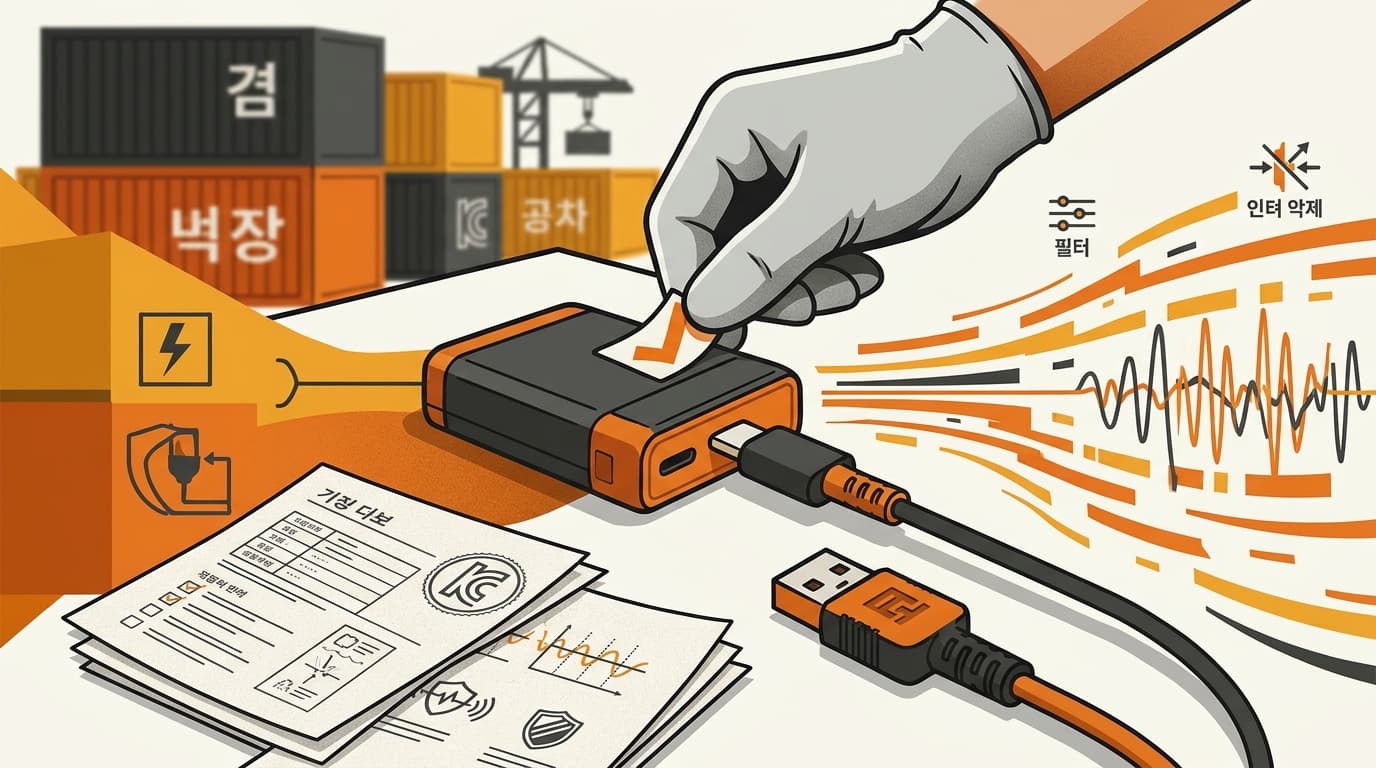
Can USB-Powered Products Avoid Korea’s KC Safety Rules?
USB power does not automatically avoid Korea’s KC rules. Learn how KATS safety review, RRA EMC checks, and customs timing affect your shipment before import.
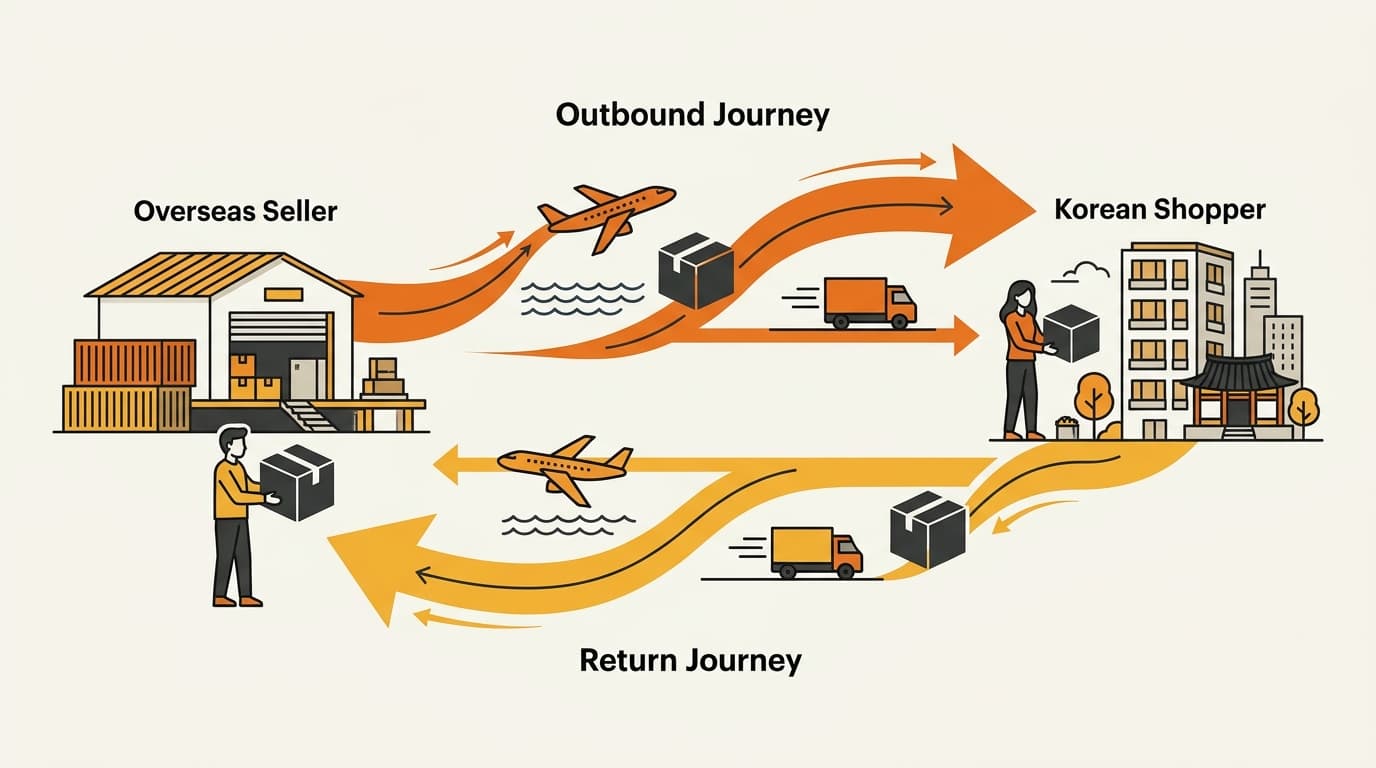
Can Coupang Buyers Pay Two Charges With Free Shipping?
On Coupang, free shipping can still leave the buyer paying two return charges: the original delivery cost and the cost of sending the parcel back to the seller.
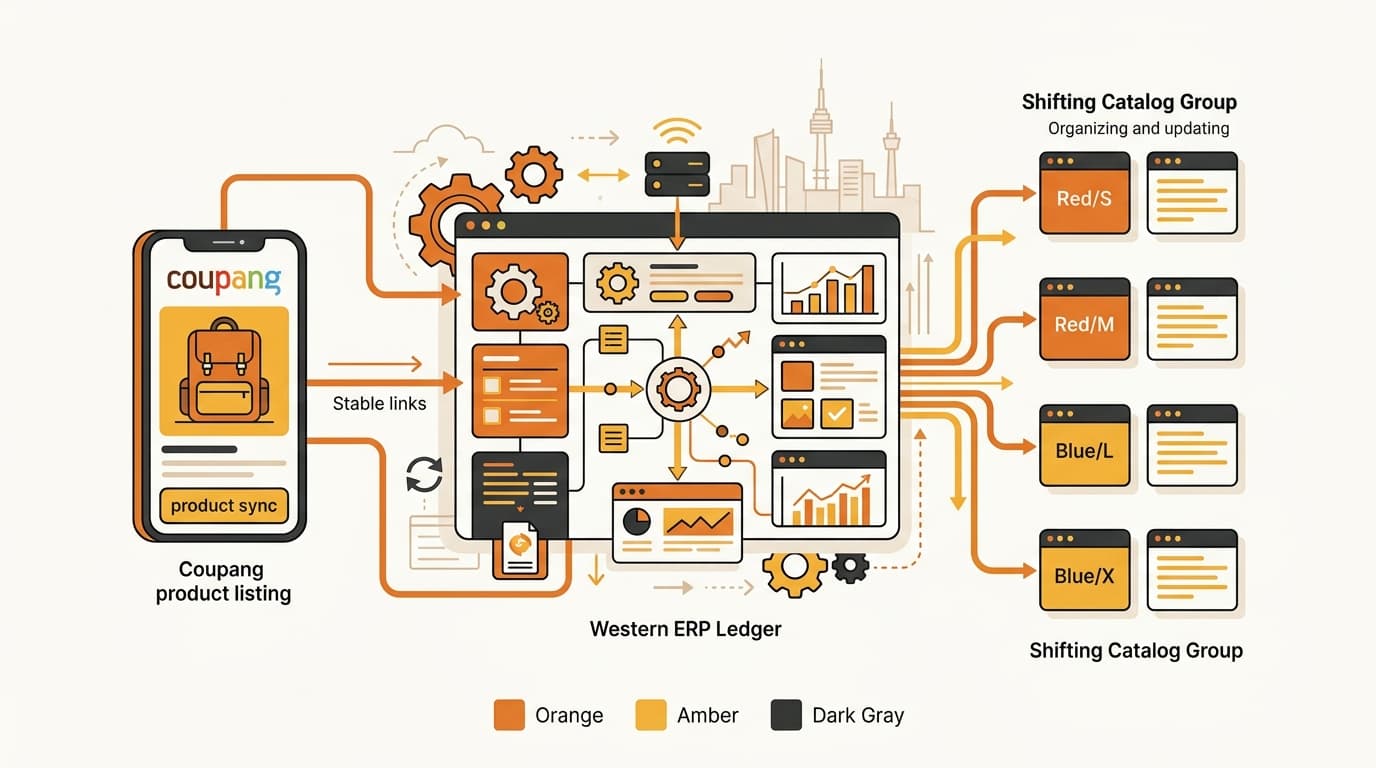
Coupang Product IDs: One ID Cannot Cover Every Variant
One Coupang product ID cannot cover every ERP variant; keep your brand SKU as the main key and map listing, option, edit, and order values to each SKU.