
Korean Business Registration: Who Is the Importer?
No. A Korean Business Registration Certificate (사업자등록증) shows that a business is registered in Korea. It does not give that business a blanket permit to import and sell every consumer product. Before naming a partner as the importer, check three things. Identify the business on the customs import declaration. Then check the category registration and the product’s Korean requirements.
What the certificate proves—and what it does not
Use the certificate as your first check. It helps you confirm that the Korean partner is a registered business and gives you the legal name to compare with other documents. It does not prove that the partner can take every import or seller role.
For an ordinary product, customs and Korean labeling may be the main checks. A regulated product can add a category registration, a facility registration, a filing, a test, a certificate, or a required Korean label. The exact product decides which steps apply.
Imagine a US skincare brand appoints a Korean logistics and sales partner. The partner sends its Korean business registration certificate. That proves the partner is registered. It does not prove that the partner is registered as the responsible cosmetics seller. It also does not prove that the serum’s Korean product information is ready. If the brand names that partner before checking both points, the launch can stop while the role and product paperwork are fixed.
Start with the certificate, not with the assumption. A Korean business registration shows who the business is. The product category decides what the business must also hold or complete.

Who is the legal importer?
The legal importer is the business named on the Korean customs import declaration. This business brings the goods into Korea under its name and takes the importer responsibility. Where a product rule requires it, that same business or named responsible party may also appear on Korean product information.
Legal importer (Importer of Record, or IoR): the business named on the Korean customs import declaration. It is the party responsible for bringing the goods into Korea and for the importer duties attached to that entry.
This is why a company address, warehouse, or marketplace account is not enough. A Korean third-party logistics provider can store cartons. A marketplace can host a listing. Neither one replaces the business named on the import declaration.
A customs broker may prepare or submit customs paperwork for the named business. That filing role does not automatically make the broker the importer. See Can a Korean Customs Broker Be Your Importer of Record? for this separation.
For a practical test, ask the partner one question: What exact legal business name will appear on the Korean customs import declaration? Compare that answer with the certificate. If the answer is a group company, warehouse, or another affiliate, check that entity instead. It—not the company that introduced you to the partner—may be the importer.
For a wider explanation, Who Can Legally Import Your Products Into Korea? explains who can act as importer. A foreign brand cannot assume its home-country registration works in Korea.
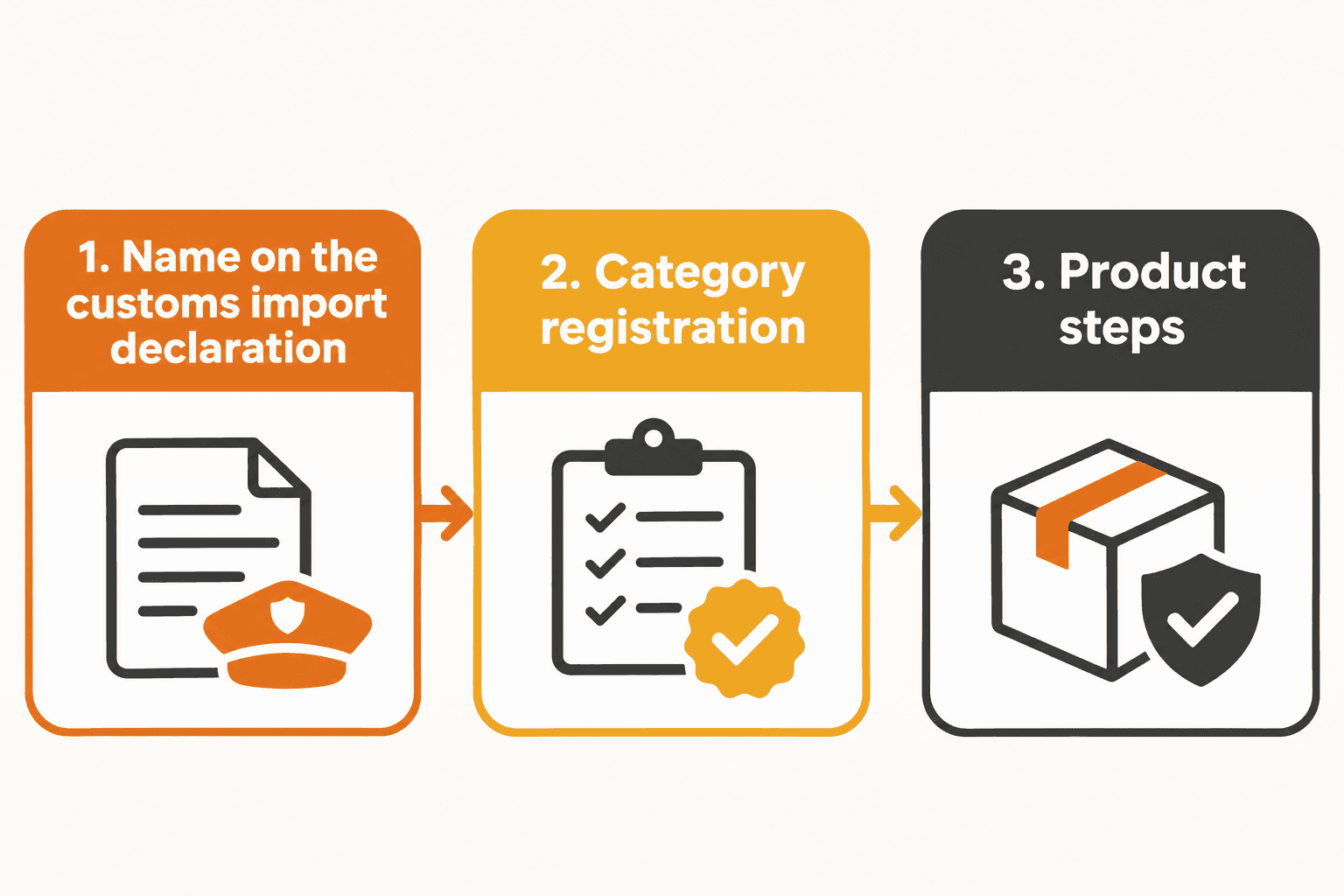
The three checks before you name a partner
Do not combine three different questions into one yes-or-no answer.
-
Name on the customs import declaration. Confirm which Korean business will be named. Match its legal name and business registration number to the certificate. A partner may manage the sale while another company imports; those are different roles.
-
Category registration. Check whether that importing business has the registration, permit, or certificate required for the product category. If no separate category registration is needed, ask for the reason and the official source supporting that answer. A general business certificate cannot answer this question.
-
Product steps. Check the exact product’s Korean filing, test, certificate, and label or product-information requirements. A business can pass the first two checks and still be unable to launch the product until its own steps are complete.
Use government sources for each question, not only the partner’s description of its services. The Korea Customs Service is the place to verify customs and import-declaration guidance. The Ministry of Food and Drug Safety (MFDS, 식약처) covers imported food and cosmetics requirements. The Korea Agency for Technology and Standards (KATS) publishes KC conformity information. Use the Korean Law Information Center to read the relevant law and implementing rules.
How the check changes by product category
Food: check the importer and the overseas facility
For imported food, the Korean importing business may need MFDS registration for an imported-food sales business. The overseas food facility may also need MFDS registration before the food can be imported. These are separate from ordinary business registration.
A US snack brand may find a Korean partner with a business certificate and a warehouse. That does not prove the partner has the required food-business registration. It also does not prove that the overseas factory has completed its own MFDS step. The partner’s certificate does not cover the factory.
Ask which Korean business will appear as importer and which overseas facility is tied to the food import. Keep those answers separate. A local address can help an authority reach someone in Korea, but it does not replace the required food registrations.
Cosmetics: identify the responsible cosmetics seller
The business acting as Korea’s responsible cosmetics seller is the party legally responsible for the cosmetic. It needs a separate registration. A partner can be a registered Korean business and still lack this role. Responsible Distributor for Cosmetics in Korea explains why this role is separate from a general business registration.
The product still needs its own Korean product information and label steps. Putting a partner’s Korean address on a page does not prove that the partner is registered for the responsible cosmetics seller role.
For example, a Japanese skincare brand may use one Korean company for storage and another company for sales paperwork. The brand should confirm which company is legally responsible for the cosmetic before it prints Korean information or names an importer. A warehouse relationship alone does not answer that question.
Products covered by KC: identify the exact safety path
KC is Korea’s product-safety system. It does not use one rule for every product. The path may be safety certification, safety confirmation, supplier conformity, or no KC path at all. The product decides the path, not the partner’s business number.
Do not ask, “Does your company have KC?” Ask which KC path applies to this product. Then ask who will complete it. A partner should be able to identify the product-specific requirement or explain why no KC step applies. KATS guidance is the place to check that answer.
Do not assume that one importer registration covers every regulated product family. Does Korean Importer Registration Cover Every Product You Sell? explains why the importer’s general registration and each product’s separate requirements must be checked together.
A local representative is not automatically the legal importer
A local representative is a Korea-based contact who can receive official notices and communicate with the authority. The legal importer is the business named on the import declaration. They may be the same company, but do not assume they are.
If the overseas brand applies directly, the authority may require a Korea-based representative. It may also require proof that the signer has authority to sign for the foreign company. Depending on the authority and filing, that proof can include the company seal and official seal certificate, or an accepted equivalent for a foreign company. A simple signed authorization should not be assumed to be enough.
This matters when a Korean partner says it can “represent” the brand. Ask what that means. Does the partner only receive notices? Will it make a category filing? Will its legal name appear on the customs import declaration? Will it answer authority questions if the product needs correction, recall, or other corrective action?
For many regulated categories, a non-resident brand uses a Korean subsidiary or an operating partner. That Korea-based business can make the sector filing, receive official notices, and be named as importer where the rules require it. A new Korean subsidiary still needs the category and product steps. An operating partner must be able to take those steps, not only provide an address.

Partner checklist before goods ship
A business certificate is one item in the packet. Ask for the following before shipping stock or printing Korean product information.
| Ask for | What it confirms |
|---|---|
| Current Korean Business Registration Certificate | The legal business name and business registration number you will compare with other documents |
| Category registration, permit, or certificate | Whether the partner can take the required role for the exact product, or why no separate registration applies |
| Exact name on the customs import declaration | Which business will be the legal importer for the shipment |
| Name and role shown on Korean product information, where required | Whether the importer or responsible seller is identified correctly |
| Local representative’s name, Korean address, and phone | Who can receive official notices and answer the authority in Korea |
| Signer-authority documents | Whether the person signing has authority to sign for the foreign company or Korean business; this may include a company seal and official seal certificate where required |
| Plan for updates, authority questions, recalls, and corrective action | Who will keep the filing current and respond after the first shipment |
Do not accept “we have a Korean business number” as the full answer. Ask whether the documents cover the exact product, not only the partner’s general business activity. If the product has a different formula, model, use, or product family, check again.
The most important line is the exact legal name. Get that name before goods ship. Changing the importer later can delay launch and may require new Korean product information or labels. Check the answer against the official rule. Use the Korean Customs Service, MFDS, KATS, and the Korean Law Information Center. Do not rely only on a sales description.
Common questions about Korean business registration and importing
Can a Korean Business Registration Certificate make a partner an importer for ordinary goods?
Not on its own. Ordinary goods may mainly need customs and Korean labeling, but the certificate does not remove those checks or prove that no other product rule applies.
Can a warehouse or marketplace account be used instead of an importer?
No. A warehouse, third-party logistics provider, or marketplace account is not a substitute for the business named on the customs import declaration. Ask whose legal name appears on that declaration.
Can a new Korean subsidiary import a regulated product just after registration?
Not automatically. The subsidiary has a Korean business registration, but it still needs every category registration and product filing, test, certificate, and label step that applies to the product.
Can a signed letter from the brand fix a missing category registration?
No. A letter may help prove signing authority if the authority accepts it, but it should not replace a food, cosmetics, or KC requirement. Check what formal proof the authority requires.
Does one registration cover every product family?
Do not assume it does. Confirm the exact product and category coverage for each regulated family, especially when the model, formula, intended use, or Korean product information changes.
Check the importer before shipping
If you are reviewing a Korean partner, contact Kontactic to discuss the business certificate, category registration, customs name, and product-specific Korean requirements before goods move.
About the author
Korean and global e-commerce operators with 15+ years of cross-border experience, led by CEO Isaac Lee — KOTRA-certified consultant and official lecturer for Seoul City and the Korea Customs Service. We run Korea market entry for overseas brands every day; this blog records what we learn in the field.
Meet the Kontactic team →Related Articles

Add or Remove a Signatory From a Korean Bank Account
Learn how to change a Korean bank signatory: approve the request, prepare documents, attend the branch, update digital access, and check timing and fees.

Korean Import Duty and VAT: Which Price Counts?
Korean import duty and VAT normally use the parent-company price, not Coupang’s retail price; freight, insurance, and some royalties can change the tax due.
What Happens to Unsold Stock After a Korea Pop-Up Store?
After a Korea pop-up, unsold stock must be sold locally, returned, re-exported, or disposed of at the brand’s cost. Choose the route before the event.