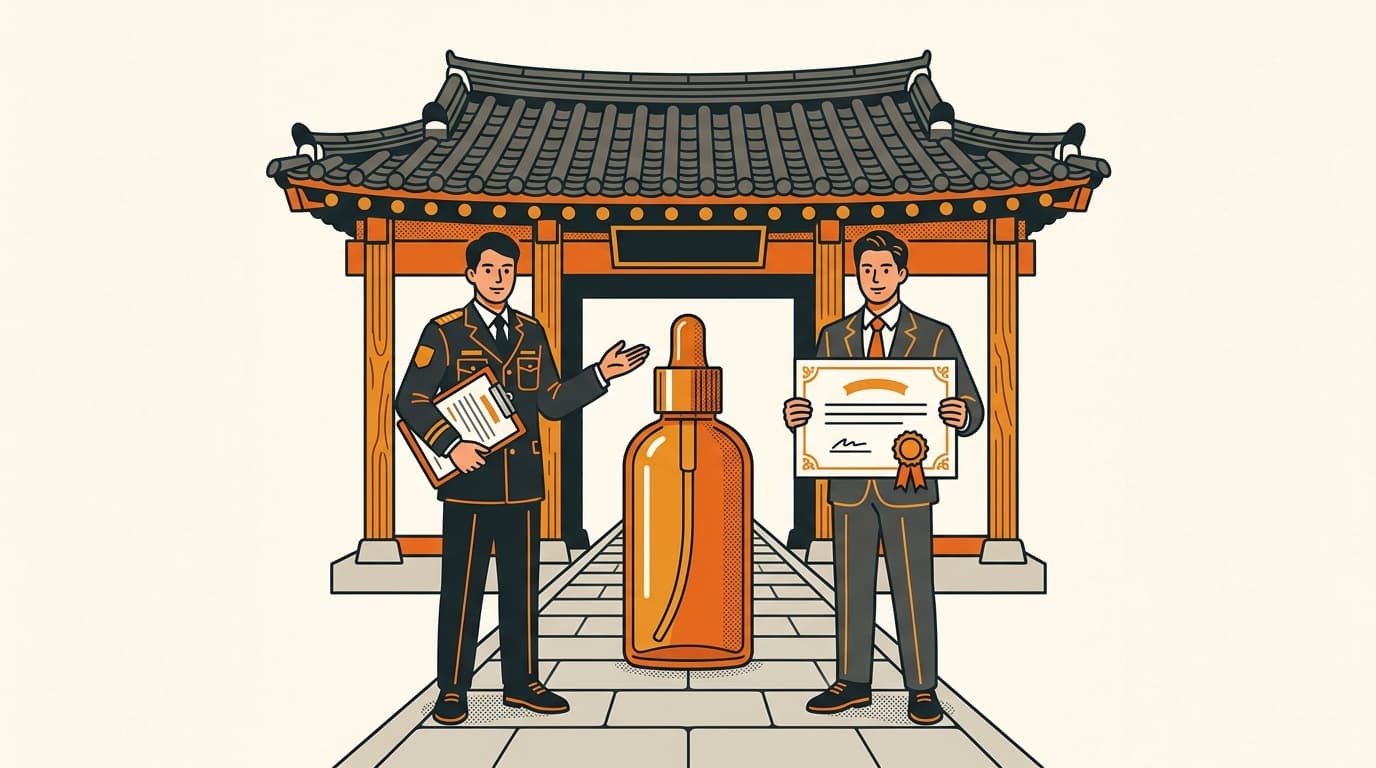
Responsible Distributor for Cosmetics in Korea
Under Korea's Cosmetics Act (화장품법), the party legally responsible for placing your imported cosmetics on the Korean market is a registered cosmetics responsible distributor (화장품책임판매업자) — a licensed role that must be held by a party established in Korea. A foreign brand with no qualifying Korean presence cannot hold this license directly, which means clearing customs is not enough to sell: without a registered responsible distributor standing behind your product, it cannot legally be distributed regardless of its customs status.
You can import a shipment, pay duty and VAT, and have the cargo sitting in a Korean warehouse — and still not be allowed to sell it. Importing and distributing are two different legal acts under two different frameworks, and each requires its own accountable party.
The Cosmetics Act separates distributing from importing
Korea's Ministry of Food and Drug Safety (MFDS / 식약처) administers the Cosmetics Act, and the law draws a line that trips up brands used to a single "importer" concept. Getting goods across the border is one obligation. Placing those goods on the market — distributing and marketing them to Korean consumers — is a separate, licensed obligation.
The market-facing license for imported finished cosmetics is the responsible-distributor registration. It is not the same thing as being the importer of record. The importer-of-record role answers to the Korea Customs Service on duties and clearance; the responsible distributor answers to MFDS on everything that happens once the product is on shelves. You can read the statute itself at law.go.kr, and MFDS publishes the registration conditions for the role — both are worth verifying directly rather than taking an agency's word for it.
Cosmetics responsible distributor (화장품책임판매업자): the party registered under Korea's Cosmetics Act to place cosmetics on the Korean market. For imported finished cosmetics, this registration is the market-facing license — distinct from the importer of record that clears customs.
Because the two roles sit in different laws, neither substitutes for the other. A general importer of record does not automatically become a responsible distributor. And a responsible distributor does not, by holding that registration, become the party that fronts your customs duties. Brands that assume "we found a Korean importer, so we're covered" are usually covering only half the requirement.

Why a foreign brand can't hold the license itself
The responsible-distributor registration presumes a qualifying Korean presence. Under MFDS conditions, the registrant must be established in Korea and must designate a responsible-distribution manager (책임판매관리자) who meets defined qualifications set out in the Cosmetics Act and its enforcement rules. That manager is a real, named person accountable for the distributor's safety and quality obligations — not a nominal title.
A foreign company operating purely offshore has neither. It has no Korean establishment to register, and no qualifying local manager to designate. This is structurally the same wall foreign brands hit elsewhere in Korean market entry — the importer-of-record requirements presume a locally reachable, accountable party, and the responsible-distributor role raises the bar further by adding a qualified individual with specific credentials.
So the license cannot be "assigned" to the foreign brand as a matter of paperwork. It has to be held by a party that genuinely satisfies the Korean conditions. That is a design constraint on how you enter, not a form you fill in later.
What the responsible distributor is actually accountable for
This is the part that makes the role consequential rather than administrative. The responsible distributor carries the market-facing obligations for the product — the accountability that follows the cosmetic once it is on sale, not just at the border.
- Safety and quality controls — ensuring the product meets Korean safety and quality standards for distribution.
- Standards and test records retention — keeping the documentation and test records that substantiate the product's compliance.
- Korean-language labeling — managing the mandatory Korean-language labeling that the Cosmetics Act requires on cosmetics sold in Korea.
- Adverse-event reporting to MFDS — reporting and handling adverse events and market safety issues through the channels MFDS defines.
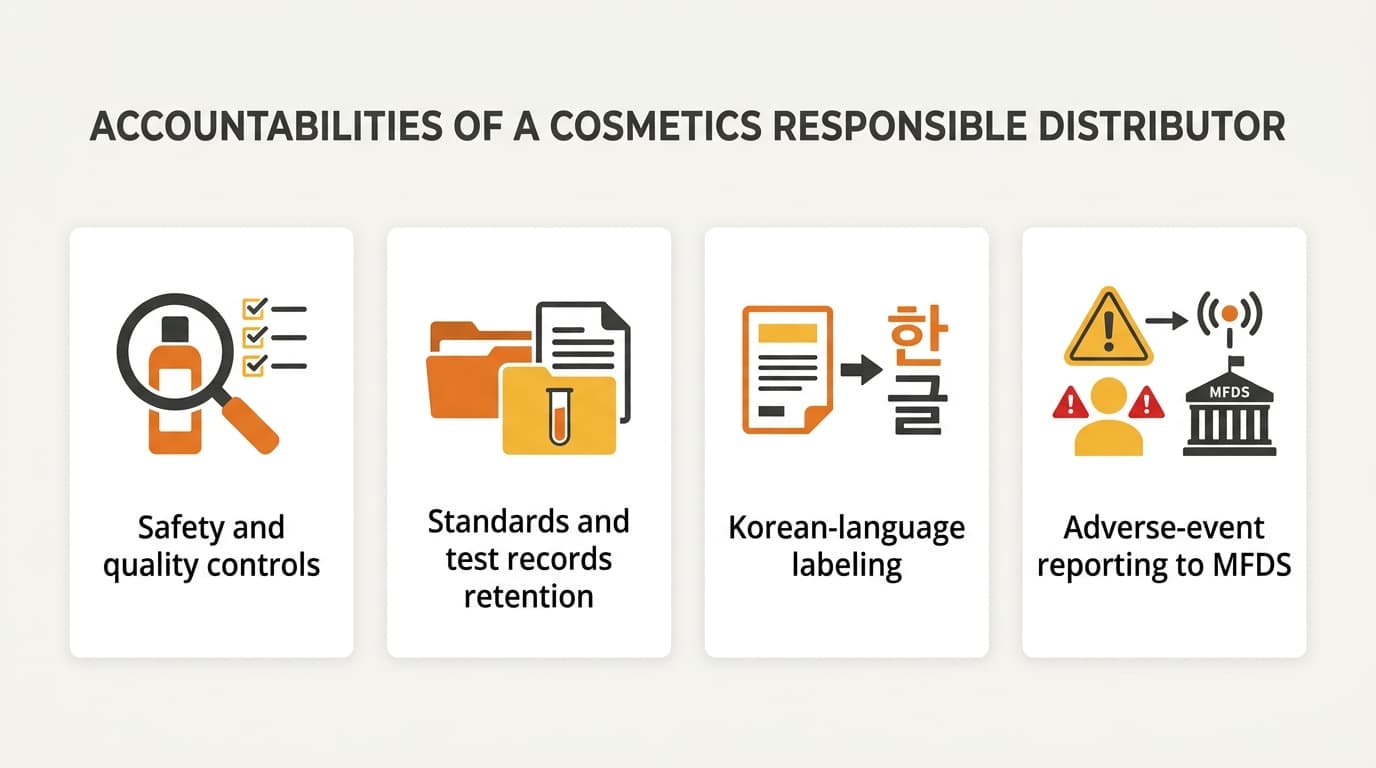
Read that list again and notice whose name is attached to it. If there is a safety complaint, a labeling deficiency, or an adverse-event report, the registered responsible distributor is the party MFDS looks to. This is why the role is not a rubber stamp: whoever holds it is genuinely on the hook for what happens in the Korean market.
“A shipment can clear the border and still be undistributable — because customs and market authorization answer to different regulators, and neither one clears the other.”
Isaac Lee — CEO, Kontactic
Customs clearance does not make a product distributable
It is worth stating plainly, because the sequence feels counterintuitive. A shipment can pass the Korea Customs Service — duties paid, VAT settled, cargo released — and still not be legally distributable if no registered responsible distributor stands behind it.
The two obligations live in different laws with different regulators. Customs clearance answers a Korea Customs Service question: has this cargo been lawfully imported and taxed? Distribution answers an MFDS question: is there a licensed party accountable for this cosmetic once it reaches consumers? A "yes" on the first does not produce a "yes" on the second.
In practice, this means the responsible-distributor registration has to exist before you count on selling, not as a cleanup step after the cargo lands. Brands that sequence it late end up with paid-for, cleared inventory they cannot legally move.
How functional cosmetics fit into this
If your product carries a whitening, anti-wrinkle, or UV-protection claim, it may be a functional cosmetic (기능성화장품) that requires an MFDS review before sale. That review is a separate step — and it does not replace the responsible-distributor requirement.
The two do different jobs. The functional-cosmetics review clears the claim — it authorizes the product to be marketed with that functional benefit. The responsible-distributor registration clears the distribution — it puts an accountable licensed party behind the finished product on the market. A functional cosmetic that has passed review still needs a responsible distributor to be placed on the market, just like any other imported cosmetic.

How a foreign brand can structure this
You have two broad paths, and both come down to who holds the genuine legal accountability.
- Appoint a qualifying Korean party as the registered responsible distributor. A Korean party that meets MFDS conditions — including a qualified responsible-distribution manager — holds the registration and carries the market-facing obligations for your product.
- Establish the licensed role through a market-entry operator or your own Korean entity. Rather than relying on an unrelated third party, you stand up the responsible-distributor function inside a Korean entity built for your brand, so the accountable party is one you control.
Either way, understand what you are doing: you are delegating real legal accountability, not just handing off a filing. Whoever holds the responsible-distributor registration is the party MFDS holds responsible for your product's safety, labeling, and adverse events in Korea. Before you commit, understand the distributor-versus-entity tradeoffs.
Common questions
Is the responsible distributor the same as the importer of record? No. The importer of record clears customs and answers to the Korea Customs Service; the responsible distributor is the MFDS-registered party that places cosmetics on the market. One product needs both roles filled, and they are governed by different laws.
Can my foreign company register as the responsible distributor? Generally not, if you have no qualifying Korean presence. The registration presumes a party established in Korea and a designated responsible-distribution manager who meets the Cosmetics Act's qualification conditions.
If my product cleared customs, why can't I sell it yet? Because customs clearance and market distribution are separate legal questions. Cleared cargo with no registered responsible distributor behind it is not legally distributable — verify the requirement against the Cosmetics Act text on law.go.kr and MFDS guidance.
Does passing the functional-cosmetics review remove the need for a responsible distributor? No. The functional review clears the claim; the responsible-distributor registration clears the distribution. A functional cosmetic still needs a responsible distributor to reach the market.
Not sure who holds your cosmetics distributor license in Korea?
Talk to Kontactic about structuring the responsible-distributor role for your imported cosmetics — so your product is legally distributable, not just cleared through customs.
About the author
Korean and global e-commerce operators with 15+ years of cross-border experience, led by CEO Isaac Lee — KOTRA-certified consultant and official lecturer for Seoul City and the Korea Customs Service. We run Korea market entry for Western brands every day; this blog documents what we learn in the field.
More about Kontactic →Related Articles

Rocket Growth: Why Outbound and Return Locations Matter?
Rocket Growth stores and ships inventory, but sellers still need outbound and return records before product registration; each has a distinct seller-side role.
Korean HS Code: Can You Reuse US/EU HS Codes? Not Always
A US or EU HS code is a useful starting point, not a portable Korean classification. Learn how Korea’s HSK affects duty, FTA treatment, and import controls.

Korean Biocide Approval: Why Coupang Claims Still Count
No. Korean biocide approval cannot be avoided by hiding a “kills bacteria” claim from the bottle; a Coupang listing can still evidence intended biocidal use.