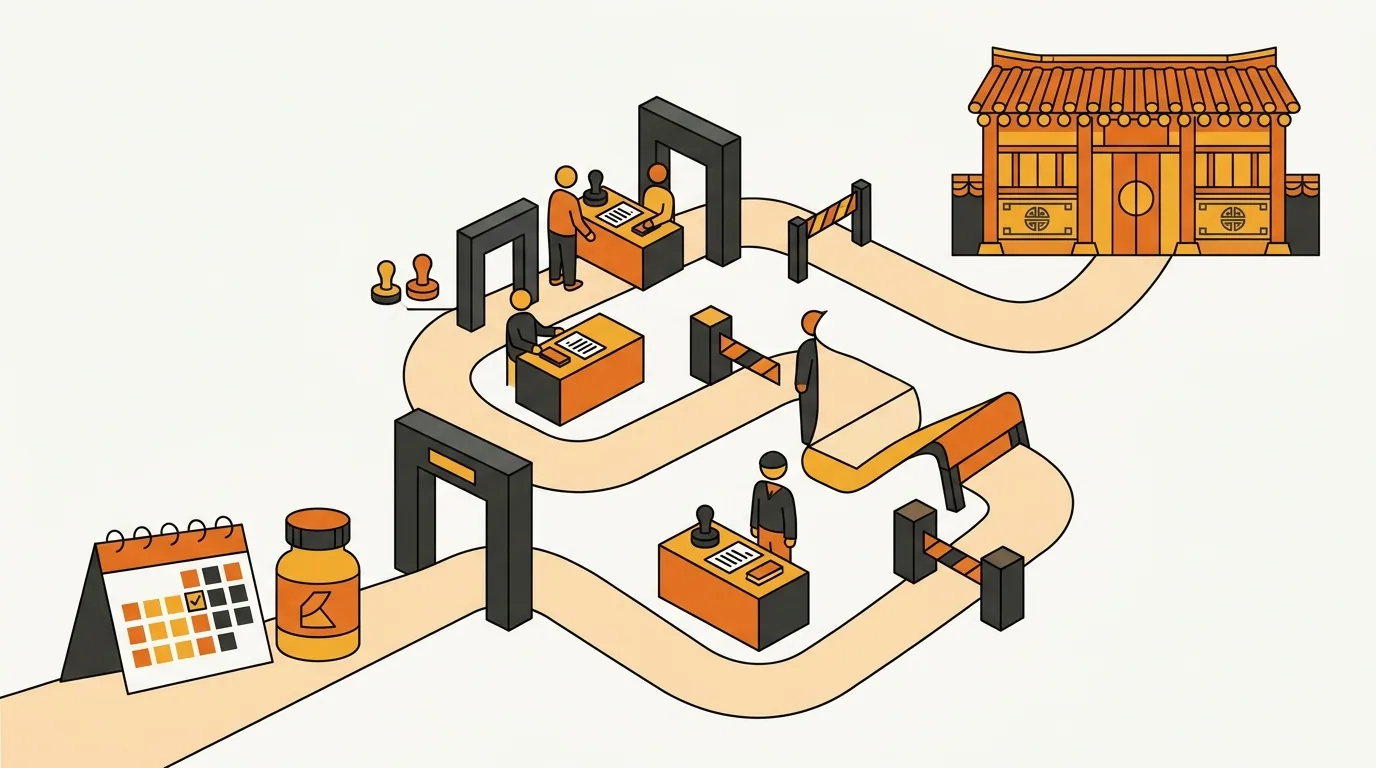
Korea Supplement Entry: 5–8 Month Timeline
A realistic Korea supplement entry timeline runs roughly 5 to 8 months from the day you start the application to the day a Korean consumer can buy your product on Coupang with next-day delivery. The single biggest variable is Health Functional Food (건강기능식품, HFF) registration, which alone can consume around four months. Coupang onboarding, localized product detail pages, and the first Rocket Growth inbound all happen on top of that — usually overlapping, sometimes serially, depending on how the work is sequenced.
This article walks through each stage with realistic durations, where the schedule typically slips, and what foreign supplement brands consistently underestimate.
What "first sale" actually means in Korea
Before the timeline is useful, define the finish line. Three different milestones get called "going live" in Korea, and they are not the same:
- First cross-border sale — your existing US/EU storefront ships internationally to a Korean address. No Korean entity, no import clearance, no Korean Seller of Record. Useful for demand validation only.
- First local sale via a partner's IoR — your goods are imported into Korea under another company's Importer of Record license and sold under their Seller of Record. Fast, but you don't own the listing, the data, or the customer relationship.
- First local sale under your own Korean entity — your Korean limited company (유한회사) is the IoR and SoR, customs are cleared in your name, and the listing on Coupang is yours.
This guide focuses on the third milestone, because it is the one that determines a real launch date and a real P&L. If you are still weighing the path, the Korea market entry decision guide for supplement brands breaks down the trade-offs.
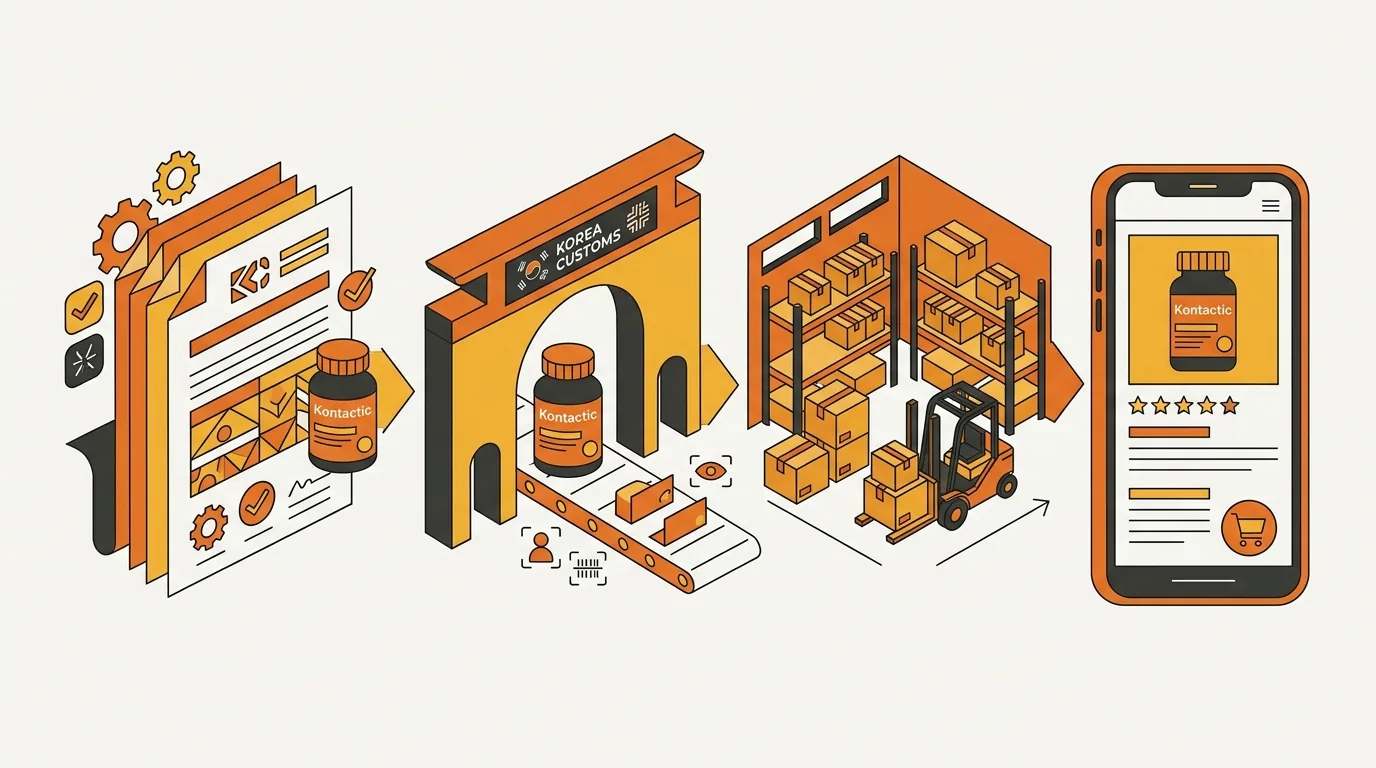
The 5-to-8 month timeline, stage by stage
The timeline below assumes a non-resident foreign founder with a finished product and existing cross-border demand in Korea. Numbers are operational ranges from how the work usually plays out, not statutory guarantees.
Stage 1: Korean entity formation — 4 to 8 weeks
A Korean limited company (유한회사) is the cleanest vehicle for a foreign brand that wants to be its own IoR and SoR. The legal registration itself is fast — the choke points are tax-office reviews and the corporate bank account. New foreign-owned entities now face significantly more scrutiny than they did a few years ago; we covered the current state of play in why setting up a Korean entity as a non-resident foreigner got harder.
Plan for 4 weeks if everything is clean and 8+ weeks if the bank pushes back. The corporate bank account is where most schedules slip.
Stage 2: HFF / product registration — 12 to 18 weeks
This is the long pole, and it's the stage that most Western supplement founders misunderstand. Korean dietary supplements are not regulated under KC certification (KC 인증) — KC is for electrical and EMC product categories. Supplements fall under the Health Functional Food (건강기능식품) framework administered by the Ministry of Food and Drug Safety (MFDS).
Two paths exist:
- Notification (신고) of products using already-recognized functional ingredients — generally faster, often in the order of three to four months including document review and overseas manufacturer registration.
- Individual recognition (개별인정) for novel functional ingredients — substantially longer, with supporting clinical and safety data; this is a separate program, not a default.
Most foreign brands fall into the first bucket. The schedule depends on documentation quality. Overseas manufacturing facility registration, ingredient specs, GMP evidence, Korean-language labeling, and translated certificates of analysis must all be ready before submission. We treat food, food-contact, and hygiene categories as a separate compliance class for this reason; see importing food and hygiene products into Korea.
KC certification does not apply to supplements. If a vendor is quoting you "KC certification for your supplement," they are either using the term loosely or selling you the wrong scope. Supplements need MFDS / HFF registration, not KC.
Stage 3: Coupang seller onboarding — 2 to 4 weeks (parallel)
Coupang seller onboarding can run in parallel with HFF registration. The seller account itself is opened against the Korean entity's business registration, with KYC on the representative director, banking details, and tax info. Allow 2 to 4 weeks once the entity and bank account exist.
For Rocket Growth (로켓그로스) — Coupang's third-party logistics service — there is a separate onboarding flow on top of the basic seller account: warehouse SLAs, barcode/labeling rules, inbound appointments, and product master data. A realistic walkthrough of the foreign-brand onboarding sequence is in our Coupang seller guide for foreign brands.
Stage 4: Localized PDP production — 3 to 6 weeks (parallel)
The Coupang Product Listing — translated title, bullets, and SEO — is the bare minimum and not enough on its own. The conversion-driving asset is the Product Detail Page (PDP), an approximately 20,000-pixel vertical visual page built specifically for Korean consumer reading patterns. PDPs cover ingredient transparency, certifications, lifestyle scenarios, FAQs, before/after framing where appropriate, and review-style social proof.
PDPs are produced by a graphic and copy team that knows Korean conversion conventions. Three to six weeks is typical for a single SKU; multi-SKU launches can compress with a shared template. PDP production is a separate one-time deliverable in our agreements — it is not bundled into base operations.

Stage 5: Customs clearance and first inbound — 2 to 4 weeks
Once HFF registration is in place, the first shipment is imported DDP under your Korean entity's IoR. Air freight from the US or EU is 1 to 2 weeks; ocean is 4 to 6 weeks. Customs clearance for HFF goods includes MFDS document checks at the border on top of standard customs valuation and 10% VAT on import.
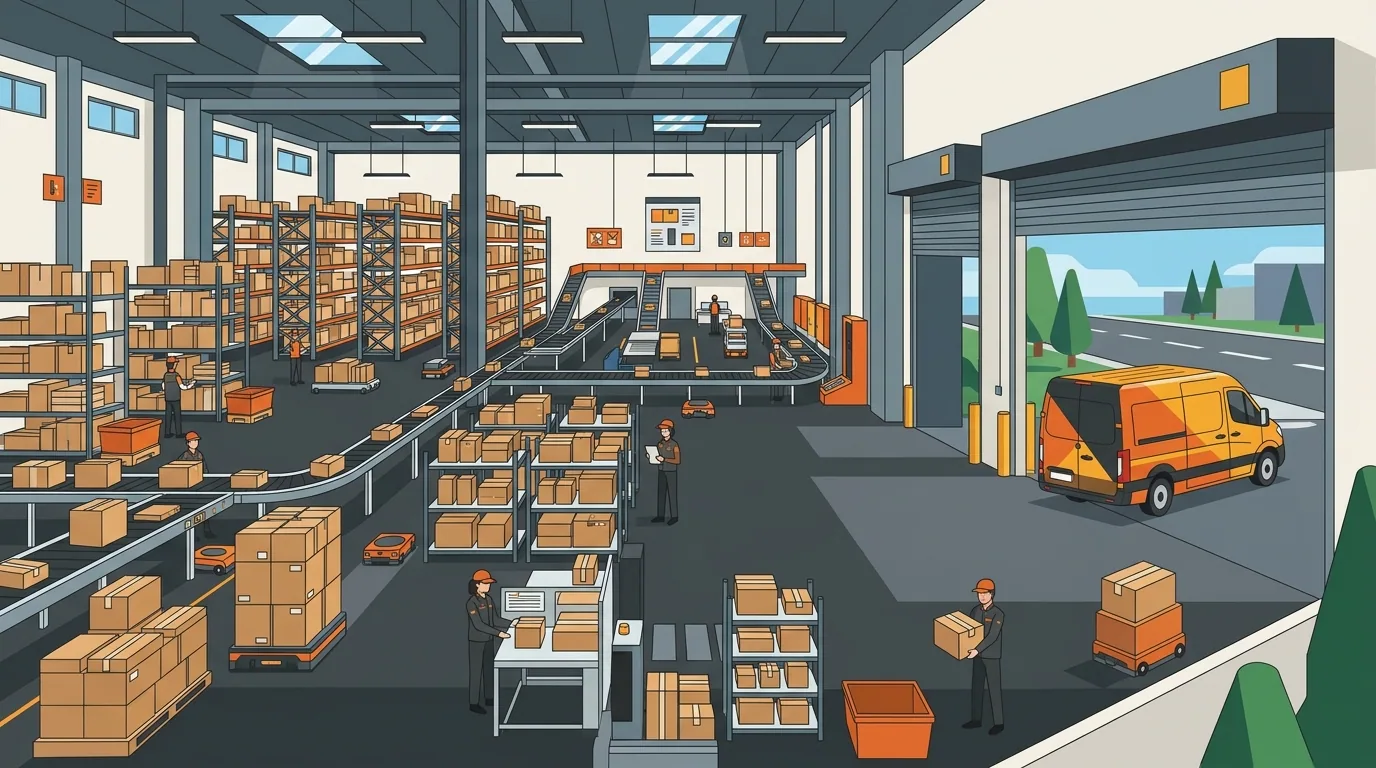
After clearance, goods are inbounded to a Coupang Rocket Growth warehouse. Inbound appointments, pallet receipt, and quality check typically take an additional few business days before stock goes live for Rocket delivery.
What foreign supplement brands consistently underestimate
In our experience, the published timeline is rarely the problem. The slip happens at the seams between stages.
Underestimation 1: Documentation, not regulation, is the bottleneck
The HFF review itself is procedural. What slows it down is the round-trip on documentation — overseas manufacturer GMP evidence in the right format, translated specs, and a label that matches the formula in both English and Korean. Brands that batch-prepare this with their factory before submitting see the four-month window hold; brands that respond reactively to MFDS queries push toward six.
Underestimation 2: PDP is a launch asset, not a post-launch one
A bare Coupang Product Listing converts poorly compared to a full PDP, especially in supplements where Korean buyers expect detailed ingredient disclosures and certification visuals. Founders often plan to "launch fast and improve the page later." In practice, a weak first PDP suppresses early conversion, which suppresses Coupang's organic ranking, which makes recovery expensive. Build the PDP in parallel with HFF, not after first sale.
Underestimation 3: Rocket Growth changes your unit economics
Switching from cross-border to Rocket Growth typically lifts orders by a multiple but compresses per-unit margin once platform commission, fulfillment fees, returns handling, and storage are netted out. The math is worked through in how Coupang IoR and 3PL change your Korea margins. It is not a reason to avoid Rocket Growth — it is a reason to price the SKU correctly before the first inbound, not after.
Underestimation 4: Ad spend before operational readiness
The fastest way to waste a Korea launch budget is to start performance marketing before the listing, PDP, fulfillment SLA, and Korean-language CS are stable. We've written about this enough that it has its own post: operational readiness before ad spend.
“The published timeline is rarely the problem. The slip happens at the seams between stages — between regulator and bank, between bank and platform, between platform and warehouse.”
Kontactic operations team — Korea market entry
A realistic critical path
If you sequence the work properly, the critical path looks like this:
- Month 0–1: Begin entity formation; in parallel, begin HFF documentation prep with the manufacturer.
- Month 1–2: Bank account opened; HFF application submitted; Coupang seller onboarding begins.
- Month 2–4: HFF review in progress; PDP production runs in parallel; product master data and Rocket Growth onboarding completed.
- Month 4–5: HFF approved; first DDP shipment dispatched; Coupang listing prepared but not yet published.
- Month 5–6: Customs clearance; Rocket Growth inbound; first sale live.
- Months 6–8: Window for slower banks, MFDS queries, or shipping delays.
Brands that try to run the work serially — entity, then HFF, then Coupang, then PDP — push the timeline well past 8 months without adding any value to the launch.
Costs that move with the timeline
Every additional month of pre-launch carries fixed-cost burn: entity maintenance, bookkeeping, retainer, and warehousing of any pre-positioned inventory. None of those costs sit on Kontactic — under all our service tiers, the client funds inventory, ads, platform fees, and operating expenses. The full breakdown is in who pays for what in Korea.
The single most expensive timeline mistake is starting HFF registration late. Because HFF is the long pole, every week of delay there is a week of delay on first sale, and a week of fixed costs without revenue.
If your product is already sold cross-border to Korean buyers, keep that channel running while local registration is in flight. Cross-border revenue offsets some of the pre-launch burn and gives you a baseline to compare against once Rocket Growth goes live.
When the timeline is shorter
Two scenarios compress the timeline meaningfully:
- Selling under a partner's IoR and SoR — skips entity formation and uses an existing import history. First sale possible in 4 to 5 months instead of 5 to 8, but the listing, customer data, and platform reputation belong to the partner, not you. Suitable for testing, not for building a long-term Korean business.
- Products that are not regulated as HFF — general food or non-functional categories follow a different (often shorter) registration path. Confirm the category classification with MFDS guidance before assuming the shorter path applies.
For most foreign supplement brands serious about owning Korea long term, the 5-to-8 month window under your own entity is the realistic plan.
Plan a realistic Korea supplement launch
If you're sizing a launch date for a supplement SKU and want a sequenced plan that accounts for HFF, Coupang, PDP, and Rocket Growth in parallel, we can map it with you.
About the author
Korean and global e-commerce operators with 15+ years of cross-border experience, led by CEO Isaac Lee — KOTRA-certified consultant and official lecturer for Seoul City and the Korea Customs Service. We run Korea market entry for Western brands every day; this blog documents what we learn in the field.
More about Kontactic →Related Articles

Rocket Growth: Why Outbound and Return Locations Matter?
Rocket Growth stores and ships inventory, but sellers still need outbound and return records before product registration; each has a distinct seller-side role.

Korean HS Code: Can You Reuse US/EU HS Codes? Not Always
A US or EU HS code is a useful starting point, not a portable Korean classification. Learn how Korea’s HSK affects duty, FTA treatment, and import controls.

Korean Biocide Approval: Why Coupang Claims Still Count
No. Korean biocide approval cannot be avoided by hiding a “kills bacteria” claim from the bottle; a Coupang listing can still evidence intended biocidal use.