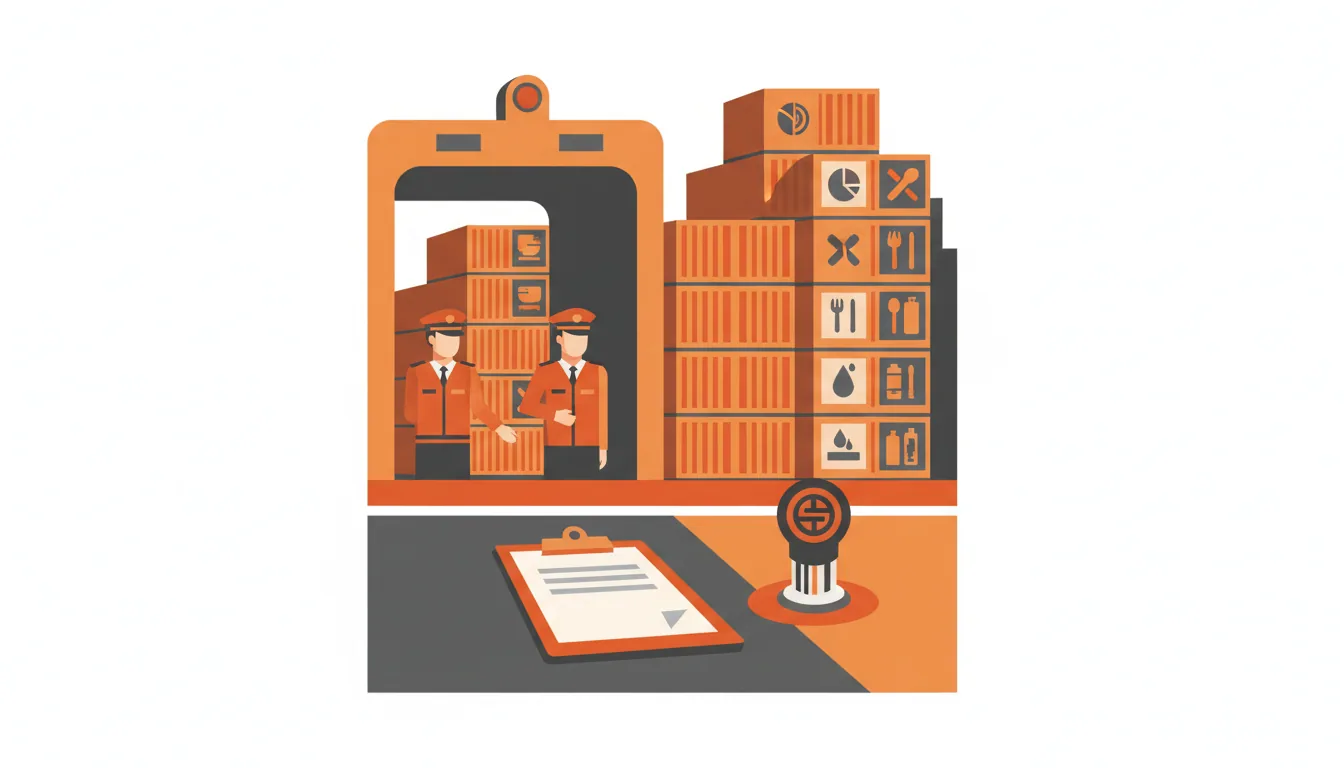
Importing Food and Hygiene Products into Korea: What Foreign Brands Actually Need to Register
Most foreign brands assume that importing into Korea is a single customs process. For general merchandise that is broadly true. But if your product is food, food-contact, or a hygiene item, Korea treats it as a licensed import category — meaning you cannot legally import and sell it under your business registration until you have gone through a specific licensing and examination regime first.
This post walks through the two licensing tracks that matter most for consumer brands: the Imported Food Business Registration (수입식품 영업등록) and the Hygiene Product Import Business Notification (위생용품수입업 영업신고). These are distinct systems, governed by different laws, with different deliverables — but they share a common logic that foreign brands consistently underestimate.
What Counts as "수입식품등" (Imported Food, etc.)
Under Korea's Special Act on Imported Food Safety Control, "수입식품등" is defined more broadly than the English phrase "imported food" suggests. It covers:
- Food and food additives under the Food Sanitation Act (식품위생법 §2)
- Utensils, containers, and packaging that come into direct contact with food under the same Act
- Health functional foods (건강기능식품) under the Health Functional Foods Act §3
- Livestock products (축산물) under the Livestock Products Sanitary Control Act §2
In practical terms: it is not just what people eat or drink. It is also the cups, bottles, utensils, cookware, and packaging materials that contact food. A stainless-steel water bottle, a silicone food storage container, and a branded ceramic mug all fall under 수입식품등 — not general merchandise.
To import any of these categories into Korea for sale, you must complete 수입식품 영업등록 (Imported Food Business Registration). Once registered, you are issued a 수입식품 영업등록증 — the certificate that entitles your business to import these items legally.
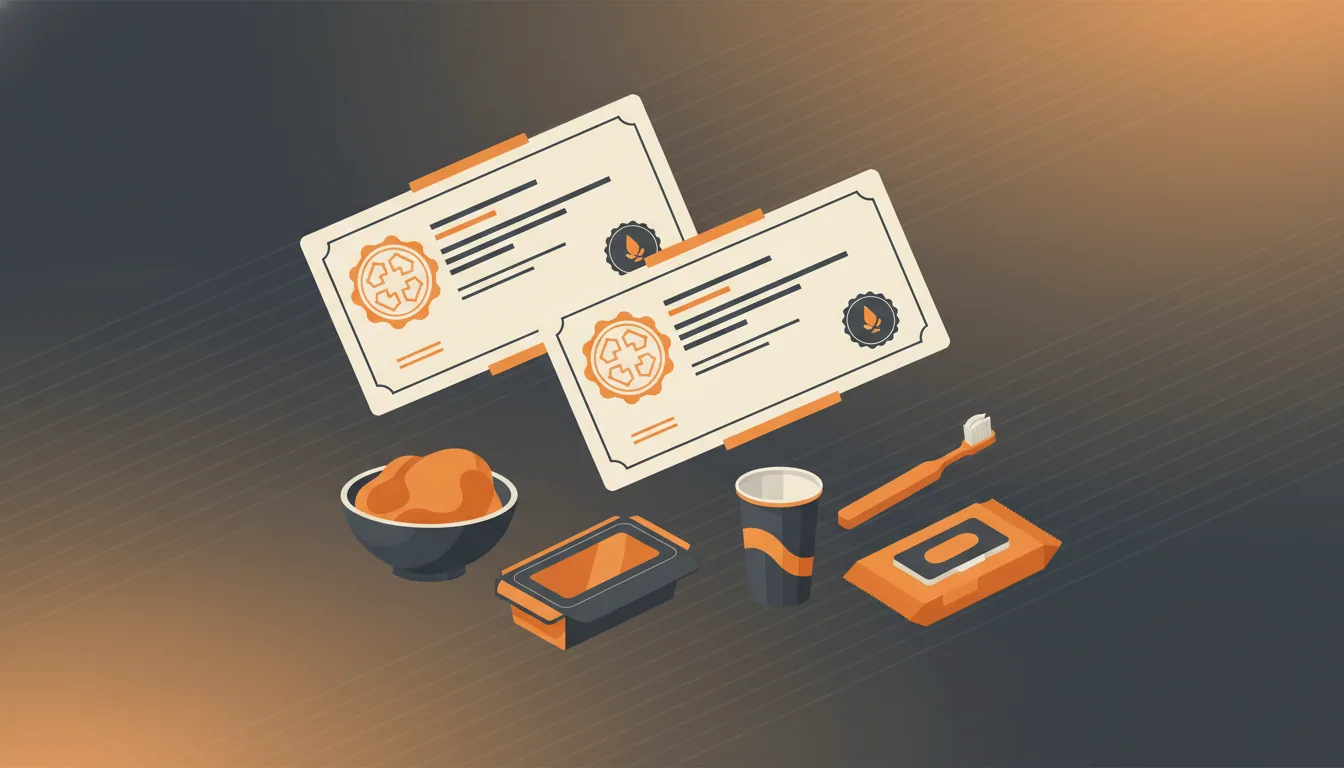
What Counts as a "위생용품" (Hygiene Product)
The hygiene product side is governed by a different statute entirely: the Hygiene Product Management Act (위생용품 관리법). One useful thing about this law is that the scope is enumerated — the categories are listed, so it is relatively easy to tell whether a product is in or out. Per Article 2:
- Cleaning agents — preparations for washing vegetables and fruits, and preparations for washing food containers, processing equipment, and cooking tools
- Rinse aids — used in the final rinse cycle of automatic dishwashers to remove residue and promote drying
- Sanitary wet towels (위생물수건) — packaged wet towels for hand-wiping use at food service establishments
- Oral care items — toothbrushes, dental floss, and tongue cleaners
- Tattoo inks — skin-coloring substances for tattooing, as further defined by Presidential Decree
- Other hygiene items — disposable cups, spoons, chopsticks, forks, knives, straws; tissue paper, disposable dishcloths, towels, paper napkins, packaged wet wipes for food service; disposable toothpicks, cotton swabs, diapers; and other items designated by Presidential Decree
A brand importing any of the above for sale must file 위생용품수입업 영업신고 (Hygiene Product Import Business Notification). The deliverable here is an 영업신고증 — a notification certificate, not a registration certificate. The legal nuance between "등록" (registration) and "신고" (notification) matters for how filings are processed, but from the operator's perspective, the functional outcome is the same: without it, you cannot import.
If you sell disposable kitchenware, paper products, oral care, or cleaning preparations into Korea, this is the license you need — and it is easy to overlook if you were assuming your product was a general consumer good. Our broader guide to selling on Coupang as a foreign brand covers how these category classifications interact with the platform-level onboarding.
Training, Examination, and the Obligations After Registration
Both regimes require the same gating step before a license is issued: mandatory training (교육 이수) and a prescribed examination (시험 응시). These are not token requirements. A designated representative must complete the training and pass the exam in Korean, under the issuing authority's rules, before the license application can be finalized.
Only after training, examination, and registration/notification does your business entity gain the legal right to import these products. And then — and this is the part foreign brands tend to miss — the work continues.
Getting the license is the starting line, not the finish line. Every subsequent shipment triggers a downstream workflow that must be executed correctly, every time.
Post-licensing, the ongoing obligations include at minimum:
- Foreign Manufacturer Registration (해외제조업소 등록) — the overseas factory producing the goods must be registered with Korean authorities before its products can enter.
- Korean-language labeling (한글라벨링) — applied to the product per the prescribed format, covering mandatory disclosures in the correct layout and font specifications.
- Import Declaration (수입신고) — a non-trivial filing for each shipment, distinct from a standard customs declaration.
- First-Time Precision Inspection (최초 수입 시 정밀 검사) — laboratory testing on the first import of a new product, with sampling and analysis against Korean standards.
This stacks on top of the general customs and Importer of Record process. If you want the broader framing of why the IoR function is a separate legal seat in Korea, we wrote about that here. And for electrical-adjacent categories, the compliance logic has its own parallel — our post on KC certification for USB and battery-powered devices covers how foreign test data can sometimes be reused, which is a different regime but a useful comparison point.

Why This Is Harder Than It Looks From Abroad
On paper, the sequence is legible: get trained, pass the exam, file the registration, register the factory, label the product, file the declaration, clear the inspection. In practice, each step has a Korean-language interface, a domestic-entity requirement, and a set of formatting conventions that are unforgiving of small mistakes.
A few specific frictions that foreign brands consistently run into:
- The training and examination must be completed by a named representative of a Korean business entity. If you have no Korean entity, there is no one to register.
- The overseas manufacturer registration requires factory-level disclosures (address, production lines, sanitary controls) that factories are sometimes reluctant to prepare until they understand why they are being asked.
- Korean labeling is format-sensitive. Labels that look fine to a non-Korean reader can fail at the border for font-size or placement issues.
- First-time precision inspection adds lead time and cost that are rarely factored into initial launch plans.
This is why we often recommend foreign brands get their operational foundation in place before scaling ad spend — licensing and compliance are the slowest part of the critical path, and ads cannot outrun a shipment that is stuck at customs.

How Spark Handles This for Foreign Brands
The reason we built Spark is that most foreign brands do not want to — and realistically cannot — build this entire stack from scratch before they have sold anything in Korea. Setting up a Korean entity, completing training in Korean, passing the examination, filing the business registration, registering every foreign manufacturer, managing labeling, and running import declarations is a full operational function, not a side task.
Under Spark, Kontactic acts as your Importer of Record and Seller of Record in Korea. The licenses, registrations, and import filings run under our entity. Your role becomes what it should be: making the product and approving what goes to market. We handle the import. You handle the brand. Under our agreement, you remain responsible for product compliance and indemnify us.
Spark comes in two forms. Spark Subscription is for selling on Coupang and is open only to Coupang-approved sellers in mainland China. Spark Project is open to brands of any nationality for one defined project — supplying Korean wholesalers or retailers, a pop-up or exhibition, or a one-off import — and each project is reviewed and quoted on its own. If you want to sell in Korea continuously in your own name, the other route is your own Korean entity, which holds the licenses itself; with Blaze, we run that entity's administration, registrations, and import coordination as its operating agent.
“If the license sits under the seller's entity, the seller has to become a Korean regulatory operator. Under Spark, that burden sits with us — so the brand can focus on actually selling.”
Isaac Lee — CEO, Kontactic
This is the same reason the IoR/SoR model is structurally useful for categories with heavy licensing overhead: the compliance seat has to sit somewhere local, and consolidating it under an operator that already runs these workflows is usually the fastest path to a live listing.
Planning to import food, food-contact, or hygiene products into Korea?
Tell us the category and we'll map out whether you need 수입식품 영업등록, 위생용품수입업 영업신고, or both — and whether Spark can carry the licensing for you or it should sit with your own Korean entity.
About the author
Korean and global e-commerce operators with 15+ years of cross-border experience, led by CEO Isaac Lee — KOTRA-certified consultant and official lecturer for Seoul City and the Korea Customs Service. We run Korea market entry for overseas brands every day; this blog records what we learn in the field.
More about Kontactic →Related Articles
Coupang Rocket Growth Stock: Can an ERP Set It via API?
An ERP cannot set Coupang Rocket Growth stock through the Open API; replenishment starts when Coupang physically receives a new inbound shipment of stock.
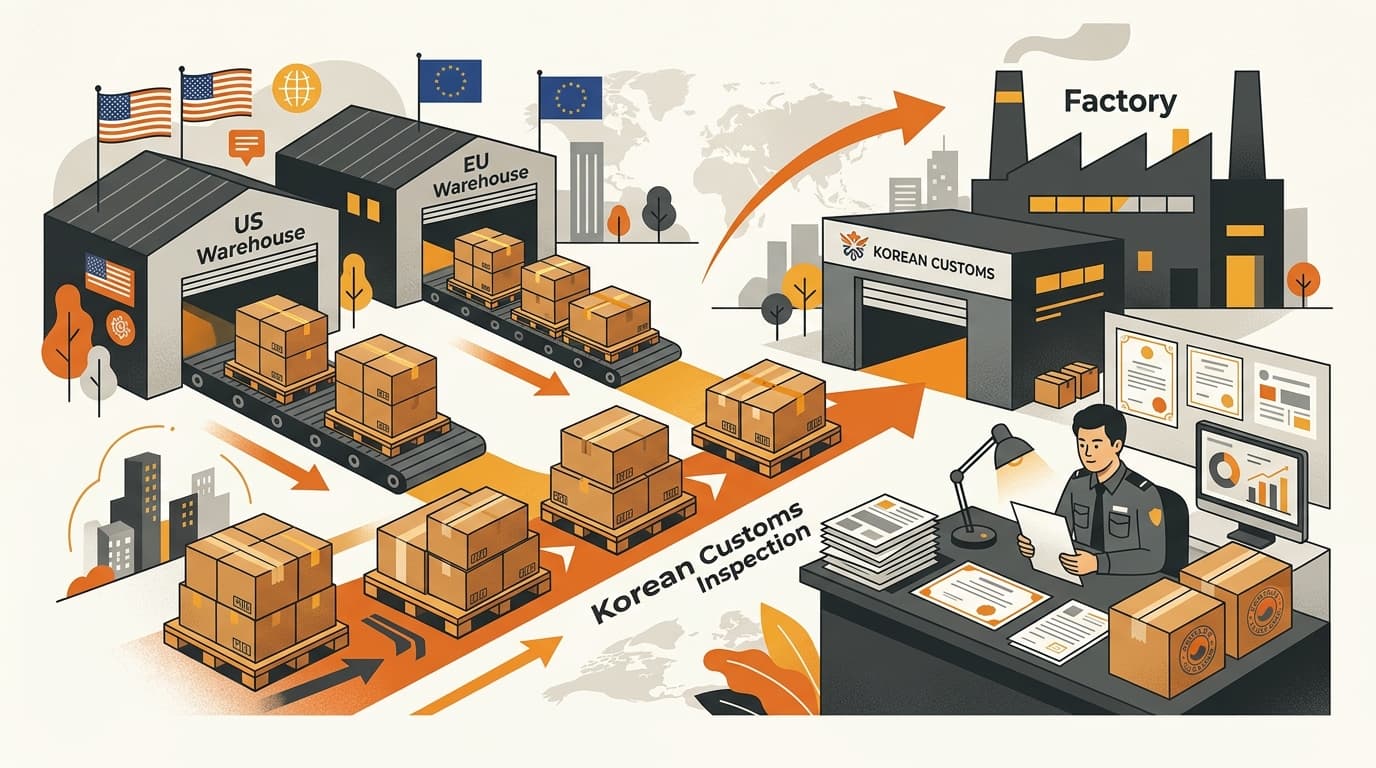
Korea FTA Duty: US/EU Warehouse Shipping Is Not Enough
A US or EU warehouse does not prove FTA origin in Korea. The importer must verify production, transit, and documents before claiming a lower customs duty rate.

Agentic Commerce: When AI Picks the Product, What Should Brands Selling in Korea Do?
AI shopping agents now search, compare, and sometimes buy for the shopper, and they recommend 1–5 products instead of a page of results. What Korea's Chamber of Commerce found in the US and Europe, and what it means for your product data in Korea.