
Korea Setup Fee: What Costs Extra After Year One?
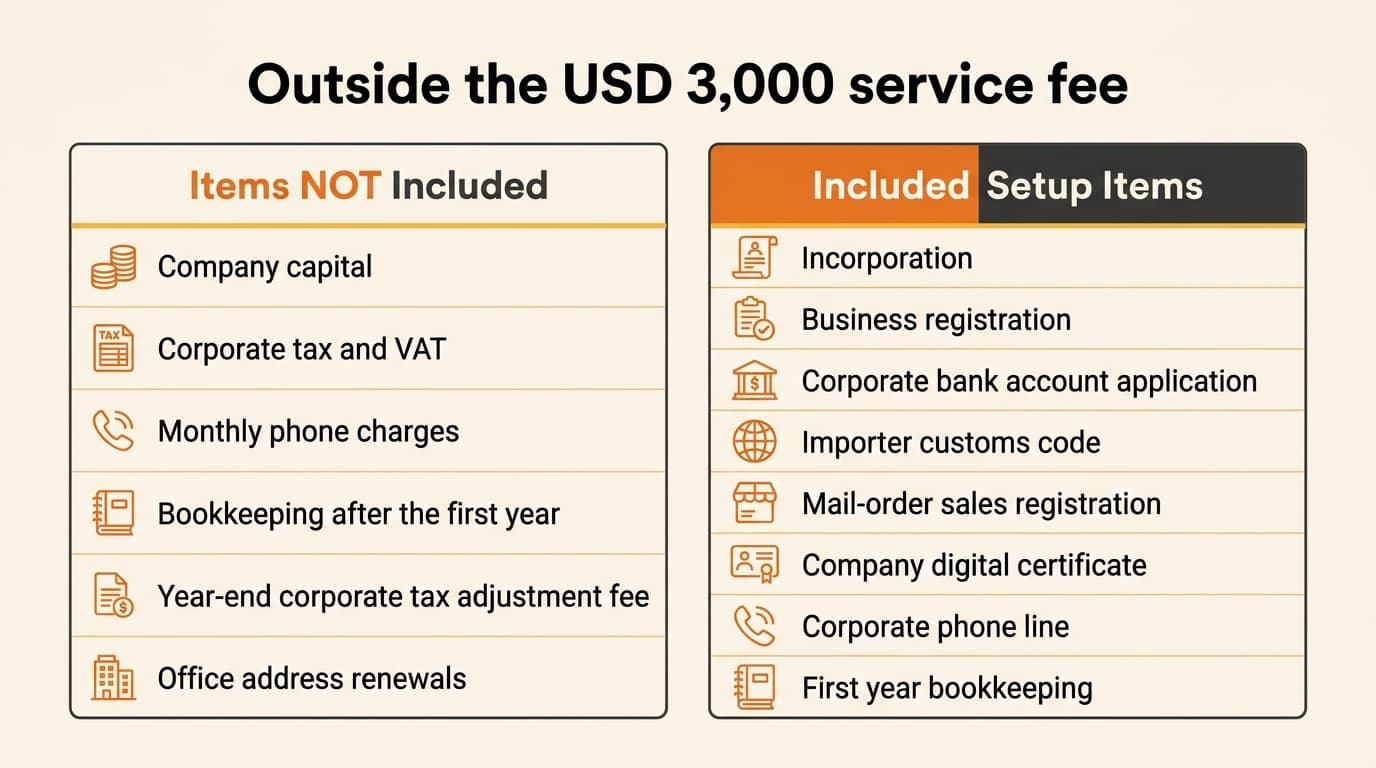
Yes. Kontactic’s USD 3,000 one-time fee covers company setup and first-year bookkeeping. After the first year, bookkeeping is extra. Monthly phone charges, office-address renewals, corporate tax, and value-added tax (VAT) are separate. The year-end corporate tax adjustment fee is separate too. Company capital is owner funding, not a service fee. The company setup process takes about six to eight weeks.
What the one-time setup fee covers
The fee covers the work needed to create the Korean company and prepare its basic registrations. It includes seven items:
- Incorporation of a Korean limited company (유한회사). The formation filing creates the legal company.
- Business registration. The new company is registered for business activity.
- Corporate bank account application. The application is prepared and submitted. The bank makes the final decision.
- Importer customs code. The company obtains the customs code used for import declarations.
- Mail-order sales registration. The company completes the registration for selling by mail or online.
- Company digital certificate and corporate phone line. The company receives its digital certificate and sets up the corporate phone line. Monthly phone charges remain separate.
- First-year bookkeeping. The company’s books are handled during the first year. This service does not extend automatically into later years. The year-end corporate tax adjustment fee is separate.
These are company setup actions, not Coupang launch work; read our explanation of who is the Importer of Record when you sell on Coupang before planning imports. For the formation calendar itself, read our Korean limited-company setup cost and timeline guide.

Which costs remain after setup
Every row below sits outside the USD 3,000 service fee. Some rows are taxes or owner funding, not fees paid to Kontactic.
| Cost outside the setup fee | What it means |
|---|---|
| Company capital | Money the owner puts into the company. It is not payment for the setup service. |
| Corporate tax and value-added tax (VAT) | Taxes the company may owe. Korea’s VAT rate is 10%, but the amount depends on what the company sells and reports. |
| Monthly phone charges | The recurring telecom bill after the corporate phone line is set up. |
| Bookkeeping after the first year | Bookkeeping for later periods after the included first year ends. |
| Year-end corporate tax adjustment fee | A separate accountant charge for the annual tax adjustment. It is not the tax itself. |
| Office address renewals | Any later renewal charge for the company’s office address. Confirm the period covered by the quote. |
Capital needs a clear line of its own. It is the owner’s money put into the company, not revenue to the company-formation provider. Our guide to Korean limited-company capital and compliance explains why capital and a setup fee are different budget lines.
Small Korean sales do not remove every company bill. A company with little revenue can still have phone charges, an address renewal, bookkeeping work, and tax work. Lower sales may reduce the amount of bookkeeping, but they do not make every continuing cost zero.
Treat the USD 3,000 as a setup line, not as a full first-year operating budget.
Why six to eight weeks still includes a bank decision
The company setup process takes about six to eight weeks. The bank application is part of that process, but the timeline does not promise approval.
The bank decides whether to open the account and what wire limit it gives you.
Kontactic’s setup fee covers the application, not the bank’s decision or the account’s wire limit. This matters when a foreign owner plans to send money to Korea, pay a Korean supplier, or fund the company’s operating bills.
For example, a foreign founder may finish incorporation and business registration while the bank is still reviewing the application. Registering the company does not guarantee a usable corporate bank account. Plan large transfers around the wire limit the bank actually gives you. Our guide to Korean corporate bank accounts explains why this step deserves its own check.

Questions to ask before you sign a setup quote
Ask for the answers in writing. A short list keeps the one-time price separate from the full Korea budget.
- What exactly is included in the USD 3,000? Confirm the seven setup items, not only the words “company formation.”
- What dates does first-year bookkeeping cover? Ask when it starts, when it ends, and whether the year-end corporate tax adjustment fee is separate.
- Does the phone item mean line setup only? Confirm that monthly phone charges are outside the one-time fee.
- When does the office address need renewal? Ask which period the quote covers and the date of the next renewal.
- Which money belongs to the company? Keep owner-funded capital separate from service fees, corporate tax, and VAT.
- Is the bank item an application or an open account? Confirm that the quote covers the application, not approval or a promised wire limit.
- Which selling tasks are separate? Ask whether Coupang account setup, Korean product-page work, product compliance, fulfillment, returns, or advertising appears in another quote.
Keep three budget lines: USD 3,000 for setup; company capital; and ongoing taxes, phone bills, address renewals, import costs, and selling costs. Keeping those lines apart makes the first-year price easier to understand.
Need a clear Korea setup budget?
Send us your planned entity, products, and sales plan. We can help separate the one-time company setup from recurring costs and the work needed to sell in Korea.
About the author
Korean and global e-commerce operators with 15+ years of cross-border experience, led by CEO Isaac Lee — KOTRA-certified consultant and official lecturer for Seoul City and the Korea Customs Service. We run Korea market entry for overseas brands every day; this blog records what we learn in the field.
Meet the Kontactic team →Related Articles

Korea Mail-Order Registration: Documents You Need
What documents do you need for Korea mail-order registration? Use this checklist for the business certificate, ID, payment proof, timing, and filing cost.

Can I Upload Korean Registration Paperwork as One PDF?
Upload Korean registration paperwork as one PDF: Seller Center separates pages, matches review items, and keeps the tax payment confirmation with the packet.

Yuhan-Hoesa Documents: Notary, Apostille or Translation?
Not every foreign document needs all three. Learn when a Korean yuhan-hoesa filing may need notarization, an apostille or legalization, and Korean translation.