
Korean Dividend Withholding Tax for Foreign Parents: 22%
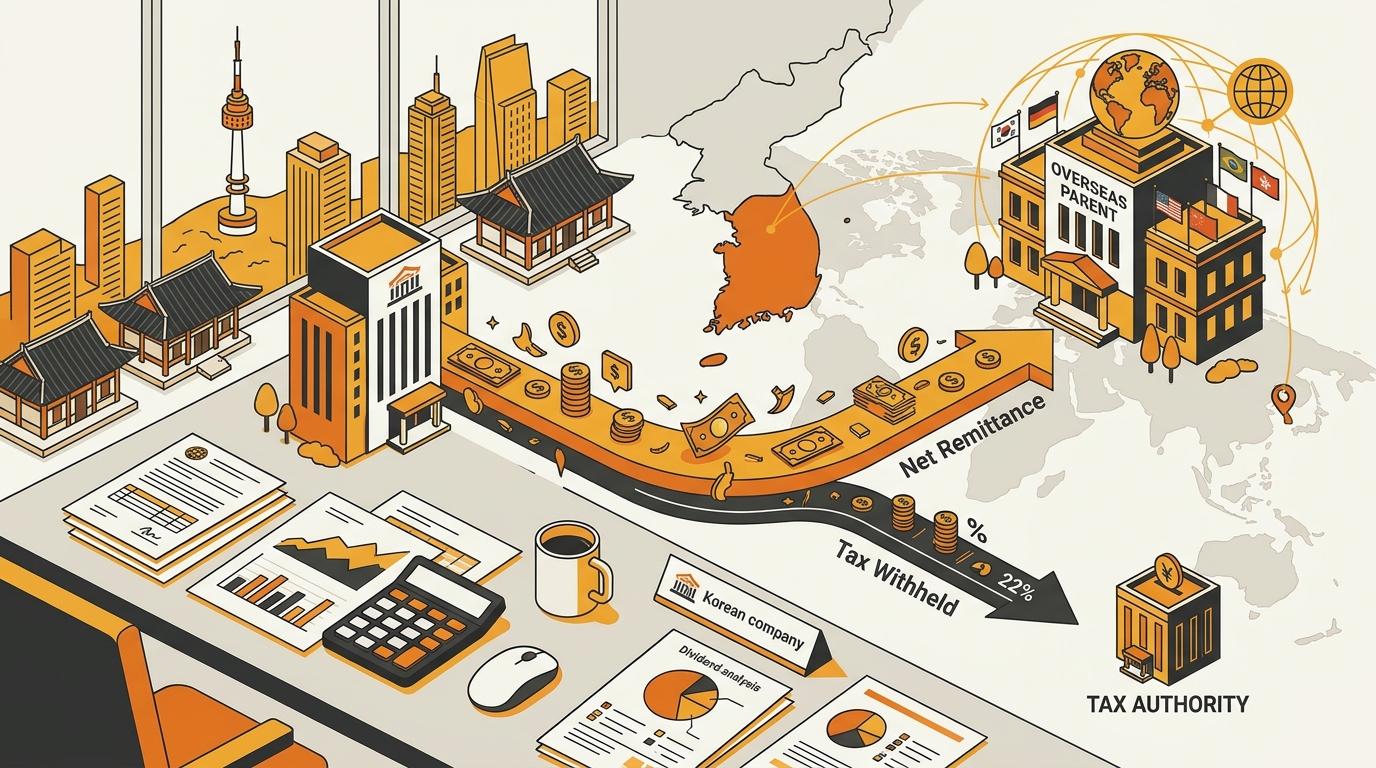
Plan for 22% Korean withholding on a dividend paid by a Korean company to a foreign parent. The company withholds the tax before sending the balance. A treaty may lower the rate based on the parent’s country, ownership, and documents.
The short answer: start with 22%, then check the treaty
Withholding tax (WHT) is tax taken out before the recipient receives a payment. For a dividend from a Korean company to a foreign parent company, use 22% as the practical domestic figure before treaty relief.
That figure applies to the gross dividend. The gross dividend is the full amount approved for the parent before tax. It is not the Korean company’s gross Coupang sales.
If the approved dividend is KRW 100 million (100 million Korean won) and no treaty reduction applies, the Korean company withholds KRW 22 million. It sends KRW 78 million to the parent. Bank fees and foreign-exchange costs are separate from that calculation.
Some Korean sources list 20%. That is usually the national part; the local income-tax part brings the combined figure to 22%. The 22% figure is the combined amount commonly used for cash planning. Ask the Korean tax accountant to confirm the current calculation for the payment.
A tax treaty may reduce Korean withholding. Public summaries often show treaty dividend rates in the 5%–15% range, depending on the treaty and the parent’s ownership level. Do not use that range as your rate. One treaty may set different rates for different ownership levels, and the quoted percentage may not include the full Korean tax calculation.
The parent normally needs to qualify as a tax resident of the treaty country. The Korean company may also need a tax residence certificate and other treaty-relief information before using the lower rate. Start with the National Tax Service’s Korean taxation guide, then have an adviser check the current treaty text and filing practice.
Do not confuse this answer with the 14% dividend rate often shown for resident individuals. A foreign parent company is a different recipient. Korean value-added tax (VAT) is separate. Its standard rate is 10%; it is not dividend withholding tax.
A treaty percentage is not a number to paste into a bank instruction. Confirm the treaty article, the parent’s ownership facts, the residence certificate, and whether the quoted percentage includes any Korean local tax.
A Coupang payout is not automatically a dividend
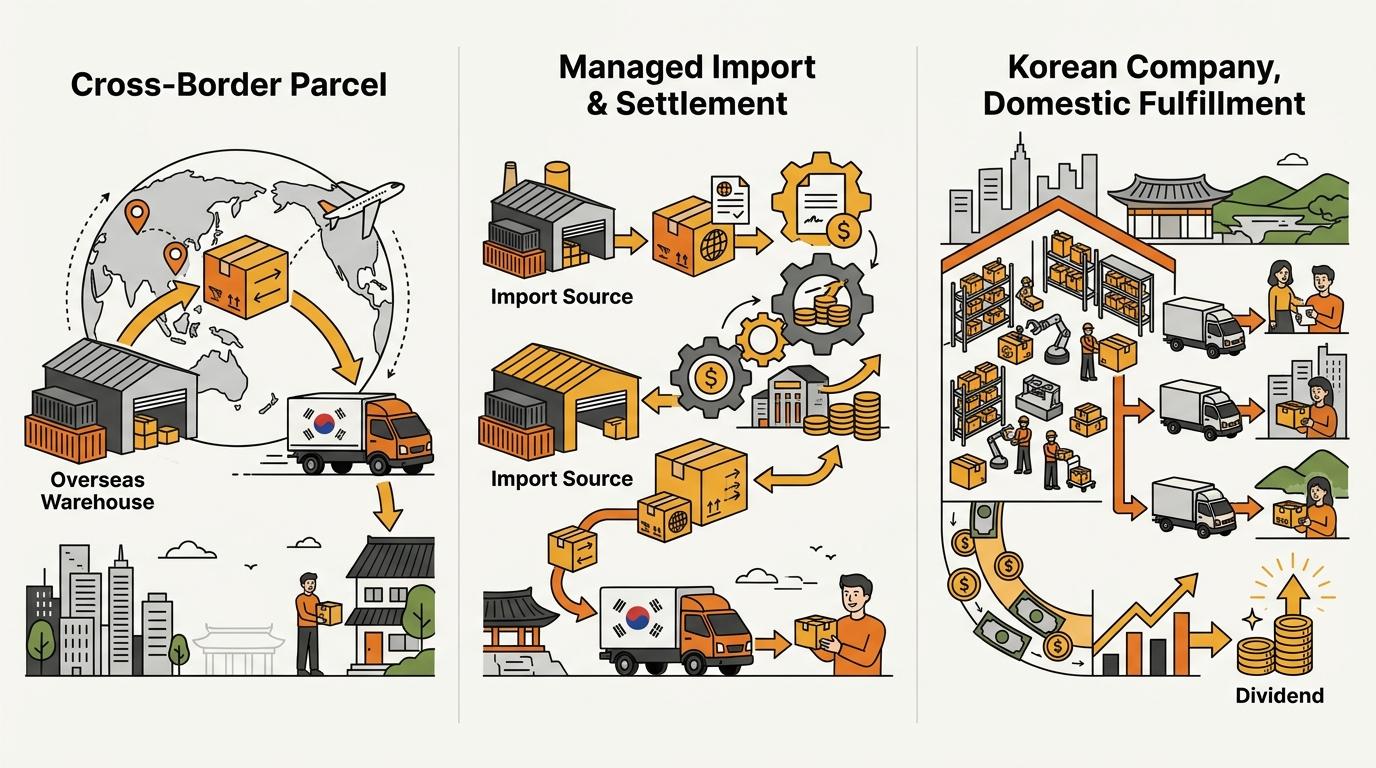
A Coupang settlement is not automatically a dividend. A brand can sell to Korean shoppers without a Korean company, or through a Korean company owned by its foreign parent. A client-owned Korean company can pay a dividend after it approves a distribution.
| Sales setup | Who sells and imports? | Is a foreign-parent dividend involved? |
|---|---|---|
| Direct | A brand shipping from the US, Europe, Japan, mainland China, or Hong Kong sells through its own cross-border Coupang seller account. Korean shoppers import through Coupang Global Fulfillment (CGF). | Normally no. No Korean company on the brand’s side pays a dividend. |
| Spark Subscription | For a Coupang seller in mainland China approved by Coupang, the service entity imports the goods and makes the legal sale. | No. The brand receives a settlement or purchase-price payment, not a dividend. |
| Blaze | The client owns a Korean limited company (유한회사). That company sells and imports. | Potentially yes. The Korean company may pay an approved dividend to its foreign parent. |
The key question is who makes the payment. A Direct or Spark Subscription payment is not a dividend from a Korean subsidiary. Under Blaze, the Korean company may pay an approved dividend to its foreign parent.
Under Blaze, do not multiply Coupang gross sales by 22%. First calculate the amount the Korean company can approve for distribution. Include platform fees, advertising, refunds and cancellations, freight, import duties and import VAT, and other company costs in the calculation.
The company that files customs and sales paperwork may not be the company that pays your foreign parent. Confirm the legal payer before calculating withholding.
Use How to Sell on Coupang as a Foreign Brand: Complete Guide for the wider channel decision. See Repatriating Korea Sales Revenue to the US or Europe for the cash transfer. For cost categories, see Who Pays for What in Korea: Operating Costs Explained.
Documents and people needed before the payment
Prepare the payment documents before the Korean company sets a transfer date. The exact list depends on the treaty, the company’s governing documents, the bank, and whether treaty relief is requested.
-
Confirm the payment facts. Write down the Korean payer, the foreign parent’s legal name and country, the ownership percentage, the gross dividend, the currency, and the intended payment date. Keep the foreign parent’s bank account in the same legal name as the recipient where possible.
-
Gather the treaty documents. Ask the parent’s home tax authority for a current tax residence certificate if the treaty requires one. Prepare the parent’s legal-entity details and ownership information. Ask the adviser which treaty-relief form or statement must be submitted before payment. A company registry extract proves that the parent exists, but it may not prove tax residence.
-
Approve the dividend inside the Korean company. Prepare the accounts or profit calculation that supports the dividend. Also prepare the required corporate approval, such as a resolution or meeting minutes, if the company documents require it. The Korean company’s authorized representative signs its documents. The foreign parent may also need an authorized officer or shareholder representative to sign a declaration or acceptance.
-
Calculate and withhold the tax. The Korean company calculates the domestic amount or the confirmed treaty amount. It withholds the tax before remitting the balance to the foreign parent. It then completes the related Korean tax filing and payment. Keep the withholding calculation and proof that the Korean company paid the tax. The parent may need the receipt to report the payment or claim a foreign tax credit.
-
Prepare the bank packet. The bank may ask for the dividend approval, the resolution or meeting minutes, recipient details, tax proof, and a signed payment instruction. It can also ask about the payment or request more identity and business-verification documents. Do not assume that a bank will accept the same documents as the tax accountant.
No withholding rule requires the foreign parent’s director to appear in Korea. A Korean bank can still require its own verification or an in-person signer. Confirm that point with the bank before anyone books travel. If a foreign document needs a Korean translation, notarization, or an apostille, confirm the receiving party’s requirement before ordering it.
For the work after a Korean company is formed, see Korean Entity Administration: What Happens After Setup?. For bank checks, Korean Corporate Bank Accounts: The Last Wall Foreign Founders Hit explains why account review and transfer limits should not be assumed in advance.

Timing and cost: what can be said honestly
There is no single processing time or fixed government fee for every Korean dividend payment to a foreign parent. Timing depends on four steps: obtaining the treaty documents, approving the dividend, calculating and filing the Korean tax, and passing the bank’s review.
A foreign tax residence certificate can control when treaty relief can start. The bank can add its own review after the Korean company prepares the tax documents. Start before the intended payment date instead of promising a fixed number of days.
The main cash cost is the withholding itself. At the 22% domestic planning figure, every KRW 100 million of approved gross dividend means KRW 22 million is withheld for Korean tax. A lower treaty rate may reduce that amount, but only after the treaty conditions and documents are confirmed.
Other costs are separate. They may include the Korean tax accountant’s work, translation, notarization or apostille work if required, bank charges, and foreign-exchange costs. None of these is the withholding rate. Ask for a quote that separates tax withheld from professional and bank charges.
The foreign parent may also have tax in its home country. A possible foreign tax credit or other relief is not the same as cash received from Korea. The parent’s home-country adviser must confirm whether Korean tax can be used in that way.
Keep three numbers separate in every approval file: the gross dividend, the Korean tax withheld, and the net amount sent to the parent. Keep bank fees and foreign-exchange differences outside those three numbers.
Five questions to answer before authorizing the transfer
Use this short check before the Korean company sends money:
- Is the payer a Korean company, rather than a platform, a third-party logistics provider, or an overseas seller account?
- Is the recipient a foreign parent company, and is its treaty residence confirmed?
- Has an adviser confirmed the domestic 22% calculation or the exact treaty rate, including any local-tax component?
- Are the parent’s residence document, corporate approval, tax proof, bank details, and required signatures ready?
- Have Coupang fees, storage, fulfillment, returns, import duties and import VAT, and other local costs been reconciled before approving the dividend amount?
Need to plan a Korea cash flow?
If you are deciding between cross-border Coupang sales and a Korean entity, contact Kontactic to review who imports, who sells, how local costs are paid, and what documents your dividend plan needs.
About the author
Korean and global e-commerce operators with 15+ years of cross-border experience, led by CEO Isaac Lee — KOTRA-certified consultant and official lecturer for Seoul City and the Korea Customs Service. We run Korea market entry for overseas brands every day; this blog records what we learn in the field.
Meet the Kontactic team →Related Articles

Korean Commercial Lease vs Virtual Office: Which Fits?
Korean commercial lease vs virtual office: choose the address that matches your company’s real work, import role, Coupang plan, and banking needs in Korea.

How Long Do Korean Registry Extracts and Seal Certificates Take?
A Korean registry extract and corporate seal certificate can often be issued the same day. See what must be ready, who may need to appear, and what takes longer.

Can an Employee Use a Corporate OTP When the Director Is Abroad?
Can a Korean company employee use the corporate OTP or joint certificate while a foreign director is overseas? Learn the safe setup, documents, and limits.