
US Food Brand Korea Market Entry: A Realistic Timeline
A realistic Korea market entry timeline for a US food brand runs roughly 6 to 10 months from decision to first local shipment. The calendar is driven less by Coupang or shipping than by two gated steps: Korean entity formation and food import registration with the Ministry of Food and Drug Safety (MFDS). Almost everything else can run in parallel.
This guide is for founders and heads of international at US food brands that already see Korean cross-border demand — through Amazon Global, a Shopify storefront, or a small specialty importer — and now want to go local. The aim is not a brochure-style overview. It is to separate what you can move quickly from what is gated by regulators, and to flag the operational tradeoffs that only surface after you start selling.
What "decision to first shipment" actually means
Before mapping a timeline, it helps to define the endpoints, because most generic guides quietly conflate them.
Decision = the moment your team commits budget and signs off on the Korea entry path (cross-border vs. local, own entity vs. partner). It is not the moment you "start thinking about Korea." Thinking is free; the clock only starts when someone is funded to execute.
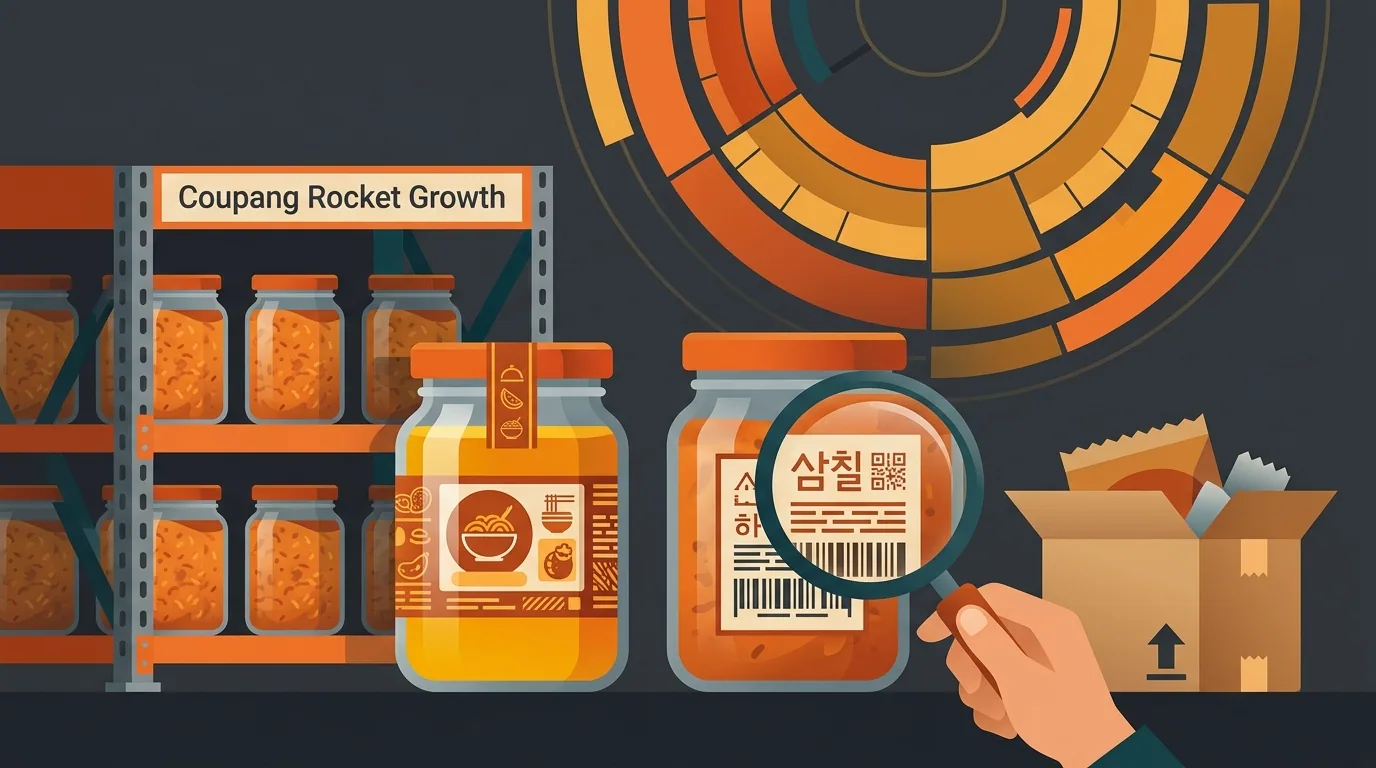
First shipment = the first inbound container or pallet that clears Korean customs under a Korean Importer of Record (IoR), is received at a domestic warehouse — usually Coupang's Rocket Growth (로켓그로스) — and is available to ship to a Korean consumer in KRW.
If your reference point is instead "first cross-border sale via Amazon Global," that timeline is days, not months. But cross-border is a different model with different economics. This article assumes you've already decided to localize.

The 6-to-10 month timeline, stage by stage
The shape below is adapted from the same logic we use for supplement entries — see our 5-to-8 month supplement timeline — but widened for general food, where MFDS food import registration and label review tend to take longer than a clean Coupang category like home goods, and shorter than functional health foods.
Stage 1: Decision and structure — 2 to 4 weeks
This is the part most founders skip on the calendar and then pay for later. Before incorporating anything, decide:
- Cross-border, IoR-only, or own Korean entity (유한회사)?
- Who funds inventory, ads, and platform fees? (Under every Kontactic tier, the client funds these — see who pays for what in Korea.)
- Which SKUs go first? Food rarely launches with a 40-SKU catalog. Pick 3–8 hero SKUs.
- What is the realistic landed cost per unit at DDP (Delivered Duty Paid) terms?
If this stage compresses to a week, fine. If it stretches past a month because of internal alignment, that is your real bottleneck — not Korea.
Stage 2: Korean entity formation — 4 to 8 weeks
A Korean limited company (유한회사) takes roughly 4 to 8 weeks to stand up end-to-end as a non-resident foreign founder, with the registered office, court registry filing, tax office registration, and corporate bank account in sequence. The bank account is often the slowest step. Treat anyone who quotes "two weeks total" with caution.
If you go the IoR-only route (no client entity), you skip this stage but accept different tradeoffs in control, branding, and long-term margin.
Stage 3: MFDS food import registration and label review — 8 to 16 weeks
This is the longest stage and the one US food founders most consistently underestimate. Korea treats food, food-contact items, and hygiene products as licensed import categories, not regular goods. The detail varies by sub-category (general food, processed food, agricultural products, food-contact materials, health-functional food), and we walk through the registration logic in importing food and hygiene products into Korea.
Roughly, this stage includes:
- Importer registration with the relevant Korean authority
- Ingredient and additive review against Korean food code (some additives permitted in the US are restricted in Korea)
- Korean-language label design and review
- First-import sampling and inspection at the port
The 8-to-16 week range assumes no formulation problems. A single non-compliant ingredient can add months because the answer is reformulation, not appeals.
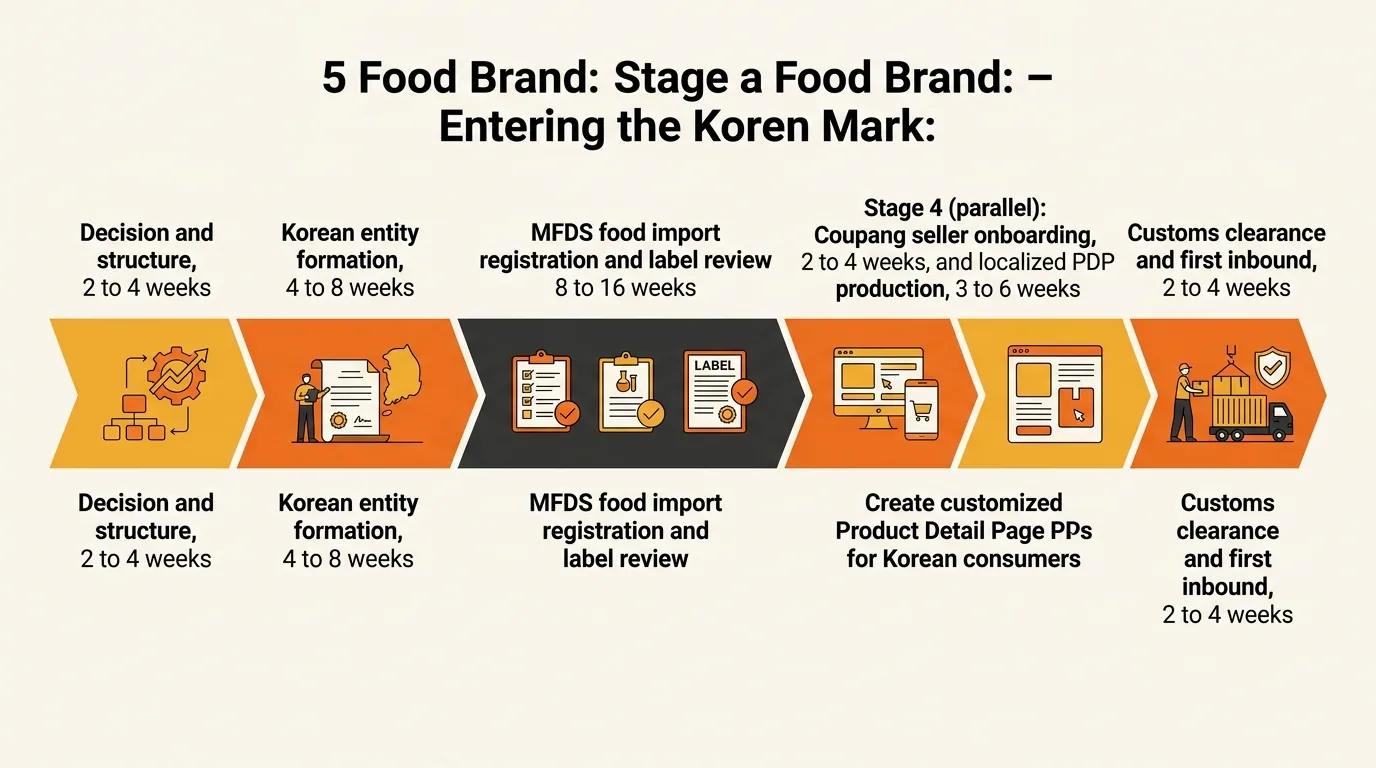
Stage 4: Coupang seller onboarding and localized PDP — 2 to 6 weeks (parallel)
Coupang seller onboarding itself takes 2 to 4 weeks once your Korean entity, business registration, and bank account exist. Localized Product Detail Page (PDP) production — the long, 20,000-pixel Korean-language visual page that actually converts on Coupang — takes another 3 to 6 weeks of design work and copy localization.
Both run in parallel with Stage 3, which is why the total timeline does not simply add every stage. A well-sequenced project finishes the PDP and Coupang seller account around the same time MFDS clears the product, so listing goes live the moment inventory lands.
Stage 5: Customs clearance and first inbound — 2 to 4 weeks
Once registration is cleared and labels are approved, the first inbound shipment is comparatively mechanical: ocean freight from a US port to Busan or Incheon, customs clearance under the IoR, transport to a Rocket Growth fulfillment center, and SKU activation. Plan for 2 to 4 weeks for this stage, including buffer for the first-import inspection that food shipments routinely undergo.
If you are scoping the cost side in parallel — IoR, customs, label review, Coupang setup — we break down typical line items in Korea food import agency fees.
What can move fast vs. what is genuinely gated
A useful operational frame: every Korea entry task is either parallelizable or gated by a third party.
Parallelizable (you control the speed):
- SKU selection and pricing strategy
- Korean translation of product copy
- PDP design and creative production
- Coupang seller onboarding paperwork
- Inventory production and US-side logistics
- Brand assets, photography, review-seeding plan
Gated (a Korean regulator, bank, or platform controls the speed):
- Corporate bank account opening
- MFDS food import registration
- Label review
- First-import customs inspection
- Coupang account approval
The single biggest mistake we see is founders pouring energy into the parallelizable column — beautiful PDPs, polished decks, ad creative — while the gated column sits idle for weeks. Start the gated work on day one of Stage 2. Everything else can catch up later.
What founders underestimate after the first shipment lands
A timeline that ends at "first sale" is honest but incomplete. The operational tradeoffs that most reshape margin show up in the first 60 to 90 days of selling, not at launch.
Settlement timing eats working capital
Coupang's default settlement pays sellers on the 20th business day of the following month — close to 60 calendar days from sale to cash in your Korean bank account. For food, where you may also be paying for cold-chain or temperature-controlled storage, the working capital gap is real. We compare default, weekly, and fast settlement options in Coupang settlement timelines.
Labels are a permanent operating cost, not a one-time project
The Korean food label you submit in Stage 3 is the label on every unit you sell — forever, or until you change the formulation. Many US brands assume they can update nutrition panels or claims quickly. They cannot, not without revisiting MFDS review. Budget for label revisions as a recurring quarterly conversation, not an annual one.
Returns logic is different for food
Rocket Growth returns handling assumes a standard physical product. Food returns are constrained by hygiene rules, expiration dates, and category-specific restrictions. Plan for higher non-resaleable rates than you would model in the US, and price your hero SKUs accordingly.
Conversion is gated by trust signals you cannot fast-forward
Korean consumers buying imported food look at three things on a Coupang PDP: Korean-language ingredient transparency, review count, and "Rocket" delivery eligibility. The first two take time. Brands that try to compensate by pouring ad spend into a cold listing usually waste budget — a point we make in operational readiness before ad spend.
In our experience, the brands that hit "first profitable month" fastest are the ones that protected the first 30 days for review seeding and listing optimization, not the ones that turned on Coupang PPC the day inventory landed.
A Korea-specific decision framework
If you take one operational frame from this article, take this:
-
Anchor on the gated path. Your real timeline is whichever of (a) entity + bank, (b) MFDS food import registration, or (c) Coupang account approval finishes last. Plan inventory production to land 2–3 weeks after the latest of those three.
-
Don't pay for parallel work you'll redo. A PDP designed before SKU selection is locked is a PDP you will redo. Translation done before label review is translation you will redo. Sequence creative work to start after the gated paperwork is in motion, not before.
-
Budget for two launch windows, not one. Korean retail has natural sales peaks (Chuseok, Lunar New Year, end-of-year shopping). If your timeline slips past one peak, target the next — don't launch into a flat week just to "meet the deadline."
-
Decide the entity question first, not last. The choice between own Korean entity, IoR-only partner, or a fully managed setup determines every downstream cost, control point, and timeline. It is the single highest-leverage decision in the entire calendar.
The honest answer to "how long?"
For a US food brand starting from zero with proven cross-border demand and a clean formulation:
- Aggressive but realistic: 6 months to first shipment
- Typical: 7 to 8 months
- Common when MFDS or banking slips: 9 to 10 months
Anyone quoting you 3 months for a US food brand entering Korea locally is either selling cross-border (different model) or skipping a step you will discover later. Anyone quoting 12+ months without a specific blocker is padding.
The realistic answer sits in the middle, and the difference between 6 and 10 months is almost entirely operational sequencing — which is, fortunately, the part you can control.
Plan your Korea food launch with realistic dates
If you want a stage-by-stage timeline tied to your specific SKUs, formulation, and target Coupang launch window, talk to the Kontactic team.
About the author
Korean and global e-commerce operators with 15+ years of cross-border experience, led by CEO Isaac Lee — KOTRA-certified consultant and official lecturer for Seoul City and the Korea Customs Service. We run Korea market entry for Western brands every day; this blog documents what we learn in the field.
More about Kontactic →Related Articles

Children’s Product KC: Does “Ages 13+” Avoid the Rules?
No. In Korea, “Ages 13+” is only one factor; design, intended use, packaging, and child-directed marketing can still trigger children’s-product KC rules.

Korean KC for a Detachable Device Charger: Not Automatic
Does Korean KC cover a detachable charger? Not automatically. The final bundle and adapter evidence must match the Korean commercial SKU before import.
Can Coupang Handle Every Korean Buyer Inquiry? No—Seller Duties
Coupang may handle platform and fulfillment contacts, but sellers still own product questions, cancellations, returns, exchanges, and order exceptions.