
How Coupang Item Matching Triggers Trademark Complaints
Coupang's item matching system can automatically merge two separate product listings into one — and that merge can be read by another seller as deliberate trademark infringement. When a complaint reaches the Korean police, the listed seller must show up in person. If you are selling from abroad without local representation, you cannot.
This is a working note from a case we handled in early 2026 for one of our Spark Subscription clients. We are publishing it because the mechanism is not obvious to brands entering Korea, and because the downstream legal exposure is real even when the seller did nothing wrong.
What actually happened
About a month before this note, we received a phone call from the Korean police. They had a complaint on file from a Korean trademark holder claiming that one of our clients had infringed their registered trademark on Coupang.
The product was a lunch bag — ordinary household goods, not a regulated category like cosmetics or food. The complainant was a local Korean seller with a trademark properly registered through the Korean Intellectual Property Office (KIPO). At first read, this looked like a straightforward IP dispute.
It was not.
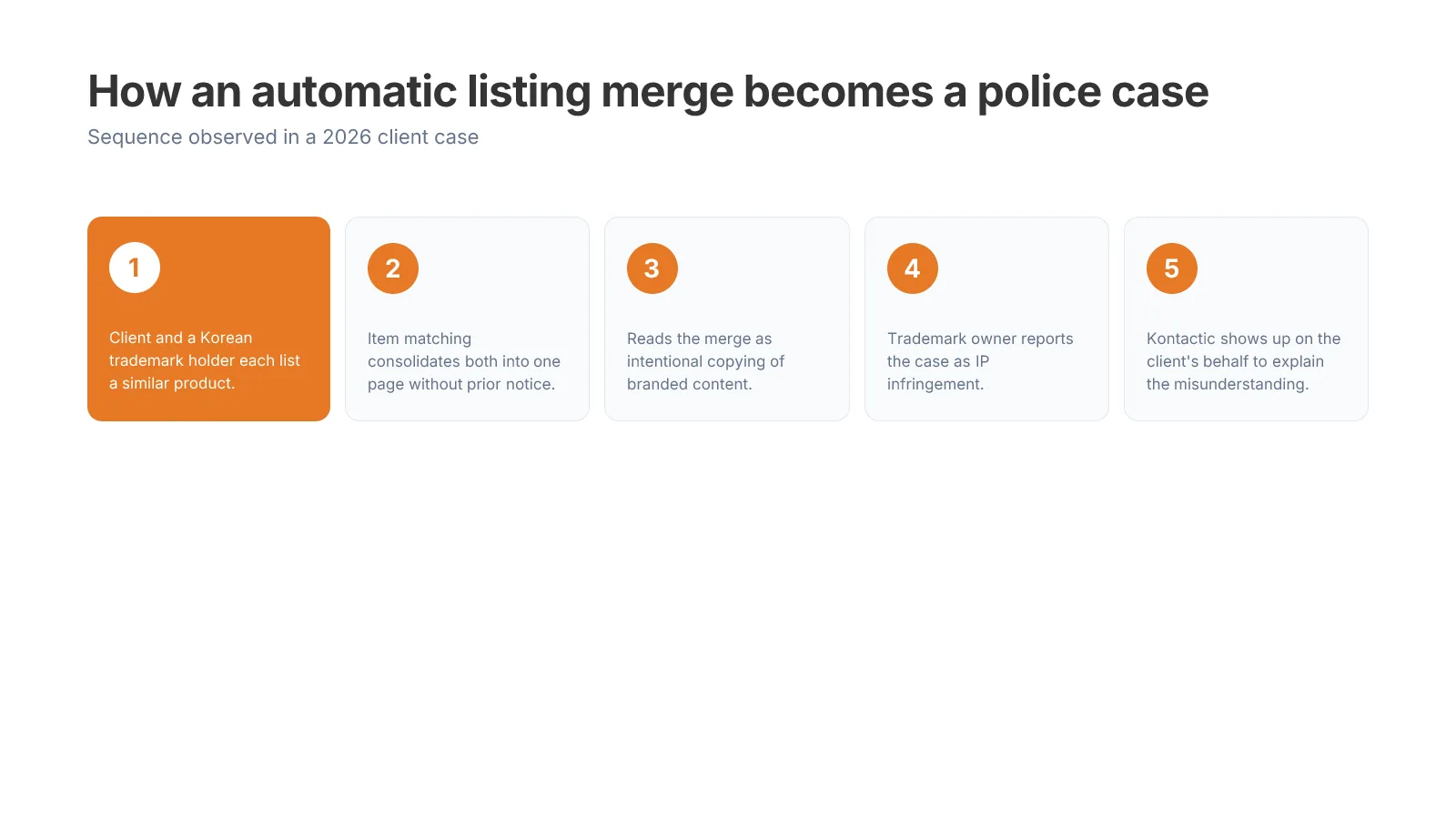
After a deeper look, we found the trigger: Coupang's automatic item matching had merged our client's listing with the trademark holder's listing into a single product page. The trademark holder saw their branded listing absorb a similar product from a different seller and read that as intentional copying.
In our experience, this kind of misunderstanding is structural, not malicious. But once a police report is filed, intent has to be established through the process — not assumed.

How Coupang's item matching system actually works
Coupang's item matching is conceptually similar to Amazon's Buy Box. If sellers A, B, and C list what the platform judges to be the same product, the system compiles those listings into a single page and ranks the offers. The seller with the best offer surfaces at the top.
This is different from how most other Korean marketplaces work. On Naver Smart Store, Gmarket, 11Street, or Auction, a seller's listing is generally a standalone page, even when the product is identical to one already on sale. You can have two, three, or four parallel listings of the same SKU. Coupang and Amazon compress that.
Item matching (아이템 매칭) is Coupang's automatic system for grouping listings the platform judges to be the same product into a single Product Detail Page, with multiple sellers attached. Sellers can request matches manually, but Coupang's algorithm also performs matches automatically — without seller consent and without prior notice — based on the platform's own judgment of similarity.
The detail that matters here is the automation. A seller can opt their product into a match, but Coupang's algorithm also acts on its own. If the system judges two SKUs functionally the same, it can combine the listings without seller consent. There is no opt-in checkbox, no email warning, no review window. This is a design choice — not a bug — and Coupang has reasonable platform-side reasons for keeping the algorithm decisive. We are not arguing the system is wrong. We are pointing out a downstream consequence foreign sellers do not anticipate.
For a related operational read on how Coupang's local fulfillment economics shape the listings layer, see our note on how Coupang IoR and 3PL change Korea margins.
How a listing merge becomes a police case
The trademark holder in this case did not see a Coupang algorithm decision. They saw their branded listing apparently being shared with another seller's similar product. From their seat, this looks like piracy. So they filed a complaint — not with Coupang, but with the police.
Korean police are obligated to take a properly filed IP complaint and investigate it. That means contacting the named respondent, asking them to come to the station, and recording a statement. The actual question of guilt comes later. The summons comes first.
A few things are worth noting about the position Coupang occupies here:
- Coupang is not a party to the dispute. Their item matching algorithm is a platform feature, and they do not testify on a seller's behalf.
- Coupang has legitimate reasons to stay out of seller-to-seller IP disputes. Once they take a position, they are exposed.
- The case is between the alleged infringer and the trademark holder. The seller has to defend themselves.
This is consistent with how most marketplaces handle IP claims globally. It is not unique to Coupang. But it is the part foreign sellers underestimate when they assume "the platform will sort it out."
Why a foreign seller without local presence is exposed
Here is the part that prompted this post.
If you are a foreign brand selling on Coupang and you receive an IP complaint of this shape, the police will ask the seller of record to appear in person and give a statement. If the seller of record is your own Korean entity and you are sitting in Berlin or Los Angeles, you cannot just send an email saying "this was an automated merge, please close the case."
If nobody shows up, the consequences cascade. The case escalates. The Korean entity you set up can be subject to administrative measures. Bank accounts can be frozen during an investigation. Penalties and fines can attach to the entity. None of that requires a finding of actual guilt — escalation can happen on procedural grounds alone, simply because no one responded.
For brands who set up their own Korean limited company without a local operator, this is the gap. Forming the entity is necessary but not sufficient. Someone has to be reachable and physically able to show up. We covered the structural side of this in why setting up a Korean entity as a non-resident foreigner got harder and what an Importer of Record in Korea actually does.
“Coupang has no say in this. The case is between the infringer and the victim. That is exactly why a foreign seller without a person on the ground is exposed — there is nobody for the police to call.”
Isaac Lee — CEO, Kontactic
What we did for the client
Once we received the call, we did the operational work in three layers:
- Investigation. We pulled the listing history on Coupang, the timestamps of the match, and the original separate listings. We confirmed that the merge was triggered by Coupang's automatic item matching and not by any action our client took.
- Evidence package. We assembled documentation showing both listings existed independently before the match, the timestamps of the platform's automated consolidation, and the absence of any seller-initiated match request from our client.
- Local representation. A Kontactic team member went to the police station on the client's behalf, presented the evidence, and explained the misunderstanding. We cannot make the complaint go away, but we can carry the message, testify to the operational facts, and cooperate with the process so the case does not snowball.
This is what Layer 1 entity administration actually looks like in practice. It is not just VAT filing and registered agent paperwork. It is being reachable on a Tuesday afternoon when the police call.
For brands evaluating whether to operate without local infrastructure, our note on operational readiness before ad spend covers similar territory from the demand side.

Common questions
Did Coupang do something wrong here? No. Item matching is a platform-side feature with reasonable design rationale, similar to Amazon's Buy Box. Coupang is not a party to seller-to-seller IP disputes and has its own legitimate reasons to stay neutral. The issue is that foreign sellers underestimate the downstream exposure when an automated merge is misread by another seller.
Could the trademark holder have contacted Coupang first? They could have. In practice, Korean trademark holders often go directly to police because criminal IP complaints in Korea are well-established and produce faster movement than platform-side takedown requests for trademark matters. Whether that is the right first step is a separate debate.
Does this only apply to consumables or regulated categories? No. The product in this case was a lunch bag — ordinary household goods. Item matching applies across categories. The risk is structural to the platform, not to a specific product type. For categories with their own certification overlay, also see KC certification and Coupang.
Can a foreign seller fight this from abroad? Not effectively. A Korean police investigation expects a respondent who can appear and give a statement in Korean. Letters and emails from overseas counsel are received but do not substitute for in-person cooperation, and a non-response will accelerate the case rather than pause it.
Is the seller's Korean entity actually at risk of being frozen? Yes, in the sense that escalation pathways exist. Bank account freezes during investigation, administrative measures against the entity, and fines on the company are all on the table if a case is not handled. Most cases never get that far — but most cases also get a respondent who shows up.
Talk to Kontactic before you need a local representative
Bring a local operator with you to Korea
If you are selling on Coupang from outside Korea — or planning to — talk to us about having a real local representative for situations exactly like this one: Spark Subscription (for Coupang-approved sellers in mainland China) or Blaze on your own Korean entity.
About the author
Korean and global e-commerce operators with 15+ years of cross-border experience, led by CEO Isaac Lee — KOTRA-certified consultant and official lecturer for Seoul City and the Korea Customs Service. We run Korea market entry for overseas brands every day; this blog records what we learn in the field.
Meet the Kontactic team →Related Articles

Korean Product Approval: Why a SKU Needs It and What to Do
Korean product approval does not have to be a yes-or-no answer. See the cited rule, preparation steps, language options, and SKU-only rechecks HQ can use.

Coupang Order Appearing Twice: How Kontactic Stops It
Coupang can send the same product option twice in one order. Here is how Kontactic joins the repeat so your local team processes one clear order line.

Korean Import Totals: Compare Supplier Payments
Kontactic compares each seller’s running Korean import total with its running supplier-payment total to help local teams find missing entries or timing gaps.