
Setting Up a Korean Entity Without the Paperwork Fog
Setting up a Korean limited company (유한회사) as a foreign owner runs through several stages: incorporation filing, capital deposit, business registration, and a corporate bank account. Most foreign founders find the process opaque — there is no real-time view of where the filing stands or how to correct a mistake once it is submitted. The way to reduce friction is to break the process into scoped steps and keep the application status visible the whole way through.
This matters most at one specific moment: a brand decides it wants its own Korean limited company. It may have been selling cross-border on Coupang, or under Kontactic's entity as Importer & Seller of Record, or it may want to go local from day one. Running your own entity, with Kontactic as its operating agent under Blaze, gives you direct control that selling under an operator's entity can't match. But it also puts a foreign-owned incorporation in front of the founder, and that is usually the step that feels the most legally opaque and the hardest to monitor from another timezone.
Why your own entity is worth the friction
On Spark, you sell without ever forming a company. Kontactic carries the customs clearance, the tax representation, and the storefront in its own name. That gets a brand into Korea fast, but it caps how much you own of the operation.
Moving to your own yuhan-hoesa changes that. You become the Importer of Record, you hold the Coupang account in your own name, and revenue lands in your corporate account rather than passing through an operator. The trade-off is that the incorporation now belongs to you — and for a founder who has never formed a company in Korea, that is where the process starts to feel like a wall.
It does not have to. The underlying filing — Corporate Registry, Articles of Incorporation, Business Registration Certificate — is the same set of documents any yuhan-hoesa setup requires. The friction comes from how the packet is presented, not from the packet itself.
What you actually have to complete
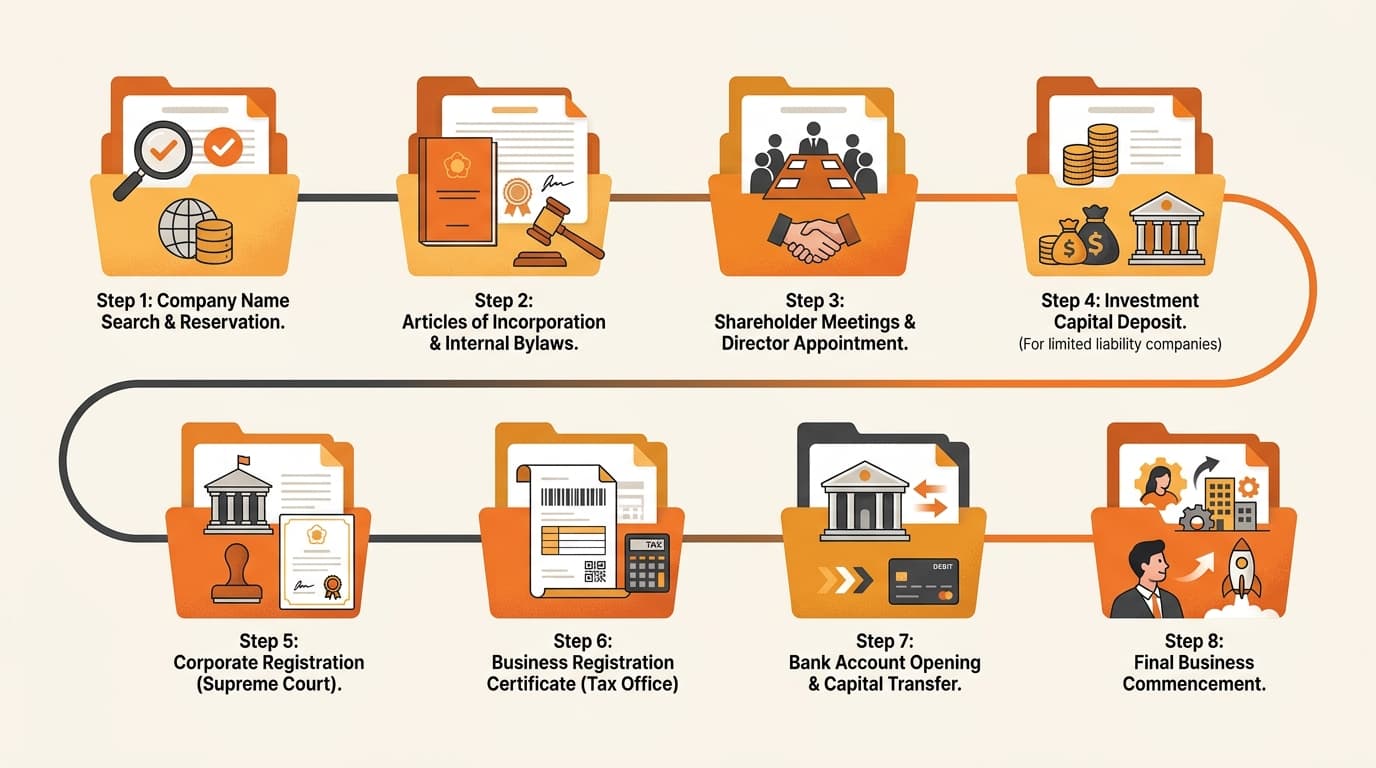
The filing looks less intimidating when it is broken into scoped stages rather than handed over as one twenty-item legal bundle. Instead of reviewing and signing everything at once, a good workflow separates formation into distinct document stages that open in sequence — you complete one, it is checked, and the next becomes available.
That sequencing does real work. Each stage tells you exactly what is needed and when, so you are never staring at the whole bundle wondering which parts apply to you and which are boilerplate. The same documents are required either way. The workflow just stops presenting the whole packet at once.
For a founder who has never formed a company in Korea, this is the difference between "I have to understand all of Korean corporate law before I can start" and "I have to complete this one clearly-scoped step in front of me."
Why visibility is the thing that actually helps
When you form a company abroad, visibility is hard to come by. Legal formation tends to go quiet — you sign something, then hear nothing for weeks and have no way to check. Any competent service should show you live progress: application status, current stage, and where the filing sits in the timeline.
In Kontactic's Seller Center, that view carries a progress bar, sortable status, and a clear indication of which stage a given application is in — and it holds up on mobile, so you can check status from a phone rather than waiting to be back at a desk.
Application detail view — a live, per-application screen showing the current stage, progress, and status of your Korean entity formation, so you can see where your filing stands at any moment without emailing to ask.
This is deliberately unglamorous. In our experience, the thing that stalls a brand's move to its own entity is rarely the legal work itself — it is the fear of losing sight of the legal work. Visibility removes the reason to hesitate.
How correction cycles reduce risk
Real applications have typos. Someone enters a name in the wrong order, or a detail changes between drafting and submission. In a traditional engagement, a submitted-then-wrong document often means starting the whole packet over.
A better approach builds the correction cycle directly into the workflow. If you need to change something already submitted, you request permission to edit that application, it gets granted, and you re-submit the corrected version. The customer-facing view stays in sync throughout, so what you see always matches the real state of the filing — no divergence between "what the portal shows" and "what is actually being processed."
The sequence is short and repeatable:
- Request edit permission on the submitted application.
- Permission is granted.
- Make the fix and re-submit.
- The detail view updates to reflect the corrected, re-submitted state.
A small mistake stays small. It does not become a reason to abandon the whole formation and re-enter everything from scratch.

Validation earlier in the process matters just as much. Rather than submitting a full form and getting back a generic "there was a problem," a step-level check flags the specific field and moves you to it. Applications are far more likely to clear on the first pass when the tool tells you precisely what to fix before you submit, rather than after. For a foreign founder working across a language barrier and a legal system they don't know by heart, "fix this exact field" is far more useful than "this document was rejected."
Signing, banking, and compliance
Two more design decisions are worth calling out, because they reflect how a foreign-owned setup can be handled repeatably and responsibly.
The first is a reduced sensitive-data footprint. Formation inherently involves personal and identity information, so identity handling is streamlined and presets are used where the same information would otherwise be entered and re-entered — the process asks for less sensitive data and touches it in fewer places. The aim is to handle only what the filing genuinely requires.
The second is bank-neutral guidance. Opening a corporate account is consistently the hardest wall in a foreign-owned setup — new accounts often carry a low default daily transfer limit that has to be lifted before real e-commerce cash can move. Because banks differ in how they structure accounts and what they ask of foreign-owned companies, banking arrangements are described in institution-neutral terms. You are not locked into assumptions about one specific bank's account structure before you have even chosen one.
Signing is the other piece. Korean corporate practice traditionally runs on carved seals (도장) — the representative seal, the corporate seal, the physical stamp on the physical page. For a foreign signatory who has none of that, seal-based signing is real friction at exactly the wrong moment. Contracts are instead executed by name-and-title signature, so a founder in New York or Berlin can sign the way they already sign everything else, without a courier round-trip for a physical stamp.
Compliance and the accuracy of what you submit remain your responsibility. A guided workflow reduces friction and error, but it does not remove the founder's accountability for the filing — and Korean tax offices have tightened scrutiny on foreign-owned registrations, so accurate inputs matter more than ever.
“The scariest part of going local is usually not the decision to own your entity — it is not being able to see the incorporation while it happens. So we made it something you can watch.”
Isaac Lee — CEO, Kontactic
None of this changes what a Korean limited company legally is or what it requires. The capital, the registry filings, the timeline — those are fixed by Korean law, and we have written separately about the capital requirements and compliance load that come with a yuhan-hoesa. What a guided workflow changes is the experience of getting there: staged instead of monolithic, visible instead of silent, correctable instead of all-or-nothing.

Common questions
Do I need my own Korean entity to sell in Korea? No. Brands shipping from the US, Europe, Japan, mainland China or Hong Kong can sell cross-border on Coupang through Direct, staying the seller with no Korean entity. Coupang-approved sellers in mainland China can sell under Kontactic's entity as Importer & Seller of Record (Spark Subscription), and a defined project such as B2B supply or an event can run under our entity through Spark Project. You form your own entity when you want more control and have Kontactic run it under Blaze — later, or from day one.
Can I watch the incorporation progress in real time? Yes. In the Seller Center, the application detail view shows the current stage, a progress bar, and status, and it works on mobile so you can check without waiting to be at a desk.
What happens if I make a mistake on a submitted document? You request edit permission, it is granted, and you re-submit the corrected version. Step-level validation also points you to the exact field to fix, which helps applications clear on the first pass.
Does this remove my compliance responsibility? No. The workflow reduces friction and error, but the accuracy of what you submit and your compliance obligations remain yours.
Ready to own your Korean entity?
Talk to Kontactic about setting up your own Korean limited company through our guided incorporation workflow.
About the author
Korean and global e-commerce operators with 15+ years of cross-border experience, led by CEO Isaac Lee — KOTRA-certified consultant and official lecturer for Seoul City and the Korea Customs Service. We run Korea market entry for overseas brands every day; this blog records what we learn in the field.
More about Kontactic →Related Articles

Korean Business Registration: How Kontactic Checks
Kontactic checks your Korean business registration certificate against the prepared address and representative, then keeps the setup open if either value differs.
Does My Korean Importer Need a License for This Product?
A Korean importer may need a license or permit even when product documents are complete. Seller Center separates the two checks and lists what to prepare next.
Import a Product Into Korea, But Can't Sell on Coupang?
Importing a product into Korea does not guarantee Coupang sales. Learn how SKU review separates import permission, online-sale rules, and importer permits.