
Yuhan-Hoesa Setup Cost and Timeline for 2026
A foreign company can register a Korean limited company (유한회사, yuhan-hoesa) in roughly 6–10 weeks, and foreign-invested status requires KRW 100 million in declared investment capital. That is the part most guides answer well. The part they leave out is that the entity is the cheapest, fastest, and least risky thing you will do all year. The work that actually decides whether you sell anything sits downstream — Coupang onboarding, fulfillment, returns, and a Korean product page that converts.
This is a working note, not a brochure. We set these entities up for brands every month, and the gap between "the company exists" and "money is moving" is wider than the registration timeline suggests.
What the search is really asking
When a founder types "yuhan-hoesa setup cost and timeline for foreign company 2026," they are rarely curious about corporate law. They are trying to answer an operating question: if I commit now, how long until I can sell locally in Korea, and what does it cost to get there?
The honest answer has two layers. The entity registration itself is bounded and predictable. The path from a registered entity to a live, converting Coupang listing is longer and far more variable, because it depends on your product category, your certifications, and how fast your Korean bank account becomes usable.
So treat the registration timeline as the floor, not the schedule. If you only budget for the company formation, you will be three months early to celebrate and three months late on revenue.
The yuhan-hoesa is the structural choice for foreign brands going local because it offers flexible governance without the board formalities of a joint-stock company. But choosing the right structure is a one-day decision. Making it operational is a one-quarter project.
The registration sequence and its real timeline
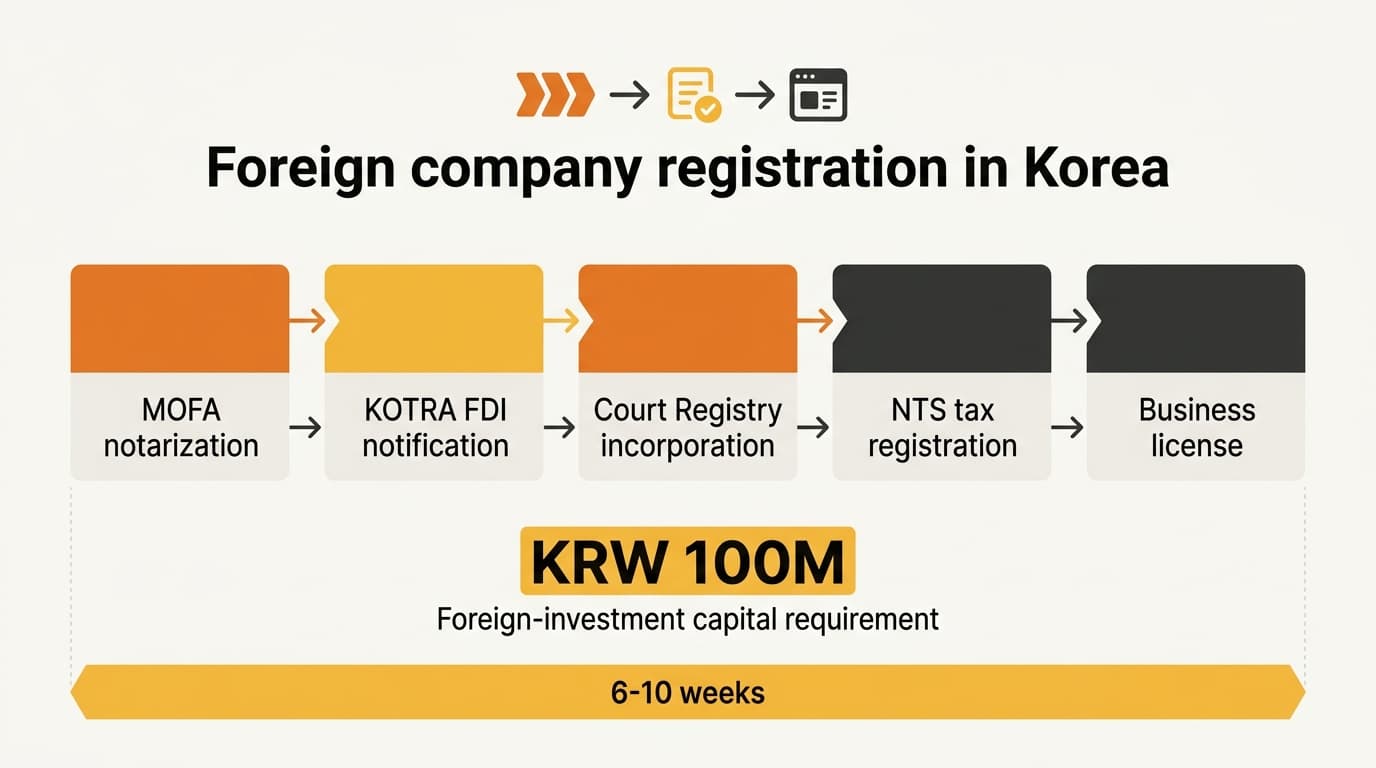
Foreign company registration in Korea runs through five distinct government touchpoints, each with its own documents and waiting period. Pearson and the other guides describe these accurately, so we will keep it short and focus on where time actually leaks.
- MOFA notarization — your home-country corporate documents (or the personal documents of the foreign investor) are authenticated for use in Korea.
- FDI notification via KOTRA (Invest Korea) — you file the foreign-direct-investment notification before bringing capital in.
- Court Registry incorporation — the entity is legally created. This is the step people picture when they say "register a company."
- NTS tax registration — you receive the business registration certificate (사업자등록증), which is what makes you a real taxpayer.
- Business license application — category-specific permits where your products require them.
End to end, expect 6–10 weeks if your documents are clean and the capital remittance goes smoothly. The variance is almost never in the court step. It is in document authentication abroad and in the bank.

The KRW 100 million figure is the threshold that earns foreign-invested status, not a fee. It is your own money, declared and remitted as investment capital — but it has to actually move through the FDI channel, and that is where the bank becomes the gatekeeper.
We have written before about why the capital requirements and compliance for a yuhan-hoesa are less about the headline number and more about everything that surrounds it. The two steps that quietly extend the calendar are worth naming directly.
First, the bank. Opening a usable corporate account is where most foreign-owned setups stall, because new accounts often default to a KRW 1.3M daily transfer limit — far too low to settle real e-commerce volume, and lifting it requires a separate review.
Second, the tax-office posture. Registration is no longer a rubber stamp. A May 2026 shift has tax offices rejecting setups that pair a non-resident CEO, a virtual office, and minimal capital. If your structure looks like a shell, expect friction.
Cross-border or local: decide before you register
Here is the question that should come before "how do I register?" — do you need a yuhan-hoesa at all yet?
If you already have Korean customers buying from your Shopify store cross-border, that demand is real signal. But it does not automatically mean you should set up an entity tomorrow. There are three broad paths into Korea, and an entity is only one of them. We lay out the full comparison in our guide to the three paths to selling on Coupang as a foreign brand, but the short version:
- Cross-border (no entity): you ship parcels into Korea per order. Fast to start, no registration, but you live with customs friction, slow delivery, and weak conversion against local listings.
- IoR & SoR partner (Spark): Kontactic's own Korean entity acts as Importer of Record and Seller of Record, so you sell locally on Coupang without registering anything. No yuhan-hoesa required.
- Your own entity (Flame / Blaze): you register the yuhan-hoesa, and Kontactic runs entity administration and commerce operations on top of it.
The decision usually comes down to control and volume, not preference. Plenty of brands that think they need an entity are better served validating local demand through a partner first, then registering once the numbers justify it. We walk through that tradeoff in detail in our operator's framework on Rocket Growth versus cross-border selling.
“The entity is the cheapest, fastest, and least risky thing a brand does all year. The work that decides whether you sell anything sits downstream.”
Kontactic — Market Entry Operations
Coupang onboarding: the part guides skip
Say you have your yuhan-hoesa and your business registration certificate. You are now a legal taxpayer in Korea. You still cannot sell a single unit until Coupang approves your seller account — and that is its own process, not a formality bolted onto registration.
Coupang's seller onboarding has tightened. The platform runs its own know-your-customer checks, and a freshly minted entity with a thin profile draws scrutiny. You will need the business registration certificate, a functioning corporate bank account for settlement, and category-appropriate documentation. For regulated categories, the interaction between KC certification, your entity, and Rocket Growth is where launches commonly slip — certification clears the product, but it does not make you a local seller by itself.
This is the underestimated link. Founders treat "register the company" and "list on Coupang" as one continuous motion. In practice they are two separate approvals with two separate institutions, and the second one waits on the first (you need the entity and the bank account before Coupang will finish onboarding you).
PDP, fulfillment, and returns: where revenue is actually won
Two operational realities surprise almost every foreign brand.
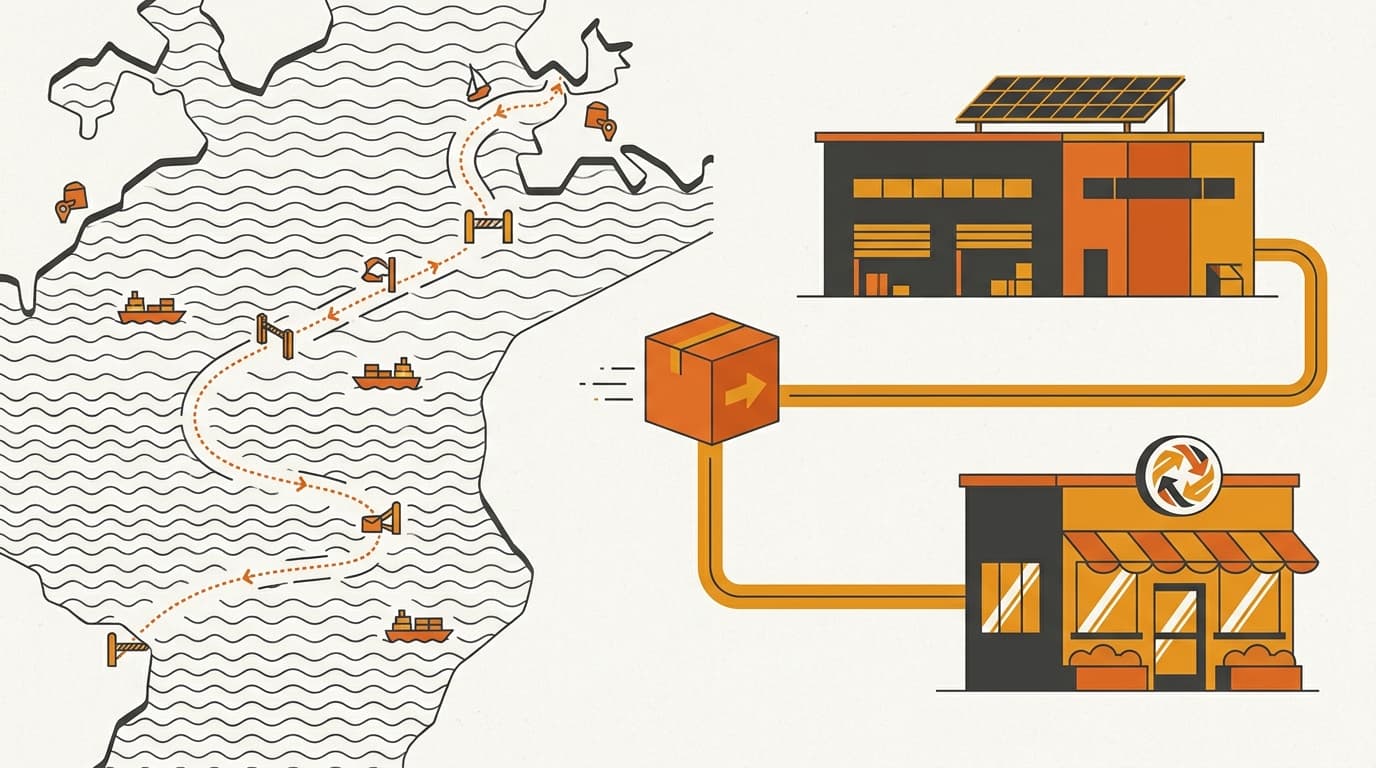
The first is the product page. A Korean product detail page (PDP) is not a translated version of your Western listing. It is a long-form, design-heavy, mobile-first sales document that Korean shoppers expect — and getting it wrong quietly caps your conversion no matter how good your product is. We treat this as a design problem, not a translation task, and explain why in our guide to localizing product pages for Korean e-commerce.
The second is fulfillment and returns. If you sell through Coupang's Rocket Growth (로켓그로스), the platform handles warehousing, delivery, and returns processing — but the cost and operational logic are not what Western sellers assume. Returns in particular carry their own fee structure and evidence burden, and recent policy changes have reset the real margin math on Rocket Growth. Budget for returns as an operating line, not an afterthought.
None of this appears in a company-registration guide, because none of it is corporate law. But it is where the money is made or lost.
Korean VAT applies at 10% on local sales, and for VAT-inclusive revenue the VAT portion equals 1/11 (≈9.09%) of gross sales. Once you sell through your own entity, you file and remit this yourself — another operating obligation the registration timeline does not surface.
What this means for your 2026 plan
If you are sequencing a Korea launch for 2026, plan in two phases. Phase one is the entity: 6–10 weeks, KRW 100 million in declared capital, five government steps, and a bank account that needs its transfer limit raised before it is useful. That phase is predictable and you should not over-engineer it.
Phase two is everything that turns the entity into a business — Coupang onboarding, certification where it applies, a converting Korean PDP, and a fulfillment-and-returns setup you actually understand. That phase is longer, more variable, and decides your outcome.
In our experience, the brands that succeed in Korea are the ones who treat registration as a checkbox and spend their real attention on phase two. The ones that struggle spend three months perfecting the entity and arrive at Coupang unprepared.
Planning your Korea entry for 2026?
Tell us your product category and where your cross-border demand sits. We will map the realistic timeline — entity, Coupang, and fulfillment — before you commit a budget.
About the author
Korean and global e-commerce operators with 15+ years of cross-border experience, led by CEO Isaac Lee — KOTRA-certified consultant and official lecturer for Seoul City and the Korea Customs Service. We run Korea market entry for Western brands every day; this blog documents what we learn in the field.
More about Kontactic →Related Articles

Korean Entity Handover: How Kontactic Aligns Each Step
See how Kontactic Seller Center keeps a Korean entity handover aligned across representative records, documents, delegated tax work, milestones, and exceptions.

Korea Payment Reconciliation Made Traceable by Kontactic
Kontactic's Korea payment reconciliation links payments, invoices, and allocations; confirmed and provisional matches stay separate, with adjustments preserved.
Product-Link Intake for Coupang: A Traceable Handoff
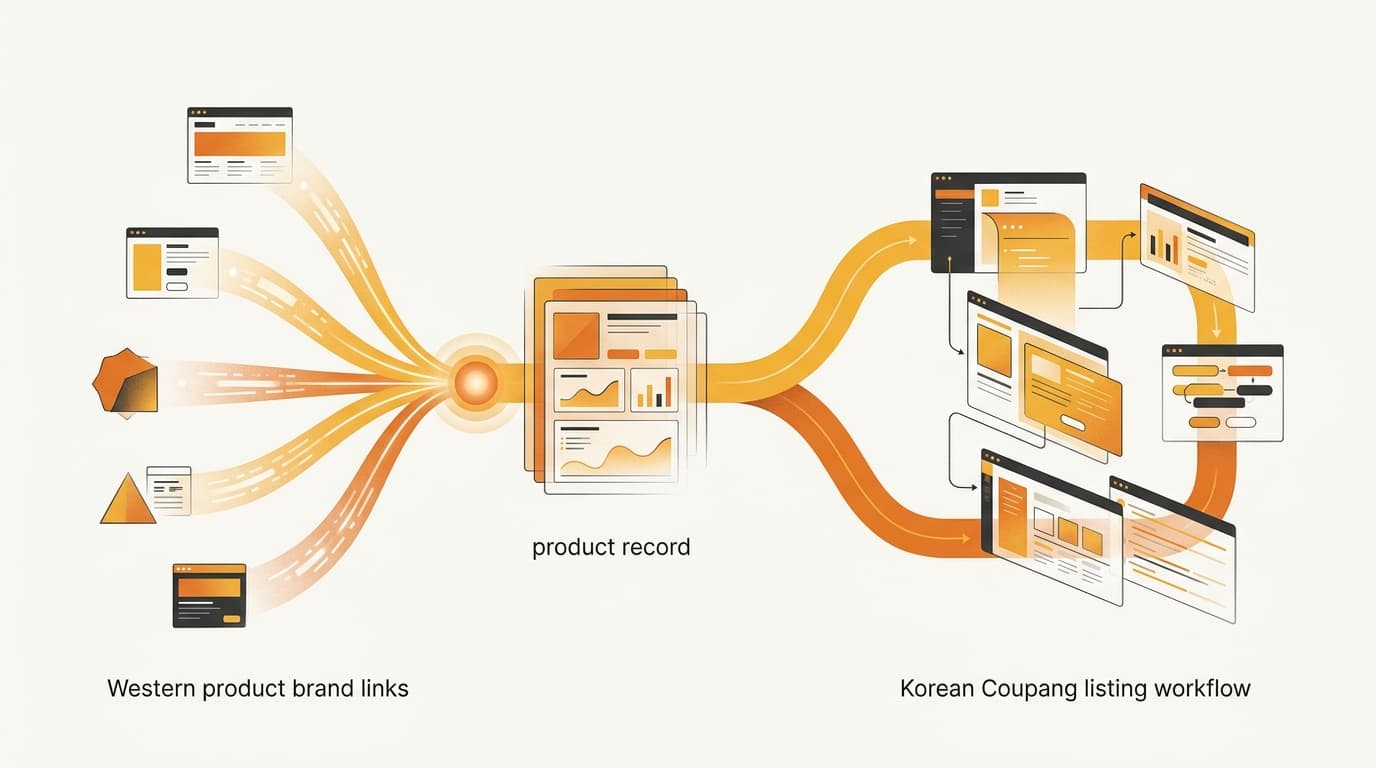
Kontactic Seller Center gives product-link intake a reviewable source record and a handoff into Coupang listing work before Korean copy or creative production starts.