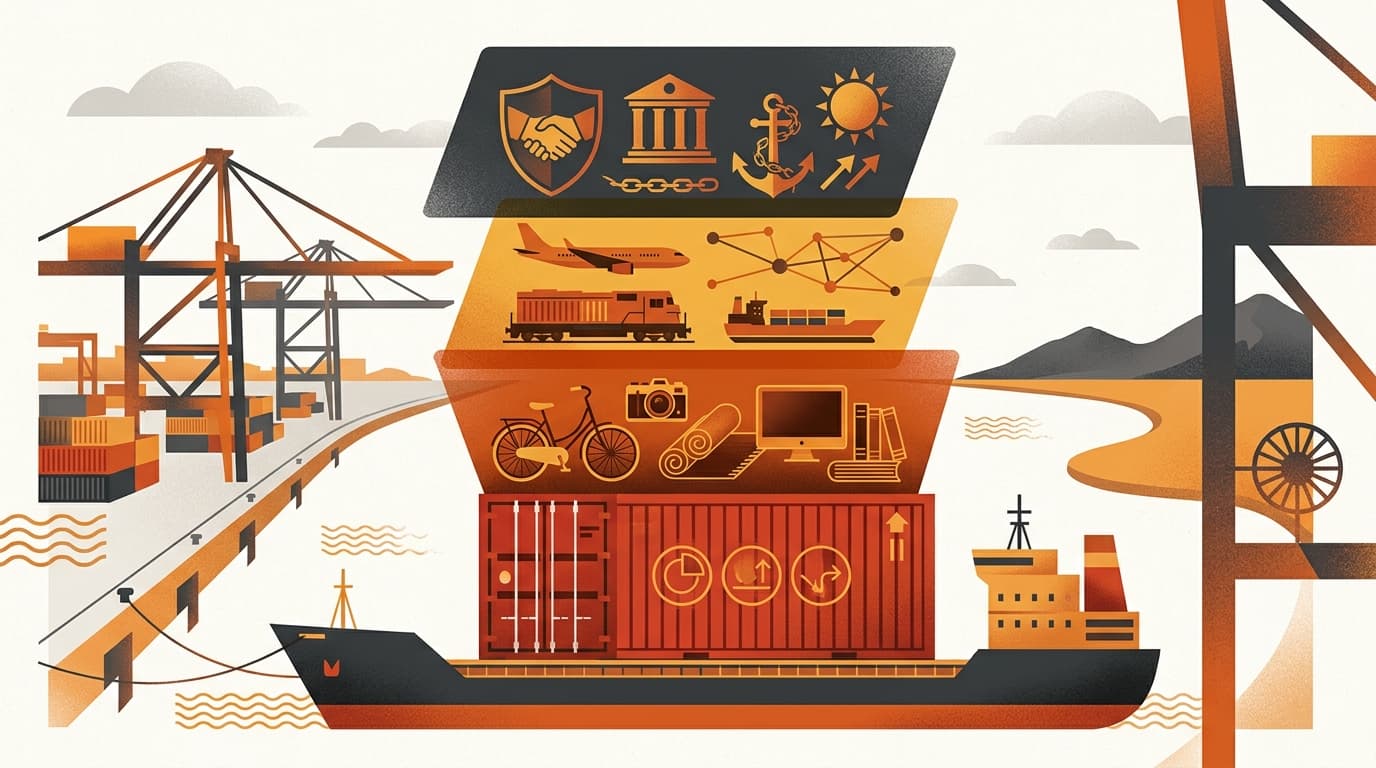
Korea Import Duty Is Assessed on CIF Value, Not Your Invoice
The Korea Customs Service assesses import duty on the CIF value of your shipment — the transaction price of the goods plus international freight and insurance to the Korean port of entry — not on the goods-only figure printed on your ex-works commercial invoice. Then it applies a flat 10% VAT on top of that duty-inclusive amount. If you modeled your Korean landed cost from the invoice total alone, you under-budgeted, and the gap is largest for bulky or freight-heavy products.
That single valuation rule quietly distorts a lot of go-local business cases. Below is how the base is actually built, why the calculation order matters, and how to model it before you commit inventory.
Why customs uses CIF, not your ex-works invoice
Korea's Customs Act (관세법) generally establishes dutiable value on a CIF basis: the price actually paid or payable for the goods, brought up to the point of importation by adding the cost of transport and insurance to Korea. The reference text is public on the national statute portal at law.go.kr, and the Korea Customs Service publishes its own valuation guidance for importers.
The practical consequence is straightforward. Two brands can ship goods with the same USD 40,000 invoice value, but if one is shipping compact high-value electronics by air and the other is shipping bulky home goods by ocean, their freight and insurance components — and therefore their dutiable bases — diverge sharply. The heavier, cheaper-per-unit product carries proportionally more freight, so it carries a higher duty base relative to its goods value.
Dutiable value (과세가격) is the CIF figure: goods price + international freight + insurance to the Korean port. It is the base Korea Customs uses to calculate duty — and it is almost always higher than the ex-works invoice total.
This is why "we'll just budget from the invoice" is a common and costly shortcut. Your invoice describes what you paid the factory. Customs cares about what it costs to land the goods in Korea.

The calculation compounds: duty first, then 10% VAT on top
The order of operations matters as much as the base, because the charges stack rather than sit side by side.
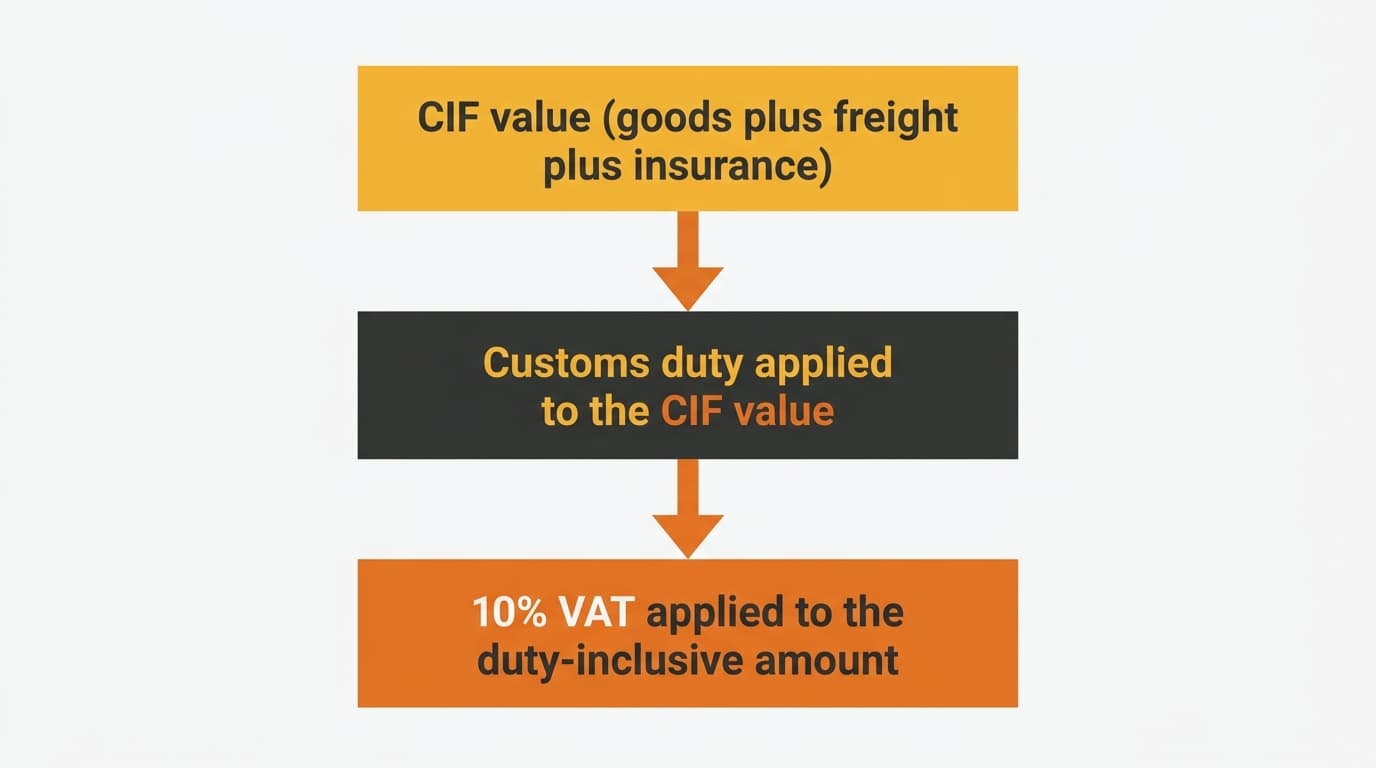
Customs duty is calculated on the CIF value first. Then Korea's 10% VAT is levied on the duty-inclusive amount — meaning the CIF value plus the duty already assessed. VAT is not charged on the goods price in isolation; it is charged on top of a figure that already includes freight, insurance, and duty. This is why the effective add-on to your goods cost is more than the sum of "duty rate + 10%."
Here is the sequence a landed-cost model should follow:
- Start from the CIF value — goods + international freight + insurance to the Korean port.
- Apply the customs duty for your product's HS classification to that CIF value.
- Apply 10% VAT to the duty-inclusive amount (CIF + duty).
Skip a step or reorder it and your margin math is wrong. We cover how this plays out with real cargo — and who fronts the cash at the border — in our breakdown of who pays Korea import duties on your first shipment.
The duty rate depends on your HS code — so classification is a valuation issue
There is no universal Korean import duty rate. The rate applied to your CIF value is set by your product's HS classification code (the tariff line under Korea's Harmonized System schedule), and it varies widely by category. A textile, a small appliance, and a food product each sit under a different line with a different rate.
This makes HS classification a valuation problem, not just a paperwork problem. Misclassify the product — even in good faith — and you may pay the wrong duty, face reassessment, or have cargo held while customs resolves the discrepancy. Because the duty then feeds the VAT base, a classification error propagates through the entire charge stack.
The correct HS line is determined at clearance, and it can hinge on product composition, function, or material in ways that are not always obvious from your domestic tariff code. If your product sits near a category boundary, confirm the Korean HS line before you finalize pricing rather than assuming your home-country classification carries over.
FTA duty savings are real — but conditional on origin paperwork
Free Trade Agreements can reduce or eliminate the duty portion for qualifying goods. The Korea–US agreement (KORUS) and the Korea–EU FTA both provide preferential tariff treatment for products that meet the agreement's rules of origin. For many Western brands, this can bring the applicable duty rate down substantially — sometimes to zero.
The catch: the preferential rate is not automatic. You claim it, and to claim it you must be able to produce valid origin documentation — a certificate or declaration of origin that satisfies the specific FTA's requirements — at the time of clearance. No valid paperwork, no preferential rate; customs simply applies the standard MFN duty.
Treat FTA duty savings as conditional, not guaranteed. Model your business case on the standard duty rate, then treat any FTA reduction as upside you capture only when the origin documentation is in order at clearance.
There is a real trap here for brands that source globally. "Made by a US company" is not the same as "originating in the US" under KORUS rules of origin. If your finished goods are assembled or substantially produced outside the FTA partner, they may not qualify — regardless of where your headquarters sits. Check the origin rules against your actual supply chain before you bake FTA savings into the plan.

Royalties, assists, and related-party pricing can be added back
If your Korean structure involves intercompany transfers or licensed-brand arrangements, the dutiable value may be higher than your stated transaction price — because Korea's Customs Act valuation rules allow certain amounts to be added back into the base.
The categories to watch:
- Royalties and license fees paid as a condition of sale can be added to dutiable value.
- Assists — materials, tooling, or design work you supply to the manufacturer below cost — can be added back.
- Related-party pricing between affiliated entities may be scrutinized, because a below-market intercompany price does not reflect the true transaction value customs expects to assess.
None of this is exotic, but it is easy to miss when a brand assumes the invoice price is the whole story. If you sell a licensed or trademarked product, or move goods between affiliated entities, have someone look at the valuation treatment before the business case is finalized — an add-back discovered at clearance is far more disruptive than one planned for in advance.
How to model your Korean landed cost correctly
The clean way to budget avoids every trap above:
- Start from CIF, not ex-works. Add your international freight and insurance to Korea onto the goods value before anything else.
- Layer duty by HS code. Confirm the Korean HS line for each SKU and apply its specific rate to the CIF value — do not assume a flat rate across your catalog.
- Apply 10% VAT on the duty-inclusive base. VAT sits on top of CIF plus duty, not on the goods price.
- Treat FTA savings as conditional. Model the standard rate; capture the reduction only when origin paperwork is confirmed.
- Flag royalties, assists, and related-party pricing for a valuation check if your structure involves any of them.
Get this sequence right and your Korean pricing and margin hold up under scrutiny. Get it wrong and you discover the gap after inventory has already shipped. For the broader tax picture around who files VAT and holds the seller account, see our Korea VAT and tax guide for foreign shippers.
Common questions
Is Korean import duty calculated on FOB or CIF value? CIF. Korea's Customs Act generally assesses dutiable value on the transaction price plus international freight and insurance to the Korean port — so freight-heavy shipments carry a higher duty base than the FOB or ex-works figure suggests.
Is VAT charged on the goods price or the duty-inclusive amount? On the duty-inclusive amount. Korea applies 10% VAT to the CIF value plus the customs duty already assessed, so VAT compounds on top of duty rather than sitting only on the goods price.
Does a US or EU brand automatically get the FTA duty rate? No. The preferential KORUS or Korea–EU rate applies only when the goods meet the agreement's rules of origin and you produce valid origin documentation at clearance. Without it, customs applies the standard rate.
Can I use my home-country HS code for Korean customs? Not safely. The Korean HS line is determined at clearance and can differ from your domestic classification. Because the duty rate — and therefore the VAT base — depends on it, confirm the Korean line before pricing.
Model your Korea landed cost before you ship
Kontactic can help you scope HS classification, CIF-based duty, and VAT so your Korean margin holds up. Talk to us before inventory leaves the factory.
About the author
Korean and global e-commerce operators with 15+ years of cross-border experience, led by CEO Isaac Lee — KOTRA-certified consultant and official lecturer for Seoul City and the Korea Customs Service. We run Korea market entry for overseas brands every day; this blog records what we learn in the field.
Meet the Kontactic team →Related Articles
Imported Food Labels in Korea: Can Stickers Work?
Imported food labels in Korea can use a Korean sticker on the consumer unit before sale, but only when current MFDS rules allow it for that product and package.
Can USB-Powered Products Avoid Korea’s KC Safety Rules?
USB power does not automatically avoid Korea’s KC rules. Learn how KATS safety review, RRA EMC checks, and customs timing affect your shipment before import.
Can Coupang Buyers Pay Two Charges With Free Shipping?
On Coupang, free shipping can still leave the buyer paying two return charges: the original delivery cost and the cost of sending the parcel back to the seller.