
Korean Commercial Lease vs Virtual Office: Which Fits?
For most foreign-owned Korean companies, a virtual office is the better starting point when the company only needs a registered address and remote administration. A commercial lease fits when staff, stock, returns, inspections, or another daily physical task must happen there. Neither option automatically gives you import authority, a bank account, Coupang approval, or product compliance.
Choose the address by the work your company must do
Start with the work, not the rent. Write down what must happen at the Korean address.
A virtual office can fit when the address mainly needs to:
- receive company and tax mail;
- support the company’s registered office details;
- give an authority or partner a place to contact the company; and
- provide occasional meeting or inspection support under the provider’s contract.
A lease fits when people work there, buyers visit, staff receive samples, or the company handles stock and returns there.
The address is only one part of the setup. A registered office is not automatically a warehouse, a laboratory, a retail shop, or a return center. A lease does not give you permission to use a building for every one of those purposes either. The contract, building use, product category, and authority involved still matter.
For example, a foreign skincare brand may have no Korean employees. It could keep inventory in Coupang’s fulfillment network and use a virtual office for company mail. A Korean distributor that receives cartons, checks samples, and meets trade buyers needs a physical operating plan. It may need a leased office plus a separate warehouse, not just a larger office.
A registered address shows where the company can be contacted. It does not prove that the company can import every product, store stock there, or sell every product.

When a virtual office fits a foreign-owned company
A Korean virtual office normally means an address service rather than a dedicated workplace. Providers may include mail receipt or forwarding, meeting-room access, and help arranging access if a tax-office visit is requested. Read the exact service agreement. These features are not identical across providers.
A virtual office is usually the sensible first choice when all three statements are true:
- No employee needs to work there every day.
- No one needs to pack orders, store products, or inspect returns there.
- The company can explain its activity to a bank, tax office, customs partner, and marketplace without pretending that the address is a warehouse.
It can keep fixed costs lower while the team tests sales. That does not mean the address is accepted for every activity. Before signing, ask whether the provider accepts your business activity and supports registration at that address. Confirm that it receives official mail and can open the premises for an authority inspection.
Ask one more question: who will respond if a letter arrives or an inspection is scheduled? A mailbox forwarding service is not the same as a person who understands your company, opens the correct documents, and gives the authority access. Put the answer in writing.
A virtual office is not enough if you advertise a showroom, employ local staff, store returns, handle regulated products, or need a site for a permit. If another provider stores the goods, write down its address and who handles each task.
When a Korean commercial lease is worth the cost
A commercial lease is worth considering when the company needs controlled physical space. Typical reasons include a local team, regular buyer meetings, product samples, order packing, return inspection, or a category-specific need for a physical workplace.
The lease also gives you a place to answer practical questions. Where does a courier deliver a sample? Who can open the door for an inspection? Where does a local employee work? Which documents must stay at the office instead of with a mail-forwarding provider?
But a lease adds more than monthly rent. Budget for the deposit, rent, building or maintenance charges, and utilities. Also budget for internet, furniture, fit-out work, moving costs, and any work needed to restore the space when the lease ends. The exact amount depends on the city, building, floor area, term, condition, and negotiation. There is no useful Korea-wide “typical office rent” without those facts.
Check the property before paying a deposit. Confirm who owns the property and who can sign for the landlord. Check that your company can register there. Also confirm whether the building allows storage, signs, customer visits, packing, and returns. Do not assume that an office classified for desk work can also operate as a warehouse or workshop.
A physical address can make your business explanation clearer, but it cannot force a bank to open an account or set the account’s transfer limit. Ask the bank what documents and activity explanation it needs before you commit to a long lease.
Your Korea sales path changes the office decision
The first question may be whether you need a Korean company at all.
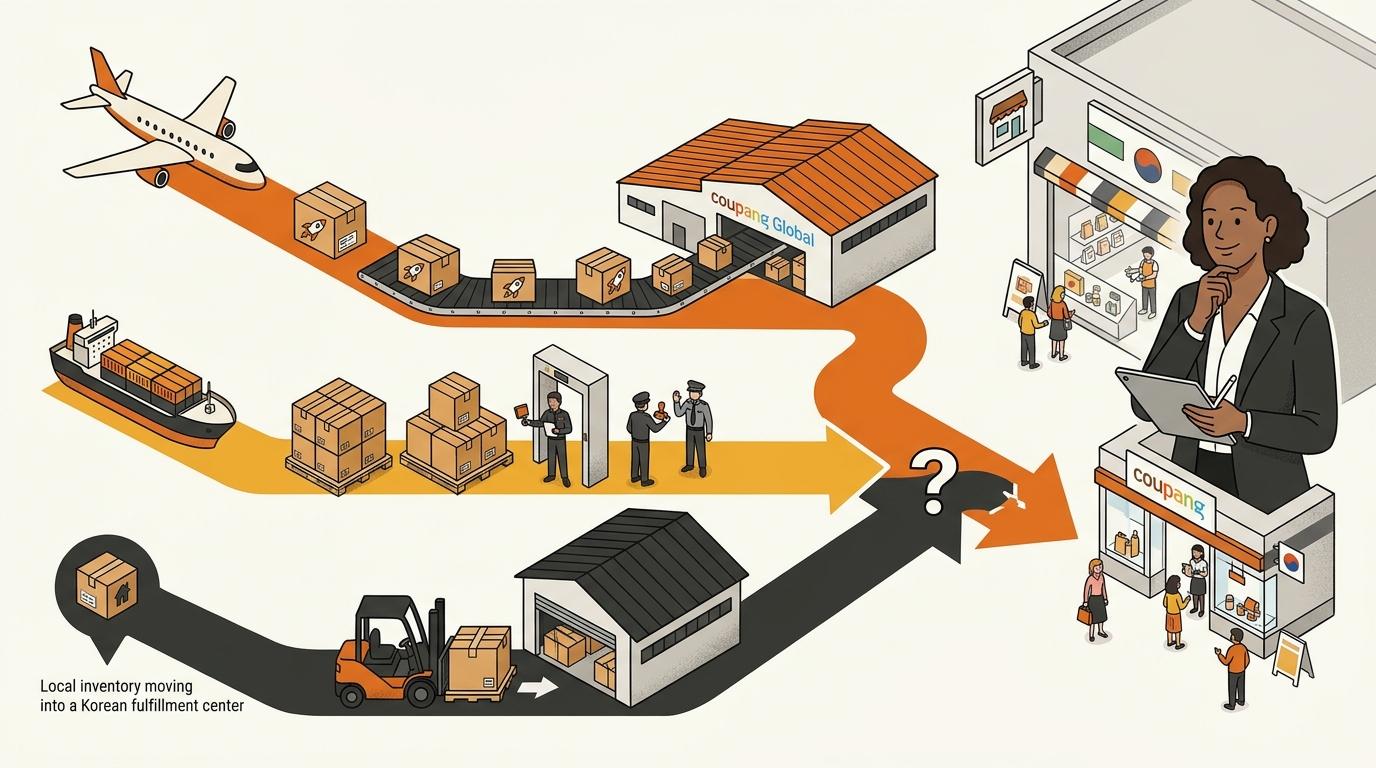
Direct is Coupang cross-border selling. The brand is the seller and exporter on its own Coupang cross-border seller account, and Kontactic acts as its operating agent. The brand does not import into Korea. Through Coupang Global Fulfillment (CGF), stock stays in a CGF warehouse outside Korea. Coupang handles pick and pack, customs clearance, delivery to Korean shoppers as personal imports, returns, and Korean-language support. Delivery is typically 3–5 days.
Direct accepts cross-border sellers shipping from the United States, Europe, Japan, mainland China, and Hong Kong. This route does not require you to form a Korean company, so a Korean office lease is not the starting requirement. Korean shoppers may call the service Rocket Jikgu (로켓직구), but CGF is the program name for seller operations.
If you want to understand the wider channel choice, see how to sell on Coupang as a foreign brand.
With Spark Subscription or Spark Project, the entity named in the agreement handles importing. Your office does not determine that role. In eligible structures, Kontactic’s Korean entity acts as Importer of Record (IoR) and Seller of Record (SoR). Spark Subscription is for Coupang-approved sellers in mainland China. Spark Project covers a defined business-to-business (B2B), event, or one-off import project. Your own virtual office or commercial lease does not make those shipments legal. The entity named in the agreement and import documents carries the stated role.
Blaze is different. The brand owns a Korean limited company (유한회사), and that client entity acts as IoR and SoR. If you choose this model, the office decision belongs to your company. A virtual office may still fit if the company has no physical work. A lease may be needed if the company’s people, samples, inventory, or returns operate from Korea.
Do not rent an office just to use Coupang Rocket Growth. Rocket Growth is Coupang’s Korean third-party logistics (3PL) service for storage, delivery, and returns. It can keep stock inside Korea without making your office a warehouse. You still own the inventory and must decide what happens to returned or damaged units.
What an address does not solve: importing and Coupang approval
A lease and a virtual office are locations. They do not replace the work attached to the product.
The Importer of Record (IoR) files the Korean import declaration and pays import duties and import VAT. The Seller of Record (SoR) is the legal seller. Under Spark Subscription or Spark Project, Kontactic’s entity holds those roles. Under Blaze, the client’s Korean entity holds them. Under Direct, each order uses Coupang’s cross-border import process for the Korean shopper. The brand is not the Korean Importer of Record (IoR) for that order.
Import VAT in Korea is 10%. The office choice does not remove it. The importer may also need the correct Harmonized System (HS) code, category registrations, Korean labels, and any required product-conformity checks. Korea Certification (KC) requirements cover several Korean product-conformity rules, not one universal safety mark. Different rules can apply to electrical and household products, children’s products, and radio products subject to electromagnetic-compatibility rules.
Read who can legally import your products into Korea before you treat an address contract as an import plan.
Coupang onboarding is separate too. A local seller may need its legal entity details, bank and tax details, and product documents. It may also need shipping, return, and listing settings in Coupang’s seller console, WING. A lease can provide the address used in the company registration. It cannot guarantee seller approval or approve a product.
An address also does not write Korean listings. For that separate work, see how to localize product pages for Korean e-commerce. For the fulfillment decision, compare local and cross-border Korea fulfillment costs.
Do not write “virtual office equals local operations” in your launch plan. It is only true when the address contract, building use, staff, fulfillment partner, and inspection plan support the exact work you intend to do.
Documents, signatures, timing, and total cost
Prepare the address and entity documents together. The exact list varies by provider, landlord, company structure, product category, and authority, but this is a useful starting checklist.
For either option, prepare:
- the Korean company’s corporate registry extract and business registration certificate, if the company already exists;
- the representative’s passport or identity document;
- ownership or parent-company documents if the company is foreign-owned and an authority requests them;
- the proposed address agreement; and
- a short description of the company’s activities and products.
For a virtual office, ask for the provider’s business registration details and the right to use the address for your activity. Also ask about mail handling, meeting-room terms, and the process for an authority visit. Confirm whether the provider will only receive mail or will also give a responsible person access to the premises.
For a commercial lease, review the landlord’s authority to sign and the property and building-use information. Check the deposit and rent schedule, permitted use, access hours, storage and return rules, signage, and any work required to restore the space at the end. Have the company representative or an authorised agent sign. The landlord or its authorised representative also signs.
A foreign owner does not always need to appear in person to sign an address contract. A provider, bank, tax office, or another authority may still ask the representative to appear. It may also ask for a power of attorney, an original document, or access to the premises. No address provider can promise what an authority will decide.
Timing has two separate parts. First, you arrange the address. A virtual-office agreement may be quicker than searching for premises, negotiating a lease, paying a deposit, and preparing a room. Second, you complete the company and operating steps. Business registration, bank review, product compliance, Coupang onboarding, and fulfillment setup each have their own timing.
If you are still forming an ordinary Korean limited company, plan around the full incorporation timetable rather than the day you buy an address. Our guide to Korean entity setup explains why registry, banking, tax, and address work do not finish at the same moment.
Compare total first-year cost, not just the monthly headline.
For a virtual-office budget, list:
- the address service, mail handling, and meeting or inspection support;
- entity administration, bookkeeping, tax work, and bank documents; and
- product compliance, Korean product-page work, Coupang fees, and fulfillment.
For a lease budget, list:
- the deposit, rent, building charges, and utilities;
- furniture, fit-out, moving costs, and any work needed to restore the space; and
- company administration, product compliance, Coupang fees, fulfillment, import duties, and returns.
Import duties and 10% import VAT come from the goods. KC or other category compliance, platform fees, advertising, Coupang Rocket Growth charges, and returns costs come from the business model. These costs exist whether you use a virtual office or a lease.
Ask each provider to put these in writing: setup fee, renewal fee, deposit terms, cancellation terms, mail charges, inspection support, and extra charges. A low monthly address fee can become expensive if you later add a separate warehouse, return center, or local employee because the virtual service never covered those tasks.

Make the decision before you sign
Before you pay a deposit or sign a virtual-office contract, get clear answers to six questions:
- What legal entity will use the address?
- Can that entity use the address for its exact business activity and product category?
- Who is the IoR and SoR for each sales path?
- Where will inventory, customer returns, and damaged units go?
- Who receives official mail and opens the premises if an authority asks for access?
- What is the full first-year cost, including renewal and extra service fees?
Need to choose the right Korea operating setup?
Share your sales channel, product category, importer plan, inventory location, and address needs with Kontactic. We can help you map the practical questions before you commit to a virtual office or commercial lease.
About the author
Korean and global e-commerce operators with 15+ years of cross-border experience, led by CEO Isaac Lee — KOTRA-certified consultant and official lecturer for Seoul City and the Korea Customs Service. We run Korea market entry for overseas brands every day; this blog records what we learn in the field.
Meet the Kontactic team →Related Articles

How Long Do Korean Registry Extracts and Seal Certificates Take?
A Korean registry extract and corporate seal certificate can often be issued the same day. See what must be ready, who may need to appear, and what takes longer.

Can an Employee Use a Corporate OTP When the Director Is Abroad?
Can a Korean company employee use the corporate OTP or joint certificate while a foreign director is overseas? Learn the safe setup, documents, and limits.

Securities Acquisition Filing in Korea: Funding Steps
Funding a Korean company may require a securities acquisition filing before payment; see the documents, timing, costs, and separate Coupang approvals.