KCS Certification: Pre-Test Before Applying in Korea
KCS certification requires testing through a single Korean government-nominated lab, with no appeals process and no second opinion. Products that pass US, EU, or Chinese safety standards often fail KCS because Korea uses independent test criteria and pass/fail thresholds. Pre-testing your product against the exact Korean standard — before you apply — is the only way to avoid a months-long, fully-paid failure.
What KCS actually is
Korea's KC mark covers a wide range of categories, and most foreign brands encounter it through electronics, electromagnetic compatibility, household goods, lifestyle items, or children's products. Those are the buckets people usually mean when they say "KC certification."
KCS is a different sub-track. The "S" stands for safety — specifically industrial safety equipment. Welding masks, safety helmets, fall-protection gear, and similar products fall here. There is also KCW for water-related products. These are niche categories with thinner manufacturer experience and far fewer pre-existing approval files to reference.
KCS (KC Safety) is the safety-product sub-track of Korea's KC certification regime. It applies to industrial protective equipment such as welding masks and safety helmets, and it is administered by a single government-nominated testing agency.
The structural difference matters. For mainstream KC categories, multiple accredited labs compete, schedules are flexible, and consultants have deep SKU-class experience. For it, there is one official testing facility. If your product fails, you reapply through the same lab — there is no second opinion to seek.
Why "we already pass in the US and EU" is not enough
The client in this case is a well-known Chinese manufacturer of industrial safety products — a large Amazon seller running both B2B and B2C globally. They were already selling other, non-certified products on Coupang through our Spark service, and wanted to add welding masks and safety helmets to the catalog. To do that locally, they needed KCS.
Their assumption was reasonable on paper: the products pass safety standards in China, the EU, and the US, and they sell in real volume in those markets. So Korea should be a formality.
It was not. Korean test criteria are written independently and use their own pass/fail thresholds. Even where the underlying physics is the same, the threshold values can differ. In our experience, that is the single most common source of preventable failure for foreign safety-equipment brands entering Korea.
A few examples of the variation that exists inside seemingly simple categories:
- Welding masks are split between auto-darkening and manual-darkening filters. The light transmittance, response time, and optical quality requirements are not interchangeable between the two.
- Safety helmets come in multiple types depending on what they are designed to protect against — impact from falling objects, falls of the wearer themselves, and in some types, electrical shock. Each type carries different test conditions.
- Fall-protection gear includes full-body harnesses, lanyards, and rescue systems, each with different load-bearing requirements, inspection cadences, and certification scopes that do not transfer between sub-types.
If you are budgeting compliance work the way you would for KC certification on Coupang, expect KCS to behave more like a regulatory project and less like a checklist.
The specific failure: a 1–2 point miss
For this client, we tested two models of welding mask. The failure point was not the darkening filter itself — it was the curved plate, the frontal safety plate that sits in front of the darkening filter.
Korea's KCS standard requires the curved plate to have over 89% light transmittance. The client's two models tested at 87% to 88%. Close, but a fail is a fail.
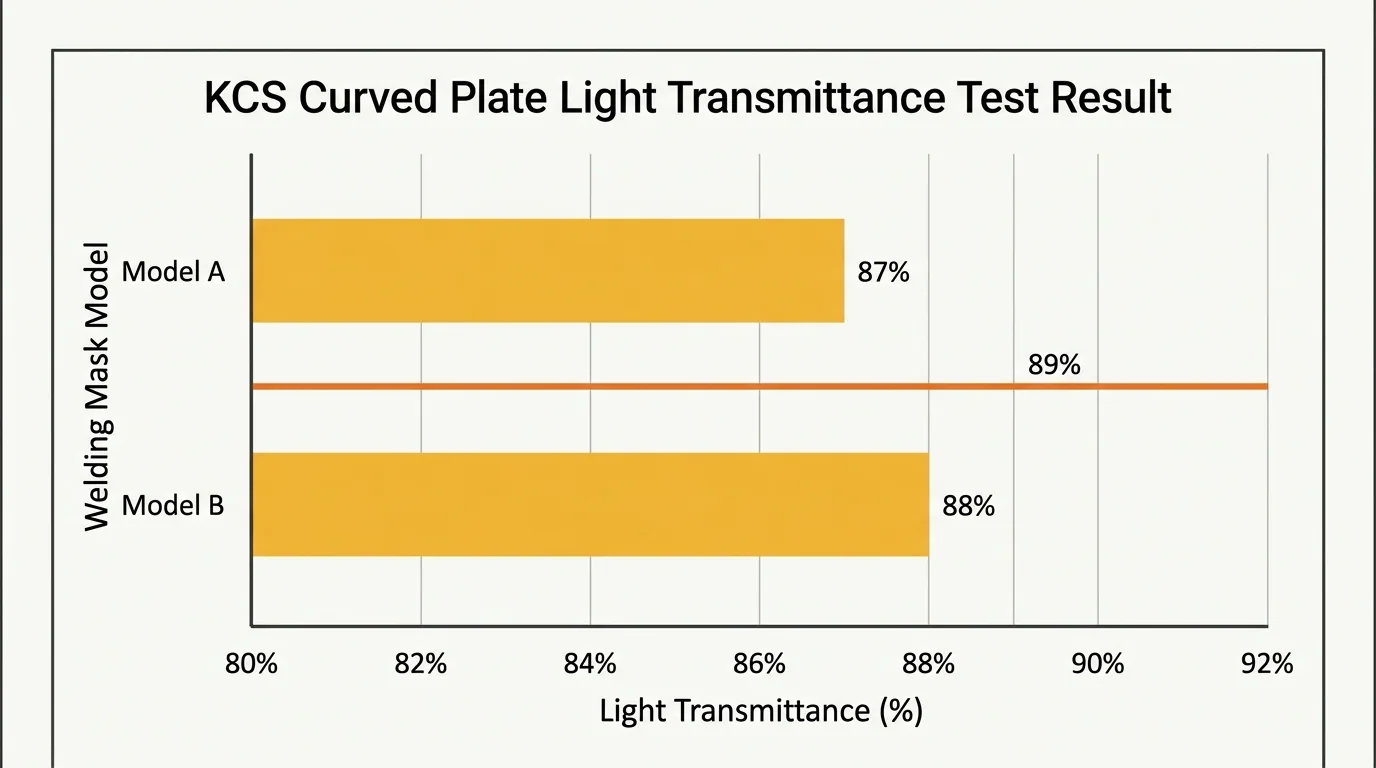
A miss this small is particularly painful, because:
- It is recoverable on the engineering side — a different curved plate spec would likely close the gap.
- But the testing fee, the lead time (often months), and the application labor are all already spent.
- Re-testing means going back through the same nominated lab on a new schedule.
The client was shocked. Their products clear domestic Chinese standards and Western safety standards without issue. The complacency is human — but in Korea it is expensive.
How we recommend approaching KCS (and KC, and KCW)
The general rule we apply across the KC family — standard KC, KCS, and KCW — is the same: do the document review before you apply, not after.
Concretely, that means:
- Pull the Korean standard for your specific product subtype. Not the umbrella category — the subtype. Auto-darkening welding mask is not the same file as manual-darkening. Type AB helmet is not the same as ABE.
- Map every numeric threshold against your existing test reports. If your existing reports do not measure that exact parameter, treat it as unknown, not as "probably fine."
- Pre-test the borderline parameters at an independent lab in your home country before you ship samples to Korea. This is cheaper than a failed Korean test and saves weeks.
- Only then apply. The official lab application is the last step, not the first.
This is the same logic we apply when reusing a foreign EMC report for KC: the Korean standard is the reference, and your foreign data either supports it or it doesn't. The work of comparison happens on paper first.
The cost math is unforgiving. A pre-test at an accredited lab in the US, EU, or China for one or two borderline parameters typically runs a few hundred to low-thousand dollars per parameter, and it can be turned around in days. A full KCS application — sample preparation, international shipping, the official testing fee, and the consultant labor to manage the application — is several times that, and a fail does not refund any of it. The math gets worse for KCW (water-related products), where parameters like material leaching, pressure tolerance, and chemical resistance are tested against thresholds that vary noticeably from NSF or EN equivalents. Brands that pass NSF in the US sometimes miss KCW on a single material parameter that was never measured the same way.
“Even a one percent deficit results in a fail. You really want to know what the questions are and what the standards are before you pay anything.”
Isaac Lee — CEO, Kontactic
For brands selling on Coupang under an Importer of Record arrangement, the cost of a failed certification is not just the testing fee — it is the delayed launch of an entire SKU line that was supposed to pull traffic and reviews. That is the part that hurts most.

What this client did next
The good news is that they have other SKUs in the catalog that do not require KCS, and those continue to sell on Coupang under our Spark service. The welding masks and safety helmets are paused pending an engineering revision on the curved plate.
That is not a failure of the market entry decision. They picked the right channel and the right service tier. The miss was upstream — a documentation and pre-testing miss, not an operational one. For brands considering a similar entry, the takeaway is to budget pre-validation as part of the certification project, not as an afterthought.
If you are evaluating KC-family compliance as part of a broader Korea entry plan, our notes on Korea entry for US electronics and grills, which usually need three separate certifications cover adjacent categories where the same pre-testing discipline applies.
Common questions
Is KCS the same as standard KC certification? No. KCS is a sub-track for industrial safety products, with its own standards and its own single nominated testing body. Standard KC for electronics and household goods uses different categories and a wider lab market.
Can I use my US, EU, or Chinese test report for KCS? Generally no, not as a direct substitute. You may be able to reuse some underlying measurement data if the parameters and methods align with the Korean standard, but KCS itself is issued only after testing through the Korean nominated lab.
How long does KCS take? It varies by product and by the lab's queue, but in this client's case the full attempt — preparation, sample shipment, testing, and result — took several months and ended in a fail. Plan in months, not weeks.
What happens if my product fails by a small margin? Failure is binary. A 1–2 percentage point miss on a single sub-test is treated the same as a larger miss. You revise the product and reapply.
Planning a Korea entry that needs KC, KCS, or KCW?
Talk to Kontactic before you apply. We will review the Korean standard against your existing test data and tell you honestly whether you are ready to test — or what to fix first.
About the author
Korean and global e-commerce operators with 15+ years of cross-border experience, led by CEO Isaac Lee — KOTRA-certified consultant and official lecturer for Seoul City and the Korea Customs Service. We run Korea market entry for Western brands every day; this blog documents what we learn in the field.
More about Kontactic →Related Articles
Korean Entity Handover: How Kontactic Aligns Each Step
See how Kontactic Seller Center keeps a Korean entity handover aligned across representative records, documents, delegated tax work, milestones, and exceptions.
Korea Payment Reconciliation Made Traceable by Kontactic
Kontactic's Korea payment reconciliation links payments, invoices, and allocations; confirmed and provisional matches stay separate, with adjustments preserved.
Product-Link Intake for Coupang: A Traceable Handoff
Kontactic Seller Center gives product-link intake a reviewable source record and a handoff into Coupang listing work before Korean copy or creative production starts.