KC Certification for USB and Battery-Powered Devices: When a Foreign EMC Report Is Enough
When Western brands ship small consumer electronics to Korea — the kind of thing that runs off a USB cable or an internal battery — one of the first compliance questions we get is: "Do we need to redo our EMC testing in a Korean lab?"
Usually, the answer is no. But the reasoning matters, because the wrong assumption here can cost weeks and thousands of dollars in duplicate lab work. This post walks through how we actually evaluate a foreign EMC report for reuse under Korea's Declaration of Conformity regime, using the exact logic our team applies internally.
What Actually Applies to USB- and Battery-Only Devices
Korea's KC mark covers several distinct regulatory streams. The two that matter most for small electronics are electrical safety and electromagnetic compatibility (EMC).
For a device that operates solely on USB bus power or internal batteries — no direct mains connection — KC electrical safety certification is not applicable. That whole stream drops away.
What does apply is EMC. Any electronic product sold in Korea has to meet electromagnetic compatibility requirements. Within Korea's EMC regime, USB/battery-powered household and similar devices typically fall under the Declaration of Conformity (자기적합확인) category — the lightest of the three EMC conformity pathways. It is a declaration the seller files, supported by a valid test report, rather than a full certification issued by a Korean body.
Plain-English summary: No mains plug usually means no KC electrical safety work. But you still need to file 자기적합확인 for EMC, and you need a test report that matches Korean standards.
EMC Is Two Tests, Not One
A lot of confusion starts here. "EMC testing" is shorthand for two separate tests bundled under one umbrella term.
- EMI (Electromagnetic Interference) — the emission test. Does your device leak electromagnetic noise that would interfere with other equipment?
- EMS (Electromagnetic Susceptibility) — the immunity test. Does your device keep working correctly when exposed to electromagnetic noise from its environment?
EMC compliance requires passing both. And when we evaluate whether a foreign test report can be reused in Korea, we have to confirm that both components map to the corresponding Korean standards — not just one.
The Core Question: Does the Report Match KS C Standards?
When a client sends us a CE-regime EMC report (often issued by a Chinese, European, or Taiwanese lab), the determination of whether it can support a Korean 자기적합확인 filing comes down to one page of that report: Applicable Standards.
The National Radio Research Agency (국립전파연구원, RRA) publishes a notice titled 전자파적합성 시험방법 (EMC Test Methods) — the current reference we work from is Notice No. 2025-50, published 2025-08-12 — which specifies exactly which KS C standards apply to which product categories.
For USB- and battery-powered household electrical and electromechanical appliances, two KS C standards dominate:
- KS C 9814-1:2022 — emission (disturbance prevention) test for household electrical and electromechanical appliances
- KS C 9814-2:2022 — immunity test for the same category
The mapping we most commonly confirm is:
EN IEC 55014-1:2021 ≡ KS C 9814-1:2022 (emission) EN IEC 55014-2:2021 ≡ KS C 9814-2:2022 (immunity)
When a foreign EMC report lists EN IEC 55014-1:2021 and EN IEC 55014-2:2021 as its applicable standards, and the actual test parameters, limits, and methods align with the KS C equivalents, that report can be used to file the Declaration of Conformity directly. No new testing in a Korean lab is required.
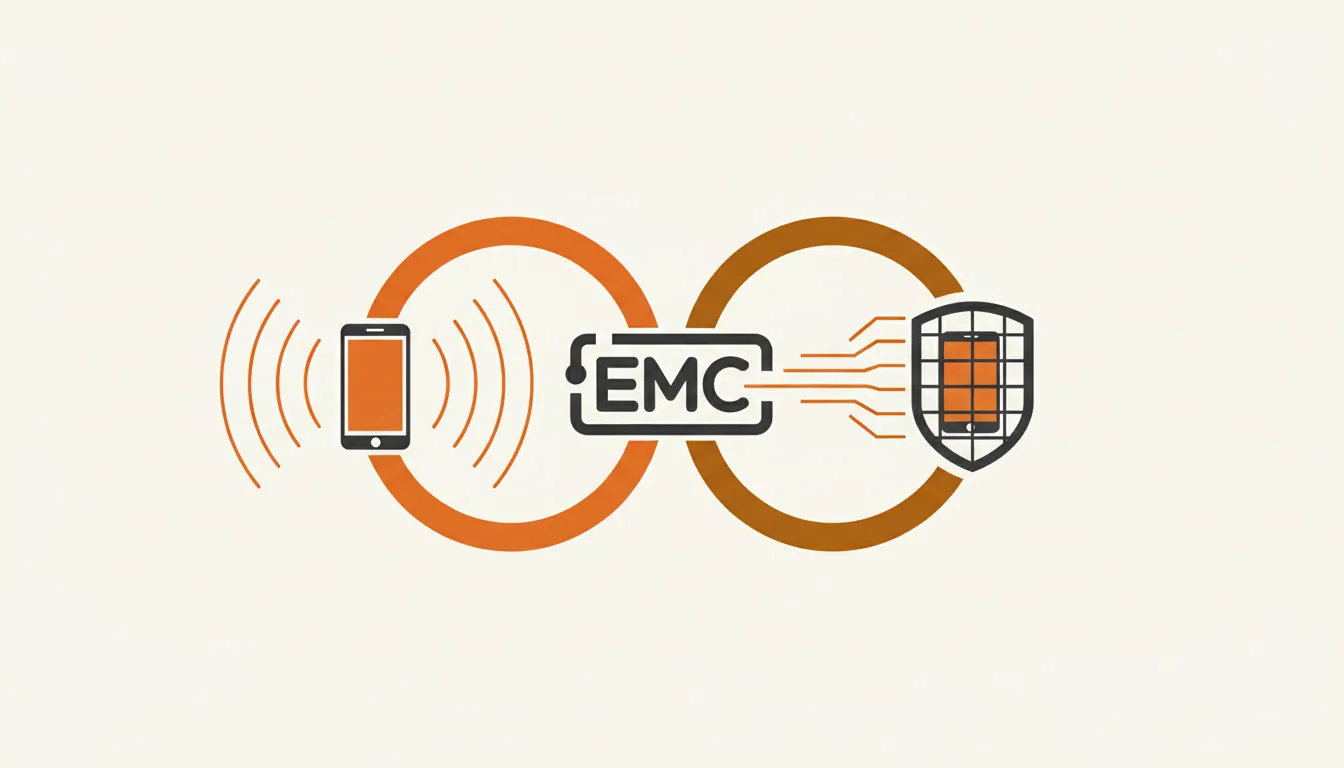
EMC compliance hinges on two separate tests. A foreign report has to cover both, and both have to map to the corresponding KS C standards.
How We Actually Verify the Mapping
The conceptual equivalence above is well-established, but we don't treat it as a blanket rule. Product categories drift, standards get revised, and a report from 2019 is not the same animal as a report from 2024. So our internal process is:
- Pull the Applicable Standards list from the foreign test report.
- Cross-reference each listed standard against the current RRA 전자파적합성 시험방법 notice to find the declared KS C equivalent for the product's category.
- Confirm that both emission and immunity are covered. A report that only covers EN IEC 55014-1 is incomplete for Korea — you still need an immunity result mapped to KS C 9814-2.
- Check revision years. Korea's notices name specific revision years (e.g., KS C 9814-1:2022). An older CE report can still be valid if the underlying test parameters haven't materially changed, but this is where we slow down and verify rather than assume.
- Verify test parameters, not just standard names. Two reports can cite the same standard and still have been run with different configurations (sample count, operating mode, frequency range). The Applicable Standards section is the starting point, not the finish line.
The reason a foreign EMC report can support a Korean Declaration of Conformity is not because Korea accepts "CE in general." It's because the specific KS C standards cited in Korea's EMC notice are the direct equivalents of the EN IEC standards on the report. The mapping has to be exact, and it has to cover both emission and immunity.
Isaac Lee — CEO, Kontactic
When This Shortcut Does Not Apply
It's worth being honest about the limits. A foreign EMC report won't carry over cleanly if any of the following are true:
- The product has a mains power connection, which reintroduces KC electrical safety scope and usually means a higher EMC conformity class as well.
- The product falls under a different category than household/similar appliances — for example, ITE, radio equipment with intentional RF emitters (Bluetooth, Wi-Fi, LTE), medical devices, or children's products. These carry their own KC regimes (often including KC 인증 proper, not just 자기적합확인) and separate certifications we treat individually.
- The foreign report cites standards that don't have a published KS C equivalent in the current RRA notice.
- The report is missing either the emission or immunity side.
- The report is for a different model than the one actually being imported. Family/series coverage has to be documented.
In those cases, the conversation shifts to Korean lab testing or, for wireless products, full KC certification — a different workflow with different timelines and costs.
Why This Matters for Go-to-Market Timing
For a small USB- or battery-powered device where the foreign EMC report is clean and maps cleanly, the Declaration of Conformity path typically removes the longest pole in the compliance tent. You are filing a declaration backed by existing evidence rather than waiting in queue at a Korean test lab. That is the difference between launching a listing this quarter and launching two quarters from now.
This is also why we push clients hard, during onboarding, to send us every test report they have — CE, FCC, internal lab reports, whatever exists — before they commit to any new testing. More often than not, the paperwork needed to get a product live in Korea is already sitting in the brand's compliance folder. It just needs to be read against the right Korean standard.
Disclaimer: Kontactic provides best-efforts import requirement research in its services. Final product-level compliance responsibility (claims, certifications, labeling) rests with the client. This article describes our working methodology, not a legal guarantee for any specific product.
Thinking about bringing a USB- or battery-powered product into Korea? Send us your existing EMC/CE reports and product specs. We'll tell you whether you can file a Declaration of Conformity on what you already have, or whether Korean lab testing is genuinely required.
About the author
Korean and global e-commerce operators with 15+ years of cross-border experience, led by CEO Isaac Lee — KOTRA-certified consultant and official lecturer for Seoul City and the Korea Customs Service. We run Korea market entry for overseas brands every day; this blog records what we learn in the field.
More about Kontactic →Related Articles
Does My Korean Importer Need a License for This Product?
A Korean importer may need a license or permit even when product documents are complete. Seller Center separates the two checks and lists what to prepare next.
Import a Product Into Korea, But Can't Sell on Coupang?
Importing a product into Korea does not guarantee Coupang sales. Learn how SKU review separates import permission, online-sale rules, and importer permits.
What Happens After Your Korean Coupang Page Is Finished?
After your Korean Coupang page is finished, see the real page, follow the same instructions in Seller Center and email, and get reminders only if needed.