
Coupang Exchange Tracking Number: Return Receipt First
RECEIPT does not permit replacement-tracking registration because it means the exchange request was received, not that the returned product was received. The seller must receive and confirm the returned item before the case moves to PROGRESS. Once the new shipmentBoxId appears, register the replacement invoice or tracking number.
Short answer: RECEIPT is request receipt. PROGRESS is the post-return-receipt stage. The gate is the recorded seller receipt, followed by the new replacement-shipment identifier—not the customer’s request time or the return-leg tracking number.
The exchange request is only the first gate
The label is easy to misread. In this workflow, RECEIPT means that the customer or Coupang customer service has opened the exchange request. It is not confirmation that the seller has received the returned product.
That distinction gives you a practical way to read the exchange record. The customer can submit an exchange request, receive return instructions, and hand the parcel to a carrier while the case remains in RECEIPT. The replacement shipment is not yet at the registration stage simply because the customer has started the process.
| Status or event | What it means | What your team should do |
|---|---|---|
RECEIPT | The customer or Coupang customer service has opened the exchange request. | Acknowledge the request and explain the return-first sequence. Do not register replacement tracking yet. |
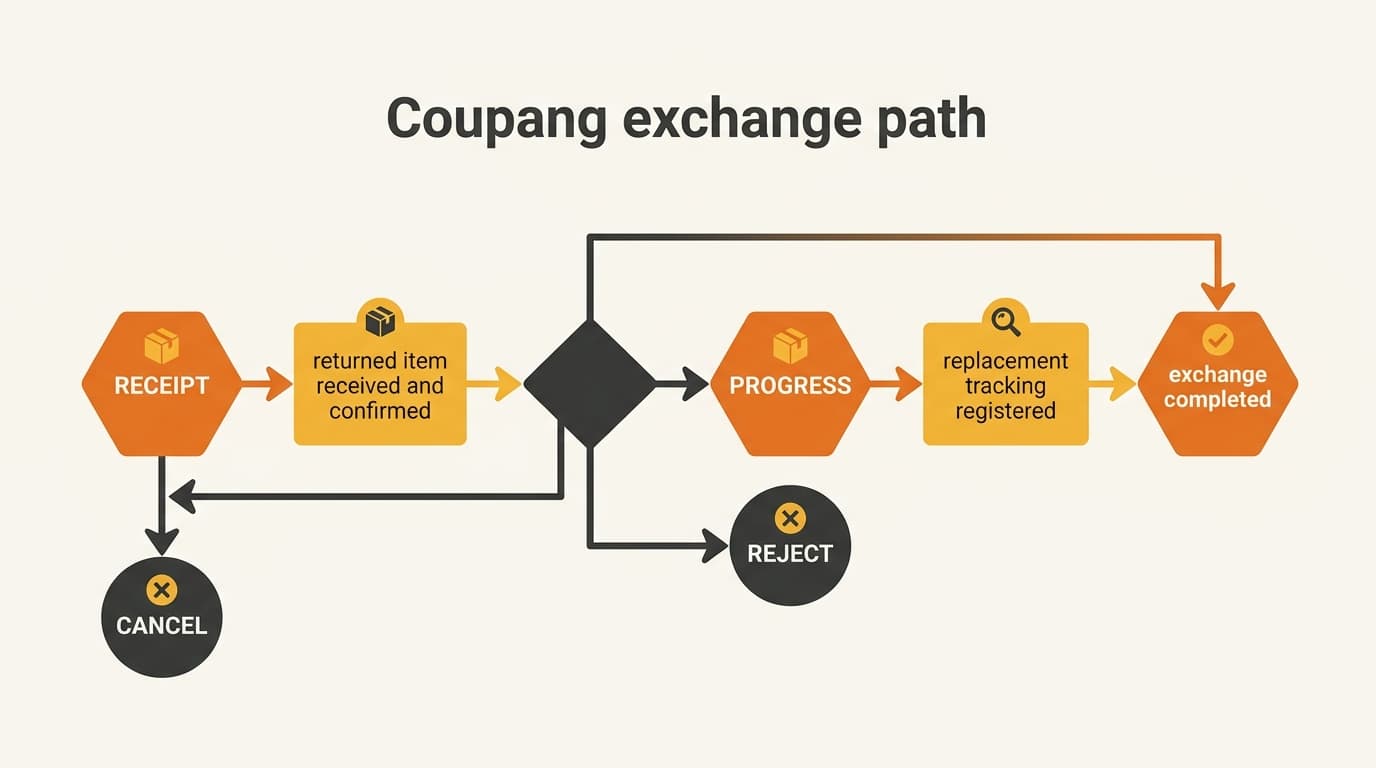
returned item received and confirmed | The seller has received the returned item and that receipt has been confirmed in the exchange workflow. | Allow the status and replacement-shipment data to update. |
PROGRESS | The exchange record reflects the seller receiving the returned item. | After the applicable processing interval for the exchange record, register the replacement invoice or tracking information. |
replacement tracking registered | The replacement shipment’s tracking information has been attached to the exchange workflow. | Monitor the replacement shipment and keep the customer informed. |
exchange completed | The exchange workflow has reached its completion point. | Close the operational case and retain the record for reconciliation. |
REJECT or CANCEL | A separate outcome, not an ordinary wait between return and replacement. | Stop treating the case as a registration delay and follow the relevant resolution procedure. |
The path is therefore: request received, returned item received and confirmed, PROGRESS, replacement tracking registered, and exchange completed. REJECT and CANCEL sit outside that ordinary path. Repeated attempts to register tracking will not turn either outcome into PROGRESS.
Receipt confirmation is a platform event, not a customer promise
Several events can look like a return has been received. The customer may see a carrier delivery scan. A fulfillment warehouse may have the parcel at its dock. A support agent may receive a message saying the return was delivered. None of those observations should substitute for the receipt confirmation recorded in the Coupang exchange case.
The operational trigger is the seller receiving and confirming the returned item. That is why a brand can have a plausible return status outside the seller account and still be unable to register the replacement tracking number. The exchange record has not yet crossed the gate that authorizes the replacement step.
When Coupang Rocket Growth is the designated fulfillment service, the return can be handled through Coupang’s platform procedures and fulfillment operation. The brand may not be the party physically handling the parcel, so the internal procedure must identify who checks the recorded receipt and passes that confirmation to seller operations. The physical-return boundary is explained in Who Handles Returns Under Coupang Rocket Growth?; the key point here is that a carrier scan alone is not the registration trigger.
After receipt confirmation, replacement data may not appear instantly. The applicable processing interval can vary by operation or status. Read it from the current exchange operation’s status response and the documentation for the relevant endpoint or API version in Coupang’s official developer documentation. Do not promise a fixed customer-facing wait time. Until that interval elapses, a temporary absence of replacement data can be normal processing rather than a defective exchange request.
For an integration or internal audit, verify the current status values and field names against the same official documentation rather than copying an old support note or translated spreadsheet. Use the exchange operation’s status response—not a carrier scan or warehouse message—to decide whether the retry threshold has passed.
Operational rule: Treat the platform-recorded receipt confirmation as the handoff. Customer service can acknowledge the request earlier, but seller operations should wait for the exchange record to reach PROGRESS and for the replacement-shipment data to become available.
Register the replacement with the new shipmentBoxId
An exchange contains two different shipping movements: the returned product going back to the seller and the replacement product going to the customer. They can belong to the same exchange case, but their shipment identifiers are not interchangeable.
Identifier confusion is the second common reason registration fails. A team sees a familiar original-order reference or the tracking number for the parcel coming back and submits it when Coupang is asking for the replacement shipment record.
| Identifier or reference | Role in this workflow | Use for replacement tracking registration? |
|---|---|---|
| Return-leg shipment identifier | Identifies the parcel moving from the customer back to the seller or fulfillment operation. | No. It belongs to the return movement. |
OriginalShipmentBoxId | The original shipment identifier named in the workflow. | No. Do not substitute it for the replacement shipment. |
Newly issued shipmentBoxId | The identifier for the newly created replacement shipment. | Yes. Use this value for the replacement registration step. |
The sequence for seller operations is straightforward:
- Confirm that the exchange record has moved from
RECEIPTtoPROGRESSafter the returned item was received and confirmed. - Wait until the applicable processing interval for that exchange record has elapsed rather than retrying immediately after the physical receipt event.
- Retrieve the newly issued
shipmentBoxIdfor the replacement shipment. - Register the replacement invoice or tracking number through the current Coupang workflow.
- Monitor the replacement shipment until the exchange reaches
exchange completed.
If the replacement identifier is not available, do not fall back to OriginalShipmentBoxId or the return-leg identifier just to populate a field. First check the exchange status, then check whether the applicable processing interval for that record has elapsed. The issue may be timing, or it may be that the wrong shipment record was fetched; using the wrong identifier hides that distinction.
This also explains why a Western brand should keep its data model explicit. Store the exchange request, the return movement, and the replacement movement as related but separate operational records. A single original-order reference is not enough to tell a support agent which parcel has arrived or which shipment should receive the new tracking information. Keep finance events separate from this exchange state machine; When Coupang Recognizes Your Sale as Revenue addresses a different record and should not be used to infer replacement readiness.

Build Korean-language support around the state transition
Customer service should describe the sequence the platform can actually execute. Acknowledge the exchange request, but do not promise immediate replacement dispatch. The return must be received and confirmed first. Register replacement tracking after the case reaches PROGRESS and the new shipment data appears.
Use this handoff:
- Acknowledge the request. Tell the customer that the exchange request has been received. Do not describe
RECEIPTas proof that the returned item has arrived. - Explain the return-first step. State that the returned product must be received and confirmed before the replacement shipment can be registered.
- Assign the receiving check. The warehouse or fulfillment owner confirms that the receipt is recorded in the exchange workflow and passes the case to seller operations.
- Wait for the stage and system update. Seller operations checks for
PROGRESS, waits until the applicable processing interval for that exchange record has elapsed, and retrieves the newshipmentBoxId. - Register and monitor. Register the replacement invoice or tracking number, then keep the customer-facing team aligned with the replacement shipment’s progress. If the case is
REJECTorCANCEL, route it as a separate outcome.
A concise customer message can be written without exposing every internal field name:
English
We have received your exchange request. The returned item must first be received and confirmed. Once that step is recorded and the exchange can proceed, we will register and monitor the replacement shipment.
Korean
교환 요청이 접수되었습니다. 반품 상품이 입고되어 확인되고 시스템 처리가 완료된 후 교환 상품의 배송정보를 등록할 수 있습니다. 해당 단계가 확인되면 교환 상품의 배송정보를 등록하고 배송 상황을 안내드리겠습니다.
The Korean wording sets an accurate expectation without promising dispatch when the request is opened. Internally, the support team should use the platform status terms consistently even if the customer sees a simpler explanation. That prevents one agent from treating a request as ready for replacement while the warehouse is still waiting for the recorded receipt.
The handoff should also preserve the distinction between a return identifier and the replacement shipmentBoxId. When a customer asks for an update, support should be able to answer three separate questions: has the exchange request been received, has the return been recorded as received, and has replacement tracking been registered? Combining those questions into a single “exchange status” is how premature promises and wrong-identifier submissions occur. Keep other post-sale workflows separate from this state machine; Coupang Instant Refund: Why Buyers Get Paid Before Returns Arrive describes a different path.

Common questions about Coupang exchange tracking
Why does RECEIPT sound as if the returned product has already arrived?
Because the label describes Coupang receiving the exchange request. In this workflow, read RECEIPT as request received; the seller’s receipt of the returned item is a later event that leads to PROGRESS.
Can we register the replacement tracking number when the return carrier says delivered?
No. A carrier scan or a customer’s delivery confirmation does not replace the seller’s confirmed receipt in the exchange record. Wait for the case to advance to PROGRESS and for the replacement shipment data to become available.
What if the returned item is confirmed but the replacement shipment does not appear?
Wait until the applicable processing interval for that exchange operation has elapsed. Then check the exchange status response and retrieve the newly issued shipmentBoxId. A short gap after receipt confirmation does not necessarily mean the request is defective; if the data remains unavailable after the applicable threshold, verify the current workflow in the official Coupang developer documentation and route the case for platform support.
Which identifier should be submitted for the replacement?
Use the newly issued shipmentBoxId for the replacement shipment. Do not substitute OriginalShipmentBoxId or the identifier belonging to the return leg.
Are REJECT and CANCEL just slower versions of PROGRESS?
No. They are separate outcomes, not ordinary shipping delays. Once either outcome is present, stop retrying replacement-tracking registration as if more processing time alone will resolve it.
Can customer service promise an immediate replacement when the exchange request is opened?
It should not. The accurate promise is to acknowledge the request, explain that return receipt comes first, and register and monitor the replacement after the exchange record reaches the appropriate stage.
Align your exchange handoff before launch
If your Korea operation needs Korean-language support, returns receiving, and Coupang replacement dispatch to follow the same state transition, map the RECEIPT-to-PROGRESS handoff with Kontactic.
About the author
Korean and global e-commerce operators with 15+ years of cross-border experience, led by CEO Isaac Lee — KOTRA-certified consultant and official lecturer for Seoul City and the Korea Customs Service. We run Korea market entry for overseas brands every day; this blog records what we learn in the field.
More about Kontactic →Related Articles

Korea FTA Duty: US/EU Warehouse Shipping Is Not Enough
A US or EU warehouse does not prove FTA origin in Korea. The importer must verify production, transit, and documents before claiming a lower customs duty rate.

Agentic Commerce: When AI Picks the Product, What Should Brands Selling in Korea Do?
AI shopping agents now search, compare, and sometimes buy for the shopper, and they recommend 1–5 products instead of a page of results. What Korea's Chamber of Commerce found in the US and Europe, and what it means for your product data in Korea.

Korea E-commerce, September 2026: The Market Shrank, Coupang Grew
Korean online shopping spend fell 2.1% in September 2026, yet Coupang grew 3.9% and reached a 72.7% share of the 12 largest platforms. What the data means for a foreign brand choosing where to sell.