
Agentic Commerce: When AI Picks the Product, What Should Brands Selling in Korea Do?
Until now, a shopper typed a product name into a search box and scrolled. AI is changing that. A shopper can now say "find me running shoes for next week's marathon, under $150" and let an AI agent search, compare, and, if allowed, place the order. This is called agentic commerce.
On October 14, 2026, the Korea Chamber of Commerce and Industry (KCCI) published a special issue of its retail newsletter, Retail Talk (no. 125), on how retailers in the US and Europe are using AI to sell. It also included an interview with Professor Jiyoung Hwang of the University of North Carolina at Greensboro, who studies how shoppers respond to AI. The issue is long. Below we pick out the parts that matter to a foreign brand selling in Korea.
Short answer: An AI shopping agent does not show a page of results. It recommends one to five products. To be one of them, your product needs complete, accurate, easy-to-read information in the language and on the marketplace where the shopper buys. In Korea, that means Korean product data and a Korean detail page, mainly on Coupang.
From chatbot to shopping agent
The newsletter describes four steps. Each one does more of the shopping for the customer.
| Step | What the AI does | Example request |
|---|---|---|
| Generative AI | Answers questions and writes text or images | "What running-shoe styles are popular?" |
| AI assistant | Finds, compares, and recommends products | "Find student running shoes under $100." |
| AI agent | Understands your needs and history, then decides and acts | "Find the running shoes that suit me." |
| Agentic commerce | Searches, compares, and buys within limits you set | "Buy running shoes for next week's marathon, under $150." |
Amazon shows the path. It launched the Rufus shopping assistant in 2024 and "Buy for Me" in April 2025, which lets its AI buy items from other brands' websites. It later added Auto-Buy, which places an order when a price the shopper set is reached. In May 2026 Amazon joined Rufus and Alexa+ into one service, Alexa for Shopping. Amazon says active users in Q2 2026 were about double a year earlier.
How big it could get
Nobody knows yet, and the forecasts are far apart. The newsletter lists these:
| Source | Forecast for 2030 |
|---|---|
| McKinsey | USD 3–5 trillion in global B2C goods sales made through AI agents |
| Accenture | About USD 3.1 trillion |
| Deloitte | Up to USD 17.5 trillion, counting sales AI only influences |
| Planet Retail RNG | AI influences 31% of e-commerce sales (from 0.5% in 2025) |
The range is wide because each firm measures something different. The useful point is narrower: the newsletter treats agentic commerce as a new route inside e-commerce, like mobile or social commerce, not as a replacement for it. Shoppers will still buy on marketplaces. More of them will arrive there through an AI.
The shelf gets much shorter
This is the change that matters most to a brand. In a store, a shopper compares maybe 30 to 100 products on a shelf. Online, one search returns thousands, and ranking on page one decides most sales. An AI agent narrows that to one to five.
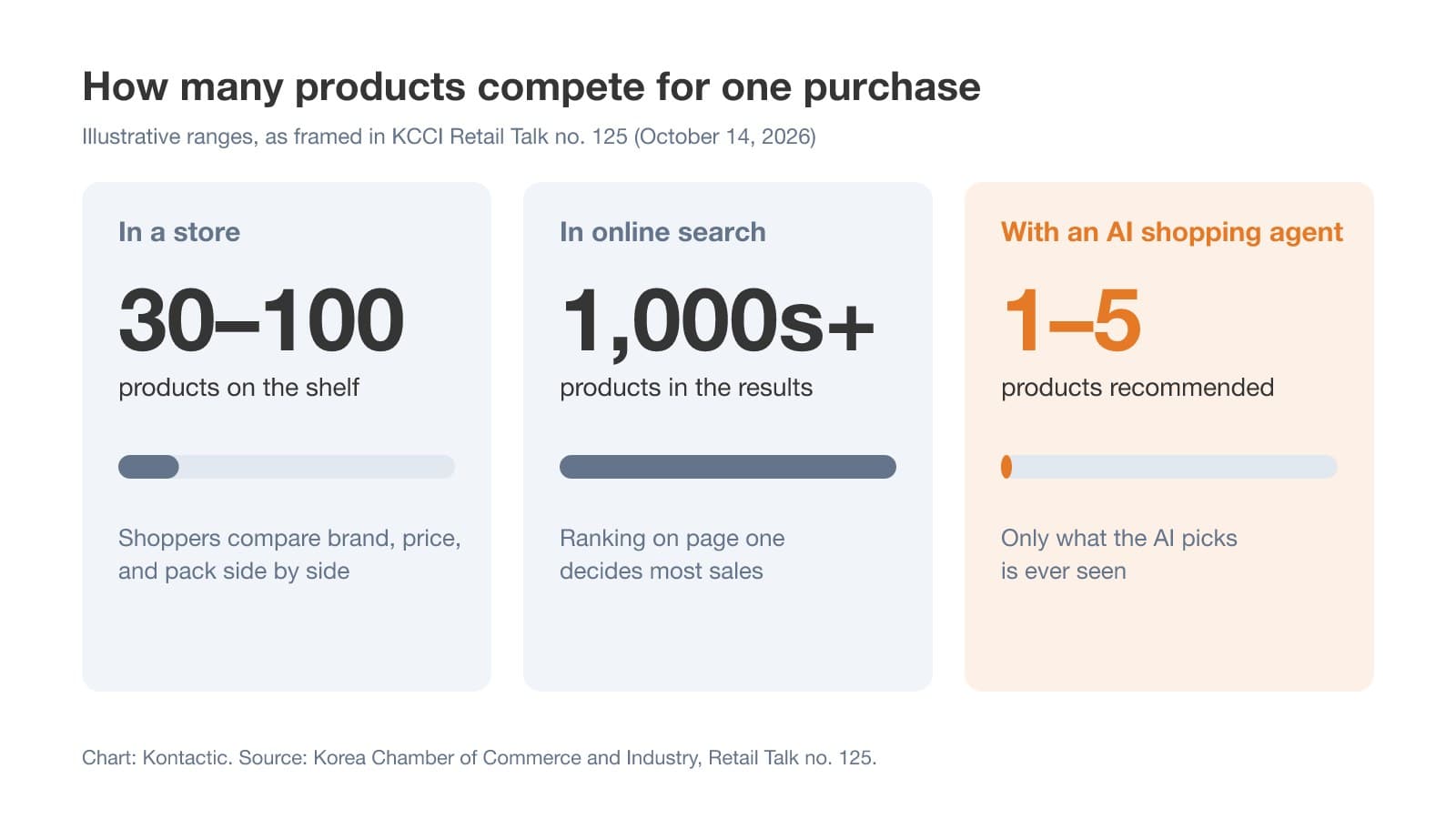
If your product is not on that short list, the shopper never sees it. So the newsletter says brands should add GEO (generative engine optimization) to SEO.
| SEO | GEO | |
|---|---|---|
| Goal | Rank high in search results | Be included in AI answers and recommendations |
| Where | Google, Naver, marketplace search | ChatGPT, Gemini, Perplexity, marketplace AI assistants |
| How | Keywords, content, site structure | Structured product data, information AI can read, trusted outside content |
| Measure | Ranking and clicks | How often, and how accurately, AI recommends you |
Shoppers let AI choose more than they let it pay
AI is good at finding and comparing. Shoppers are slower to hand over the final purchase.
- US: In September 2026, 51% of US consumers used at least one AI tool while shopping in the past month, according to NIQ. 20% used AI product recommendations and 16% used an AI shopping assistant.
- Europe: A McKinsey survey of shoppers in the UK, France, and Germany found 38% use AI to research and decide. But 47% said they were uncomfortable letting AI make repeat purchases for them.
- Walmart and ChatGPT: Walmart tested buying directly inside ChatGPT on about 200,000 products. The conversion rate was about one third of Walmart's own website. Walmart moved to a different setup: ChatGPT helps people find products, and Walmart's own assistant, Sparky, takes over the purchase. OpenAI also shifted its focus in March 2026 from checkout inside ChatGPT to product search and comparison.
For a brand, the lesson is simple: the AI decides the shortlist, but the sale often still closes on the store's own page. That page has to do its job.
Which purchases shoppers will hand over first
At NRF 2026 in January, the retail tech company Rokt grouped purchases by how much AI is likely to do. The newsletter adapted it into four groups.
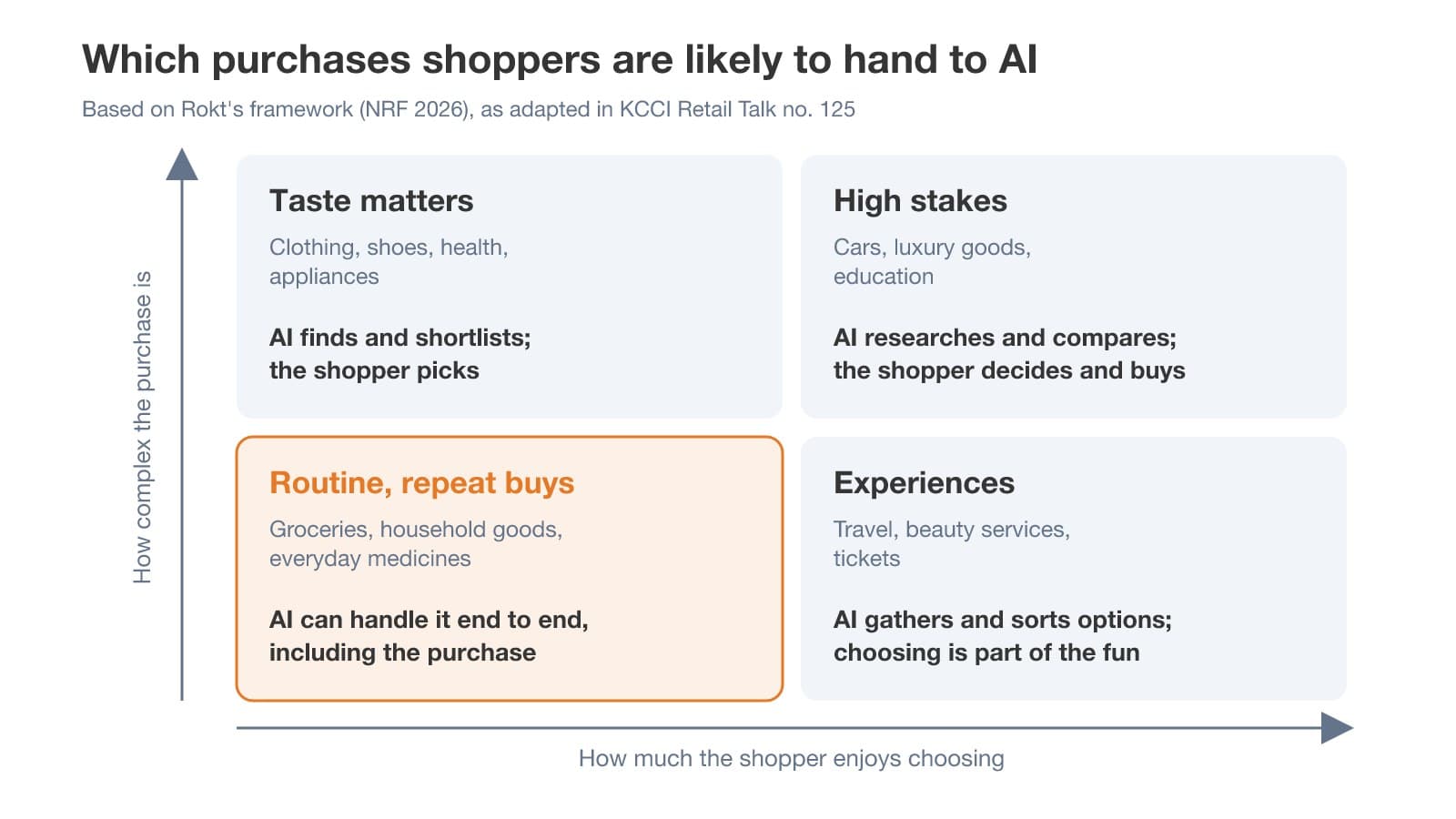
- Routine, repeat buys (groceries, household goods, everyday medicines): AI may handle these from search to purchase.
- Taste-driven buys (clothing, shoes, health, appliances): AI builds the shortlist; the shopper picks.
- High-stakes buys (cars, luxury goods, education): AI researches; the shopper decides.
- Experiences (travel, beauty services, tickets): AI sorts options, because choosing is part of the enjoyment.
If you sell consumables, being the product the AI reorders matters. If you sell fashion, electronics, or beauty, being on the shortlist and then winning on the detail page matters.
What leading retailers are doing
A few examples from the newsletter, with the retailers' own figures:
- Walmart says customers who use its Sparky assistant spend about 35% more per order than those who do not. Walmart also connects its products to ChatGPT and Google Gemini, so it is reachable through outside AI as well as its own app.
- Zalando, the European fashion platform, said that about 90% of its marketing content was made with generative AI, up from almost none a year earlier. Work that took six to eight weeks per piece now takes a few days, which makes it practical to localize content for each of its markets. Its AI size advice also cut size-related returns by more than 8% last year.
- Lowe's says shoppers who use its AI advisor, Mylow, online convert at three times the rate of those who do not.
A warning about over-short product information
Professor Hwang's research adds a useful caution. Many shopping sites now use AI to boil thousands of reviews down to a few keywords. Her study found that when summaries were cut too short, shoppers understood them but found them harder to take in, and they felt less sure about buying. Her point, in short: shoppers do not want the shortest information. They want information that is easy to read and has what they need to decide.
Her other finding: the more shoppers felt an AI understood their situation, the more they trusted it and the happier they were with their choice. That effect was stronger for lower-priced products.
What this means if you sell in Korea
The newsletter's examples come from the US and Europe. Korea's marketplaces will move on their own timeline, and we do not make a forecast here. But the groundwork is the same, and it is the groundwork Korean marketplace search already rewards today:
- Complete Korean product data. Fill in every attribute: size, material, ingredients, compatibility, model numbers, and certification details such as KC marks. An AI can only recommend what it can read and filter. A translated Amazon title with empty fields gives it nothing to work with.
- A Korean detail page that answers the questions. When the AI hands the shopper over, the detail page (상세페이지) has to close the sale. Professor Hwang's finding applies here too: make it easy to read, not thin.
- Real reviews and steady ratings. Reviews are one of the main sources AI uses to judge a product. They take time to build, so start early.
- Consistent information outside the marketplace. GEO counts trusted outside content. Your brand site, Korean-language content, and press should state the same facts as your listing.
- Match the plan to your category. For consumables, make reordering easy and keep stock steady. For taste-driven products, invest in visuals, sizing, and comparison points.
Where Kontactic fits
Most of this is listing work, and it is work we do every day on Coupang:
- Localized detail pages — we build Korean, mobile-first Coupang detail pages from what you already have. See Localized PDP.
- Direct — we run your own Coupang cross-border store as your operating agent, including listing optimization, Coupang ads, and Korean phone support. For brands shipping from the US, Europe, Japan, mainland China or Hong Kong. Learn about Direct.
- Blaze — full operations on your own Korean entity, across Coupang and other Korean channels, including listings, content, and growth marketing. Learn about Blaze.
Start light and scale up, or go all in from day one. Either way, the product data and the detail page are where the AI era starts.
Common questions
What is agentic commerce?
Shopping in which an AI agent searches, compares, and, within limits the shopper sets, buys a product for them. It goes one step beyond an AI assistant, which recommends but leaves the purchase to the shopper.
What is GEO?
Generative engine optimization: preparing your product information so AI tools include it in their answers and recommendations. SEO aims to rank in search results; GEO aims to be one of the few products an AI suggests.
Are Korean shoppers already buying through AI agents?
The newsletter covers the US and Europe, not Korea, so we do not give a figure. What already applies in Korea is that marketplace search relies on complete, structured product data, which is the same data AI agents need.
Does this mean SEO no longer matters?
No. Most shoppers still search. The newsletter treats agentic commerce as a new route inside e-commerce. Good product data helps both.
Where can I read the original?
Retail Talk is a free newsletter (in Korean) from the Korea Chamber of Commerce and Industry. This article summarizes issue no. 125 of October 14, 2026, with our own view for foreign brands. Figures are as reported by the newsletter and the companies it cites.
Get your Korean listings ready
Tell us what you sell and where you ship from. We will look at your current product data and detail pages and suggest what to fix first.
About the author
Korean and global e-commerce operators with 15+ years of cross-border experience, led by CEO Isaac Lee — KOTRA-certified consultant and official lecturer for Seoul City and the Korea Customs Service. We run Korea market entry for overseas brands every day; this blog records what we learn in the field.
More about Kontactic →Related Articles
Korea E-commerce, September 2026: The Market Shrank, Coupang Grew
Korean online shopping spend fell 2.1% in September 2026, yet Coupang grew 3.9% and reached a 72.7% share of the 12 largest platforms. What the data means for a foreign brand choosing where to sell.
Natural Room Spray: Does Korea Require Safety Filing?
Natural room spray still needs Korea’s safety filing: Korea checks its use, claims, formula, spray method, and labels before commercial import for sale.
Korean Children's KC: Do Toys and Hoodies Differ?
Toys and hoodies can follow different Korean KC paths. Korea may require product testing, factory inspection, a filing, or a supplier declaration before sale.