Korea E-commerce, September 2026: The Market Shrank, Coupang Grew
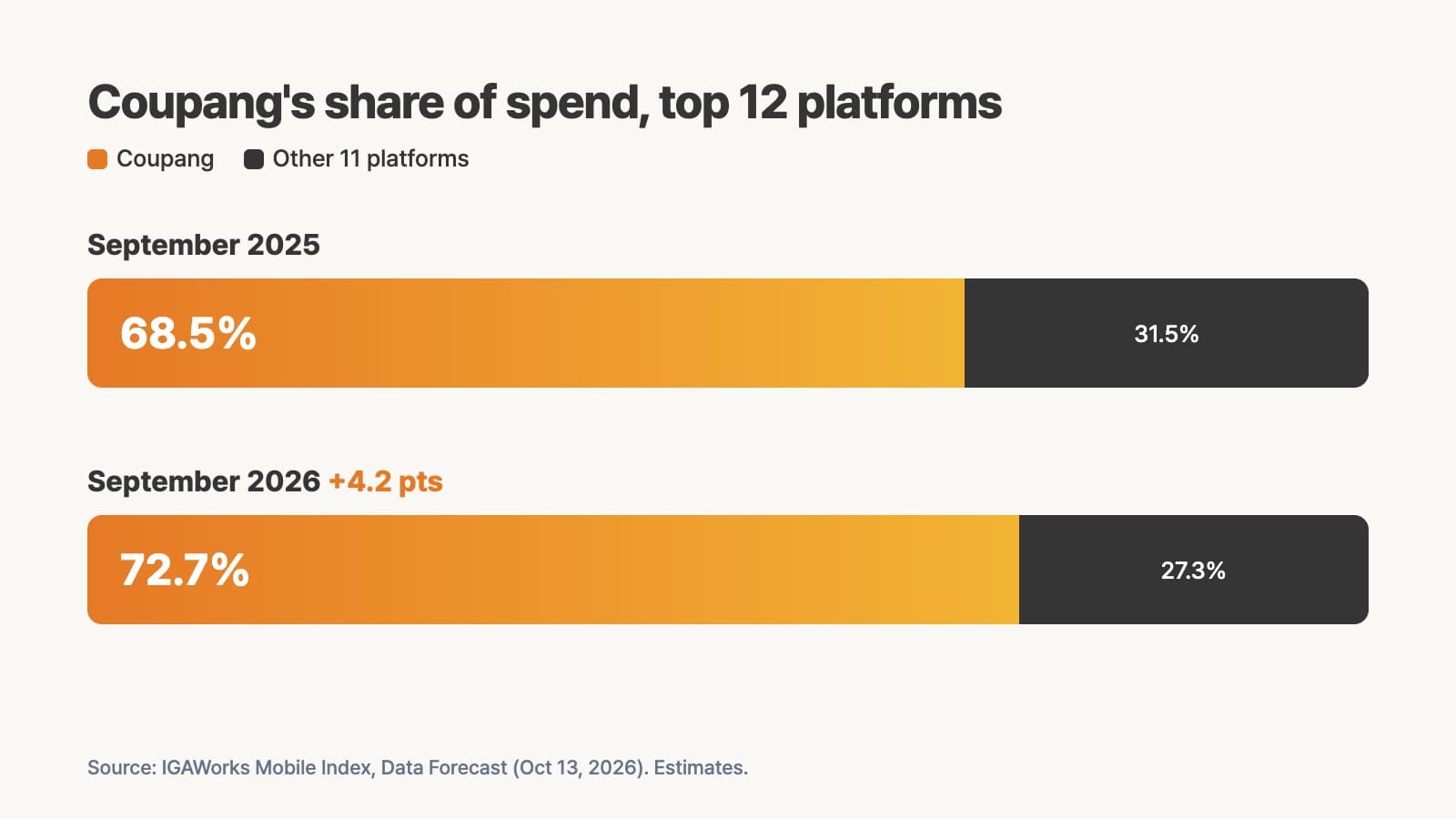
In September 2026, Korean shoppers spent less online than a year earlier, but they spent more on Coupang. Across the 12 largest online shopping companies, card and payment spend fell 2.1%. Coupang's spend rose 3.9%, and its share of that group climbed from 68.5% to 72.7%.
The numbers come from IGAWorks' Mobile Index Data Forecast, published on October 13, 2026. They are Mobile Index estimates built from its consumer payment panel, not figures reported by the companies. Even so, they show clearly where Korean online spending is going — and that matters if you are deciding how to sell in Korea.
Short answer: Coupang is not just the biggest Korean marketplace. In a shrinking month it kept growing while Gmarket, 11st, Auction, and AliExpress each lost about a third of their spend. For a foreign brand, a Korea plan without Coupang leaves out about seven of every ten won spent on the large platforms.
What the September 2026 numbers say
Mobile Index compared September 2026 with September 2025 for the 12 largest online shopping companies in Korea.
| September 2025 | September 2026 | Change | |
|---|---|---|---|
| All 12 companies | KRW 6.83 trillion | KRW 6.68 trillion | −2.1% |
| Coupang | KRW 4.67 trillion | KRW 4.85 trillion | +3.9% (about +KRW 181 billion) |
| Coupang's share of the 12 | 68.5% | 72.7% | +4.2 points |
The loss did not come from everywhere. About three quarters of it (75.6%) came from three older open marketplaces: Gmarket, 11st, and Auction. Together they lost more than Coupang gained.
Growth by company, year on year:
- Daiso: +17.1%
- Lotte Homeshopping: +6.0%
- Coupang: +3.9%
- CJ OnStyle: −13.9%
- 11st: −29.7%
- Gmarket: −30.0%
- Auction: −35.7%
- AliExpress: −36.9%
Read one month with care
September 2026 included Korea's Chuseok holiday, while in 2025 Chuseok fell in October. Holiday weeks change how and when people shop, so a single month can swing. The newsletter itself points out that spend over the last 12 months was up 7.9% year on year. In short, the market is not collapsing. What stands out is the gap between Coupang and almost everyone else.
Where Naver Plus Store's lost users went
Naver Plus Store, Naver's standalone shopping app, grew fast: its monthly active users were up 88.5% year on year. But growth in users did not mean users stayed.
- Of the people who used Naver Plus Store in August, about 2.31 million (25.5%) did not use it in September.
- 73.7% of them, about 1.7 million people, used Coupang in September.
- Only about 120,000 people moved the other way, from Coupang to Naver Plus Store.
That is a 14-to-1 flow in Coupang's favor. It does not mean Naver is losing shoppers overall; Naver is still a major channel and its app is growing. It means Coupang is where many Korean shoppers end up when they try something else.
For more on how Coupang and Naver compare as sales channels, see Q1 2026 Coupang–Naver Shift: Your Channel Strategy.
New installs are not the same as new customers
The newsletter also looked at what happened after people installed a shopping app in September.
| App | New installs | Opened again the next week | Deleted within 15 days |
|---|---|---|---|
| Naver Plus Store | about 740,000 | 43.6% | 20.0% |
| Temu | about 640,000 | 49.6% | 64.0% |
| Coupang | about 400,000 | 74.7% | 44.1% |
| Gmarket | about 160,000 | 51.6% | 29.6% |
Next-week return: devices that installed between September 7 and 20. Deletion: devices that installed between September 1 and 14.
Naver Plus Store had the most installs, but fewer than half of those devices came back the next week, down from 58.6% a year earlier. Temu also had many installs, but almost two thirds of them deleted the app within 15 days. Coupang had fewer installs, yet three in four came back the next week — the highest of the group.
Shoppers use several apps, but pay on Coupang
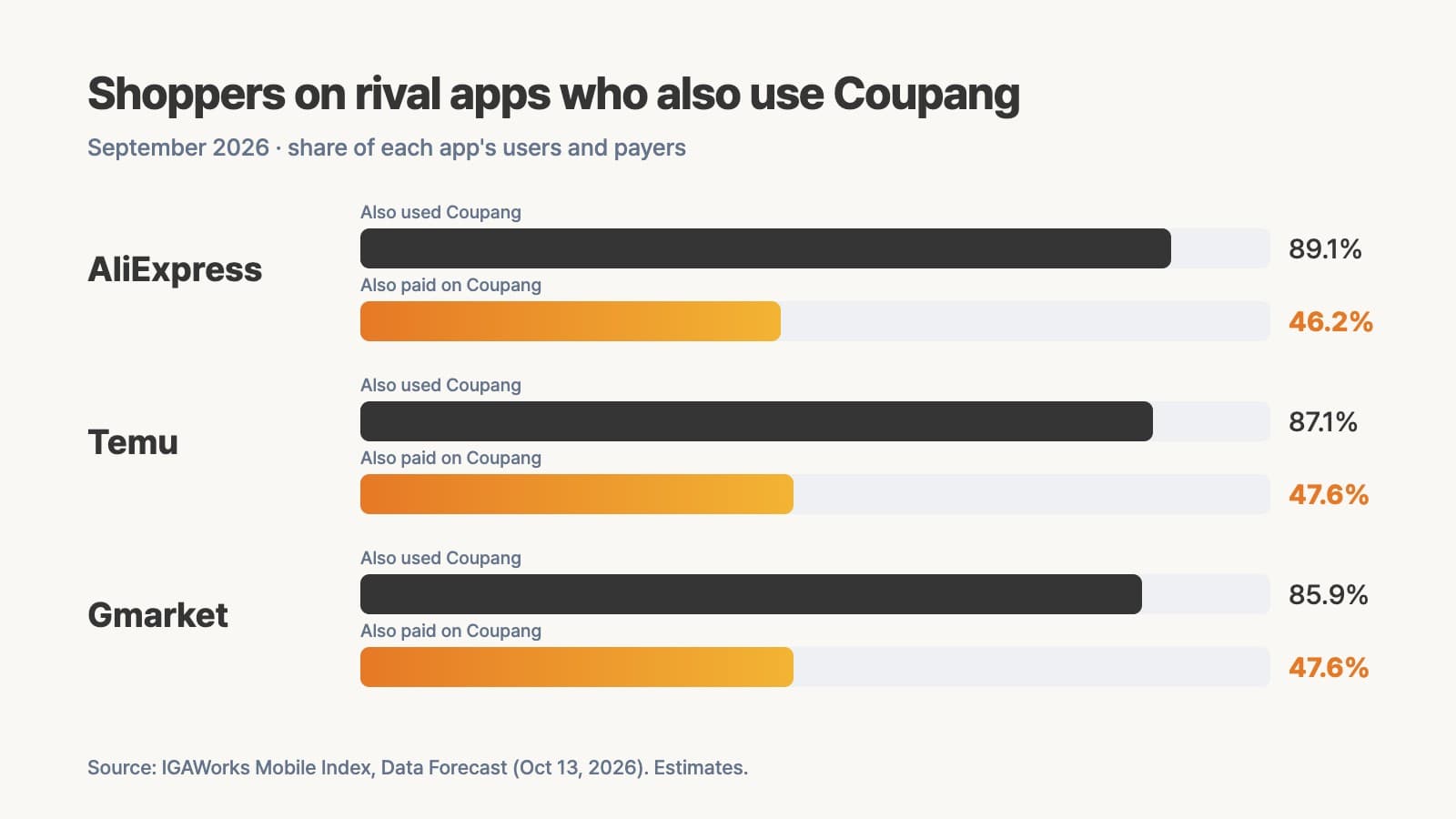
People in Korea rarely use only one shopping app. In September, 85–89% of AliExpress, Temu, and Gmarket users also used Coupang. Fewer actually paid on both: 46–48% of shoppers who paid on AliExpress, Temu, or Gmarket also paid on Coupang that month.
| Competing app | Users who also used Coupang | Payers who also paid on Coupang |
|---|---|---|
| AliExpress | 89.1% | 46.2% |
| Temu | 87.1% | 47.6% |
| Gmarket | 85.9% | 47.6% |
The newsletter is careful here, and so should we be. Overlap does not prove that Gmarket's lost spend moved straight to Coupang. It shows that about half of the people who buy on rival apps are already Coupang customers too.
What this means for a foreign brand
These numbers are about Korean platforms, not about your brand. But they answer one practical question many foreign brands ask early: where do Korean shoppers actually pay?
- Plan around Coupang. With about 73% of large-platform spend, and growth while the market shrank, Coupang is the channel most Korean shoppers already trust with their card. A product that is not on Coupang is missing from where most of that money is spent.
- Do not drop other channels on reflex. Naver's user numbers are growing, and Daiso and some home-shopping companies grew faster than Coupang. Category matters. A beauty or lifestyle brand may find good buyers off Coupang too.
- Judge channels by repeat use, not first clicks. The install data is a reminder: big launch numbers mean little if shoppers do not come back. When you measure a Korean channel, look at repeat purchases and returns, not only traffic.
- Do not read one month as a trend. A holiday month moves numbers. Look at several months before you move budget.
How to get onto Coupang
There is more than one way in, and you can pick the one that fits:
- Direct — sell cross-border on Coupang through Coupang Global Fulfillment (CGF) from your own Coupang cross-border seller account. You need no Korean entity, and we run the store as your operating agent. For brands shipping from the US, Europe, Japan, mainland China or Hong Kong. Learn about Direct.
- Blaze — sell locally through your own Korean entity, on Coupang and other Korean channels such as Naver, with Kontactic running operations as your operating agent. You can start here from day one, including if you already have a Korean entity or partners. Learn about Blaze.
- Spark Subscription — for Coupang-approved sellers in mainland China, our Korean entity acts as Importer & Seller of Record on Coupang. Learn about Spark.
Start light and scale up, or go all in from day one. The data does not choose your entry point for you; your goals, your region, and your products do.
Common questions
Is Coupang really 72.7% of Korean online shopping?
Not of all Korean online shopping. It is Coupang's estimated share of September 2026 spend across the 12 largest online shopping companies that Mobile Index tracks. Smaller sites, brand stores, and offline sales are not in that group.
Where do these numbers come from?
From IGAWorks' Mobile Index Data Forecast, published October 13, 2026. The figures are estimates from Mobile Index's consumer and app-usage panels, not company reports.
Did Gmarket's lost sales go to Coupang?
The data does not prove that. About half of Gmarket payers also paid on Coupang, but the newsletter itself warns against reading that as a direct transfer.
Should a foreign brand sell only on Coupang?
Not always. Coupang is where most large-platform spend goes, so most brands should be there. Some categories also do well on Naver or specialty channels. On your own Korean entity, you can sell on several channels at once.
Do I need a Korean company to sell on Coupang?
Not necessarily. With Direct, brands shipping from the US, Europe, Japan, mainland China or Hong Kong sell cross-border on Coupang without a Korean entity. Brands that want to sell locally can set up their own entity and work with us under Blaze.
Plan your Coupang entry
Tell us what you sell and where you ship from. We will walk you through the entry points that fit — cross-border on Coupang or locally through your own Korean entity.
About the author
Korean and global e-commerce operators with 15+ years of cross-border experience, led by CEO Isaac Lee — KOTRA-certified consultant and official lecturer for Seoul City and the Korea Customs Service. We run Korea market entry for overseas brands every day; this blog records what we learn in the field.
More about Kontactic →Related Articles
Korean Children's KC: Do Toys and Hoodies Differ?
Toys and hoodies can follow different Korean KC paths. Korea may require product testing, factory inspection, a filing, or a supplier declaration before sale.

Korean Cosmetics Responsible Seller: Who Takes the Role
Imported cosmetics need a Korea-registered responsible seller before sale; learn who can take the role, what the Korean label must show, and what to verify.
Korea Food Import Declaration: File Every Shipment
Korea food import declaration rules apply to one shipment only, so MFDS requires a new declaration for every reorder and later checks may delay stock in Korea.