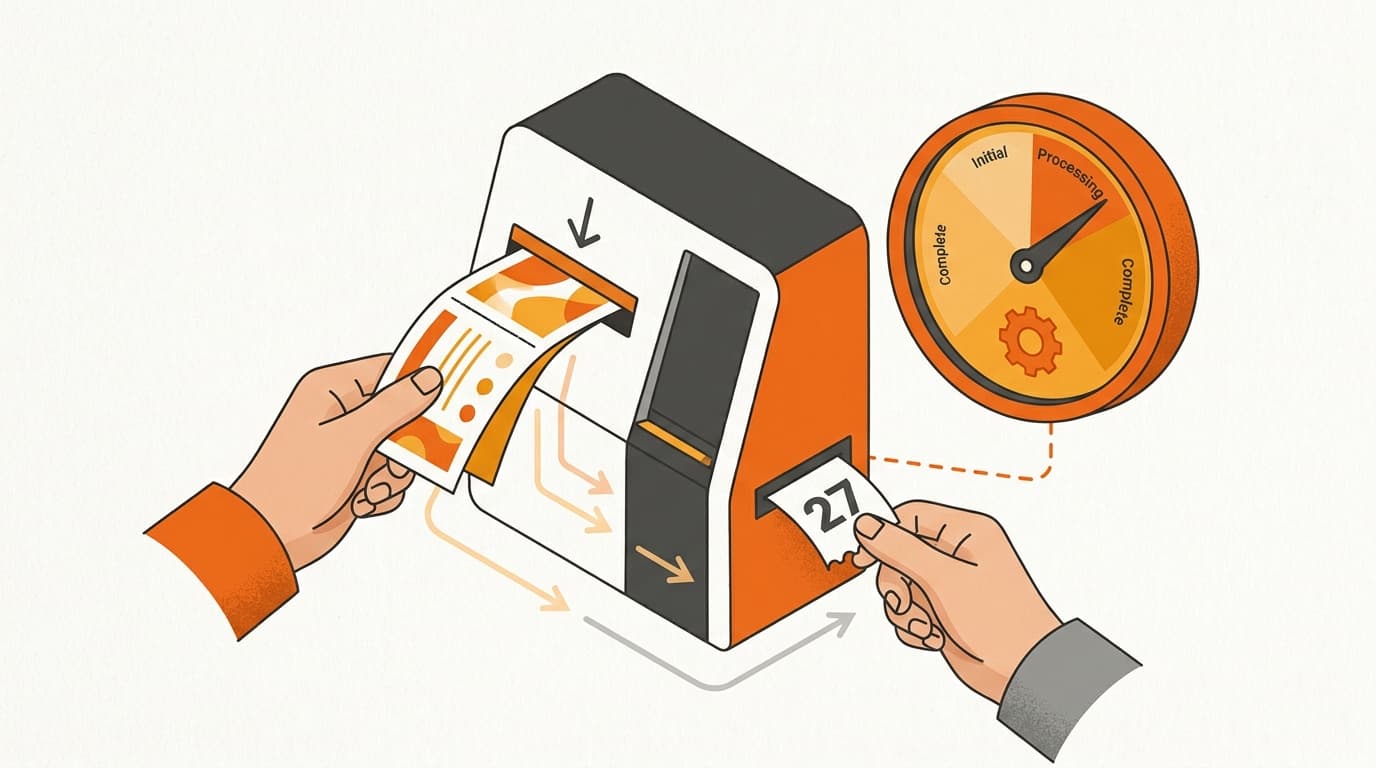
Coupang Coupon API Is Asynchronous: Poll for the Result
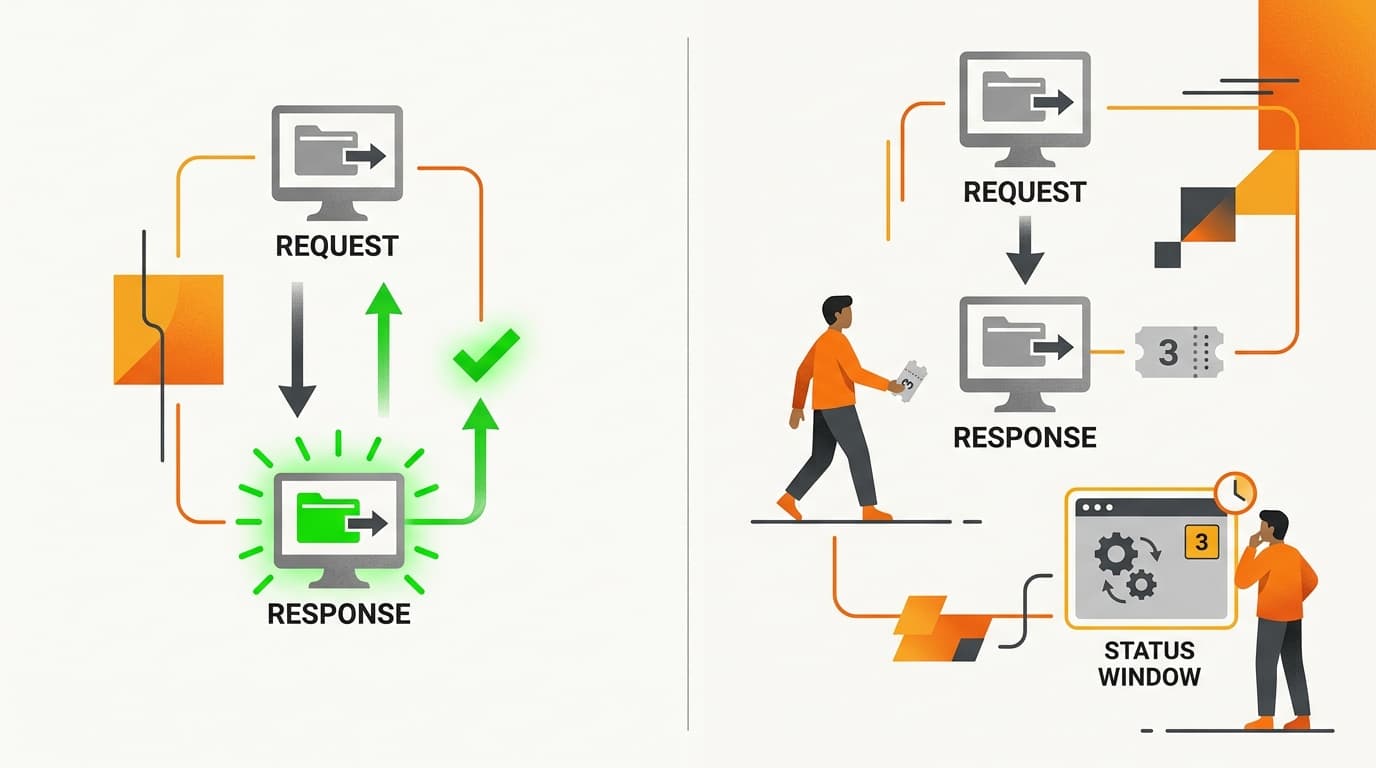
Creating a coupon on Coupang's Open API does not return a success confirmation. The API accepts your request and hands back a request identifier; to learn whether the coupon actually activated, you call a separate status-check endpoint and poll it. This one design fact — the coupon endpoints are asynchronous, not synchronous — is what most Western brands miss, and it quietly breaks fire-and-forget promotion tooling.
That matters because a request that returns an HTTP success can still fail downstream. If the underlying product isn't in an approved state yet, Coupang rejects the coupon after it accepts the call, and you only find out by polling the status endpoint. For a time-boxed flash promotion tied to a Korean shopping event, a coupon that silently never activated means a dead campaign and wasted ad budget behind it.
Asynchronous coupon API means the create/destroy/add-item calls return a request ID, not a result. Success or failure is confirmed only when you query a separate "request status" endpoint — so your integration has to poll and verify rather than trust the initial response.
What the coupon API actually covers
Coupang's coupon (promotion) endpoints handle the two promotion types a brand actually cares about: immediate-discount coupons (즉시할인쿠폰), which knock a discount off at checkout automatically, and downloadable coupons (다운로드쿠폰), which the shopper clicks to claim before it applies. From a brand's perspective they behave differently on the storefront, but from an integration perspective they share the same thing that matters here: the same asynchronous creation pattern.
So whichever promotion type you run, the mechanics below are the same. You do not get an instant yes. You get a ticket, and you go check on it.
This is not a bug or a quirk of a specific SDK. It is how Coupang's developer documentation describes the endpoints, and it is verifiable against Coupang's official developer docs — the primary source any engineer scoping this work should read before committing to a design. If a vendor's "create coupon" feature doesn't mention status polling, that's a signal it's building on an assumption the platform doesn't honor.
Creating a coupon is a workflow, not a call
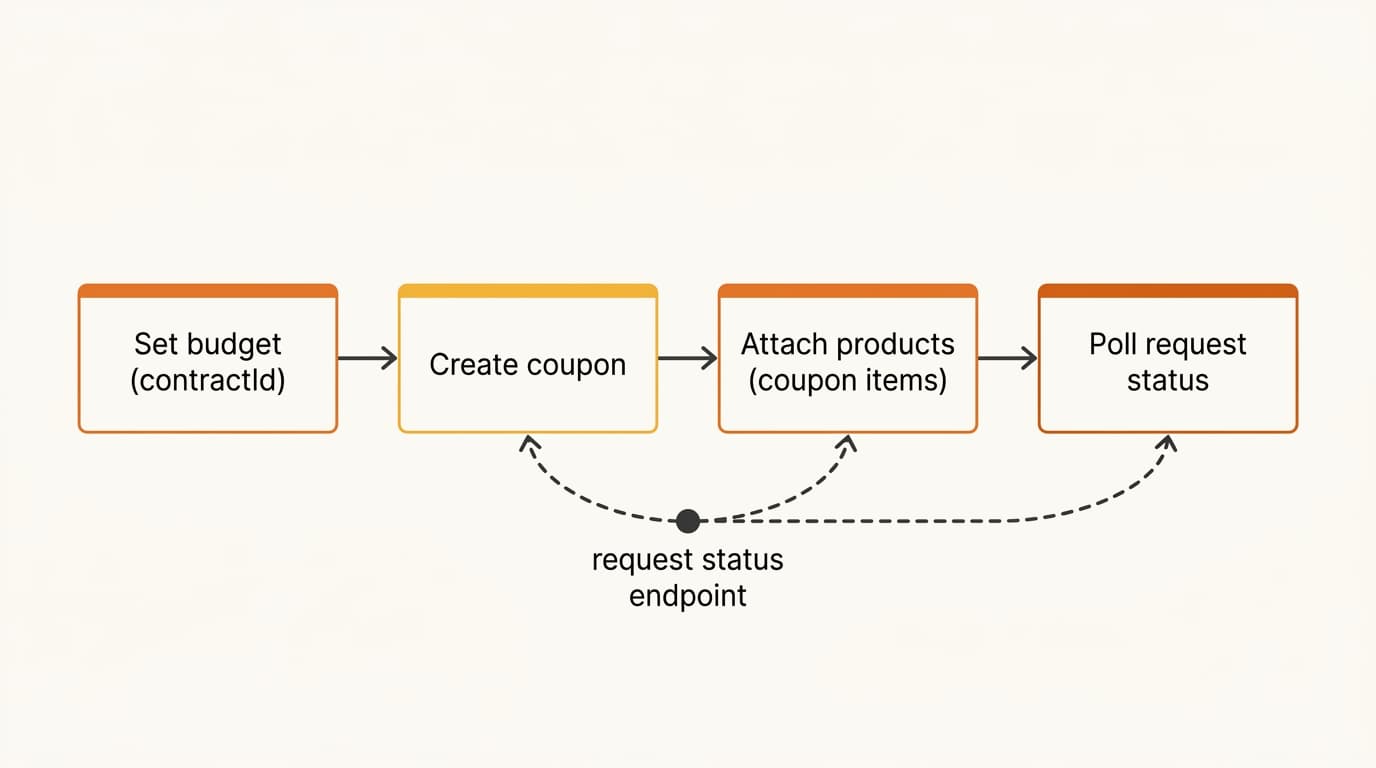
A coupon is not a single API call. It's a sequence, and each step depends on the one before it.
- A budget must exist first. You set a promotion budget in Coupang's seller console, which generates a contract identifier (contractId). The coupon is created against that budget — no budget, no coupon.
- Then you create the coupon. This is the asynchronous step: the call returns a request ID, not a confirmed coupon.
- Then you attach products to it. Products are added as "coupon items" in a separate call — also asynchronous.
Each of those creation steps returns a request identifier rather than a final result. The confirmation lives at the status endpoint. In practice this means the naive mental model — "call create-coupon, get a coupon back" — is wrong at three separate points, not one.
Only approved products can carry a coupon. A coupon request can be accepted by the API and still fail downstream because the product isn't approved yet — and that failure surfaces only when you poll the status endpoint. Because listing approval and price/stock updates run through their own separate item-level endpoints once a listing is approved, it's easy to have a product mid-approval when you fire the coupon call.
Why the async pattern is easy to get wrong at scale
The efficiency of the coupon API is also where it bites you. Coupon items can be applied to a large batch of products in a single call — convenient when you're running a promotion across a full catalog. But a single request covering thousands of products can partially fail: some items attach, others don't, and the top-line response gives you no reliable signal about which.
If your tooling assumes the batch either fully succeeded or fully failed, you will ship promotions with holes in them. Half your catalog is discounted and half isn't, and nothing surfaced the difference until a customer — or your own margin report — noticed.
The correct pattern is a poll-and-verify loop: submit the request, capture the request ID, poll the status endpoint until it resolves, and reconcile the result against the actual coupon state. That's meaningfully more engineering than a "create coupon" button. It's closer in shape to the discipline of a daily operational check-in that catches problems before they compound than to a one-click action.

What this means for build vs. buy
If you build the tooling yourself, "create coupon" is the easy 20%. The 80% is the reliability layer around it:
- A poll-and-verify loop with sensible retry and timeout logic against the status endpoint.
- Reconciliation of the reported result against the actual coupon state, item by item on batch calls.
- Alerting when a promotion fails to activate before its campaign window opens — the failure you most need to catch.
If you buy the tooling instead, the question to ask a vendor is narrow and revealing: how do you confirm a coupon actually activated, and what happens on a partial batch failure? A vendor that treats coupon creation as synchronous — or that can't describe its polling and reconciliation behavior — has built on the wrong assumption, and it will fail silently on exactly the high-stakes campaigns where you can least afford it.
The planning takeaway: stage coupons early
Because activation is not instant and depends on product approval, don't fire coupon creation at the launch minute. Stage it ahead of the campaign start — create the coupon, attach the items, poll until the status confirms, and fix any approval gaps — while there's still time to react.
This is especially true for promotions timed to Korean shopping events, where the window is short and the demand spike is real. As the 2026 Coupang–Naver channel dynamics push more brands to run event-driven promotions on both platforms, the cost of a coupon that quietly never activated only goes up.
Common questions
Does the coupon API ever return success directly? No. The create, destroy, and add-item calls return a request identifier. You confirm the outcome by calling the separate request-status endpoint and polling it until it resolves.
Why did my coupon call succeed but the coupon isn't live? The most common cause is that the underlying product isn't in an approved state. The API accepts the request, but the operation fails downstream, and that failure appears only in the status check.
Do immediate-discount and downloadable coupons behave differently in the API? They behave differently on the storefront, but they share the same asynchronous creation pattern — both require the budget-then-create-then-attach sequence and status polling.
Can I attach a coupon to many products at once? Yes, coupon items can be applied to a large batch in one call. That's efficient, but it makes status polling and per-item reconciliation more important, because a partial failure across thousands of items is easy to miss.
Planning promotions on Coupang?
If you're scoping whether to build or buy your Coupang promotions tooling, talk to Kontactic about how we run coupon creation and status verification for brands going local in Korea.
About the author
Korean and global e-commerce operators with 15+ years of cross-border experience, led by CEO Isaac Lee — KOTRA-certified consultant and official lecturer for Seoul City and the Korea Customs Service. We run Korea market entry for Western brands every day; this blog documents what we learn in the field.
More about Kontactic →Related Articles

Children’s Product KC: Does “Ages 13+” Avoid the Rules?
No. In Korea, “Ages 13+” is only one factor; design, intended use, packaging, and child-directed marketing can still trigger children’s-product KC rules.

Korean KC for a Detachable Device Charger: Not Automatic
Does Korean KC cover a detachable charger? Not automatically. The final bundle and adapter evidence must match the Korean commercial SKU before import.
Can Coupang Handle Every Korean Buyer Inquiry? No—Seller Duties
Coupang may handle platform and fulfillment contacts, but sellers still own product questions, cancellations, returns, exchanges, and order exceptions.