Tax Representative Cost in Korea: What Brands Pay
A Korean tax representative — sometimes called a fiscal representative — typically costs a foreign brand somewhere between USD 1,000 and USD 3,000 per year as a standalone service. That figure covers VAT registration, filing, and acting as the local point of contact for the National Tax Service. For brands going local on Coupang, the tax fee is rarely the cost driver. The actual operating stack — IoR, listings, payment processing, Korean PDPs — typically determines ROI.
This article keeps the basics — what a tax representative is, who needs one, what it costs — and then covers the parts that most fiscal-representative pages skip: cross-border versus local entry, reading Korean demand, Coupang onboarding, and the localized product detail page (PDP) that decides whether any of this pays back.
What a tax representative in Korea actually does
A tax representative (세무대리인) is a Korea-resident individual or entity authorized to act on behalf of a foreign company for VAT and certain other tax matters. The legal foundation is the VAT Act and the Adjustment of International Taxes Act. In practice, the representative:
- Files VAT returns under the foreign company's Korean VAT number
- Receives correspondence from the National Tax Service (NTS)
- Is jointly liable for tax obligations in some scenarios
A tax representative is not the same as an Importer of Record, a Seller of Record, or a Korean legal entity. It is a narrower role that exists primarily so a non-resident company can comply with Korean VAT. For a deeper look at when this role is required at all, see Tax Representative in Korea for Cross-Border Shopify.

What a tax representative actually costs
Public price lists are rare. Based on what is quoted in the market by Korean accounting firms and formation specialists, standalone tax representative fees for a foreign company without a Korean entity generally fall in this range:
- USD 1,000–3,000 per year for the representative role itself
- Plus VAT filing fees (often quoted per filing — Korea has quarterly VAT returns, two of which are preliminary)
- Plus a one-time VAT number registration fee, usually USD 300–800
These numbers vary widely by firm. A boutique tax accountant in Seoul might quote at the low end. A multinational accounting firm will quote at the high end and unbundle every line item. Neither is wrong — they are pricing different scopes.
What standalone tax representatives generally do not include:
- Customs clearance or Importer of Record responsibility
- A Seller of Record relationship with Coupang, Naver SmartStore, or other Korean platforms
- Korean-language customer service
- Payment collection in KRW
- Logistics or 3PL coordination
- Korean PDP creation or marketing
If your goal is to sell to Korean consumers on a Korean platform, you will need most of those things. The tax representative fee, in that context, is a small share of the real cost.
Why "tax representative" is usually the wrong search
The query "cost of appointing a tax representative in South Korea for foreign brand" almost always comes from one of three operating positions:
- Cross-border seller validating demand. Already shipping to Korean buyers from a US or EU warehouse, now hitting a VAT threshold or a payments processor question.
- Brand planning a local launch. Looking at Coupang Rocket Growth, Naver SmartStore, or a Korean-language D2C site and trying to scope total overhead.
- Finance team building a budget. Someone asked "what does Korea cost" and tax compliance was the first concrete line item they could find.
In our experience, only the first group genuinely needs a standalone tax representative — and even then, only sometimes. The other two groups will end up needing a broader structure where tax representation is bundled, not standalone. The cleaner version of the question is: which entry model do I need, and how is tax representation included in it?
Cross-border vs local: where the cost actually sits
There are two structurally different ways a foreign brand sells into Korea, and they have very different tax-and-cost profiles.
Cross-border (DDP from your home warehouse). Each parcel clears Korean customs under the buyer's name (or under a de minimis exemption below USD 150 per shipment). You may or may not need a Korean VAT number depending on volume, channel, and whether you are paid via a Korean entity. A tax representative is sometimes required, sometimes not. This distinction is covered in detail in Korea VAT and Tax for Foreign Shippers.
Local (import once, sell domestically). A Korean entity — yours or a partner's — imports the goods, pays 10% VAT and roughly 8% customs duty at the border, holds the inventory in a Korean 3PL, sells in KRW on Coupang, and files VAT under that entity. The tax representative role collapses into the entity's normal tax filings.
The economic break-even between these two models usually arrives somewhere around 100 monthly Korean orders, walked through in Local vs Cross-Border Korea Fulfillment. Below that threshold, the standalone tax representative fee is one of the cheaper line items. Above it, you are almost certainly going local — and the question stops being about tax representation in isolation.
The three working entry models in 2026
For a consumer brand selling on Coupang, three models cover the field. Each handles the tax representative role differently.
1. Pure cross-border with a Korean VAT number. You keep selling from your home warehouse, register for a Korean VAT number, and appoint a tax representative. Cost: roughly USD 1,500–3,000/year for the representative plus filing fees. The timeline to actually get the VAT number is longer than most expect — see Korea VAT Number: 1–2 Month Timeline.
2. Partner Importer of Record + Seller of Record (Spark-style). A Korean partner acts as both IoR and SoR. The partner's entity files VAT, so there is no separate tax representative fee for you. Kontactic's Spark Subscription works this way for Coupang-approved sellers in mainland China — VAT is filed under our entity at no separate tax filing cost, and the dedicated Coupang seller account, Korean-language CS, and settlement come with the subscription. Brands elsewhere can use the same two roles for a defined project, such as supplying Korean trade buyers (Spark Project, quoted per project).
3. Your own Korean entity (Blaze). You set up a Korean limited company (유한회사). VAT and corporate tax are filed under your own entity. At Kontactic, the tax filing fee for client entities is USD 1,200 per year, covering VAT and corporate tax filing coordination up to 100,000,000 KRW in annual revenue, with overage rates defined by schedule.
The trap is comparing only the standalone fee against the partner-bundled or entity-bundled models without counting the rest of the operating stack. A USD 2,000/year tax representative looks cheap until you remember it does nothing about customs, listings, payments, CS, or returns.
Importer of Record: the deeper customs question
Tax representative pages tend to stop at VAT. The moment you ship a pallet rather than parcels — i.e., the moment you go local — the more consequential role is the Importer of Record (IoR), not the tax representative.
The IoR:
- Is the registered importer on the Korean customs declaration
- Pays the import VAT (10%) and any customs duty at the border
- Holds product liability exposure for whatever clears in its name
- Is responsible for any category-specific certifications (KC, MFDS, APQA, etc.) attached to the import
A tax representative does not take on IoR responsibility. A partner like Kontactic, operating under Spark, does — our Korean entity (Inuf Co., Ltd., d/b/a Kontactic) acts as IoR, and usually SoR, for the client goods it imports under Spark Subscription or a Spark Project. That is a structurally different liability footprint, and it is reflected in the service fee, not in a per-filing line item.
If you are still scoping at the tax representative level, the practical next read is What is an Importer of Record (IoR) in Korea?.
Demand signals: how deep to go first
Before scoping a tax representative — or any Korean operator — look at how much Korean demand you can already see. It does not decide whether you can sell in Korea, but it does shape how deep you go first.
Practical signals to look at:
- Direct cross-border orders from Korean addresses, especially repeat buyers
- Korean-language reviews or social mentions on your existing channels
- Grey-market resellers listing your SKU on Coupang or Naver without your involvement
- Korean cross-border platforms (e.g., Balaan, Trenbe for fashion) pulling your inventory
If none of those exist, a standalone tax representative is premature — you can start light, selling cross-border so Korean buyers can find you. If two or three exist, you are probably late: local is already happening to your brand without you, and that evidence is what you need to run your own Korean entity with an operator (at Kontactic, Blaze). The signal-reading is covered more carefully in Why Cross-Border Orders Understate Your Korea Market Opportunity.
The cheapest tax representative in Korea is the one you do not appoint because you went local with a partner who already files VAT under their own entity. The next cheapest is the one bundled into your own Korean entity's annual tax filing. The most expensive, dollar-for-dollar of useful work, is the standalone one.
Selling on Coupang: listings and localization
Coupang is the dominant platform for almost every product category a Western brand cares about. Becoming a Coupang seller is not a tax-representative function. It requires:
- A Korean business registration number (사업자등록번호)
- A Korean corporate bank account
- A Korean phone number and address for customer correspondence
- KYC documentation, which has tightened materially over the last two years
- A Korean-language listing meeting Coupang's content standards
A foreign company holding only a Korean VAT number and a tax representative cannot, by itself, open a domestic Coupang seller account in any practical way. Either a partner's entity holds the seller account (at Kontactic, Spark Subscription — for Coupang-approved sellers in mainland China), or your own Korean entity holds it (Blaze). The other route skips the domestic account: Coupang's cross-border program, Coupang Global Fulfillment (CGF), where you stay the seller and ship from outside Korea. Kontactic runs that store for you through Direct, for brands shipping from the US, Europe, Japan, mainland China or Hong Kong.
This matters for budgeting because anyone who quotes you a tax representative fee and implies it gets you onto Coupang is mis-scoping the work.
The other piece that pure tax/formation guides miss: the Korean product detail page. Coupang and Naver buyers expect a long, image-heavy, Korean-language PDP — roughly 20,000 pixels of vertical content with localized claims, comparison shots, usage scenarios, and trust signals. A translated Amazon listing converts poorly. A native Korean PDP often doubles or triples conversion on the same traffic.
At Kontactic, a Korean PDP runs USD 300 per SKU, charged separately whichever service you use. For a brand with 5–10 launch SKUs, that is USD 1,500–3,000 — comparable to a standalone tax representative's annual fee, and arguably more decisive for revenue. The other cost that usually outweighs the tax line item is Coupang advertising and marketing, which you budget for in every model.

If you are sizing Korea on a spreadsheet and the largest line item is the tax representative, the spreadsheet is wrong.
A realistic budget framing
For a Western consumer brand seriously evaluating Korea, the useful framing is not "what does a tax representative cost." It is:
- If you stay cross-border with low volume: USD 1,000–3,000/year for tax representation plus filing fees. Smallest line item; smallest business.
- If you use a partner IoR/SoR (at Kontactic, Spark Subscription or a Spark Project): no separate tax filing fee, plus the partner's fees, plus inventory and ads paid by you. Korean PDPs are extra at USD 300/SKU.
- If you set up your own entity (and have Kontactic run it under Blaze): roughly USD 1,200/year for VAT and corporate tax filing coordination up to 100,000,000 KRW in revenue, on top of entity setup, banking, and operations.
The short answer is: the standalone tax representative fee is real, knowable, and small. Treat it as a sanity check on whether you are in the right entry model, not as the headline cost of entering Korea.
Scope Korea entry with the full cost picture
Tell us where you are — cross-border orders, planned launch, or already on Coupang — and we will map the tax, IoR, and operations stack against your actual revenue assumptions.
About the author
Korean and global e-commerce operators with 15+ years of cross-border experience, led by CEO Isaac Lee — KOTRA-certified consultant and official lecturer for Seoul City and the Korea Customs Service. We run Korea market entry for overseas brands every day; this blog records what we learn in the field.
More about Kontactic →Related Articles

Coupang Rocket Growth Stock: Can an ERP Set It via API?
An ERP cannot set Coupang Rocket Growth stock through the Open API; replenishment starts when Coupang physically receives a new inbound shipment of stock.
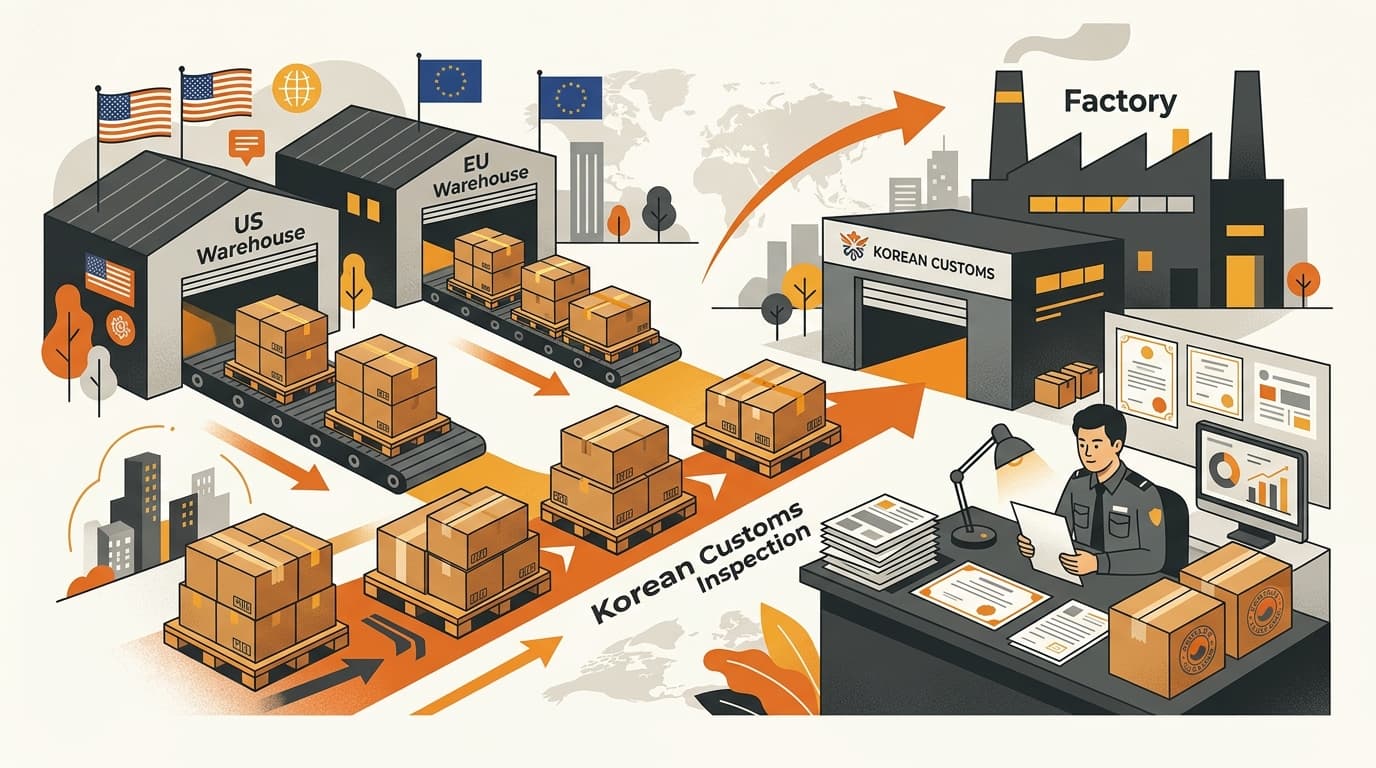
Korea FTA Duty: US/EU Warehouse Shipping Is Not Enough
A US or EU warehouse does not prove FTA origin in Korea. The importer must verify production, transit, and documents before claiming a lower customs duty rate.

Agentic Commerce: When AI Picks the Product, What Should Brands Selling in Korea Do?
AI shopping agents now search, compare, and sometimes buy for the shopper, and they recommend 1–5 products instead of a page of results. What Korea's Chamber of Commerce found in the US and Europe, and what it means for your product data in Korea.