
Korea VAT Number: 1–2 Month Timeline for Foreign Firms
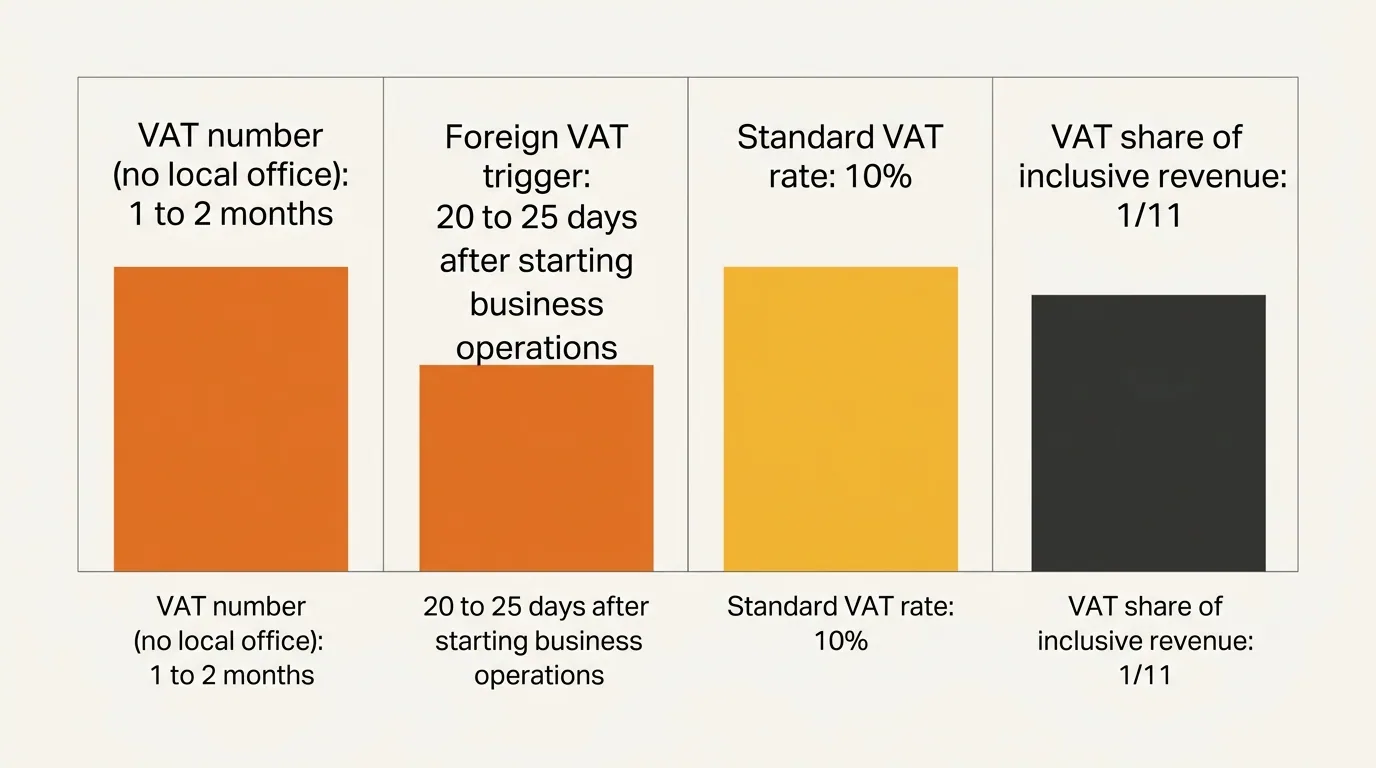
A Korean VAT number for a foreign company with no local office typically takes 1 to 2 months end to end. The trigger is separate: South Korea expects foreign businesses to file for registration within roughly 20 to 25 days of starting taxable activities. These are not the same timeline — and the timeline question hides the real one, because a VAT number on its own rarely unlocks the launch you actually want.
Most founders search this when they are trying to time an ad spend, a Coupang listing, or a first DDP shipment. The VAT number is one input in a longer sequence. This article keeps the basic facts useful, then walks through the parts of a Korea launch that the VAT registration page does not tell you about.
How long the VAT registration itself takes
For a foreign company without a Korean branch or subsidiary, the registration process at the National Tax Service (NTS, 국세청) generally runs 1 to 2 months end to end. That is the window from filing the application to receiving a usable business registration number (사업자등록번호) that can be quoted on invoices and tax returns.
The triggering rule is separate. A foreign business that begins taxable activity in Korea is expected to file for registration within 20 to 25 days of starting operations. Missing the window does not automatically void the registration, but it does open the door to late-filing penalties and, more practically, to messy retroactive VAT accounting on early sales.
In practice, the actual wait depends on:
- Whether the foreign entity has any Korean nexus (a fixed place of business, a dependent agent, a digital services footprint)
- Whether a Korean tax agent is appointed to handle filings on the foreign company's behalf
- The completeness of the foreign incorporation documents — apostilled or notarized translations slow things down when missing
- The specific district tax office (세무서) handling the file
If you want the same number a domestic seller has — the one you quote on Coupang, on a Korean tax invoice, and on customs paperwork — you are almost always looking at the Korean limited company (유한회사) route, not the foreign-company VAT registration. We come back to that distinction below.

What a Korean VAT number actually gives you
Korea applies a flat 10% VAT on most goods and services. For VAT-inclusive revenue — the way Coupang reports settlement totals — the VAT portion equals 1/11 of gross sales (approximately 9.09%). A VAT number lets you:
- Issue compliant Korean tax invoices (세금계산서), including electronic invoices transmitted through the NTS system
- File the standard quarterly VAT returns
- Reclaim input VAT on Korea-side expenses, where the rules allow it
- Be recognized as a registered taxpayer by Korean counterparties — banks, customs brokers, platforms
What it does not give you, on its own:
- A Coupang seller account that can run Rocket Growth (로켓그로스)
- An Importer of Record (IoR) status for clearing your goods into Korea
- A local bank account capable of receiving Korean settlement
- A Korean-language product detail page (PDP) that converts
Each sits on a separate timeline. Three of the four require a Korean entity, not just a foreign VAT registration.
The VAT number is necessary but not sufficient. If your goal is to sell on Coupang in KRW, the binding constraint is almost never VAT registration — it is the local entity, the IoR designation, and the Korean PDP.
The four parallel timelines that actually decide your launch
The "how long does VAT take" question makes more sense when you map it next to the other launch tracks. They run in parallel, not in sequence, and the longest one wins.
Track 1 — VAT and entity registration
If you go the Korean limited company (유한회사) route, you are no longer registering as a foreign company — you are registering a domestic Korean taxpayer. That changes the timeline and the politics. As we wrote in the May 2026 tax-office crackdown note, Korean tax offices have become noticeably stricter about non-resident-CEO entities with virtual offices and 1M KRW capital. Plan on more documentation and more interview-style questions than the textbook 10–14 business days would suggest.
Track 2 — Importer of Record and customs
You cannot sell physical goods locally without someone in Korea taking on Importer of Record responsibility. For most foreign brands, that ends up being the Korean limited company itself. The IoR is the entity that clears customs, pays the 10% import VAT, owes any product-category duties, and holds the compliance record if MFDS, APQA, or KCS comes asking. See what an Importer of Record actually means in Korea and our broader Korea VAT and tax guide for how this stacks together.
Track 3 — Coupang seller onboarding
A Coupang seller account is its own approval flow. You need a Korean business registration number, a Korean corporate bank account, the relevant product certifications (KC, MFDS HFF, food import declarations — whichever applies), and Coupang's own KYC clearance. Foreign-controlled entities now go through additional checks. Our foreign-brand Coupang guide walks through what the seller portal actually asks for. If you are weighing Coupang against cross-border, the Rocket Growth vs. cross-border framework is the right comparison, not VAT versus no VAT.
Track 4 — Localized PDP and Korean-language conversion
This is the track most VAT-focused articles ignore, and the one that most often gates real sales. A Coupang product detail page is roughly a 20,000-pixel vertical rich-media document — closer to a long-form landing page than a product listing. Without one, you have a registered, tax-compliant, fully imported product that does not convert.
Brands that finish the VAT and IoR work but skip the PDP launch into a category, run ads against a sparse listing, and conclude the Korean market is hard. The market is not hard. The listing was thin.
A converting Korean PDP needs:
- A Korean product title written for Coupang search, not literal English translation
- Hero imagery sized for mobile-first Korean browsing patterns
- Trust signals Korean buyers expect — KC mark display where required, returns policy, AS contact, manufacturer/importer information
- Comparison and use-case sections, not just feature bullets
- A review-seeding plan from day one
None of that requires the VAT number. All of it requires Korean-language work that, if started in parallel with the entity and VAT process, lands on the same launch date. If it is started after the VAT number arrives, the brand burns 4 to 8 weeks of paid registration time with nothing on shelf.
What can be done fast, and what cannot
The honest separation:
Can be done fast (often inside the VAT registration window)
- Foreign incorporation documents notarized and translated
- HS code classification and duty estimates
- Korean trademark search and filing
- Coupang category research and competitor PDP teardown
- Korean PDP design, copywriting, and translation
- KC, MFDS, or APQA scoping (the scoping — not the testing)
Cannot be done fast
- KC certification testing for in-scope electrical or wireless products
- MFDS Functional cosmetics or HFF supplement review
- The Korean corporate bank account (frequently the longest single item, regardless of VAT status — see the corporate bank account wall)
- Coupang Rocket Growth onboarding once the seller account is open
- Real review volume on a new listing
The "fast" column is exactly where most foreign brands underinvest. They wait on the slow column to finish before kicking off PDP and Coupang prep, and end up adding 1 to 2 months of avoidable lag.
“The VAT number is the easy part. The brands that launch on time are the ones who started the Korean PDP and Coupang prep before the tax office said yes.”
Kontactic editorial — Operating note
Cross-border versus local — and why VAT looks different in each
If you are still selling cross-border to Korean buyers, you generally do not need a Korean VAT number. Customers clear their own parcels under Korea's personal-use rules, and your business is taxed where it sits. That is a legitimate model — and a useful validation channel — but it caps at a fraction of the volume a local listing can do. Our cost-math comparison of local vs. cross-border fulfillment shows the inflection point clearly.
The moment you want a Coupang Rocket Growth listing, KRW pricing, and local returns, you are no longer optional on VAT. You need the registered entity, the import VAT paid at the border, the output VAT charged on sales, and the quarterly filings. The choice is not "should I register for VAT?" — it is "am I going local or staying cross-border?"
For a clean breakdown of who funds what once you do go local, who pays for what in Korea lays out the cost flow. The VAT is one line in a larger stack.

What foreign brands usually underestimate
Three patterns we see repeatedly:
- The VAT number is treated as the finish line. It is closer to the starting line. Most of the launch work — Coupang account, PDP, Rocket Growth inbound — happens after the number is issued, not before.
- The 20–25 day trigger is misread as a deadline for the whole registration. It is the deadline to start. The processing time is separate.
- Korean-language PDP work is scheduled last. It should be scheduled first, because it has no dependency on the tax office and is the single biggest converter once the listing is live.
If you are at the stage of asking how long a VAT number takes, you are probably also at the stage where the right next move is to start the entity, the PDP, and the Coupang prep in parallel — not sequentially. The calendar saves itself.
Planning a Korea launch around the VAT timeline?
Kontactic runs the entity, VAT registration, Coupang onboarding, and Korean PDP in parallel so the launch date is not held hostage by any single track. Tell us where you are and we'll map the realistic timeline against your category.
About the author
Korean and global e-commerce operators with 15+ years of cross-border experience, led by CEO Isaac Lee — KOTRA-certified consultant and official lecturer for Seoul City and the Korea Customs Service. We run Korea market entry for overseas brands every day; this blog records what we learn in the field.
More about Kontactic →Related Articles
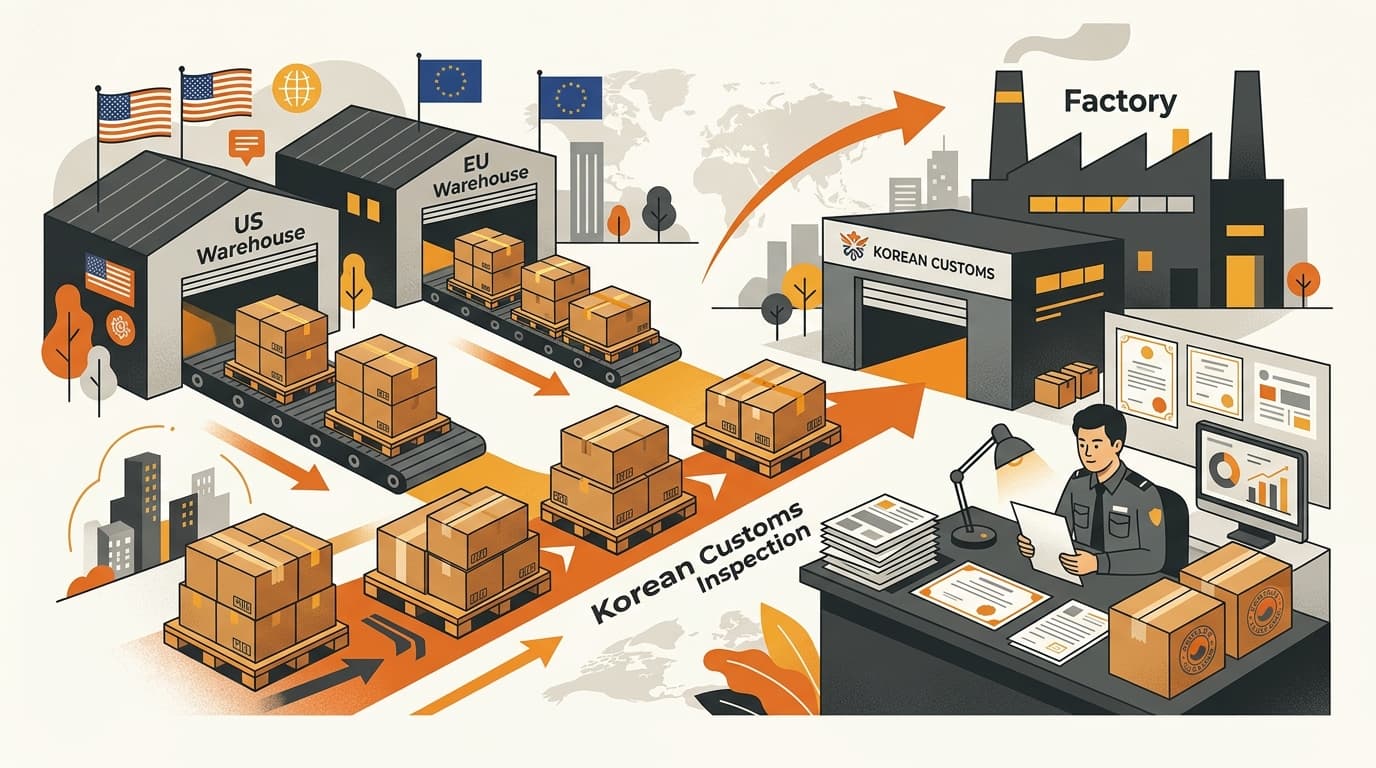
Korea FTA Duty: US/EU Warehouse Shipping Is Not Enough
A US or EU warehouse does not prove FTA origin in Korea. The importer must verify production, transit, and documents before claiming a lower customs duty rate.

Agentic Commerce: When AI Picks the Product, What Should Brands Selling in Korea Do?
AI shopping agents now search, compare, and sometimes buy for the shopper, and they recommend 1–5 products instead of a page of results. What Korea's Chamber of Commerce found in the US and Europe, and what it means for your product data in Korea.

Korea E-commerce, September 2026: The Market Shrank, Coupang Grew
Korean online shopping spend fell 2.1% in September 2026, yet Coupang grew 3.9% and reached a 72.7% share of the 12 largest platforms. What the data means for a foreign brand choosing where to sell.