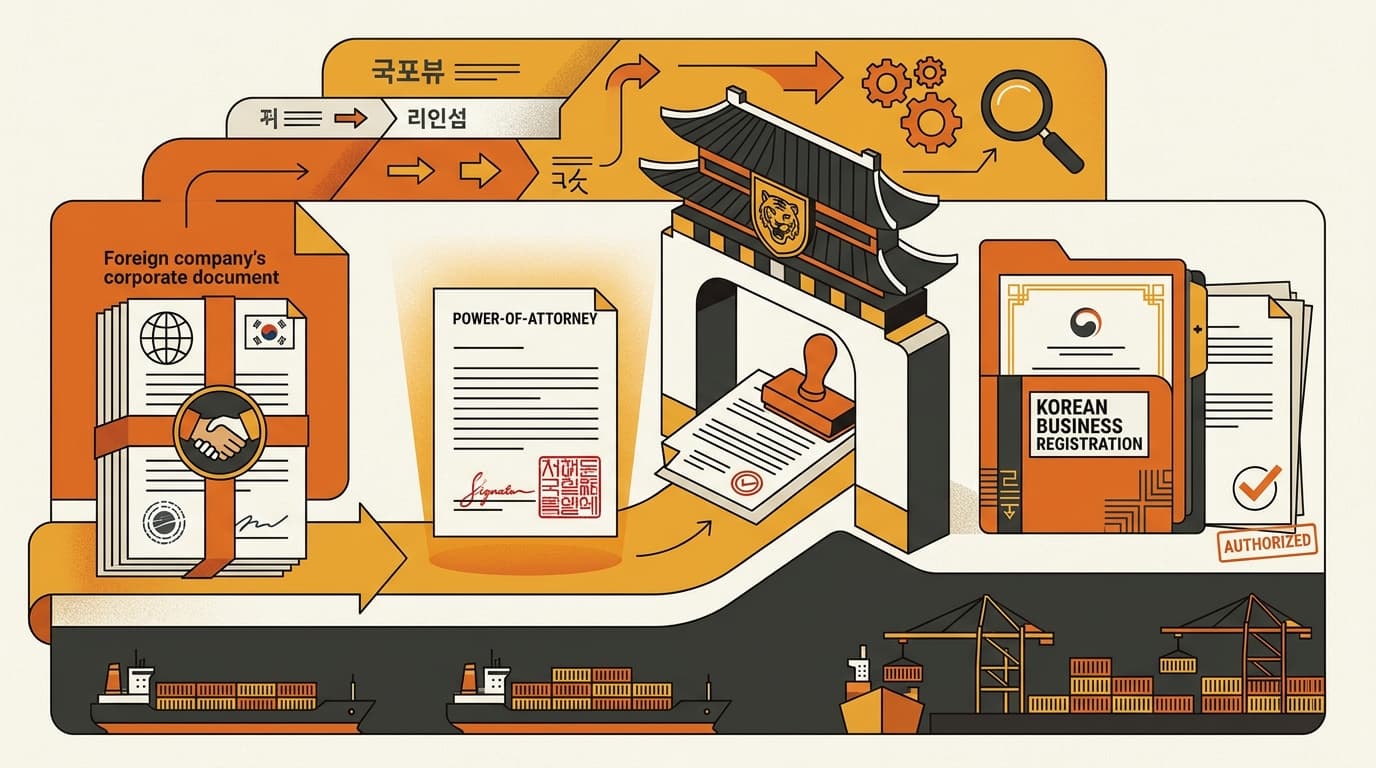
Korean Importer Registration: Why a POA Is Not Enough
No. A Korean representative’s simple power of attorney (POA) does not, by itself, register a foreign company as Korea’s importer of record. The filing still needs proof that the foreign company exists and that the signer had authority. It also needs a Korean entity or operating importer registered for the relevant customs or product-regulatory activity.
Core distinction. A POA is evidence of authorization to act. It is not, on its own, proof of the Korean importer’s registration, the foreign company’s signatory authority, or any category-specific permission needed for the product.
That distinction is the starting point for understanding what an Importer of Record means in Korea. A representative may be the person who communicates with an authority or submits a file, while a different legal entity appears in the customs or product-regulatory record as the importer. Those roles have to be identified separately.
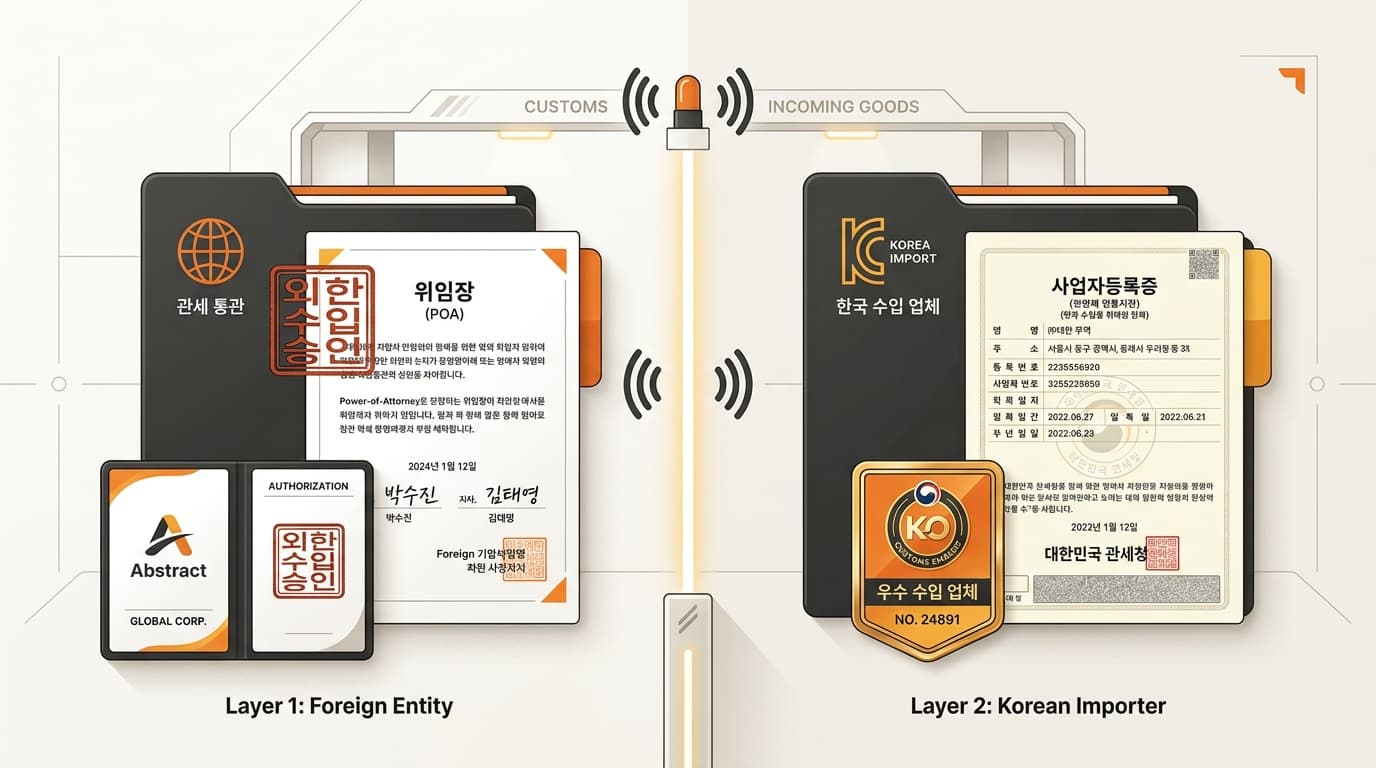
The two proof layers authorities need
A sound filing answers two different questions. First: does the foreign company exist, and did a person with authority validly appoint the Korean representative? Second: is the Korean entity or operating importer eligible and registered for the activity being filed?
Layer one: the foreign company and its authority
The foreign-company packet may include evidence such as:
- A certificate of incorporation, business registry extract, or comparable official company record.
- Evidence showing who may sign for the company, such as authorized-signatory evidence accepted for that filing.
- A corporate seal certificate or legally accepted equivalent, where the relevant agency asks for one.
- An executed power of attorney identifying the foreign company, the representative, and the authority being granted.
These documents answer different questions. A registry extract can help establish that the company exists. Signatory evidence helps connect the person who signed the POA to that company. The POA then shows that the company authorized a particular person or entity to act within a defined workflow.
A scanned signature does not automatically answer any of those questions. It may be a usable copy for an initial exchange, but the receiving agency can still ask how the signature was authorized and whether the document has been properly executed. Korean translation, notarization, or authentication may also be requested, depending on the agency and filing route. Treat those formalities as requirements to confirm, not as a universal rule or a box that a generic template can check.
Layer two: the Korean importer and its registration
The second layer concerns the Korean party that will appear in the relevant record. It may be a Korean registered entity, a branch, or a qualified operating importer that holds the registrations required for the particular activity. The evidence can include the Korean party’s business registration information and any additional category-specific registration or permission required by the authority handling the product.
This is why the Korean business registration number attached to an Importer of Record matters. The person carrying documents is not automatically the entity that customs or a product regulator recognizes as the importer. A representative appointment cannot fill a gap in the Korean party’s legal or regulatory status.
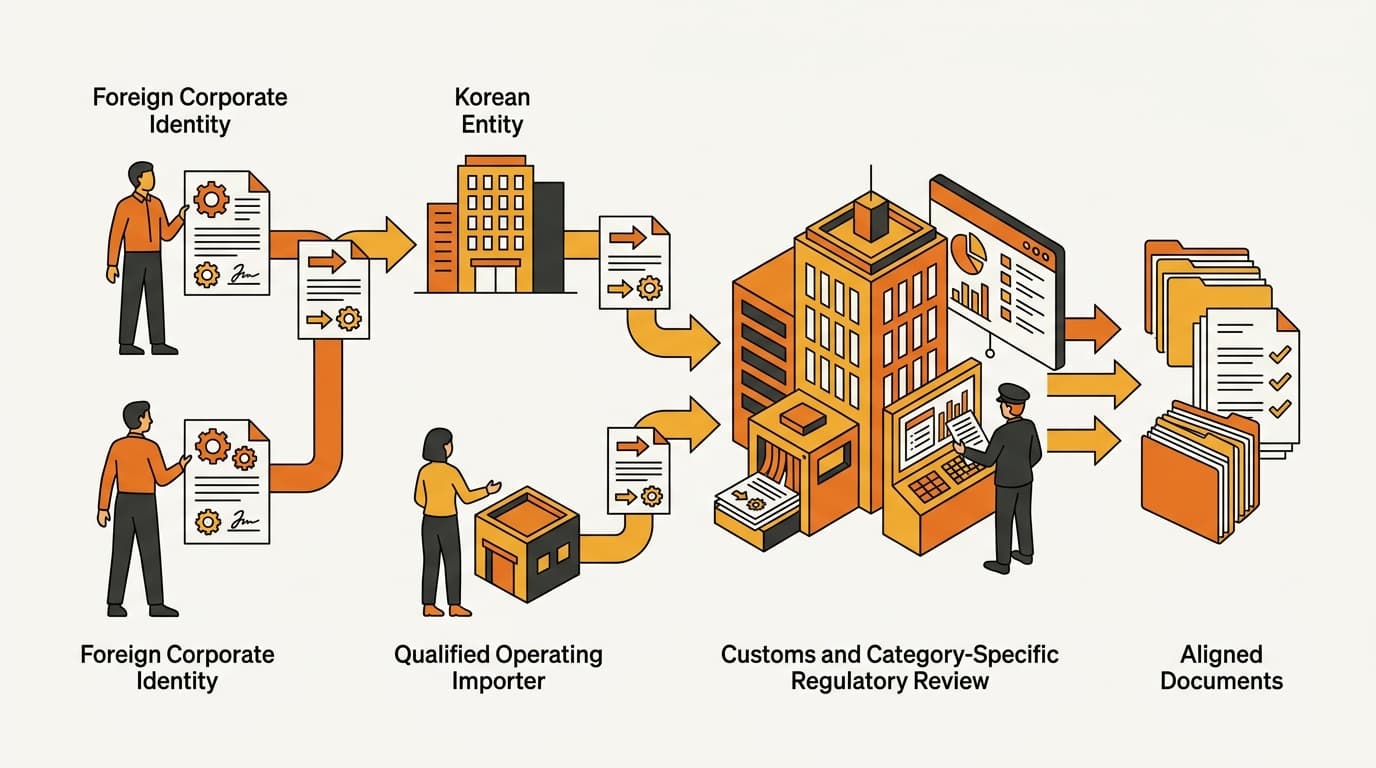
The two layers can support one filing, but they do not merge into one document. A foreign company’s certificate of incorporation does not prove that the Korean operator is registered for a regulated product. A Korean business registration does not prove that the foreign signatory had authority to appoint that operator. The application has to make both relationships legible.
What a power of attorney does—and what it cannot do
A POA gives an overseas company a formal way to authorize someone in Korea. The representative may then communicate with an authority, submit documents, or perform another defined act in the applicable workflow. It can establish the relationship between the foreign principal and the Korean representative. It can also give an agency a document to review when it needs to understand who is acting for the foreign company.
But the POA has a limited job. It can authorize action; it cannot create every legal status that the filing requires.
A POA does not, by itself:
- Create a Korean business registration for the foreign company or its representative.
- Make the representative the legal importer merely because the representative submitted the application.
- Transfer a category-specific import permission from one entity to another.
- Replace evidence that the foreign company’s signatory had authority to bind the company.
- Substitute for the registrations, licenses, or applicant qualifications required for a particular product route.
Do not treat authorization as importer status. A representative may be authorized to submit a file while the registered importing business remains responsible for the applicable customs and product-regulatory record. Name that business before the filing is prepared.
This is also why “we have a signed POA” is not a complete answer to a customs or regulatory question. The next question is always: signed by whom, for which company, authorizing which Korean party, for which product and filing? If the packet cannot answer those points, a signature scan may create the appearance of authority without proving it.
Separate the representative, importer, and customs broker
Before submitting anything, map the roles in plain language. A simple internal sentence should be possible: “The foreign company authorizes [party] to submit [application], while [legal entity] appears as the importer in [customs or regulatory record] and handles the applicable obligations.” If that sentence cannot be completed, the document packet is probably being assembled before the legal structure is clear.
Regulatory representative
A regulatory representative is the person or entity appointed to communicate with an authority, provide information, submit documents, or support a defined compliance workflow. The representative’s authority comes from the appointment and from the rules of the particular filing.
That appointment does not automatically make the representative the importer. It also does not automatically give the representative permission to sell, import, label, or handle category-specific obligations. Those consequences depend on the record and the applicable product rules.
Registered importing business
The registered importing business is the legal entity that appears in the relevant customs or product-regulatory record. For a particular category, that entity may be the one expected to handle applicable duties, labeling, records, complaints, recall coordination, or other responsibilities. The exact allocation depends on the route, but the entity should be identified rather than inferred from whoever is filing the paperwork.
For most non-resident brands, the practical structure is a Korean registered entity or branch, or a qualified operating importer that holds the required registrations. The representative paperwork supports that structure. It does not replace it.
Customs broker
A customs broker can prepare or file customs work on behalf of an importer where the workflow permits, but filing authority is not the same as importer status. The broker’s role should therefore be kept separate from the question of which legal entity is named in the import record. Why a Korean customs broker is not automatically your Importer of Record is a useful distinction to settle before documents are signed.
One Korean company can occupy more than one role in a particular workflow. That is possible, but it should be confirmed from the applicable rules and records—not assumed because the same company is available to receive a POA.

Build the document packet by proof question, not a generic checklist
A universal checklist is tempting, but it is the wrong tool for this subject. Customs, MFDS, KC, cosmetics, and chemical-product workflows can ask for different applicant and authorization evidence. Build the packet by asking what each document proves, then confirm the current list with the authority handling the filing.
The following is an evidence map, not a complete application checklist:
| Proof question | Evidence category that may answer it | Why it matters |
|---|---|---|
| Does the foreign company exist? | Certificate of incorporation, business registry extract, or comparable company record | Establishes the identity of the foreign principal rather than relying on a brand name or website. |
| Who may bind the foreign company? | Authorized-signatory evidence, corporate seal certificate, or legally accepted equivalent | Connects the person who signed the authorization to the company’s authority structure. |
| Did the foreign company appoint this Korean party? | Executed POA identifying the principal, representative, and scope of authority | Shows the relationship the representative is relying on when communicating or filing. |
| Who is the Korean applicant or importer? | Korean entity or branch details, business registration information, and applicable category registration or permission | Identifies the party that can appear in the relevant customs or regulatory record. |
| Will the agency accept the form as submitted? | Required Korean translation, notarization, authentication, or other formalities if requested | Addresses execution and document usability for that agency and route. |
The table deliberately says “may.” A document can be valid in the foreign company’s home jurisdiction and still need translation, authentication, or additional explanation for a Korean filing. Conversely, a formal document that proves authority may still be irrelevant if the Korean applicant lacks the registration required for the product.
Do not assume that importer registration for one product or activity covers every product the brand sells. Korean importer registration does not cover every product automatically; regulated categories can add their own route and evidence. The relevant product classification should be settled before the POA is drafted around the wrong applicant.
A practical pre-filing sequence
Use this sequence as a control process, not as a substitute for the authority’s current instructions.
- Name the legal importer first. Identify the entity that should appear in the customs or product-regulatory record. Do not start with the name of the person who is convenient to contact.
- Map the product and authority. Decide whether the filing is customs-only or also involves MFDS, KC, cosmetics, chemical products, or another category-specific route. Each can define the applicant and supporting evidence differently.
- Assemble the foreign-company authority packet. Collect the company identity record, authorized-signatory evidence, corporate seal certificate or accepted equivalent where relevant, and the executed POA.
- Assemble the Korean-status packet. Collect the Korean entity, branch, or operating importer’s business registration information and the registrations or permissions relevant to the product and activity.
- Reconcile names, roles, and scope. The foreign company named in the corporate record, the person signing, the Korean representative, and the legal importer should not be left ambiguous. The POA should not describe a broader or different role than the filing actually requires.
- Confirm formalities with the receiving authority. Ask whether Korean translation, notarization, authentication, or additional corporate evidence is required for that specific route. Save the current response or guidance with the filing record.
This sequence catches the common structural error: spending time perfecting a POA before deciding which Korean entity is supposed to carry the import and product-regulatory record. For a non-resident brand, the practical question of who can be the Korean Importer of Record should be answered before the representative’s paperwork is finalized.
Where to verify the current requirements
The document list should come from the authority and product route, not from a generic “Korea importer” template.
- Customs: Start with the Korea Customs Service and the applicable UNI-PASS workflow. Use the current customs guidance to identify the applicant and filing path, then check the governing text and amendments through law.go.kr.
- Food, supplements, and cosmetics: Check the relevant MFDS guidance for the product category, applicant, and authorization evidence. A POA may support communication, but it does not answer every category-specific registration question.
- KC-regulated products: Verify the applicable conformity-assessment route with the Korea Agency for Technology and Standards (KATS) and the relevant product-safety guidance. Do not assume that a customs filing packet proves KC eligibility.
- Chemical products and other regulated categories: Confirm the current applicant and representative requirements with the authority responsible for that product route. The required relationship between the foreign company, Korean representative, and importing business can differ.
These sources are useful for checking the current rules, but they do not turn one category’s document list into a universal checklist. The goal is to verify the exact route before the foreign company signs a POA that names the wrong party or grants the wrong scope.
Common questions about Korean representative authorization
Can a Korean representative submit an application with a power of attorney?
Sometimes, if the specific workflow accepts a representative submission and the POA is properly executed. Submission authority is narrower than importer status, so the Korean entity named in the customs or regulatory record still has to satisfy the applicable requirements.
Does notarizing the POA make the representative the importer?
No. Notarization or authentication may help establish that a document was formally executed, if the agency requests it. It does not create a Korean business registration, add a category-specific permission, or change which entity is legally named as the importer.
Is a scanned signature enough?
Do not assume it is. A scan may be useful for an initial review, but the agency can still require evidence of signatory authority, an original or formally authenticated document, a corporate seal certificate, a Korean translation, or another accepted form of execution.
Can a foreign company use a POA instead of forming a Korean entity?
A POA is not a substitute for the Korean status required by the relevant route. For most non-resident brands, the practical compliant structure is a Korean registered entity or branch, or a qualified operating importer holding the required registrations. Whether a different route is available depends on the product and authority.
Can one POA cover customs, MFDS, KC, and other filings?
Do not assume so. Each authority may define its own applicant, representative, scope, and document formalities. A single corporate authorization can sometimes support multiple tasks, but the current requirements for each route should be confirmed before relying on it.
Map the importer record before filing
If you are unsure which Korean entity should appear in the customs or product-regulatory record, contact Kontactic for a scoped discussion of the roles and evidence to confirm.
About the author
Korean and global e-commerce operators with 15+ years of cross-border experience, led by CEO Isaac Lee — KOTRA-certified consultant and official lecturer for Seoul City and the Korea Customs Service. We run Korea market entry for Western brands every day; this blog documents what we learn in the field.
More about Kontactic →Related Articles
Can You Delay Korea Import Duty on Consignment Stock?
No. Korea import duty and import VAT are normally assessed when consignment stock is cleared for domestic circulation, not when a Korean customer buys one unit.

Children’s Product KC: Does “Ages 13+” Avoid the Rules?
No. In Korea, “Ages 13+” is only one factor; design, intended use, packaging, and child-directed marketing can still trigger children’s-product KC rules.

Korean KC for a Detachable Device Charger: Not Automatic
Does Korean KC cover a detachable charger? Not automatically. The final bundle and adapter evidence must match the Korean commercial SKU before import.