Can You Delay Korea Import Duty on Consignment Stock?
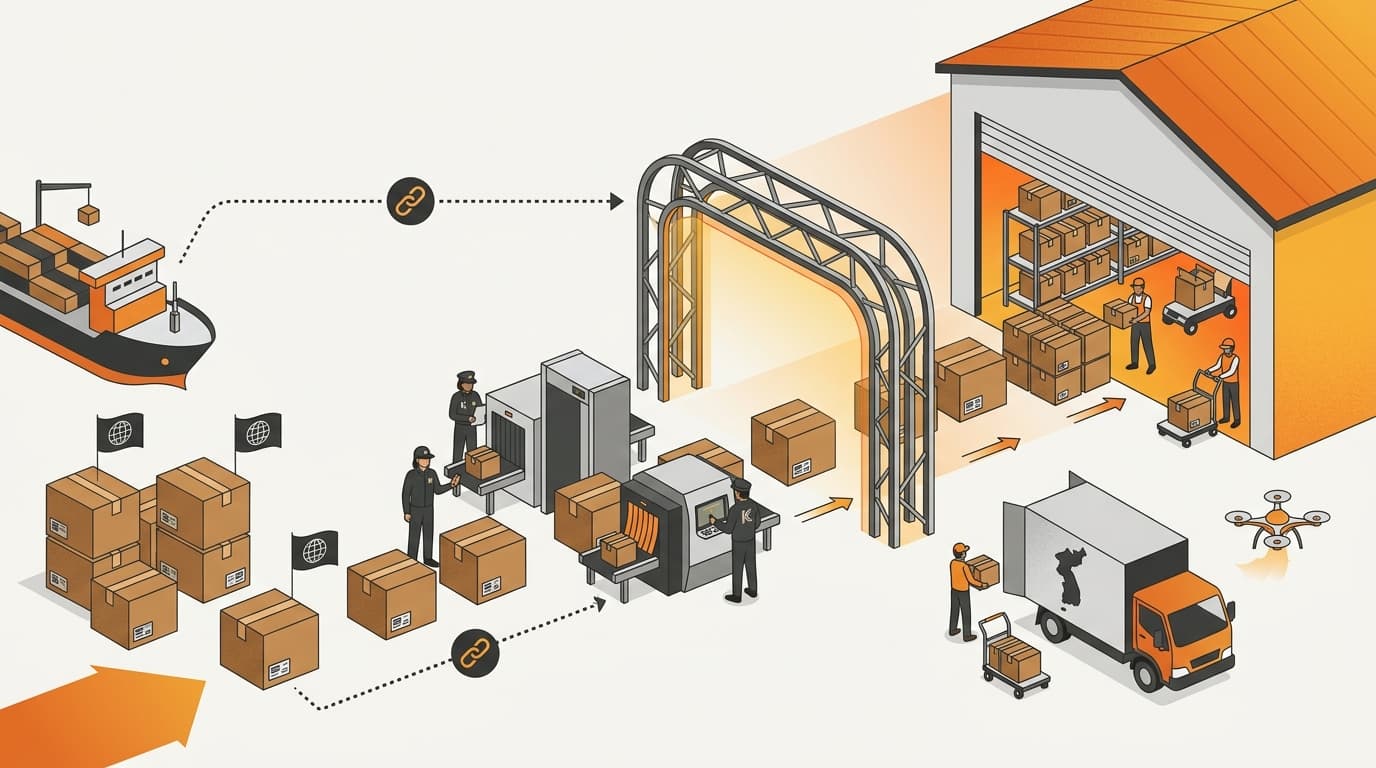
Korean customs normally assesses import duty and import VAT when commercial consignment stock is cleared for domestic circulation. It does not wait for a Korean customer to buy a unit. Keeping title to unsold stock, using a regular 3PL, or waiting for a Coupang order does not, by itself, defer that tax.
Deferral is a separate customs question. Goods may remain under a qualifying bonded or other formal customs-control regime, but an ordinary 3PL or marketplace fulfillment warehouse is not automatically bonded.
Import clearance is the customs process that authorizes goods to enter Korean domestic circulation. For commercial consignment inventory, the normal tax point is that release—not the later retail sale.
The legal framework is the Korean Customs Act (관세법), which you can check on the National Law Information Center. For current administrative guidance and customs procedures, check the Korea Customs Service. The exact result still depends on the goods, documents, importer, valuation evidence, and customs regime.
Consignment is a sale arrangement, not customs relief
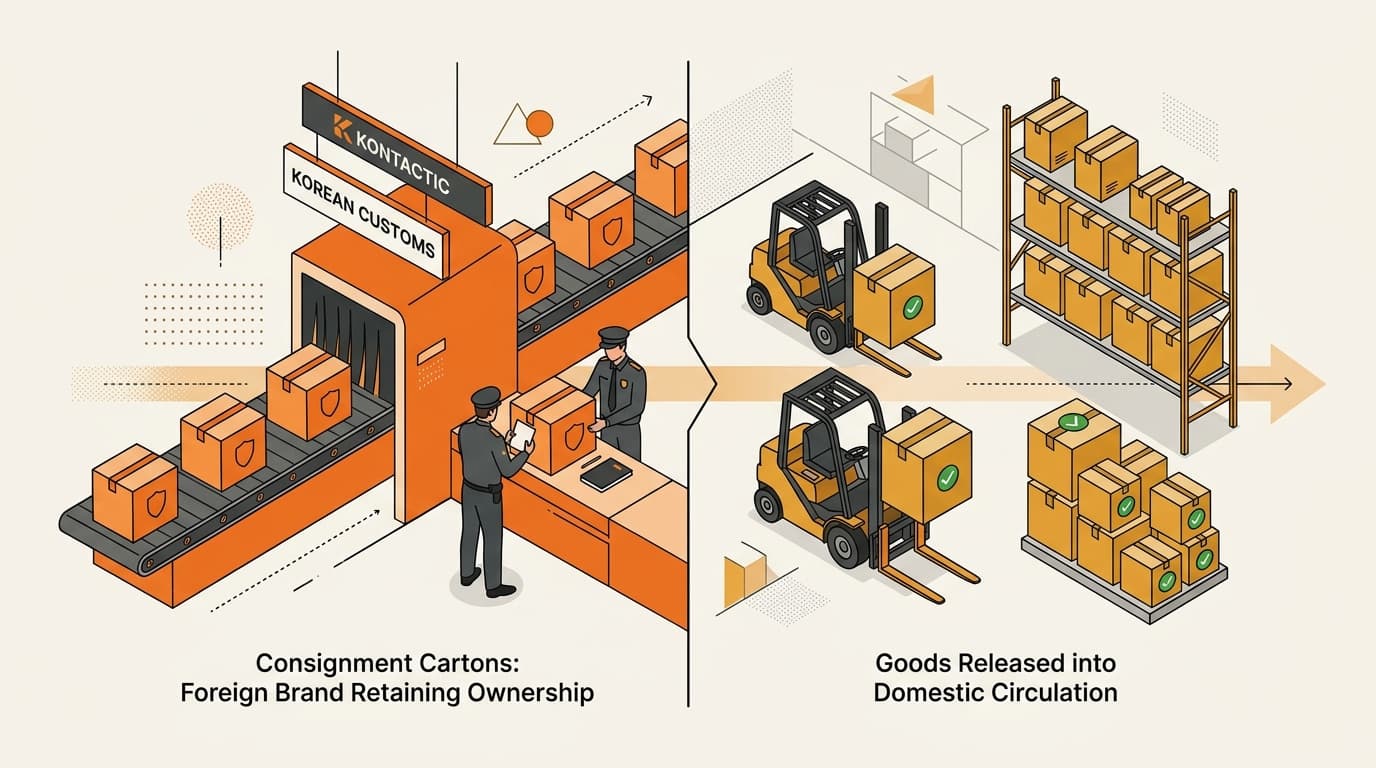
Consignment answers a commercial question: who owns the stock, who holds it, and when does the Korean selling party settle with the brand? It does not, by itself, answer whether the goods have been released into Korea for domestic use.
A typical arrangement might leave title and economic risk with the foreign brand until a unit sells. The stock may sit at a Korean warehouse, and the local seller may remit proceeds only after a customer order. Those facts can matter for the contract and settlement account. They do not automatically move the import-tax point from clearance to retail sale.
For ordinary import clearance, the practical sequence is:
- The shipment is declared to Korean customs for commercial entry.
- Customs reviews the classification, value, and supporting documents.
- Import duty and import VAT are assessed under the applicable rules.
- The goods are released into Korean domestic circulation and can then move through the ordinary fulfillment chain.
The stock can remain unsold after that release. Its lack of a Korean customer does not undo the import event. A later Coupang sale is a sales and settlement event, not the event that first brought the goods into Korea.
The party named as importer on the import declaration remains accountable for the accuracy of the declaration and the import taxes. A customs broker may prepare or file the entry, but filing authority is not the same as taking the importer’s underlying responsibility. The distinction is also the reason it is useful to understand what an Importer of Record in Korea actually is before choosing a consignment structure.
“Consignment changes who owns the stock; it does not change when ordinary import taxes are assessed.”
Customs planning rule — Commercial imports
No sale price does not mean zero customs value
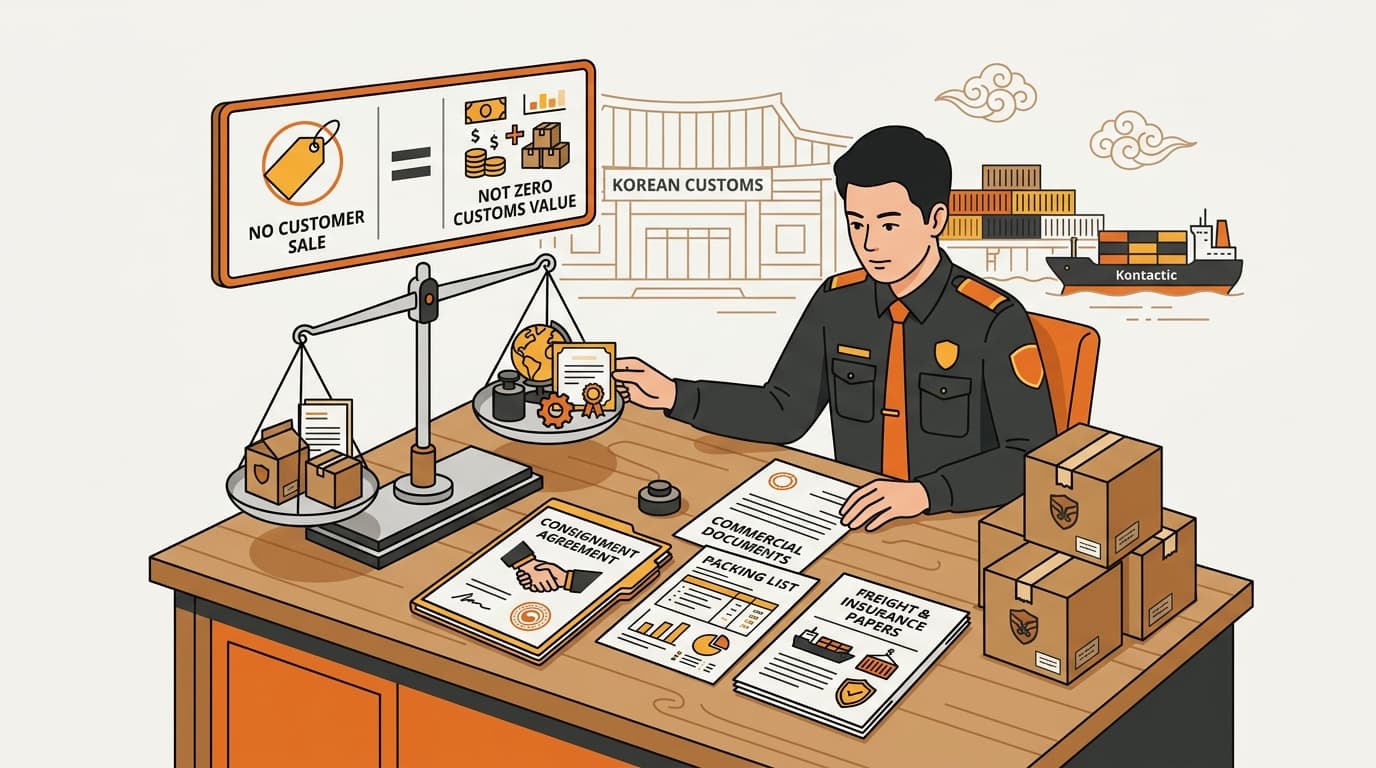
A consignment shipment may not contain a conventional sale from the foreign brand to a Korean buyer. That does not give the shipment a customs value of zero. If there is no qualifying price actually paid or payable for export to Korea, the Customs Act’s prescribed alternative valuation methods apply.
This is the key distinction:
- Was there a qualifying price actually paid or payable for the export to Korea? If so, that price and the surrounding facts may support the applicable valuation route.
- If not, which prescribed alternative method applies? The answer depends on the commercial arrangement and the evidence available, rather than on the fact that the goods are consigned.
- What supports the declared amount? The importer needs a defensible record connecting the declared value to the goods, the parties, and the chosen method.
A no-charge commercial invoice can show that the Korean party did not pay the foreign brand at the time of shipment. It does not automatically establish a zero customs value. A token amount has the same problem: it describes the invoice, but not necessarily the economic value that the customs valuation rules require.
The eventual Korean retail price is not an automatic substitute either. A Coupang selling price may include local fulfillment costs, platform charges, promotions, commissions, and a local seller’s margin. It is not simply the export value of the imported goods. Where an applicable alternative method uses Korean sales data, the data is handled under the statutory deductions and rules for that method. You cannot simply copy the highest retail price—or choose a token price—because it is convenient.
Depending on the method under review, useful support may include:
- The consignment agreement and any commission, settlement, return, or unsold-stock terms.
- Commercial invoices or other records showing how the goods were produced, supplied, or previously sold.
- Evidence supporting a comparable value where the applicable method permits comparison with identical or similar goods.
- Korean resale data and the deductions used if a sales-based method is applicable.
- Freight, insurance, and packing information relevant to the import valuation.
- SKU descriptions, quantities, and records that allow the declared goods to be matched to the commercial documents.
The point is not to create a number that produces a preferred duty result. It is to document the real arrangement before the goods arrive. The relationship between invoice value, consignment terms, and later settlement should make commercial sense when read together. The separate mechanics of freight, insurance, and customs value are explained in how Korea import duty is assessed on CIF value, not simply on your invoice.
A zero or token figure without supporting valuation logic can create a mismatch between the consignment contract, the customs entry, and the actual commercial arrangement. Resolve the valuation route before dispatch rather than asking the broker to improvise after arrival.
Import VAT arrives in the same cash-flow window
Customs duty is not the only import-time cash requirement. Import VAT is a separate tax, but it is normally assessed as part of the import clearance process rather than waiting for the later Korean retail sale.
The import VAT base is legally defined and generally builds from the customs value and applicable duty. That means a missing sale price does not remove the need to establish a customs value, and it does not automatically remove the VAT calculation. The precise base and included amounts should be checked against the current rules and the facts of the entry.
For cash-flow planning, model the sequence as a payment obligation before sell-through:
- The foreign brand dispatches inventory under the agreed shipping and consignment terms.
- The Korean import entry is filed and the declared value is reviewed.
- Import duty and import VAT are assessed under the applicable route.
- The stock is released to the domestic warehouse or fulfillment chain.
- Korean customer sales occur later, at an uncertain pace.
The later sale may be when the brand receives commercial revenue, but it is not necessarily when the first Korea-related tax cash leaves the business. A launch plan that budgets only for freight and the tariff line can therefore understate the cash required to get inventory released. The separate funding mechanics for a first shipment are worth considering alongside the question of who pays Korea import duties before the first payout.
Formal customs control can defer duty—but only under a qualifying regime
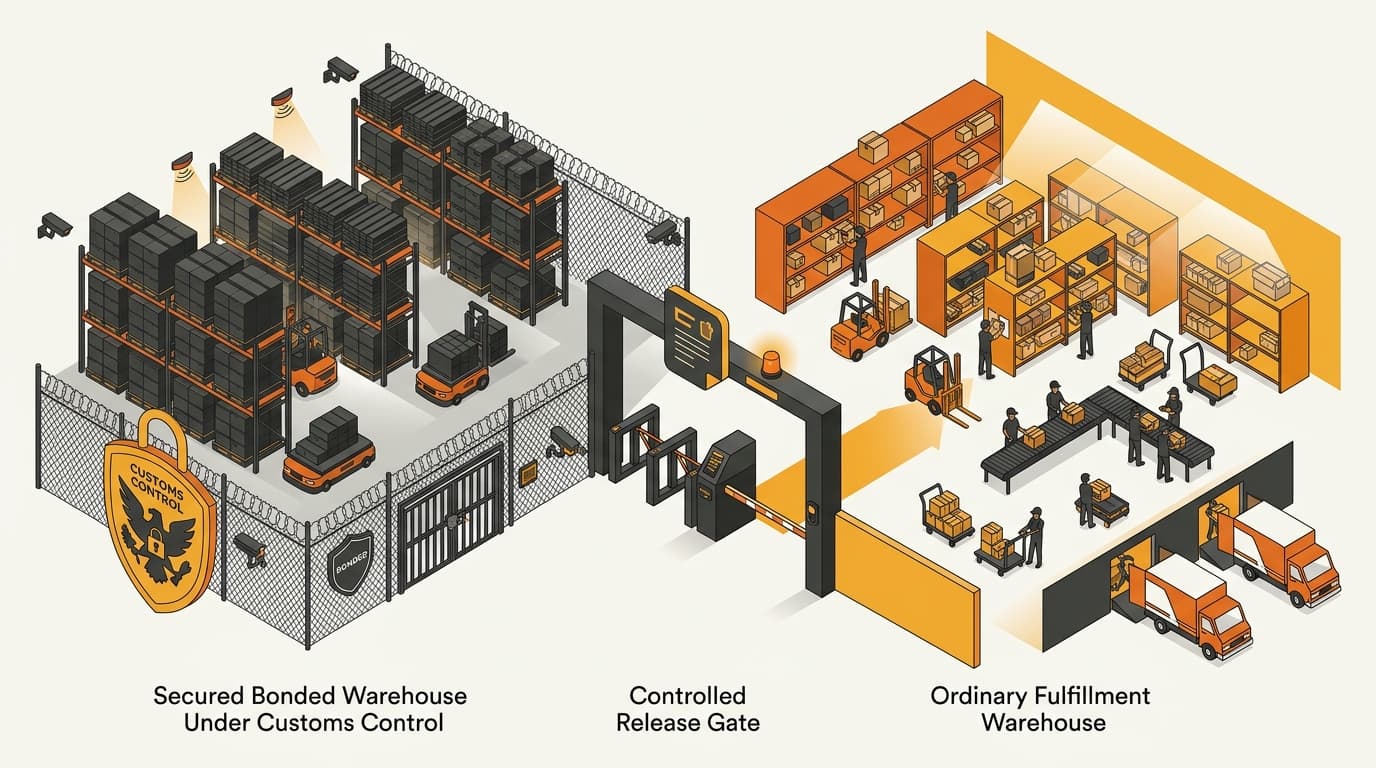
Customs duty may be deferred while goods remain in a qualifying bonded warehouse or another formal customs regime in which the goods stay under customs control. The deferral belongs to that legally recognized regime. It does not arise merely because the brand retains title or calls the inventory “consignment.”
The distinction matters operationally. A formal bonded arrangement may control where the goods are held, how movements are recorded, what processing is allowed, and when goods are released for domestic circulation. Once goods leave that regime for ordinary Korean sale, the applicable import declaration and tax obligations must be addressed under the rules for the release.
A normal Korean 3PL, a warehouse used by a marketplace, or a fulfillment location serving Coupang is not automatically a bonded warehouse. A warehouse contract does not change the customs status of the facility. If goods are cleared through ordinary import and then delivered to a regular fulfillment site, moving them into storage does not retroactively defer the duty.
Samples, warranty replacements, and temporary imports are separate exception questions. They may qualify for relief or a different treatment only if the shipment meets the current Korea Customs Service conditions for that route. Sellable commercial inventory cannot become duty-free simply because the invoice or carton is labelled “sample.” If a shipment contains both genuine samples and saleable stock, keep the purposes and documentation distinct rather than treating the whole shipment as an exception.
Before relying on bonded treatment or another formal regime, confirm the facility, records, permitted movement, release trigger, and tax treatment. Review those points with the Korean importer and customs broker against current Korea Customs Service guidance. Do not assume that a warehouse’s ability to store imported goods means it can hold uncleared commercial inventory.
Lock the declaration route before the goods leave origin
The practical control point is before dispatch. Before the stock reaches Korea, the importer should answer two questions. Which customs regime applies? How will customs value the goods if there is no sale price?
Use this pre-dispatch checklist:
- Separate the shipment purpose. Identify sellable consignment inventory, genuine samples, warranty replacements, and temporary imports separately. Do not use an exception label for ordinary stock.
- Map every role. Record the owner, exporter, importer, consignee, local seller, warehouse, and the party that will later settle the sales proceeds. The owner and importer may have different commercial roles, but the named importer must be clear.
- Write the consignment terms. State who retains title, who bears inventory risk, how commission or settlement works, what happens to unsold units, and how returns are handled.
- Build the valuation file. Gather any invoices, cost or comparable-value support, applicable Korean sales data, the consignment agreement, and freight, insurance, and packing information. A no-charge invoice is only one document in that file.
- Agree the entry route. Have the importer and broker review whether this is ordinary import clearance or a qualifying formal customs regime. Confirm the proposed valuation method before the shipment leaves origin.
- Model the pre-sale cash need. Include import duty, import VAT, freight, insurance, packing, and other charges that must be funded before ordinary domestic release. Do not base the plan only on the expected date of the first customer sale.
Keep the same facts consistent across the consignment agreement, commercial invoice, packing documents, customs entry, and later settlement records. If the documents describe a no-sale transfer but the valuation file assumes a normal wholesale sale—or if a declared token amount sits next to evidence of a much larger commercial value—the discrepancy should be resolved before filing.
Before dispatch, ask: On what legal basis will this stock be released into Korea, and what evidence supports the declared value? If the answer is only “it will be consignment until it sells,” the customs plan is incomplete.
Common questions about consignment stock and Korean customs
Can the foreign brand keep title and still pay import duty at clearance?
Yes. Title retention and customs-tax timing are separate issues. A consignment contract can leave ownership with the foreign brand while the named Korean importer handles the ordinary import declaration and import taxes before domestic release.
Does a no-charge invoice create a zero customs value?
No. It may show that no money was paid at shipment, but if there is no qualifying price actually paid or payable, the prescribed alternative valuation framework still applies. The declared value needs supporting evidence.
Can I use the later Korean or Coupang retail price as the customs value?
Not automatically. If a permitted alternative method uses Korean sales data, that data must be applied under the relevant statutory deductions and rules. The later retail price cannot simply replace the valuation analysis.
Can a regular Korean 3PL defer duty until the inventory sells?
Not by being a 3PL. Duty deferral depends on a qualifying bonded or other formal customs regime and continued customs control. Ordinary fulfillment storage after import clearance does not create that status.
Can I label sellable units as samples to avoid import taxes?
No. Genuine samples, warranty replacements, and temporary imports must be analyzed under their own current conditions. A sellable commercial unit does not become a sample because the label says so.
If the stock never sells, are the import taxes automatically postponed or refunded?
No. Unsold inventory does not, by itself, change the original import-tax timing or create an automatic refund. Any return, re-export, relief, or refund treatment is a separate question governed by its own current conditions.
Plan the import route before shipping
If you are weighing ordinary import against a formal customs-control arrangement, send us the product, consignment terms, and proposed fulfillment path. We can help you organize the valuation and documentation questions that need to be resolved before dispatch.
About the author
Korean and global e-commerce operators with 15+ years of cross-border experience, led by CEO Isaac Lee — KOTRA-certified consultant and official lecturer for Seoul City and the Korea Customs Service. We run Korea market entry for Western brands every day; this blog documents what we learn in the field.
More about Kontactic →Related Articles

Children’s Product KC: Does “Ages 13+” Avoid the Rules?
No. In Korea, “Ages 13+” is only one factor; design, intended use, packaging, and child-directed marketing can still trigger children’s-product KC rules.

Korean KC for a Detachable Device Charger: Not Automatic
Does Korean KC cover a detachable charger? Not automatically. The final bundle and adapter evidence must match the Korean commercial SKU before import.
Can Coupang Handle Every Korean Buyer Inquiry? No—Seller Duties
Coupang may handle platform and fulfillment contacts, but sellers still own product questions, cancellations, returns, exchanges, and order exceptions.