
Korean Importer of Record Needs a Business Registration Number
To be the importer of record in Korea, your name has to attach to a Korean business registration number (사업자등록번호) — and a non-resident foreign company with no Korean presence generally cannot get one directly. That single number, not the corporate seal and not the resident representative, is the actual structural wall. Every import-side registration you will ever need — customs importer registration, the MFDS food or cosmetics importer filing, the importer-of-record field on your KC certificates — keys off that number. No number, no importer of record in any of those systems.
Most "how to import into Korea" explainers stop at "you need a resident representative and a corporate seal." Those are real requirements, but they are steps inside one specific route. They only matter once you have already decided how you will obtain the business registration number in the first place. Get that ordering wrong and you can spend months on category certification before discovering the importer name on your filings has nowhere to live.
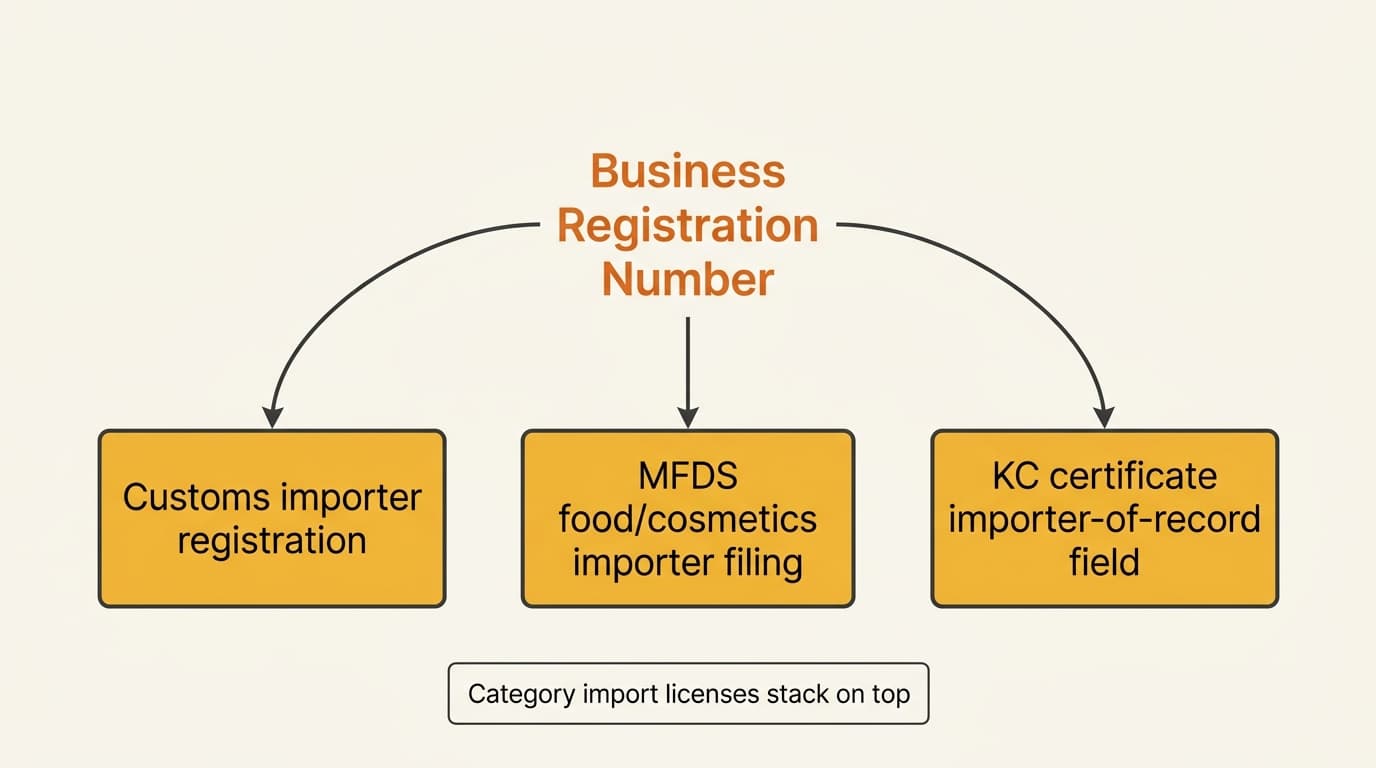
The business registration number is the anchor every import filing references
The business registration number is the identifier that every Korean import-side registration attaches to. Think of it as the tax-side identity of a business in Korea, issued by the National Tax Service (국세청) and referenced anywhere the government needs to know who is transacting.
On the import side specifically, three separate systems all point back to it:
- Customs importer registration. The Korea Customs Service (관세청) records the importer of record against a valid business registration number. This is the entity that files the import declaration and is accountable for duty and VAT.
- MFDS importer filing. Regulated ingestibles and cosmetics run through the Ministry of Food and Drug Safety (식약처) via the 식품안전나라 (Food Safety Korea) system, and the importer registration there is tied to the same number.
- KC certificate records. For KC-certified electrical and children's products, the importer-of-record field recorded against the certificate references that same business registration.
Because all three reference the same anchor, the number is not one line item among many. It is the prerequisite that makes the rest of the paperwork possible. Without it, you are not an importer of record in customs, you are not a registered food or cosmetics importer at MFDS, and there is no valid holder name to put on a KC certificate.
Business registration number (사업자등록번호) is the tax-side identifier issued to a business in Korea. Every import-side registration — customs, MFDS, KC — attaches the importer of record to this number, which is why obtaining it is the true first gate, not the last.
Why a non-resident foreign company can't get the number directly
A non-resident foreign company with no establishment in Korea generally cannot obtain its own business registration number the way a domestic company does. The reason is structural, not procedural: the number presupposes a taxable presence in Korea. It exists to identify an entity that is transacting and subject to Korean tax administration. A purely overseas brand — headquartered in the US or EU, with no office, no permanent establishment, and no local filing footprint — has nothing for that identity to attach to.
This is where the common assumption breaks. Brands with proven Korean cross-border demand often treat becoming the legal importer as a paperwork exercise they can complete from headquarters. They picture couriering a signed form and a company stamp to a filing agent. But the form has to name an importer, and the importer has to be a business Korea already recognizes. You cannot back into that recognition by importing first; the recognition is what lets you import at all.
It is worth being precise about the edge cases, because they matter for planning. The specific mechanics depend on the structure you choose and, for regulated categories, on the reviewing agency. If you are unsure whether your particular situation qualifies, the primary sources to verify against are the National Tax Service / Hometax for the registration itself, the Korea Customs Service (관세청) for importer registration, and MFDS 식품안전나라 for food and cosmetics importer filings. The statute text lives at law.go.kr. None of these will let a company with no Korean presence self-register as the importer of record — which is exactly why the decision below comes first.
For the fuller version of why a non-resident brand can't complete this alone, see our explainer on whether a non-resident brand can be the Korean importer of record.
Two legitimate structures produce the number
There are exactly two clean ways to get a business registration number that can hold your importer-of-record status, and choosing between them is the real decision this whole topic forces.
- Establish a Korean entity. The brand sets up its own presence — a subsidiary (a Korean limited company, or 유한회사) or a registered branch or liaison of the foreign company. That entity obtains its own business registration number, and your importer of record is then you, operating locally. This is where the corporate seal and resident representative requirements finally enter the picture.
- Appoint an operating partner. The brand works with a partner that already holds a Korean business registration and can act as the importer of record on the brand's behalf. Here you are not obtaining a number; you are borrowing an existing one under a contractual arrangement.
The tradeoffs are well-worn — control and long-term cost economics on the entity side, speed and lower fixed overhead on the partner side. What matters for this article is narrower: both routes exist precisely because the business registration number cannot be conjured remotely. One route builds a new number; the other rents access to an existing one. There is no third path where a non-resident brand simply files as its own importer.

The corporate seal and resident representative are downstream, not a substitute
This is the part most guides invert. The corporate seal (법인인감) and the resident representative are real requirements — but they belong to the entity route, and they sit downstream of the business-registration prerequisite. They are steps inside establishing a Korean entity, not an alternative way to become an importer.
Here is the correct ordering. You do not need a corporate seal to decide whether you'll go entity or partner. You need it only once you've chosen to build your own entity, because registering that entity — and later opening a corporate bank account and executing filings — requires a registered seal and a locally reachable representative. Treating "get a seal and a rep" as the whole task is how brands end up with the mechanics of a route they haven't actually committed to.
If you want the detail on those two specific requirements, we've written separately on why Korean importer registration demands a corporate seal and a resident representative. Read it as a description of the entity route's internals — not as the first thing to solve.
“The seal and the resident representative aren't the wall. They're steps inside one route past the wall. The wall is the business registration number itself.”
Kontactic — Korea market-entry operations
Category import licenses stack on top of the number
A valid business registration number is the foundation, not the finish line. Even after you have one, regulated categories each add their own importer license or filing — and every one of them references that same number.
- Food and ingestibles require an MFDS importer registration through 식품안전나라, and each shipment then carries its own import declaration.
- Cosmetics require a licensed responsible distributor role in addition to the importer registration.
- KC-certified products — electrical goods, children's products, certain wireless devices — record the certificate holder against the business registration.
The practical point is that these licenses assume the number already exists. You cannot file an MFDS importer registration for a business that has no registration number, and you cannot list a KC certificate holder who isn't a recognized Korean business. This is also why importer registration doesn't automatically cover everything you sell — each regulated category adds its own separate license on top of the foundation.

Decide entity-vs-partner before any category certification
The single most useful planning takeaway: choose your entity-vs-partner structure before you begin any category certification or importer filing. The importer-of-record name recorded on your customs and MFDS filings has to match the entity that will actually hold your certificates and clear your goods.
If you certify first and decide the importer structure later, you risk recording a name that doesn't line up — and re-associating certificates and importer registrations to a different holder is slow, sometimes requiring re-filing. Because the importer of record on Coupang must be a Korea-resident, accountable party, that downstream reality should be settled first, then everything else attaches to it cleanly.
The sequence that saves months is simple:
- Decide how you'll obtain the business registration number — own entity or operating partner.
- Get that number in place under the chosen holder.
- Then file customs importer registration, MFDS filings, and KC certificate records — all against that one number.
Common questions
Can my US or EU company be the importer of record in Korea directly? Generally no. As a non-resident company with no Korean presence, you can't obtain the business registration number that customs, MFDS, and KC filings all reference. You need either a Korean entity of your own or an operating partner that already holds one.
Isn't the corporate seal the hard part? The seal (법인인감) and resident representative are real, but they're steps inside establishing a Korean entity — downstream of getting the business registration number. They only matter if you've chosen the entity route.
Does one business registration number cover all my products? No. The number is the foundation. Regulated categories — food via MFDS, cosmetics, KC-certified electrical and children's products — each add their own importer license or filing that references the same number.
Where can I verify these requirements myself? Check the National Tax Service (국세청) / Hometax for the registration, the Korea Customs Service (관세청) for importer registration, MFDS 식품안전나라 for food and cosmetics, and law.go.kr for the underlying statutes.
Not sure whether you need your own entity or a partner?
Kontactic helps Western brands pick the right importer-of-record structure before any certification begins — and then runs it. Tell us your category and current setup.
About the author
Korean and global e-commerce operators with 15+ years of cross-border experience, led by CEO Isaac Lee — KOTRA-certified consultant and official lecturer for Seoul City and the Korea Customs Service. We run Korea market entry for Western brands every day; this blog documents what we learn in the field.
More about Kontactic →Related Articles
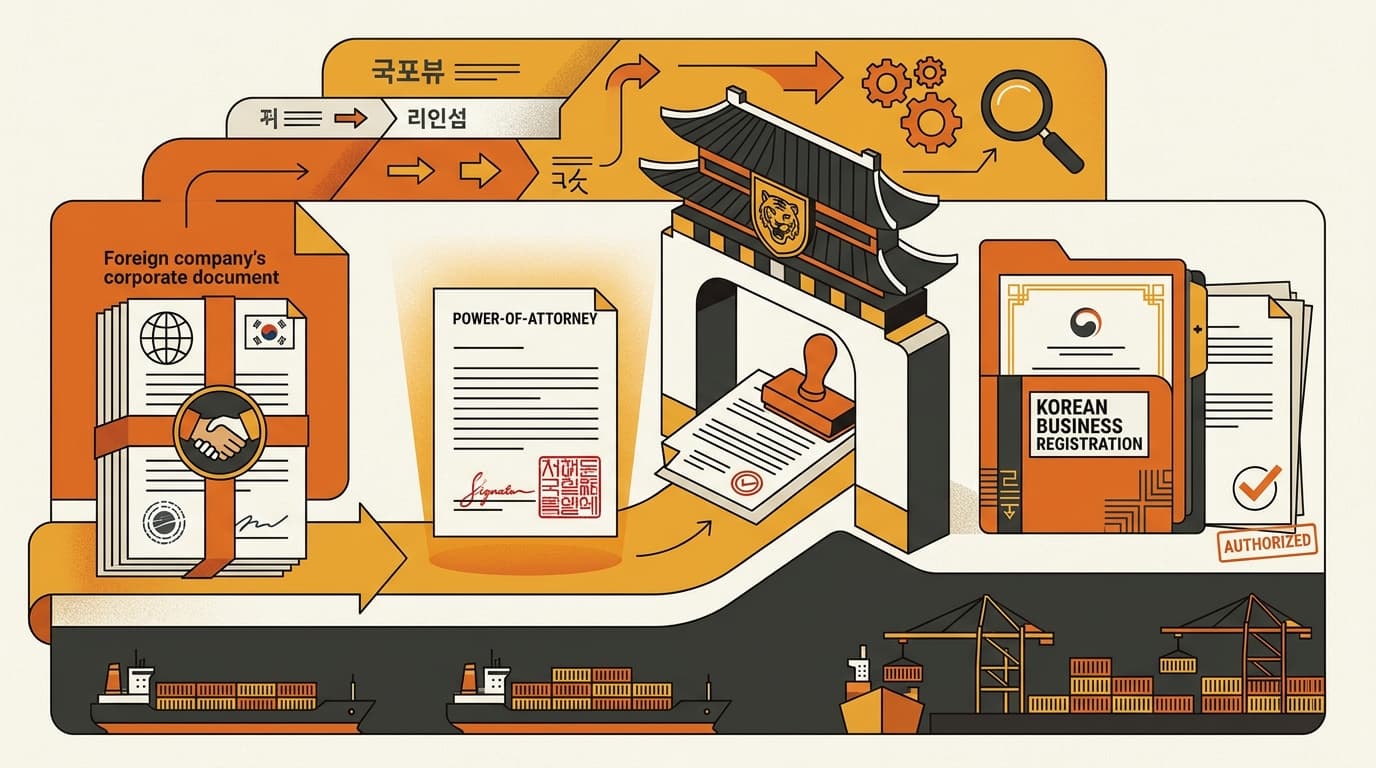
Korean Importer Registration: Why a POA Is Not Enough
A power of attorney cannot establish Korean importer registration; corporate-authority proof and Korean importer records are still required for the filing.
Can You Delay Korea Import Duty on Consignment Stock?
No. Korea import duty and import VAT are normally assessed when consignment stock is cleared for domestic circulation, not when a Korean customer buys one unit.

Children’s Product KC: Does “Ages 13+” Avoid the Rules?
No. In Korea, “Ages 13+” is only one factor; design, intended use, packaging, and child-directed marketing can still trigger children’s-product KC rules.