Korea Launch Roadmap: Kontactic’s Brand-Specific Plan
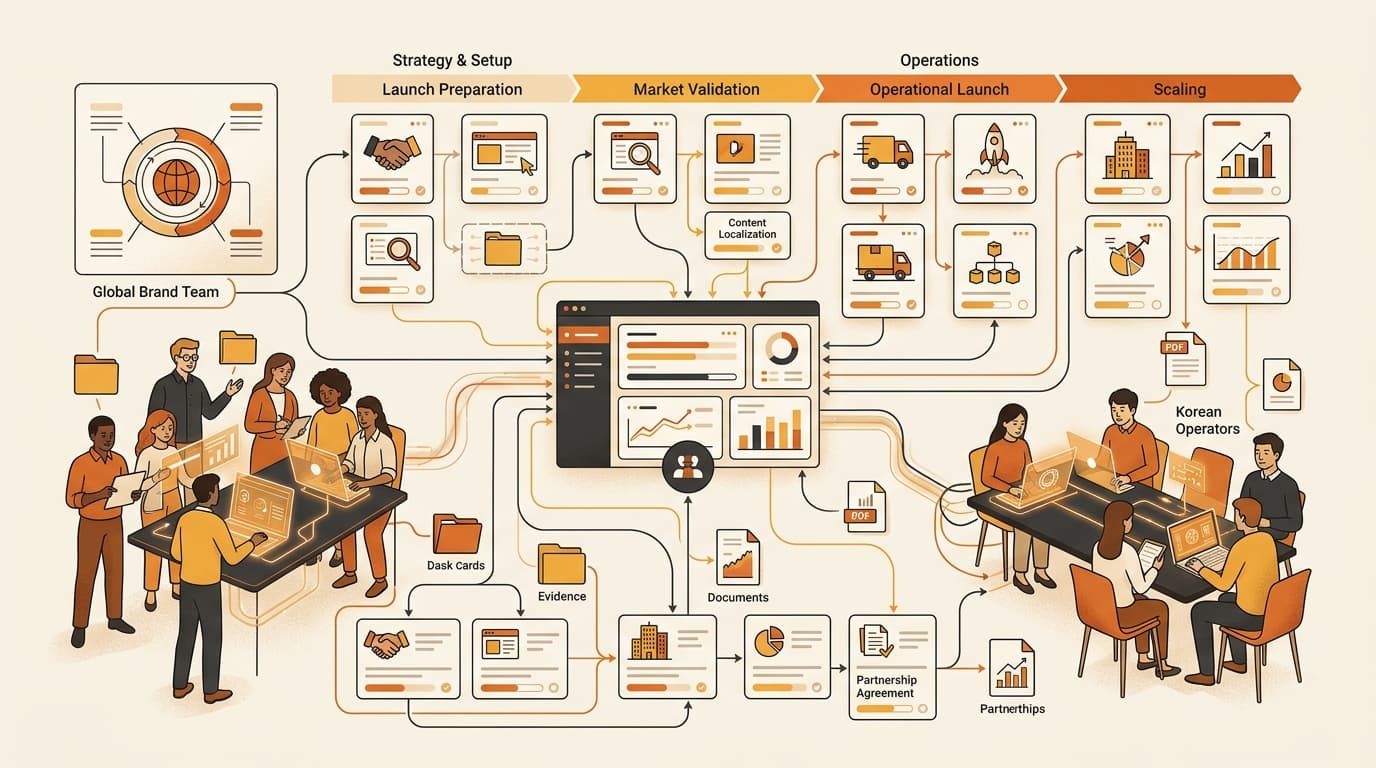
Kontactic builds a Korea launch roadmap by converting the documented scope of a specific program into a configurable execution plan inside Kontactic Seller Center. It keeps only relevant work, orders tasks around dependencies, captures evidence and completion rules, and gives clients and local operators one shared view of what is complete, next, and required.
A brand-specific Korea launch roadmap is an ordered execution plan built from a program's actual scope, required evidence, dependencies, procedures, and completion rules—not a fixed checklist of everything a foreign brand might do.
Start with the program's documented scope
Most generic launch checklists start with a country rather than a client. They list everything a foreign brand might need to do in Korea and leave the team to work out which items apply. That is useful as a rough reference, but it is a poor operating plan.
Seller Center starts with the documented scope and deliverables for the specific Korea program. That scope becomes the boundary for the roadmap. A program may include entity administration, import readiness, product-specific evidence, marketplace work, and the handoff into ongoing operations. Another may require additional documentation, a different sequence, or no need for some of those steps at all.
The distinction matters because irrelevant work creates false complexity. If every possible task appears in the plan, a decision-maker cannot easily tell which items are committed, which are optional, and which are simply unrelated to the brand. If a required procedure is missing, the opposite problem appears: the program can look further along than it really is.
When entity formation is part of the scope, for example, the roadmap can represent that work as one defined part of the Korean operating path rather than as a vague incorporation project. The underlying stages are different from ongoing commerce work, as the practical guide to setting up a Korean entity without the paperwork fog explains. The roadmap's job is to put the relevant work in the right program, with the right context.
This is the first product principle: the plan should describe the work this brand has to execute, not everything Kontactic could theoretically do.
Filter the work and sequence it around dependencies
Relevance alone is not enough. The order of work matters, especially when one step depends on evidence, a decision, or an earlier handoff.
The Seller Center capability supports three practical forms of configuration:
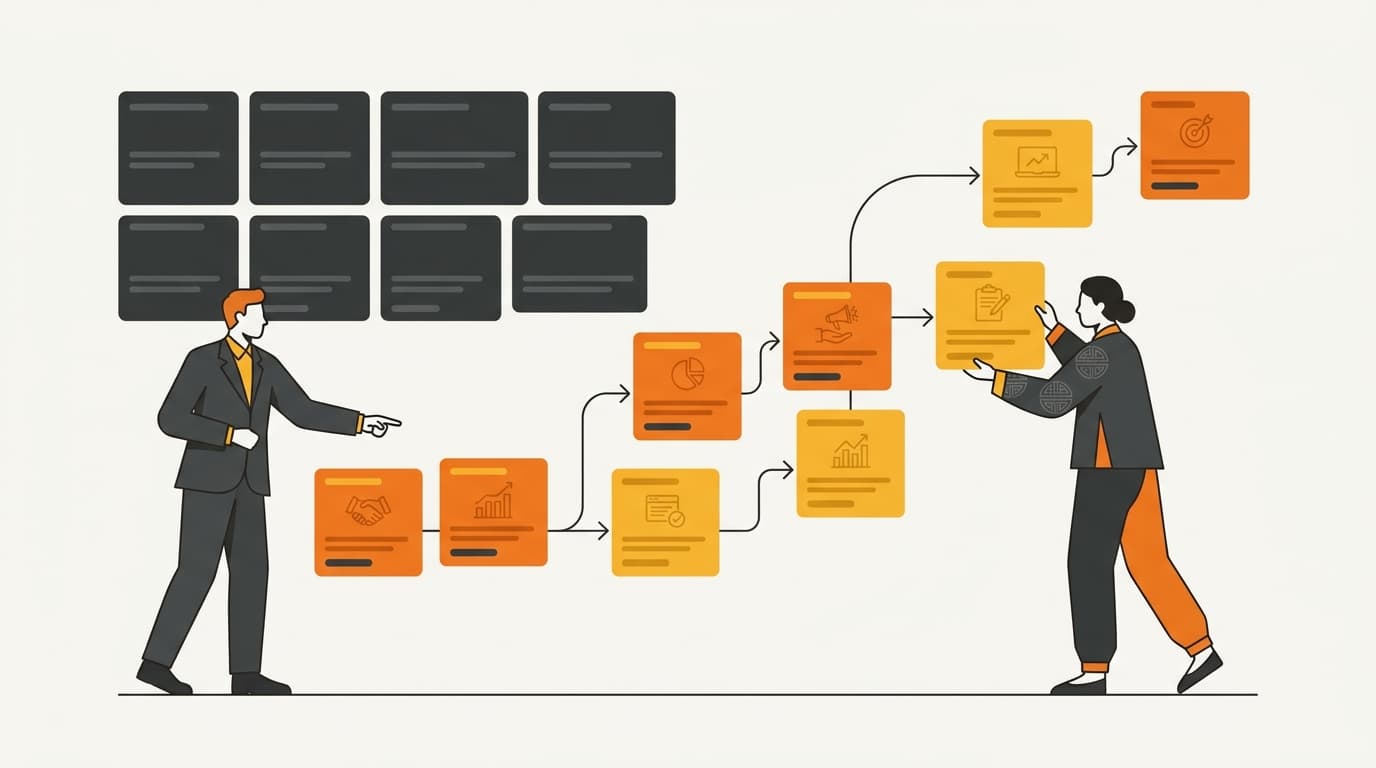
- include only work that applies to the program;
- reorder steps when dependencies change; and
- add one-off procedures with clear client-facing descriptions.
A useful roadmap should make four questions easy to answer:
- Does this task apply to this program?
- What has to happen before it can move?
- What evidence or decision is required?
- Is this a standard step or a custom procedure added for this brand?
Reordering is not cosmetic. Suppose a product review needs to happen before downstream listing or inbound work can proceed. If the required evidence changes what must happen first, the roadmap should reflect that relationship instead of leaving the client and operator to infer it from separate messages.
Product compliance is one example of why this matters. A SKU may need a Korea-specific certification screen before the team can treat later commerce work as ready. The exact review depends on the product, which is why a SKU-by-SKU Korea certification screening process is more useful than a generic “certification” line in a checklist.
The same logic applies to custom work. An additional document request, a special review, or a program-specific handoff should not live only in an email thread. Adding it as a one-off procedure gives the step a place in the operating plan and gives the client a clear description of what has been added and why.
A roadmap becomes genuinely brand-specific when these variations are visible in the order of work—not just mentioned in a kickoff call.

Turn custom procedures into shared instructions
Custom work is only useful if people can act on it. A step that appears in a plan without a usable description simply moves the coordination problem somewhere else.
Seller Center allows one-off procedures to carry clear, client-facing descriptions. That gives a Western stakeholder enough context to understand what is being requested, while giving the local operator a defined step to follow. The goal is not to make every program look identical. It is to make each difference explicit and workable.
Translation is part of that control. A custom instruction that is written for one audience and informally explained to another can lose its meaning during handoff. Consistently translated step instructions help Western stakeholders and local operators work from the same plan instead of maintaining separate interpretations of the same task.
That shared instruction layer is especially important when product information moves into marketplace work. A traceable product-link intake for Coupang follows the same operating principle: the next person should receive the source context and expected action without rebuilding the history from scattered conversations.
The useful test for any custom procedure is straightforward. Can the client understand why the step exists? Can the operator understand what needs to happen? Can both sides see what evidence or condition is needed before the step is finished? If the answer is yes, the procedure belongs in the roadmap as operational context, not as a private note.
Make completion a rule, not an impression
Progress visibility is weak when “complete” means whatever the last person believed was complete. A request sent, a document received, a review finished, and an operational step ready are not necessarily the same event.
Kontactic Seller Center builds completion rules into the workflow. Required evidence can be part of the step, and when a manual process requires a signed document, that signed-document requirement can be included in the conditions for completion. The point is not to pretend that every approval can be automated. It is to make the requirement visible before someone treats the work as finished.
This matters for both sides of the program. A client can see what is still required without searching through old messages. The operator can work against the same completion condition rather than relying on an informal interpretation. Different programs can carry different rules because the roadmap is based on their documented scope.
A practical test for any roadmap step is simple: can a client see what is required, can an operator see how to act, and can both tell what condition marks completion?
When a manual step depends on a signed document, put that requirement in the completion rule rather than leaving it as an assumption in an email thread.
Keep status and notifications in the same operating view
A client-visible roadmap solves a different problem from a private task list. Decision-makers need to know what has been completed, what comes next, and what is required from them. Local operators need to work from the same current sequence and instructions. If those views diverge, the launch acquires a hidden coordination layer.
Kontactic Seller Center makes progress visible in the program's shared workspace. Notifications are tied to meaningful stage changes, so the people responsible for decisions can see when the state of the work has changed in a way that matters to the next action. That reduces the need to reconcile scattered emails and spreadsheets simply to answer a basic status question.
The roadmap also does not have to end when setup ends. It is an execution layer that can adapt as the program moves into active Korean operations. A step can be reordered when a dependency changes, a custom procedure can be added when the program requires it, and progress can continue in the same place rather than being abandoned at launch.
That continuity is important during transitions. A Korean entity handover, for example, still needs aligned records, milestones, and exceptions; Korean Entity Handover: How Kontactic Aligns Each Step looks at that kind of coordination in more detail. The broader principle is the same: setup and operations should not rely on two disconnected versions of the plan.
This is what makes the capability more than a formatted checklist. It gives a brand-specific Korea program an execution layer that can show the current work, explain its requirements, and change with the program.

Common questions about a brand-specific Korea roadmap
Is this a fixed checklist for every Korean launch?
No. The roadmap starts from the documented scope and deliverables of the specific program, includes relevant work only, and can omit or add steps as the program requires.
Can the roadmap include a one-off procedure?
Yes. Custom procedures can be added with clear client-facing descriptions, then placed in the sequence where they belong. Their instructions can be translated consistently so Western stakeholders and local operators work from the same plan.
How does the workflow handle a signed document?
When a manual process requires a signed document, that requirement can be built into the completion rule for the step. The document is therefore part of what must be satisfied before the work is treated as complete.
Who can see progress and receive updates?
Progress is visible in Kontactic Seller Center, and notifications are tied to meaningful stage changes. That gives the client and the local operators a shared view of what is complete, what is next, and what is required.
Does the roadmap stop after the initial setup?
No. It is designed as an execution layer that can adapt as the program moves from setup into active Korean operations, including changes to sequencing and additional procedures when the work evolves.
Build the Korea plan your program actually needs
If your Korea launch has a specific scope, dependencies, documentation path, or operating handoff, contact Kontactic to discuss a brand-specific execution roadmap in Seller Center.
About the author
Korean and global e-commerce operators with 15+ years of cross-border experience, led by CEO Isaac Lee — KOTRA-certified consultant and official lecturer for Seoul City and the Korea Customs Service. We run Korea market entry for Western brands every day; this blog documents what we learn in the field.
More about Kontactic →Related Articles

How Does Kontactic Protect Coupang Catalogs When Sync Fails?
When Coupang connectivity fails, Kontactic separates shared incidents from seller-level issues and protects the live catalog from incomplete inventory updates.

Korean Entity Handover: How Kontactic Aligns Each Step
See how Kontactic Seller Center keeps a Korean entity handover aligned across representative records, documents, delegated tax work, milestones, and exceptions.

Korea Payment Reconciliation Made Traceable by Kontactic
Kontactic's Korea payment reconciliation links payments, invoices, and allocations; confirmed and provisional matches stay separate, with adjustments preserved.