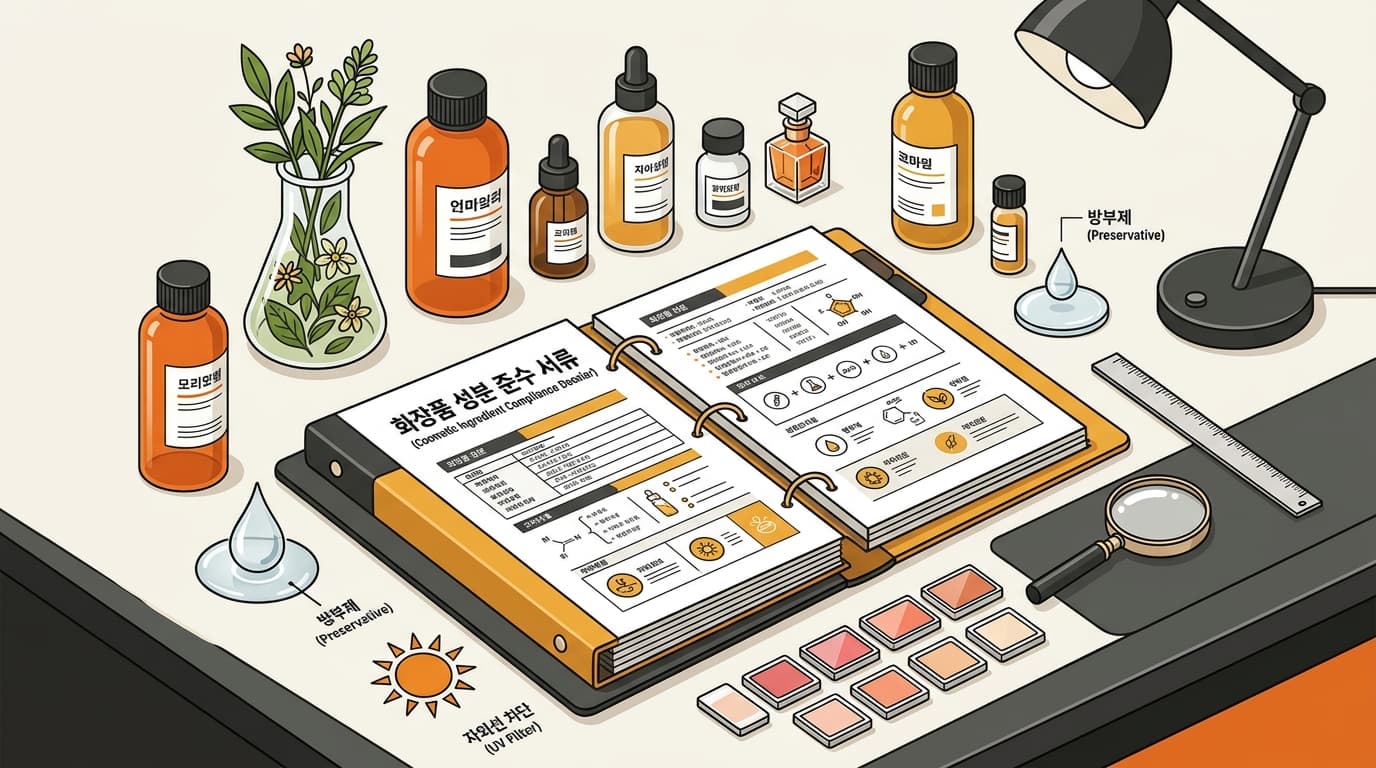
Korea Cosmetic Ingredient Rules: Every Formula Matters
Korean cosmetic safety compliance is not limited to the ingredients a brand calls “active” or “hero.” The Korea-bound finished formula—including preservatives, UV filters, colorants, fragrance components, extracts, and other base materials—must be screened against the MFDS Cosmetics Safety Standards. That screening does not mean MFDS individually pre-approves every component of an ordinary general cosmetic.
What “every ingredient matters” means in practice
Every component matters as an input to the review. That does not mean every ordinary raw material receives a separate MFDS approval or a unique restriction. It means a reviewer cannot make a reliable Korean safety assessment from the short list of ingredients used in your marketing story.
Western product files often give prominence to a hero ingredient while treating the preservative system, fragrance components, colorants, botanical extracts, and other base ingredients as formulation details. Those details can still affect whether the finished cosmetic fits Korean safety standards and whether a permitted material is being used under the right conditions.
The distinction is important. A product that is lawful in the United States or European Union has passed a different legal test. That status is useful background, but it does not establish that the same finished formula satisfies Korean requirements. The relevant question is not “Which ingredients do we advertise?” It is “What exactly is in the product that will be imported and sold in Korea, and how is each relevant component regulated there?”
Start with the current Cosmetics Safety Standards (화장품 안전기준 등에 관한 규정) and related notices published by the Ministry of Food and Drug Safety (MFDS). You can also verify the current Korean legal text through the official law.go.kr database. These are the references to use for prohibited raw materials, restricted raw materials, and category-specific rules rather than an old supplier spreadsheet or a home-market ingredient opinion.
The practical rule: screen the complete Korea-bound formula, not only the hero-ingredient list. “Not a hero ingredient” is a marketing description, not a Korean compliance category.
Build a formula file Korea can actually screen
Before asking whether a cosmetic ingredient is acceptable in Korea, make the product file complete enough to answer the question. A reviewer should be able to reconstruct the finished product and its intended use without guessing what a supplier’s shorthand means.
Include at least the following:
- The exact finished-product formula. Identify each component and its concentration in the version intended for Korean import and sale. Do not substitute a generic family formula if the Korean product will use a different fragrance, preservative level, colorant, extract, or other formulation detail.
- Normalized ingredient identity. Reconcile the INCI name, Korean standardized name, supplier trade name, and the actual material supplied. Check salts, derivatives, and mixtures individually; similar-sounding names should not be treated as interchangeable by assumption.
- Composition of compound raw materials. For each premix, extract, or other compound material, identify its relevant components. Provide enough detail to match the material to the correct Korean entry and calculate its contribution to the finished formula.
- Fragrance-blend information. A trade name or a simple “fragrance” description may not be enough to resolve the materials that matter for the Korean screen. If the blend contains components subject to a restriction, those components and their finished-product concentrations need to be understood.
- The intended use profile. Record the product type, application area, leave-on or rinse-off use, directions, and any relevant warnings. These facts can determine whether a restricted material is permitted in the exact product being imported.
- Manufacturer and supplier information. The local responsible cosmetics seller needs accurate information about who made the product and supplied the raw materials. Incomplete supplier data makes an ambiguous material harder to resolve.
This is a technical compliance file, not a marketing ingredient list. The safety review needs the underlying identity, concentration, and composition detail.
Prepare one frozen review version: identify the formula version, the intended Korean use, and the date of the information supplied by the manufacturer or raw-material vendors. If any of those change, reopen the Korean review instead of assuming the previous answer still applies.
The MFDS screening workflow for a finished cosmetic
A practical review follows a sequence. The sequence prevents the common mistake of searching a raw-material name first and only later discovering that the product’s use changes the result.
-
Fix the product and use context. Define what the finished cosmetic is, where it is applied, whether it remains on the skin or is rinsed off, and what the directions say.
-
Normalize each material’s identity. Map the supplier’s trade name and formulation notation to the relevant INCI and Korean standardized identity. Review salts, derivatives, extracts, and mixtures as the materials they actually are, not as the closest familiar name.
-
Check the prohibited raw-material requirements. If a component matches a prohibited Korean entry, there is no permitted concentration to find for that use. The Korea-bound product must be reformulated or withheld from Korean distribution; it should not be imported on the assumption that a small amount will be overlooked.
-
Check restricted raw materials and category-specific standards. Review the conditions for preservatives, sunscreen ingredients or UV filters, colorants, and any other relevant restricted category. The check may depend on concentration, product type, application area, leave-on or rinse-off use, and required warnings.
-
Record the conditions, not just the ingredient name. A result that says “ingredient allowed” is incomplete if it does not state the use context and limits that made the result possible. Capture the applicable condition and any warning or instruction that must carry through to the Korea-facing product materials.
-
Document gaps and control changes. Mark unresolved trade names, missing concentrations, undisclosed blend components, and uncertain use directions as open issues. Recheck the formula if a concentration, fragrance blend, other component, or use direction changes.
The outcome is a reasoned screen of one finished formula in one defined use. It is not a universal statement that the raw material is acceptable in every Korean cosmetic. The current MFDS materials and Korean legal text should be checked when the shipment or formulation decision depends on the result.
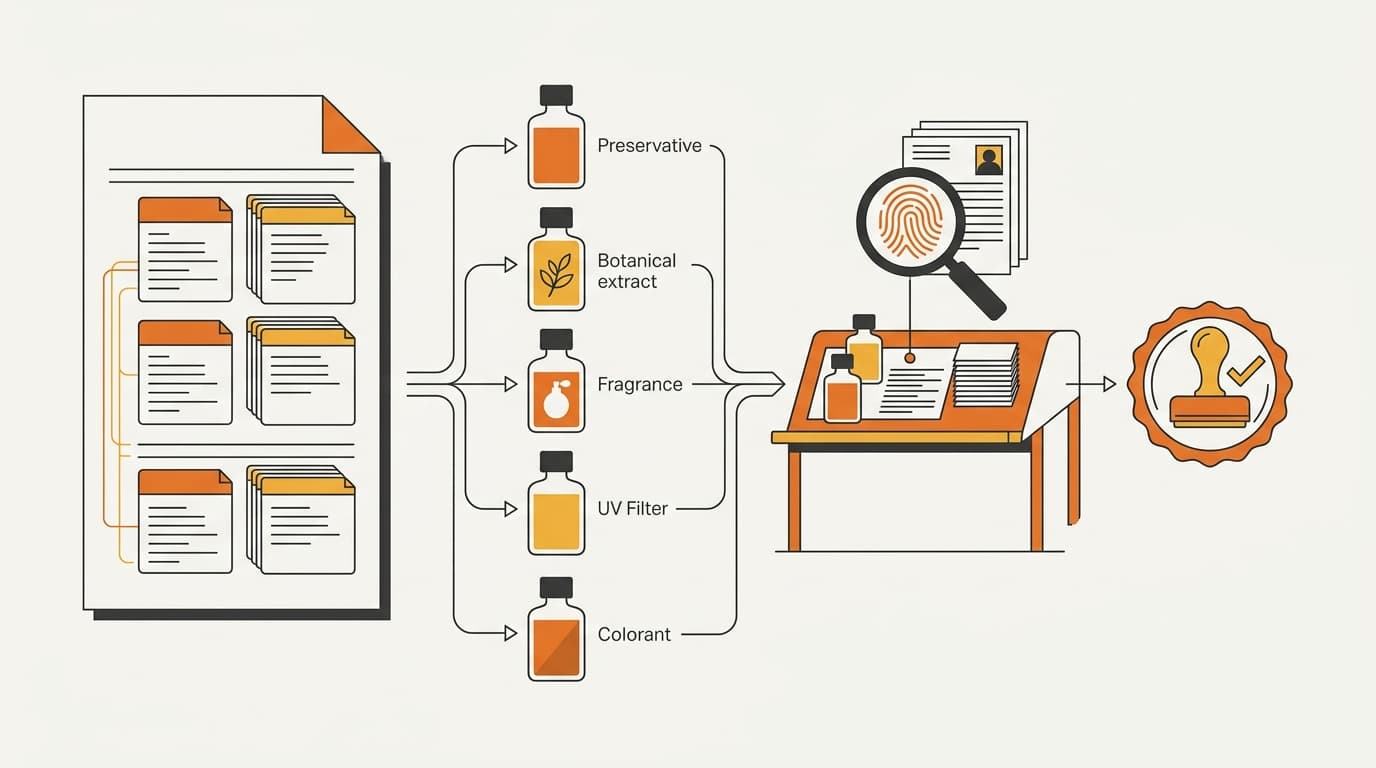
Why blends, extracts, and restricted materials need extra checking
The most difficult gaps often sit outside the ingredient a brand uses in its headline claim. They sit in materials whose identity is compressed into a trade name or whose legal use depends on context.
A trade name is not automatically a regulatory identity. A supplier may sell a premix under one commercial name. The Korean review still needs its relevant components and each component’s contribution to the finished product. The same caution applies to salts, derivatives, and mixtures. A familiar parent name does not prove that the supplied form matches the Korean entry or conditions.
Extracts need enough detail to be matched correctly. A botanical extract can be described by its plant source and commercial name, but the review still needs the relevant composition information and the finished-product concentration. Do not assume that calling something an “extract” removes it from the ingredient screen or that a permitted plant source answers every question about the supplied material.
Fragrance cannot be treated as a black box. A supplier trade name may not reveal whether a fragrance blend contains a restricted component. Obtain enough composition data to determine which components are present and their finished-product concentrations. The correct response is to obtain further composition information. It is not to mark the blend acceptable because no prohibited material is visible in the short description.
Restricted means conditional, not universally clear. An ingredient may be permitted for one product type or use and restricted in another. Concentration, application area, leave-on or rinse-off status, and required warnings can all matter. Preservatives, UV filters, and colorants therefore need more than a simple name lookup against a prohibited list.
Use this three-way reading of a screening result:
| Finding | What it means | Action before import |
|---|---|---|
| Prohibited raw material | The component cannot be used in the Korea-bound product under the applicable rule. | Reformulate or withhold the product; do not import it on the assumption that the amount is minor. |
| Restricted raw material | The component may be usable only when the applicable Korean conditions are met. | Check concentration, product type, application area, leave-on or rinse-off use, and required warnings; change the formula or use if necessary. |
| Unclear trade-name blend | The material’s identity or relevant composition has not been resolved. | Obtain further composition information and keep the import decision open; do not assume that uncertainty equals acceptance. |
This is why “not prohibited” is not the same as “cleared.” The missing step is often the use-condition check, not a more persuasive marketing description.
Do not close an open identity gap with an assumption. If a compound raw material or fragrance blend cannot be mapped to the relevant Korean entry, pause the decision until the composition information is sufficient for review.

What the Korean responsible cosmetics seller can and cannot do
The Korean registered responsible cosmetics seller is accountable for local quality and safety compliance, but it cannot assess an incomplete formula. The role provides a local compliance point; it does not turn an unknown blend, missing concentration, or unreported formula change into an acceptable ingredient.
The foreign brand must provide accurate formulation and manufacturer or supplier information, confirm the exact version intended for Korea, and flag changes. That handoff should cover more than the hero-ingredient story. It should include the materials that usually live in technical files: preservatives, fragrance components, colorants, extracts, and other base ingredients.
The role is also distinct from the brand’s assumption that a home-market approval or internal safety opinion travels automatically to Korea. A Korean responsible cosmetics seller can work from the applicable local standards and maintain the local compliance record, but it needs the technical facts to do that work. This is the practical boundary described in the guide to the Korean responsible distributor role for imported cosmetics.
Ingredient screening does not replace the separate Korean labeling or functional-cosmetics review; see why a cosmetic needs a Korean label even if it is already registered and functional-cosmetics guide for whitening products for those separate questions.
Run this decision tree before import:
- Can every relevant component be identified? If a trade-name blend, extract, derivative, salt, or mixture is still unclear, obtain more composition information and pause the decision.
- Does the exact identity match a prohibited raw material? Do not import the product. Reformulate it or withhold it from Korean distribution.
- Is the identity restricted rather than prohibited? Check the concentration, product type, application area, leave-on or rinse-off use, and required warnings. Reformulate or bring the use within the permitted conditions before import.
- Did the formula or use change after review? A changed concentration, fragrance blend, other formula component, or use direction requires a fresh Korea compliance check.
The seller’s local accountability and the brand’s technical disclosure therefore work together. Neither one makes the other unnecessary.

Common questions about imported cosmetic ingredients in Korea
Does MFDS pre-approve every ingredient in a general cosmetic?
No. Korea does not require an item-by-item MFDS pre-approval of every ordinary formula component simply because it appears in a cosmetic. The complete finished formula still needs to be screened against the applicable prohibited, restricted, and use-specific standards.
If an ingredient is legal in the US or EU, can it be imported into Korea?
Not on that fact alone. Home-market legality does not establish Korean conformity. The exact identity, concentration, product type, application area, leave-on or rinse-off use, and relevant Korean restrictions still need to be checked.
Is the consumer-facing INCI or hero-ingredient list enough?
Usually not for a reliable safety screen. The review needs the finished-product formula, concentrations, and enough information about compound raw materials, extracts, and fragrance blends to identify the relevant components.
Can a proprietary fragrance blend be accepted under its trade name?
An unresolved trade name is not a reason to assume acceptance. Obtain composition information sufficient to determine the relevant Korean identity and conditions; if that information is unavailable, keep the import decision open.
If an ingredient is not prohibited, is it automatically unrestricted?
No. It may be subject to restricted-use conditions, including concentration, product type, application area, leave-on or rinse-off use, or required warnings. Preservatives, UV filters, and colorants should be checked against their applicable category-specific rules.
Ready to check a Korea-bound cosmetic formula?
Check the formula before you ship
If you are preparing a Korea-bound cosmetic formula and need help mapping the complete composition to the local compliance workflow, contact Kontactic to discuss the next step.
About the author
Korean and global e-commerce operators with 15+ years of cross-border experience, led by CEO Isaac Lee — KOTRA-certified consultant and official lecturer for Seoul City and the Korea Customs Service. We run Korea market entry for Western brands every day; this blog documents what we learn in the field.
More about Kontactic →Related Articles
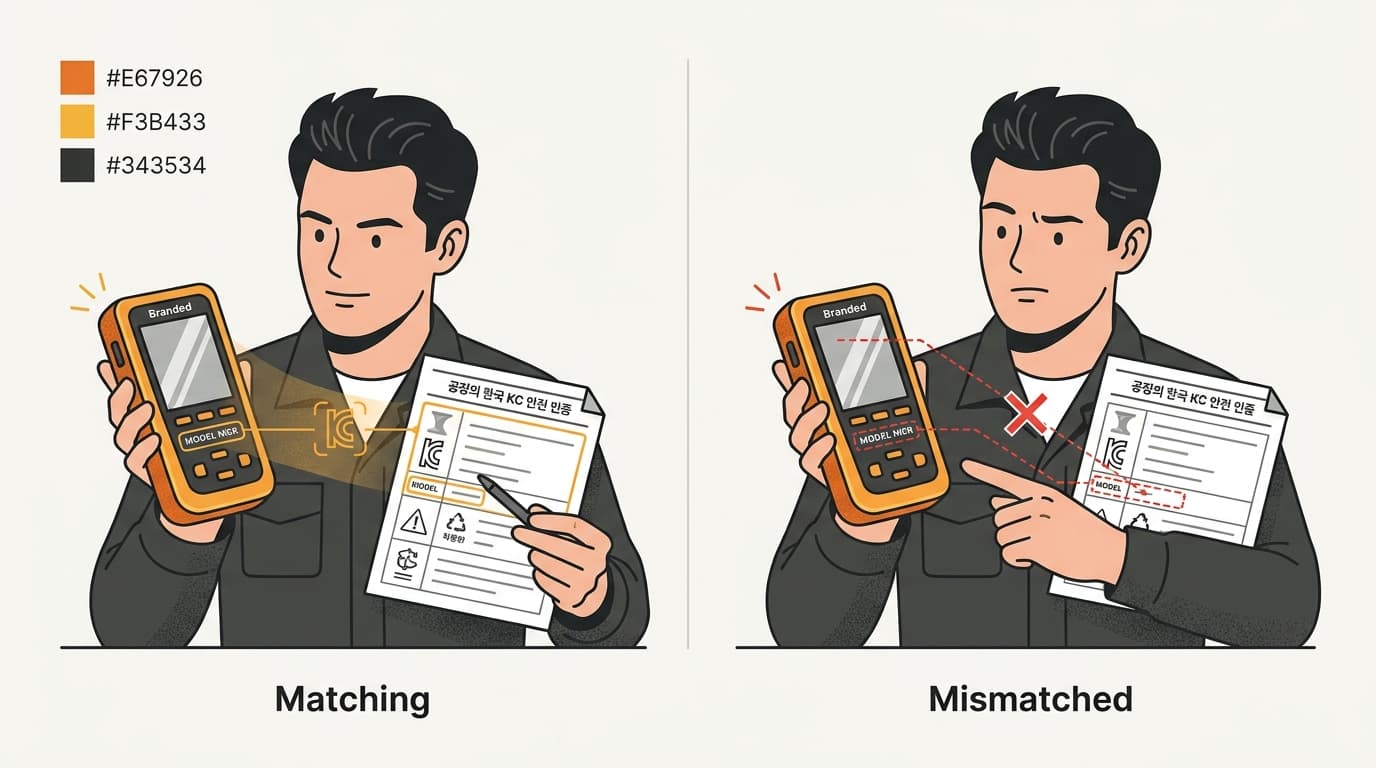
Can a Factory's KC Certificate Cover Your Brand?
Factory KC paperwork covers your private-label product only when the approved model, factory, and version match. Wireless products need a separate RRA check.

Can You Reject a Coupang Exchange? Only Two Reasons
Coupang exchange rejection is limited to SOLDOUT or WITHDRAW. Learn when each code applies—and what to do when a seller simply prefers a refund instead.
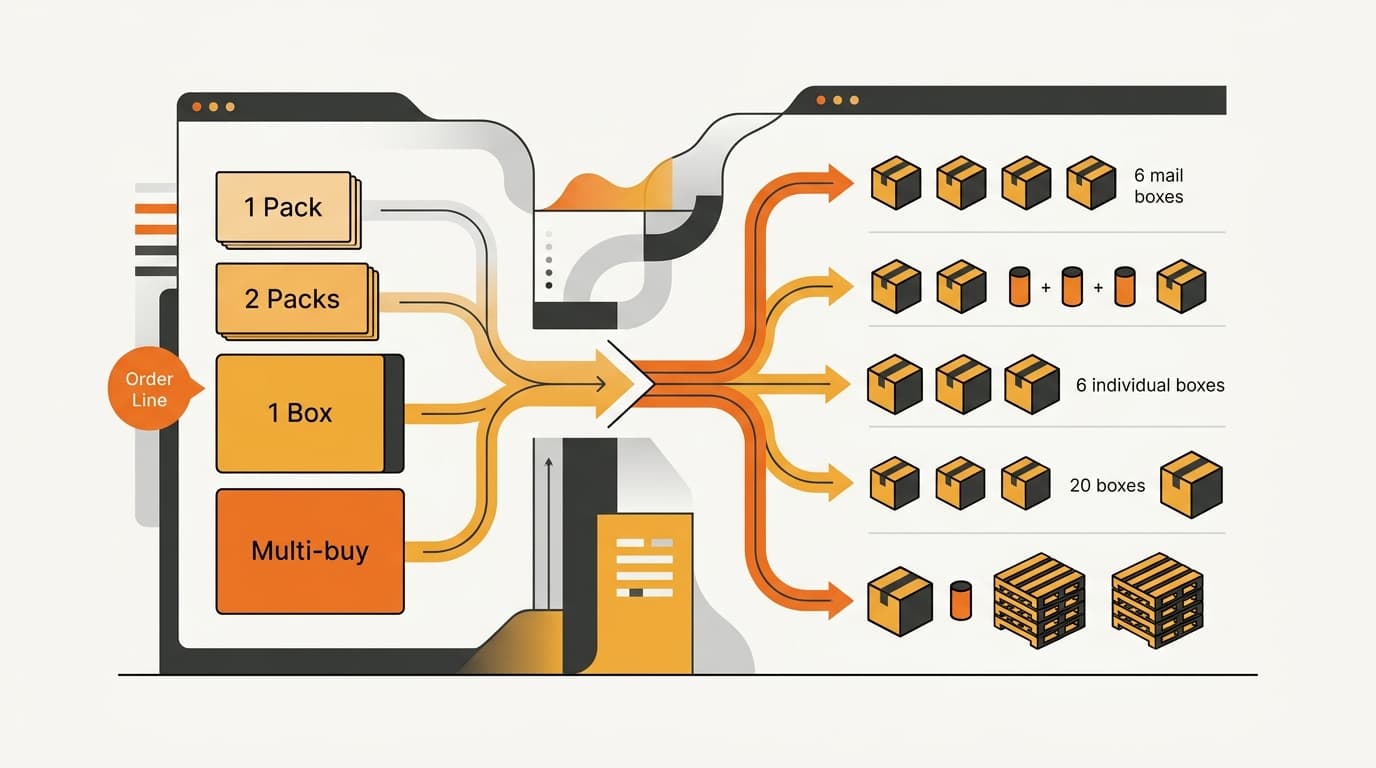
Coupang Order Lines: One Line Is Not One Unit
A Coupang order line can represent a generated quantity option, so your connector must map it to a base SKU and physical quantity before stock movement.