Inbounding EU Cosmetics to Korean 3PL: What Breaks
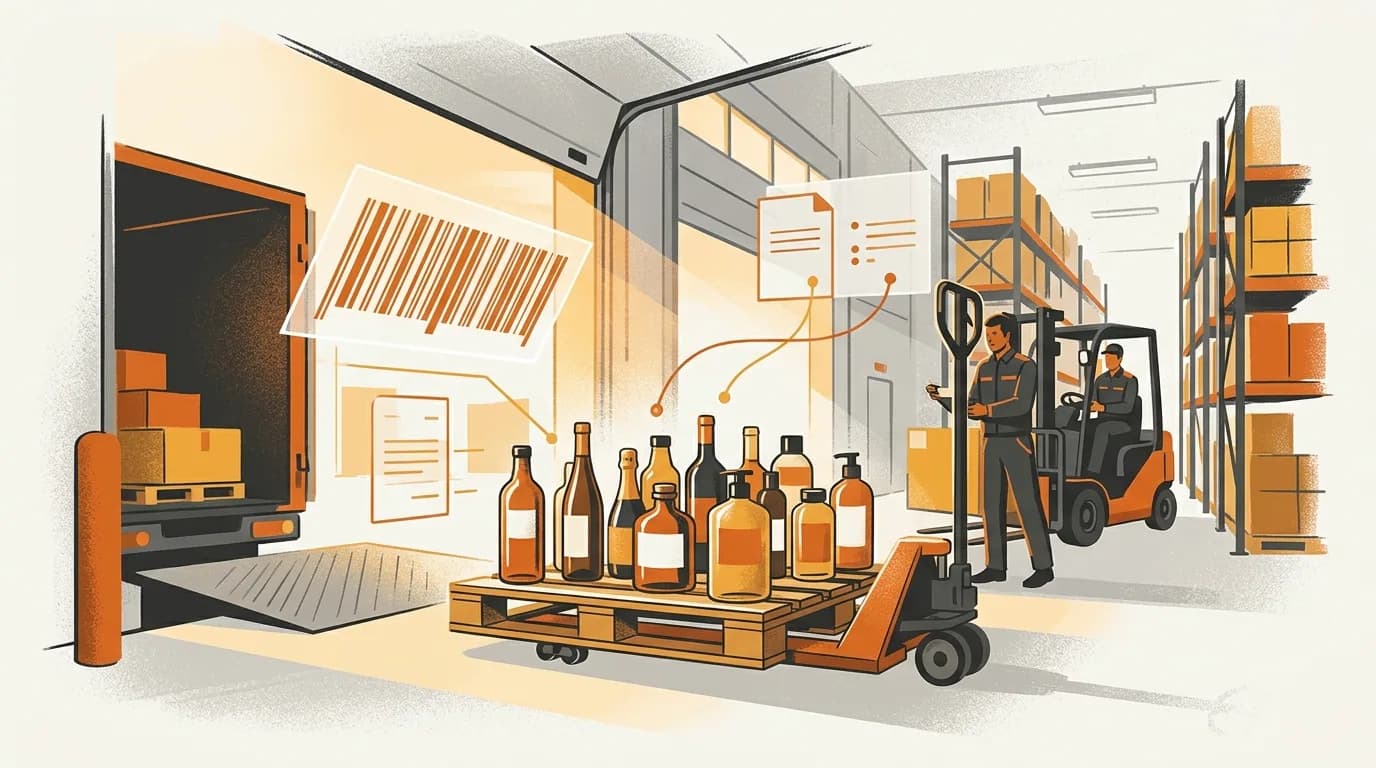
Inbounding European cosmetics to a Korean 3PL warehouse — typically Coupang's Rocket Growth (로켓그로스) — rarely fails at the freight stage. It fails at the warehouse door, where a single missing Korean label, an unregistered barcode, or an unfinished Ministry of Food and Drug Safety (MFDS) record can stop a pallet from being received.
The freight forwarder gets you to Incheon. The compliance work decides whether you can actually sell.
This guide walks through what European cosmetics brands underestimate when moving from cross-border parcels to a real local fulfillment footprint in Korea. It separates the parts that can be solved in weeks from the parts that require local infrastructure you can't shortcut.
Why the 3PL stage is where most plans break
Most top-ranking pages on Korean cosmetics import cover Importer of Record (IoR), VAT, settlement, and KC certification at a generic level. What they tend to skip is the operational reality at the warehouse: a Korean 3PL is not a passive storage facility. Coupang's Rocket Growth warehouse rejects inbound shipments that don't match the registered SKU master, don't carry compliant Korean labels in the correct position on the unit, or arrive before the MFDS import declaration is cleared.
In our experience, the founders who hit this wall hardest are the ones who treated Korea like another European 3PL destination — pack out the carton, book the freight, ship it. Korea is structurally different in three ways:
- The Importer of Record is a regulated role, not a logistics line item. Cosmetics imports require a pre-registered importer with MFDS, and certain product types (whitening, anti-wrinkle, sunscreen, hair dye) trigger Functional Cosmetics (기능성화장품) review that has to be cleared before the goods land.
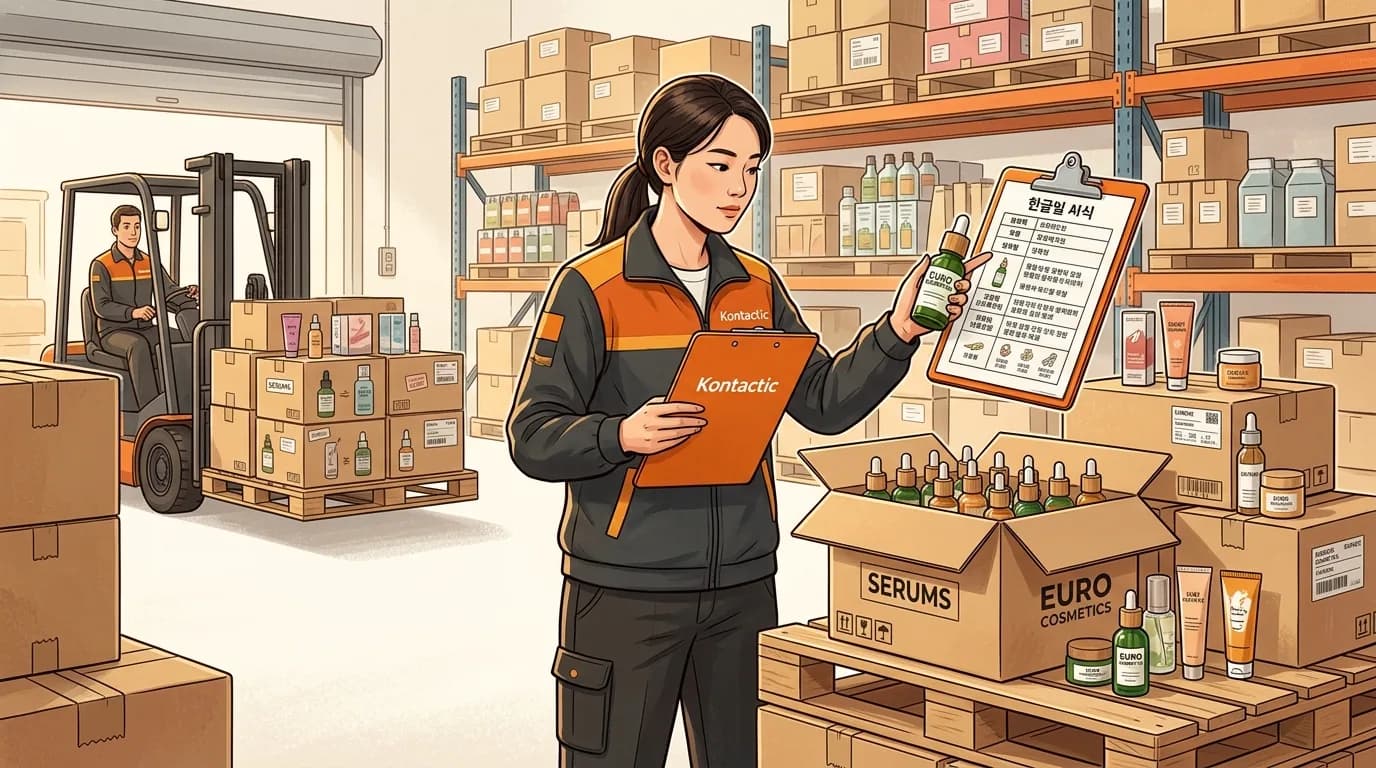
- Korean labeling is physical, not digital. A bilingual export carton is not enough. Every unit needs a Korean ingredient list, importer information, and expiry data printed or stickered on the primary or secondary packaging itself.
- The 3PL inbound is gated by data, not just product. Coupang's warehouse books inbound appointments against a registered SKU with a barcode, dimensions, weight, and batch metadata that has to match the physical pallet.
If any of those three are wrong, the freight arrived but the inventory didn't.
The five gates before a pallet is received
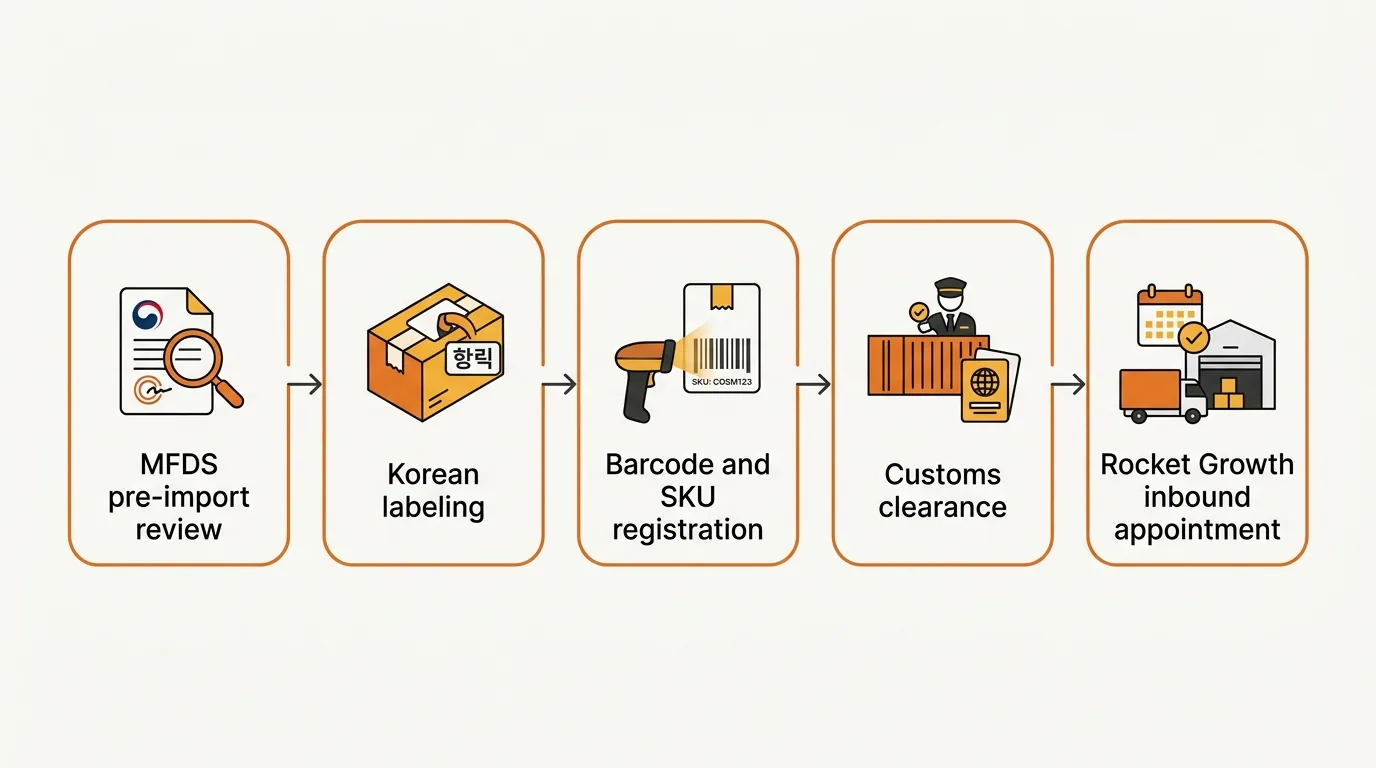
For European cosmetics, there is a predictable sequence between "container leaves Rotterdam" and "units are live on Coupang." Each stage has its own owner and its own failure mode.
1. MFDS pre-import review. The Korean IoR submits an import declaration to MFDS per shipment, against a previously registered product record. For Functional Cosmetics, the underlying registration must already be approved — that is a separate process measured in months, not days. If a brand's hero SKU contains niacinamide above the whitening threshold and was never registered as a Functional product, MFDS won't clear the shipment. The freight sits at the bonded warehouse accruing storage fees.
2. Korean labeling. Every unit needs a Korean-language label that meets MFDS content rules: all ingredients in INCI Korean transliteration, importer name and address, manufacturing or expiry date, volume, and usage cautions. Brands that try to add labels at the Korean warehouse usually discover that 3PLs charge per-unit relabeling and that the operation is slower than they expected. Relabel-on-arrival is sometimes the right answer for a pilot batch; it is rarely the right answer at scale.
3. Barcode and SKU registration. Coupang's Rocket Growth requires each SKU to be registered with a Coupang-issued barcode (or a brand barcode mapped to the SKU) before the inbound appointment can be booked. If the unit barcode is missing, unreadable, or doesn't match the registered master, the 3PL won't receive it. European brands often ship with EAN-13 codes that work fine in the EU but were never mapped on the Coupang side.
4. Customs clearance. Standard import duty plus 10% VAT on cosmetics applies. The IoR pays at this stage, and the cost is the client's economic burden regardless of who fronts it operationally. We have written separately about how funding flows between client, IoR, and operator under different Korea entry models.
5. Rocket Growth inbound appointment. Coupang requires a booked inbound slot. Pallets that arrive without an appointment, or with a packing list that doesn't match the booking, are turned away. The 3PL is optimized for predictable receipt — not for unexpected freight.
What European brands usually underestimate
A few patterns show up in almost every onboarding.
Functional Cosmetics is a category trap. EU formulations that are marketed as "brightening" or "anti-aging" often include actives that Korea regulates as Functional Cosmetics. The EU CPNP notification does not translate. The Korean registration is a separate dossier with Korean stability data requirements, and it gates the whole launch. Brands that learn this after manufacturing their pre-launch inventory either reformulate the marketing or wait.
Korean labels need physical space. The Korean ingredient list is long. For small primary packs (10–30 ml), brands sometimes have to redesign the secondary carton to fit the required text. This is not something a 3PL solves with a sticker. We have seen this delay launches by 6–8 weeks when discovered late.
Coupang's SKU master doesn't tolerate ambiguity. Color variants, volume variants, and limited editions each need separate SKU records, separate barcodes, and separate inbound lines. Brands used to managing variants as attributes on Shopify find this rigid. It is.
The IoR is responsible to the regulator, not to your timeline. Your IoR partner will not file a Functional Cosmetics dossier on a rushed schedule because the regulator's clock is the regulator's clock. If your launch plan assumes a 4-week MFDS approval, the plan is wrong. See our breakdown of how cosmetics IoR and Responsible Person services are scoped and priced for what the IoR partner is — and isn't — accountable for.
“Freight to Korea is the easy part. The hard part is making sure the pallet matches the data Coupang's warehouse expects to see before they'll receive it.”
Kontactic operations team — Korea commerce operations
What can be done fast vs. what needs full local infrastructure
Founders comparing entry paths often ask the wrong question — "agency or in-house?" The more useful question is: which parts of the inbound flow can be stood up in weeks, and which parts require a Korean entity, a Korean bank account, and a registered local presence?
Fast (weeks, not months):
- Cross-border parcel sales to validate demand. Useful for SKU and price testing before committing to a Korean warehouse.
- Korean PDP and listing translation. The Product Detail Page is a 20,000-pixel vertical conversion asset — it can be produced in parallel with compliance work.
- Coupang seller onboarding under an IoR/SoR partner's account. Brands without a Korean entity can begin selling under a partner's Seller of Record arrangement.
Medium (1–3 months):
- Korean labeling redesign and reprint.
- Standard (non-Functional) cosmetics MFDS product record registration through the IoR.
- Initial Rocket Growth SKU registration and inbound planning.
Slow (3+ months, sometimes 6+):
- Functional Cosmetics review for any whitening, anti-wrinkle, or sunscreen claims.
- Setting up your own Korean limited company (유한회사), opening a corporate bank account, and becoming your own IoR/SoR. We have written about why Korean corporate bank accounts are the hardest step for foreign-owned entities.
- Negotiating Coupang account-level terms that depend on a Korean entity's track record.
The practical implication: most European cosmetics brands do not need to choose between "cross-border forever" and "full Korean entity day one." A staged path — cross-border to validate, IoR-led local launch on Coupang to scale, own entity when volume justifies it — almost always beats trying to land in Korea fully integrated on the first try.
For a side-by-side comparison of these three models, see our piece on agency vs. IoR vs. own entity for Korea skincare entry.

A decision framework for the next 90 days
If you are a European cosmetics brand evaluating a Korean 3PL move right now, the questions worth answering — in order — are:
- Are any of your hero SKUs Functional Cosmetics in Korea? If yes, that registration drives the whole calendar. Start there.
- Is your current packaging large enough to carry a Korean label? If no, build the redesign timeline into your launch plan before booking freight.
- Do you have a Korean IoR partner who can also act as Seller of Record on Coupang? If yes, you can launch without forming a Korean entity. If no, the non-entity IoR path is worth examining before you commit to incorporation.
- What is your real first-12-month volume forecast? Coupang's settlement and platform fee structure means low-volume launches are unforgiving on margin. Our analysis of Coupang's recent policy changes affecting Rocket Growth margins is the honest version of what the unit economics look like in 2025.
- How are you getting product to Korea? For brands also using a Chinese contract manufacturer, Coupang's Direct LCL service from China is worth comparing against standard ocean LCL.
The short answer for most European cosmetics founders we work with: the 3PL move is achievable in a few months if the compliance and data work starts before the freight is booked. It is painful when the order is reversed.
Planning a Korean 3PL launch for your cosmetics brand?
If you are weighing cross-border vs. local fulfillment, or scoping an IoR-led Coupang launch, we can walk through the compliance and inbound timeline against your specific SKUs. Talk to the Kontactic team.
About the author
Korean and global e-commerce operators with 15+ years of cross-border experience, led by CEO Isaac Lee — KOTRA-certified consultant and official lecturer for Seoul City and the Korea Customs Service. We run Korea market entry for Western brands every day; this blog documents what we learn in the field.
More about Kontactic →Related Articles

Children’s Product KC: Does “Ages 13+” Avoid the Rules?
No. In Korea, “Ages 13+” is only one factor; design, intended use, packaging, and child-directed marketing can still trigger children’s-product KC rules.

Korean KC for a Detachable Device Charger: Not Automatic
Does Korean KC cover a detachable charger? Not automatically. The final bundle and adapter evidence must match the Korean commercial SKU before import.

Can Coupang Handle Every Korean Buyer Inquiry? No—Seller Duties
Coupang may handle platform and fulfillment contacts, but sellers still own product questions, cancellations, returns, exchanges, and order exceptions.