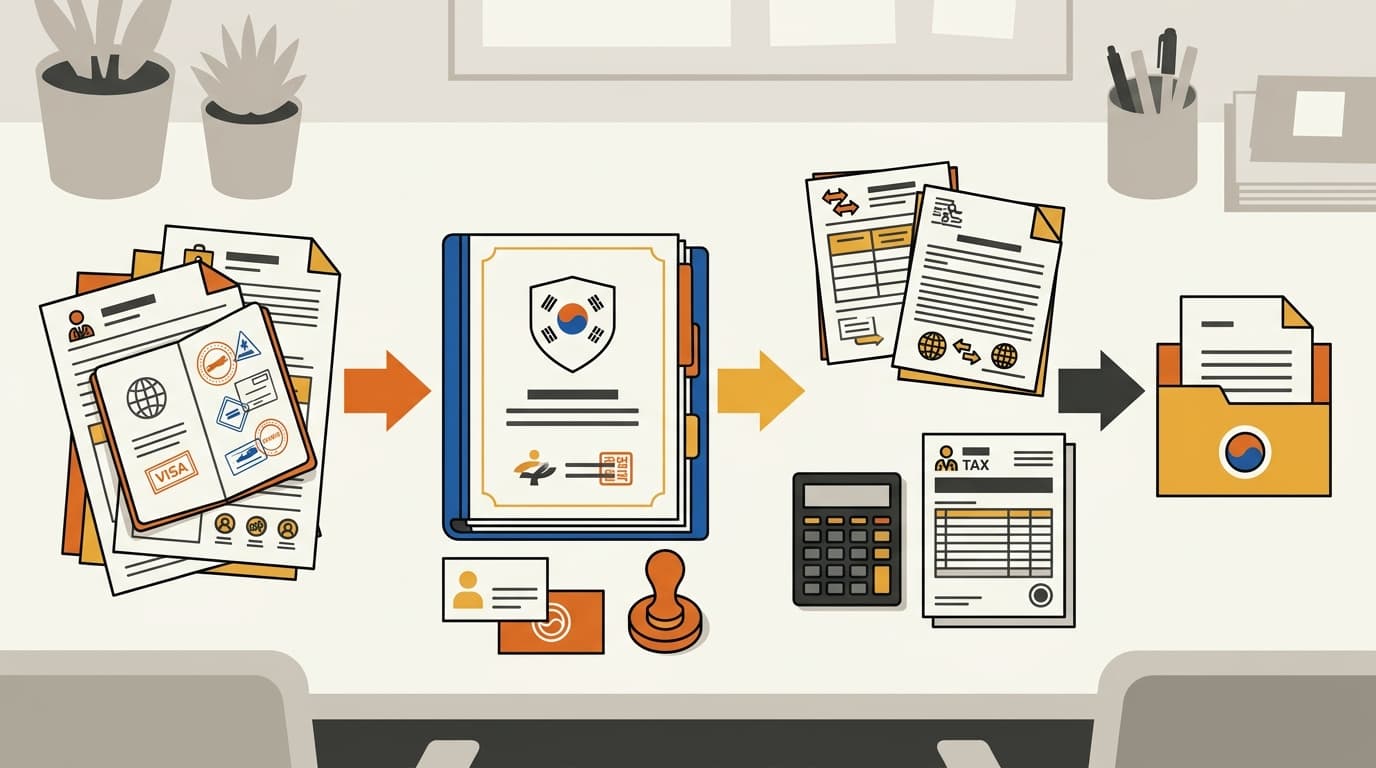
How Representative Documents Support Korean Filing Work
Kontactic Seller Center turns representative documents into Korean administrative work. It captures identity and passport evidence in relevant corporate records, translates contracts and administrative documents for Western headquarters, and routes delegated local-tax and import-license work as operational tasks. The process moves from submitted evidence to record updates and local action rather than stopping at a file upload.
An operational paperwork layer keeps the relationship between evidence, corporate records, translation, and delegated Korean actions visible as one workflow. It treats documents as inputs to administrative work, not as the end product.
The bottleneck is coordination, not the existence of a document
A brand going local in Korea rarely lacks documents in the abstract. The harder problem is coordinating the right evidence with the right corporate record and the right local action.
A packet may include representative identity information, passport evidence, contracts, and other administrative documents. Headquarters may hold one version while a local operator is working from another. The representative may have changed, or a document may need translation before review. A filing question can remain unresolved when nobody links it to the supporting file that answers it.
A file repository can tell you that something was uploaded. It does not, by itself, answer four operational questions:
- What information does this document establish?
- Which corporate record should reflect that information?
- Who needs to review or understand it?
- What local administrative action follows?
That distinction becomes important after incorporation or during a handover. Korean entity administration continues after setup, so representative information and administrative evidence need to remain usable after the initial registration work is finished. Seller Center’s paperwork layer is designed around that ongoing coordination problem.
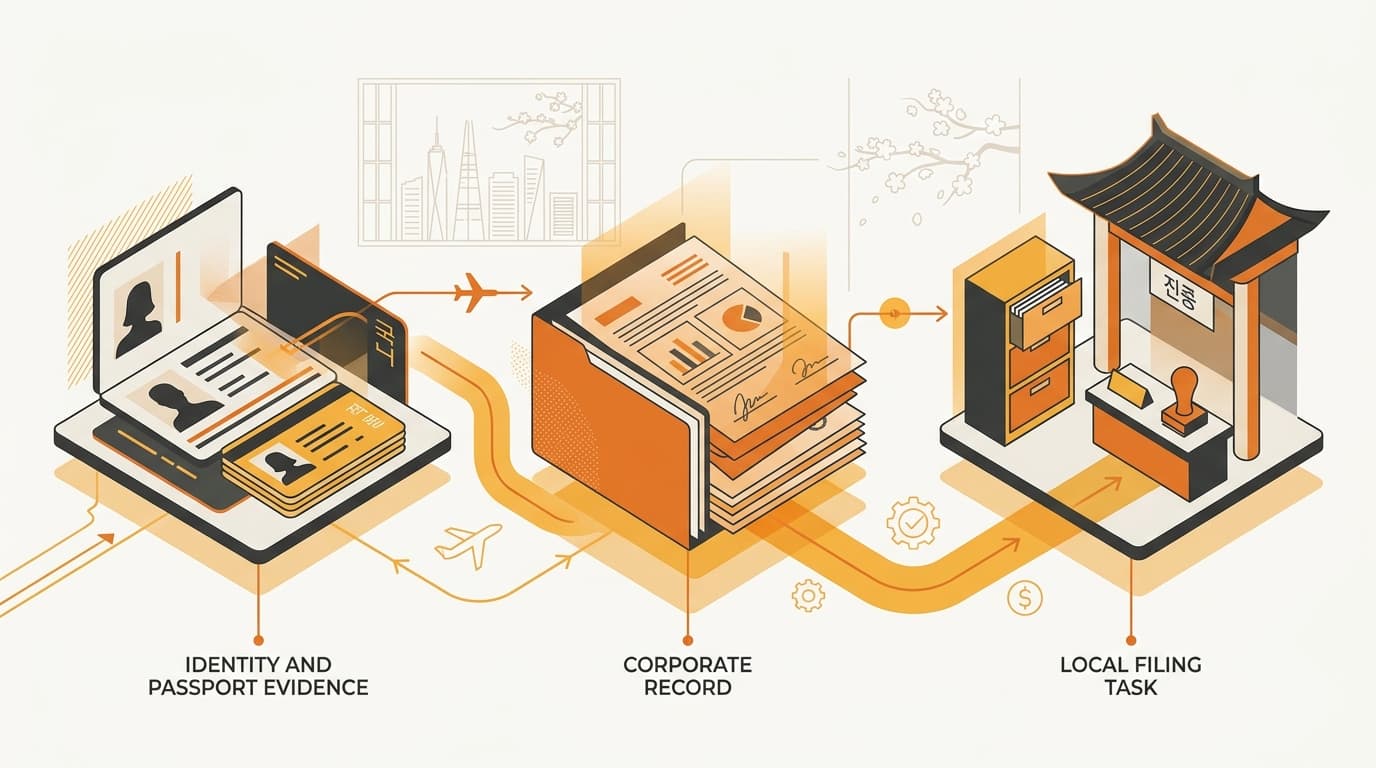
A packet can move through five operational stages
The capability is easiest to understand by following one representative-document packet from submission to delegated action. The exact contents will vary by brand, but the operating path is consistent:
- Submit the packet. Representative identity and passport evidence, contracts, and administrative documents enter the workflow as source material.
- Capture the relevant information. Document extraction reads usable representative information into the relevant corporate records instead of leaving it only inside an attachment.
- Prepare it for review. Contract and administrative document translation gives Western headquarters a way to review Korean-language materials without running every Korean-language step itself.
- If needed, resolve an extraction issue. If the system encounters a problem reading the packet, the workflow points to the most informative supporting file so the correction request has context.
- Move the local work forward. Delegated Korean local-tax and import-license actions are handled as operational tasks, not merely stored as uploaded documents.
The value is in the connection between these stages. A record update without its source evidence is difficult to review. A translated document without a next action can sit indefinitely. A filing task without the right supporting file creates another round of questions between headquarters and the local operator.
This is also why the paperwork layer is different from asking a team to maintain a shared folder. The packet is not treated as a static bundle. Its contents are used to update the operating record, support review, identify a correction, and progress delegated work.
Representative evidence becomes a usable corporate record
Representative information is treated as structured operational data. The workflow extracts identity and passport information into the relevant corporate records. The source file remains available as supporting evidence, while the extracted information becomes a usable operating reference.
That matters because a document and a record serve different purposes. The document is the evidence. The record is the working reference that helps an operator understand who the current representative is and which administrative work depends on that information. Keeping those two connected makes review easier without pretending that the record replaces the evidence.
It also gives headquarters and local operators a common reference point. Headquarters can review the source packet, while the local side can work from the corresponding corporate information instead of reconstructing it from an email thread. During a handover, this reduces the chance that the incoming operator starts with an outdated name or an unexplained attachment. The same principle is central to aligning a Korean entity handover across records and documents.
The distinction between evidence and authority is important here. A representative document may identify a person, but the document still has to be matched to the record or action for which it is relevant. Importer-related work is a useful example: a power of attorney is not by itself Korean importer registration. The paperwork layer helps keep that supporting evidence in the operational context where it needs to be reviewed.

Translation keeps headquarters in the review loop
Contract and administrative document translation serves a practical purpose: it makes Korean-language paperwork reviewable by the Western headquarters responsible for the brand and its operating decisions.
That is different from translating every interaction into a separate headquarters-led process. The local operator can continue handling the Korean-language administrative path, while headquarters receives material it can inspect and discuss. The result is a clearer division of work: local execution can remain local, but the underlying documents do not become opaque to the brand owner.
Translation is therefore part of the administrative workflow, not a decorative add-on. It helps headquarters confirm that the document is the expected version and that the named representative matches the corporate record. It also shows whether the material is ready for the next review or delegated action. It does not turn an unclear source file into a confirmed filing; it gives the people responsible for review a usable way to examine what was submitted.
Delegated actions are where paperwork becomes operations
The final distinction is between storing a document and progressing the work that document supports. A local-tax or import-license document sitting in an upload area is evidence waiting for interpretation. A delegated local-tax or import-license action is an operational task that can be taken forward by the local operator.
That difference changes the handoff for both sides:
- For headquarters, the packet is not lost after submission. The brand can review translated materials and understand that the relevant local work has a defined place in the operating workflow.
- For the local operator, the action is not detached from the evidence. The supporting document and the corporate information it informs remain part of the same administrative context.
- For correction work, an extraction issue is not reduced to a vague request to try again. The workflow points to the most informative supporting file, making the next request more actionable.
The correction path is a small but important part of the capability. Document packets often contain several files that look similar from a distance. When extraction encounters an issue, identifying the file most likely to clarify the missing or unreadable information gives the operator a narrower place to investigate. The correction can focus on the source that matters instead of restarting the entire packet.
The result is not an assertion that every Korean filing is completed by uploading a document. The useful change is more precise: evidence can be read into the relevant record, made reviewable through translation, and connected to delegated local-tax or import-license work. That is the operational layer between a headquarters inbox and a Korean filing action.

Common questions about the paperwork layer
Does Seller Center replace the original representative documents?
No. The original identity, passport, contract, and administrative documents remain the supporting evidence. The capability makes relevant information usable in corporate records while keeping the source packet available for review.
Does document translation complete a Korean filing?
No. Translation supports Western headquarters’ review of Korean-language contracts and administrative documents. Delegated local-tax and import-license work remains a separate operational action.
What happens when representative information cannot be extracted cleanly?
The workflow points to the most informative supporting file. That gives the correction request a specific source to inspect instead of leaving the operator with an unqualified request to fix the packet.
Does uploading a document automatically complete a local-tax or import-license requirement?
No. The purpose of the operational task is to move the delegated work forward, not to imply that an upload alone satisfies every local requirement. Evidence, record updates, review, and filing action remain connected but distinct steps.
Why not handle the packet by email?
Email can transfer files, but it does not reliably preserve the relationship between the current representative, the relevant corporate record, the translated review material, and the local action. The paperwork layer keeps those relationships available to the people progressing the Korean operation.
Make Korean administrative work easier to progress
If your brand is moving from cross-border demand to a Korean operating structure, contact Kontactic to discuss how representative records, document review, and delegated local actions can fit into the launch workflow.
About the author
Korean and global e-commerce operators with 15+ years of cross-border experience, led by CEO Isaac Lee — KOTRA-certified consultant and official lecturer for Seoul City and the Korea Customs Service. We run Korea market entry for Western brands every day; this blog documents what we learn in the field.
More about Kontactic →Related Articles
Coupang Settlement Periods: How Kontactic Reconciles
Kontactic closes Coupang settlement periods by confirming allocations, checking bank evidence, and keeping FX differences and late corrections visible.
Korean Entity Administration: What Happens After Setup?
Incorporation is the start for a Korean entity. See how Kontactic Seller Center stages renewal reminders and routes local-tax and import-license document work.
Korea Launch Roadmap: Kontactic’s Brand-Specific Plan
A Korea launch roadmap should reflect the brand, while Kontactic Seller Center turns scope, evidence, dependencies, and progress into one shared plan.