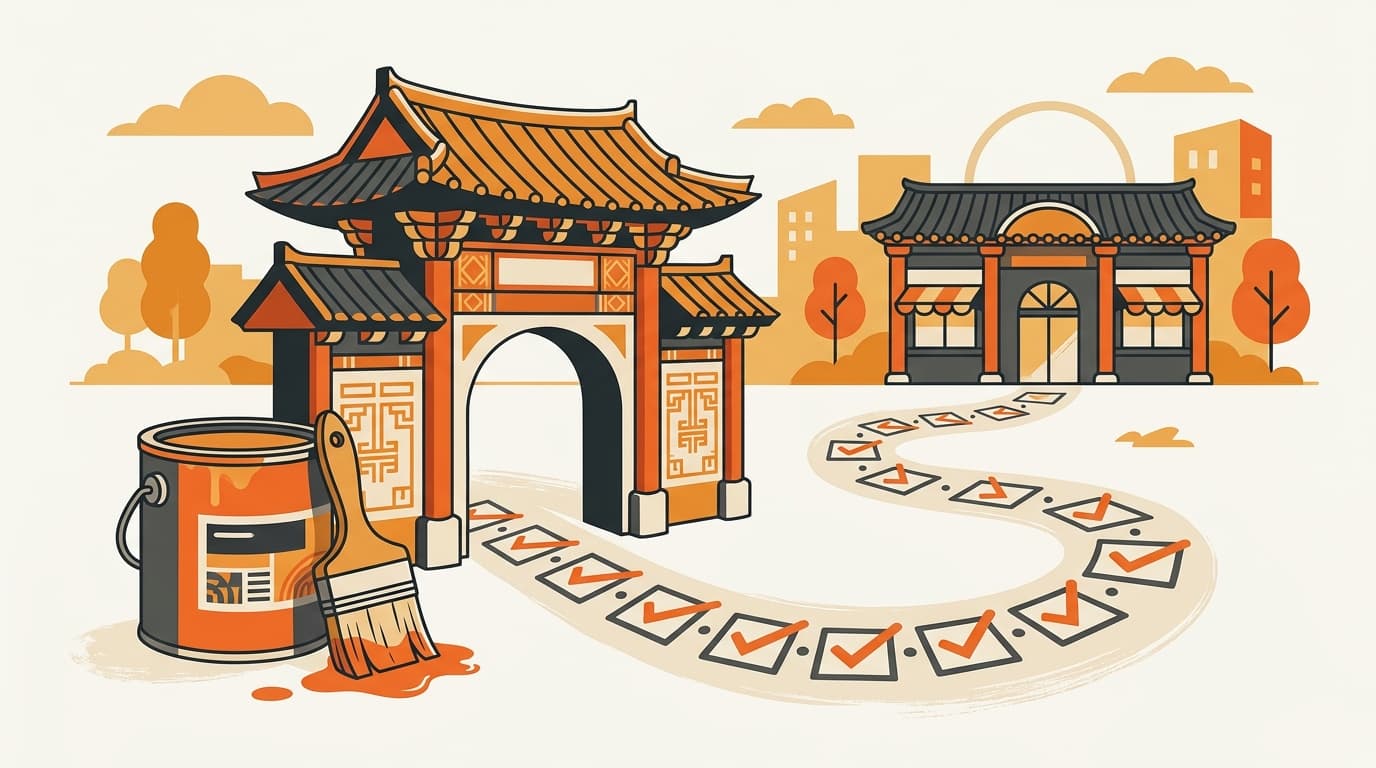
Do You Need KC Certification to Sell Paint in Korea?
The short answer is: it depends on the specific paint, and you should treat the KC question as a scoping exercise rather than a yes/no. KC certification (KC 인증) is a category-specific mandatory safety certification, and Korean customs verifies it during clearance for products that fall under its scope. Whether your particular paint is in scope turns on its formulation, hazard classification, and intended use — so the real first step is to confirm where your product sits before you spend on testing or freight.
That answer is less satisfying than "yes" or "no," but it is the honest one. And it points to the bigger mistake we see foreign brands make: they treat KC as the whole compliance project, when in practice it is one early gate in a longer launch sequence. This guide keeps the useful KC basics, then covers the parts most KC explainer pages skip — how you actually get paint to a Korean customer and sell it.
What KC certification actually is — and how to check paint
KC certification is Korea's compulsory product safety mark. Products that fall under its scope cannot be cleared through customs or legally sold without a valid KC certification number, and authorities can penalize non-certified products found on the market. That much is consistent across every certification body's explanation of the system.
The harder question is scope. KC is not one list — it is a family of regimes covering electrical and electronic products, household goods, children's products, and other regulated categories, each administered under its own law and standard. For paint, the classification work matters more than the marking work. A decorative wall paint, an industrial coating, a spray product in a pressurized can, and a children's craft paint can land in very different regulatory buckets — and some of those buckets pull in chemical-substance and hazardous-material rules that sit outside the KC safety scheme entirely.
Do not assume your product's certification status from a competitor's listing. Korean marketplaces are full of items sold under the wrong category or by sellers who simply have not been caught yet. Confirm scope against the actual Korean standard for your product's HS code and formulation before you commit budget.
The compliance landscape is also tightening, not loosening. Starting April 2025, AliExpress began enforcing KC requirements in its K-Venue marketplace by blocking the sale of non-certified products — including electrical and electronic products, household goods, and other regulated items. The direction of travel is clear: marketplaces are being pushed to verify certification at listing time, not just at the customs dock. If you are reading this to decide whether you can skip the question, the trend says no.
For the underlying mechanics of how the certificate, your seller status, and your fulfillment model interact, our explainer on how KC certification, entity, and Rocket Growth actually interact is the companion to this piece. And if your paint turns out to involve more than one regime — for example a powered dispenser or a children's product — it is worth seeing how multi-certification products work in practice in our breakdown of the three separate certifications a grill needs to sell in Korea.
Where compliance fits in the launch sequence
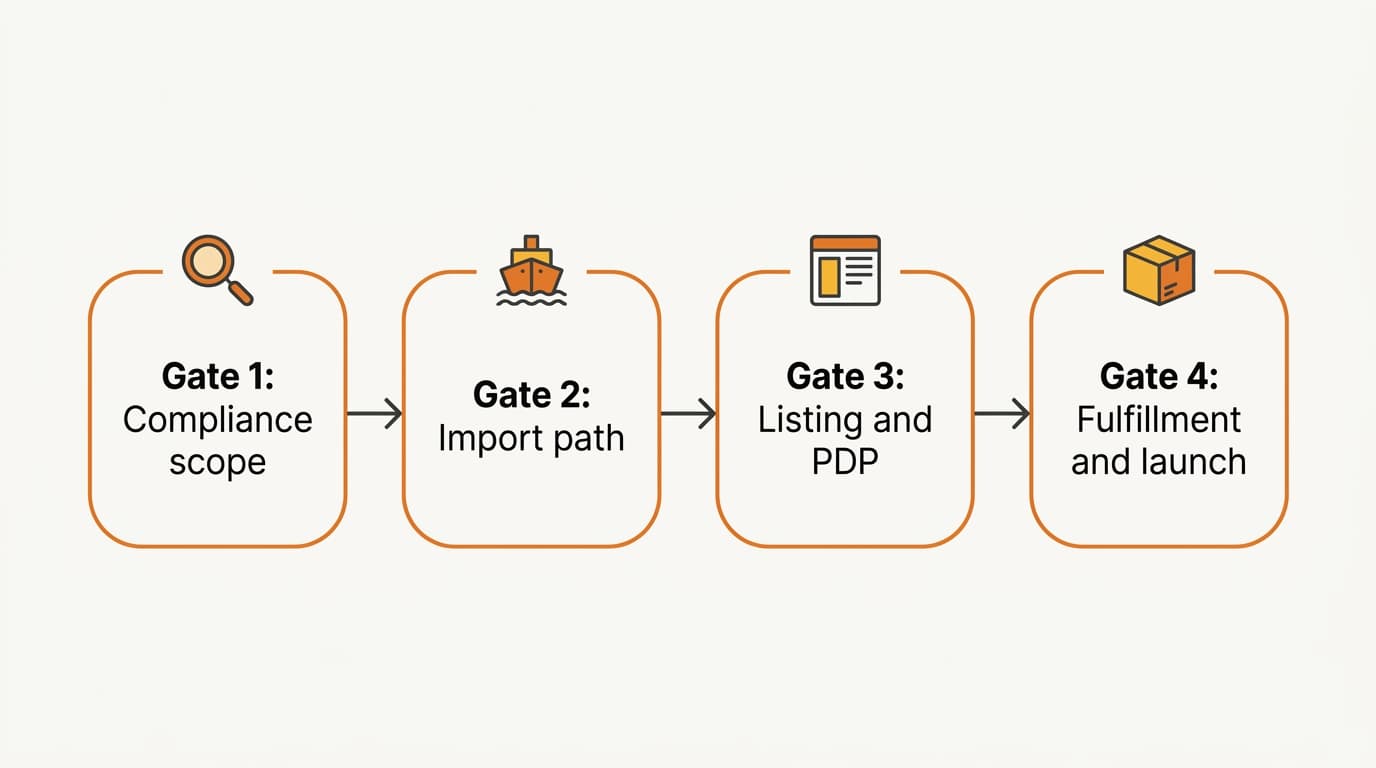
Here is the framing that most KC pages miss. Compliance research is Gate 1 of four. It is necessary, but passing it does not put a single unit in front of a Korean buyer. We think about Korea entry as four gates, run roughly in order:
- Gate 1: Compliance scope — confirm whether your paint requires KC certification (or another regime), and what the standard demands.
- Gate 2: Import path — decide who imports the goods as Importer of Record and who sells them as Seller of Record.
- Gate 3: Listing and PDP — build the Korean-language product page that actually converts.
- Gate 4: Fulfillment and launch — get inventory into the channel's warehouse, set returns handling, and sequence marketing.
Brands that fund Gate 1 and then stall on Gate 2 end up with a certified product they cannot sell. Brands that run paid acquisition into a page that does not convert waste 70–80% of ad spend on visitors who leave without adding to cart. The sequence is the point — and we have written separately on why operational readiness should come before ad spend.
Cross-border versus local: the path that decides everything
Before you sink money into KC testing, settle the path. There are two broad ways to reach a Korean buyer, and they change who bears the compliance obligation.
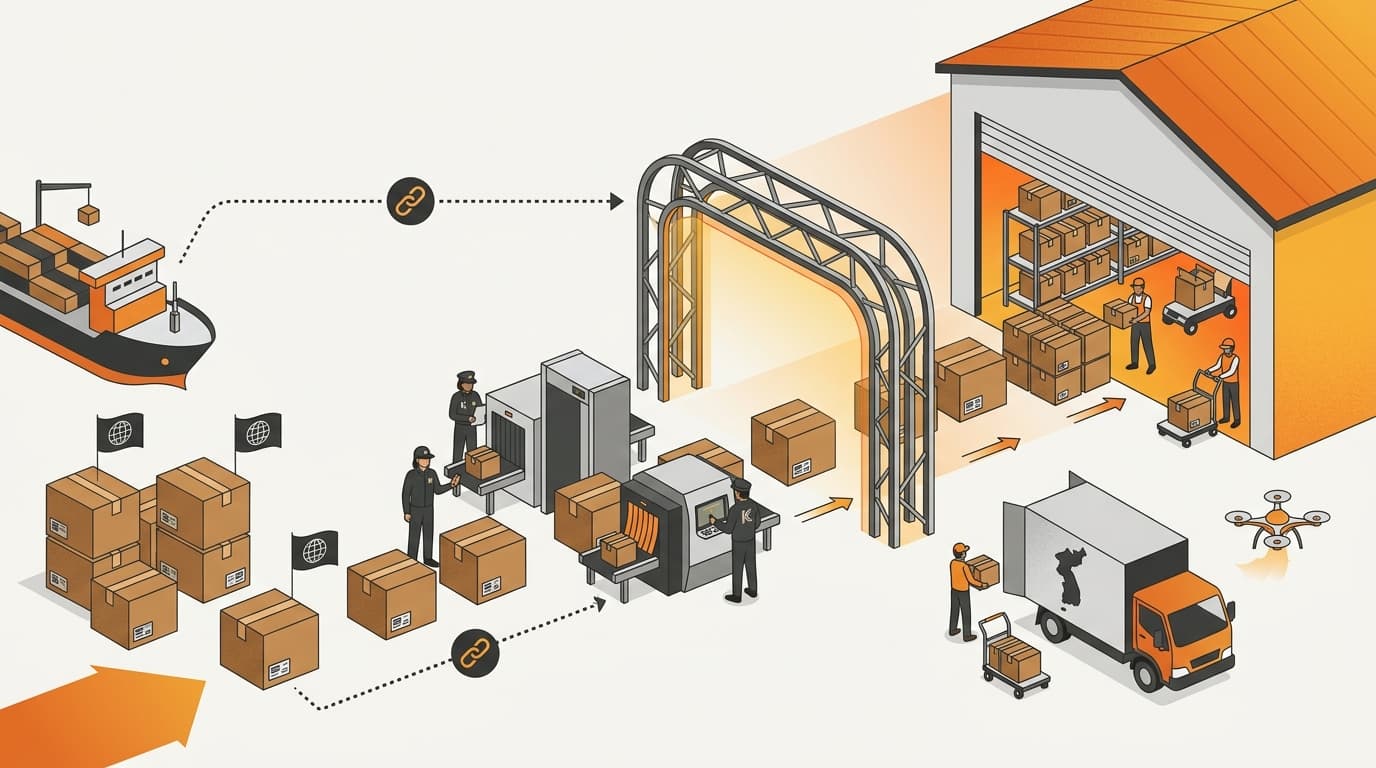
In a cross-border model, the Korean consumer is often the importer of record on their own small parcel, and the order clears under personal-import rules. This validates demand cheaply, but it caps you: per-order freight is high, delivery is slow, and you are invisible to the local marketplace search and review systems that drive Korean purchasing. For the trade-offs in detail, see our operator's decision framework on Rocket Growth versus cross-border selling.
In a local model, a Korean entity imports the goods commercially, holds inventory in-country, and sells in KRW on Coupang with fast domestic delivery. This is where KC certification becomes unavoidable if your product is in scope — because now a commercial Importer of Record is clearing pallets through customs, not a consumer clearing a single can.
That importer can be your own Korean entity or a partner's. Under Kontactic's Spark tier, our own Korean entity (Inuf Co., Ltd., d/b/a Kontactic) acts as both the Importer of Record and the Seller of Record, so you can sell locally without forming a company first. Under the Flame and Blaze tiers, you operate through your own Korean limited company (유한회사) and Kontactic runs entity administration and commerce operations on top. Each tier puts the inventory, ad, and platform costs on you — we have mapped exactly who pays for what across Spark, Flame, and Blaze.
KC scope and import path are coupled decisions. A product that is borderline on KC scope under personal cross-border import can become squarely in scope the moment a commercial entity imports it for resale. Decide the path first, then scope the certification against that path.
One more practical note: all inbound inventory to Korea in these models ships DDP (Delivered Duty Paid), meaning you bear freight, insurance, duties, and import taxes to the door. That includes Korea's 10% VAT.
The Korean PDP: a design problem, not a translation problem
Suppose your paint clears Gate 1 and Gate 2. You are certified and importing locally. You still have nothing that sells, because a Korean buyer will not convert on a translated Amazon listing.
Korean e-commerce runs on the Product Detail Page (PDP) — a full-length, image-heavy page roughly 20,000 pixels tall, built as a rich-media graphic design deliverable rather than a block of text. For paint specifically, this page has to do real work: show true color under different lighting, demonstrate coverage and finish, communicate VOC and safety credentials, and answer the questions a Korean buyer asks about a product they cannot touch before buying. A machine-translated spec sheet does none of that.
This is why we treat localization as a conversion discipline, not a language task. Our guide on how to localize product pages for Korean e-commerce walks through why the PDP sits downstream of your entity, KC, and channel decisions — and why it is the lever that most often separates a listing that gets traffic from one that gets orders. In the Spark tier, a standard text-based localized Product Listing is included; the full conversion-optimized PDP is an optional add-on, and for a visual category like paint it usually earns its keep.

Rocket Growth, fulfillment, and the returns math
Once the page converts, fulfillment decides your margin. Most foreign brands selling locally on Coupang use Rocket Growth (로켓그로스), Coupang's third-party logistics service that handles warehousing, fast delivery, and returns processing. It is what makes the Rocket badge — and the fast shipping Korean buyers expect — possible.
Two things to plan for with paint. First, inbound logistics: Rocket Growth will accept inventory at low minimums, but the real lead time sits upstream in your entity, KC, and IoR work, not at the warehouse dock — a pattern we detail in our piece on Rocket Growth inbound minimums and real lead times. Second, returns. Paint is a category where returns can be costly and where damaged or opened units are hard to resell. Coupang has tightened the economics here, and the three 2025 policy changes that reset Rocket Growth margins — return fees, an evidence threshold, and a shifted burden of proof — are worth modeling before you set price.
In practice, this is where the line items stack up: platform commission, Rocket Growth storage and fulfillment fees, returns handling, and the 10% VAT on top of your landed DDP cost. None of that shows up in a KC certification quote, which is exactly why KC is the wrong place to anchor your budget.
Marketing and launch sequencing
The last gate is the one brands are most tempted to pull forward. Do not run paid acquisition into a page that does not convert or a catalog that is out of stock. Marketing on Coupang — PPC and off-site campaigns, review seeding, conversion optimization — is the growth layer (Layer 3 in Kontactic's Blaze tier), and it amplifies whatever foundation you have built. If the foundation is shaky, it amplifies the leak.
A sensible sequence for a paint brand looks like this: confirm KC scope, lock the import path, build the PDP, get inventory into Rocket Growth with a returns plan, then turn on marketing once the listing has its first reviews and a stable in-stock position. The compliance question that brought you here is real and important — but it is the opening move, not the finish line.
Scope your paint's KC requirement before you spend
Tell us your product's formulation and intended use, and we'll confirm where it sits on KC and what a realistic local launch on Coupang looks like — import path, PDP, and fulfillment included.
About the author
Korean and global e-commerce operators with 15+ years of cross-border experience, led by CEO Isaac Lee — KOTRA-certified consultant and official lecturer for Seoul City and the Korea Customs Service. We run Korea market entry for Western brands every day; this blog documents what we learn in the field.
More about Kontactic →Related Articles
Can You Delay Korea Import Duty on Consignment Stock?
No. Korea import duty and import VAT are normally assessed when consignment stock is cleared for domestic circulation, not when a Korean customer buys one unit.

Children’s Product KC: Does “Ages 13+” Avoid the Rules?
No. In Korea, “Ages 13+” is only one factor; design, intended use, packaging, and child-directed marketing can still trigger children’s-product KC rules.

Korean KC for a Detachable Device Charger: Not Automatic
Does Korean KC cover a detachable charger? Not automatically. The final bundle and adapter evidence must match the Korean commercial SKU before import.