Can a Coupang Open API Connector Renew Its Key? Use WING
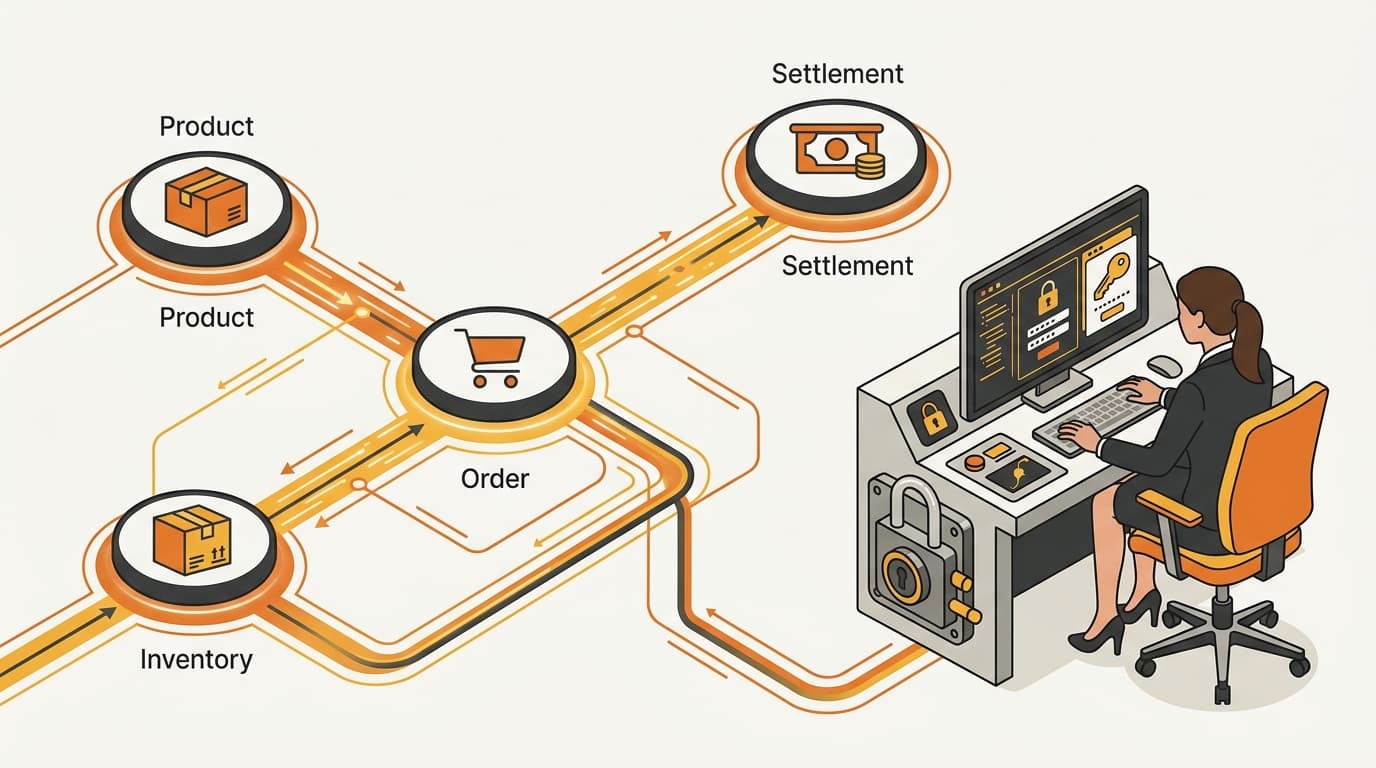
A Coupang Open API connector cannot issue or reissue the seller-account credentials it uses. Coupang puts those actions in WING, the seller console. The connector can automate catalog, order, inventory, and settlement workflows after authentication, but a WING owner must manage rotation and recovery.
That is the practical build-versus-buy boundary. A connector can remove repetitive data work without becoming the authority for the seller account. If procurement treats those as the same thing, it can approve an integration that works today but has no defined owner when its credentials need attention.
Short answer: Treat the API key as an account-control dependency, not as another data object your integration can manage. Your system can call endpoints; a person with the correct WING access must manage issuance and reissue.
The API automates commerce data, not seller-account authority
A useful way to assess a Coupang integration is to separate the data plane from the control plane. The data plane is the work the connection performs with an existing credential. The control plane is the account authority that makes the connection possible and keeps it usable.
| Layer | What a connector may handle | What still needs an accountable owner |
|---|---|---|
| Business data | Product or catalog sync, order retrieval, inventory updates, and settlement workflows, depending on the connector’s scope | Mapping decisions, exception handling, and confirmation that the workflow matches the seller’s operating rules |
| Credential lifecycle | Sending authenticated API requests with the current seller-account credentials | Issuance and reissue in WING |
| Runtime access | Scheduled jobs, logs, alerts, and failed-request handling | Stable outbound access, response to a blocked server IP, and any required WING intervention |
A successful product sync proves only that the credential worked for that request. It does not prove that the integration can create a replacement credential, see the expiry state, or act when WING requires account-level action. Those are separate capabilities and should be listed separately in a technical evaluation.
Keep data-plane jobs separate from credential ownership; catalog uploads, price-and-stock calls, and shared seller-ID design belong in their own operational discussions, covered in Can Coupang Open API Upload Product Catalogs?, Why Coupang Needs Separate API Calls for Price and Stock, and Coupang Open API: Can Two Systems Share One Seller ID?.
For a Western brand going local in Korea, this separation is especially useful during vendor selection. Ask for separate business-workflow and credential-workflow diagrams, including who uses WING, who receives alerts, and who deploys the replacement.
If a proposal shows only the first diagram, it has not yet explained how the connection will be operated.

Key issuance and reissue stay inside WING
Coupang’s official Open API developer documentation is the right primary source for the API’s authentication and request behavior. For the account-side action, check the WING seller console and its current help or FAQ. The important boundary is consistent: the API consumes seller-account credentials, while documented issuance and reissue happen in WING, not through an Open API call.
That means a running connector cannot use its existing API session to ask Coupang for a new key. It can detect a problem, report a failed request, and—if designed for it—help an operator update the stored secret. It cannot turn those signals into WING authority. The person or team with the correct seller-console access remains part of the integration design.
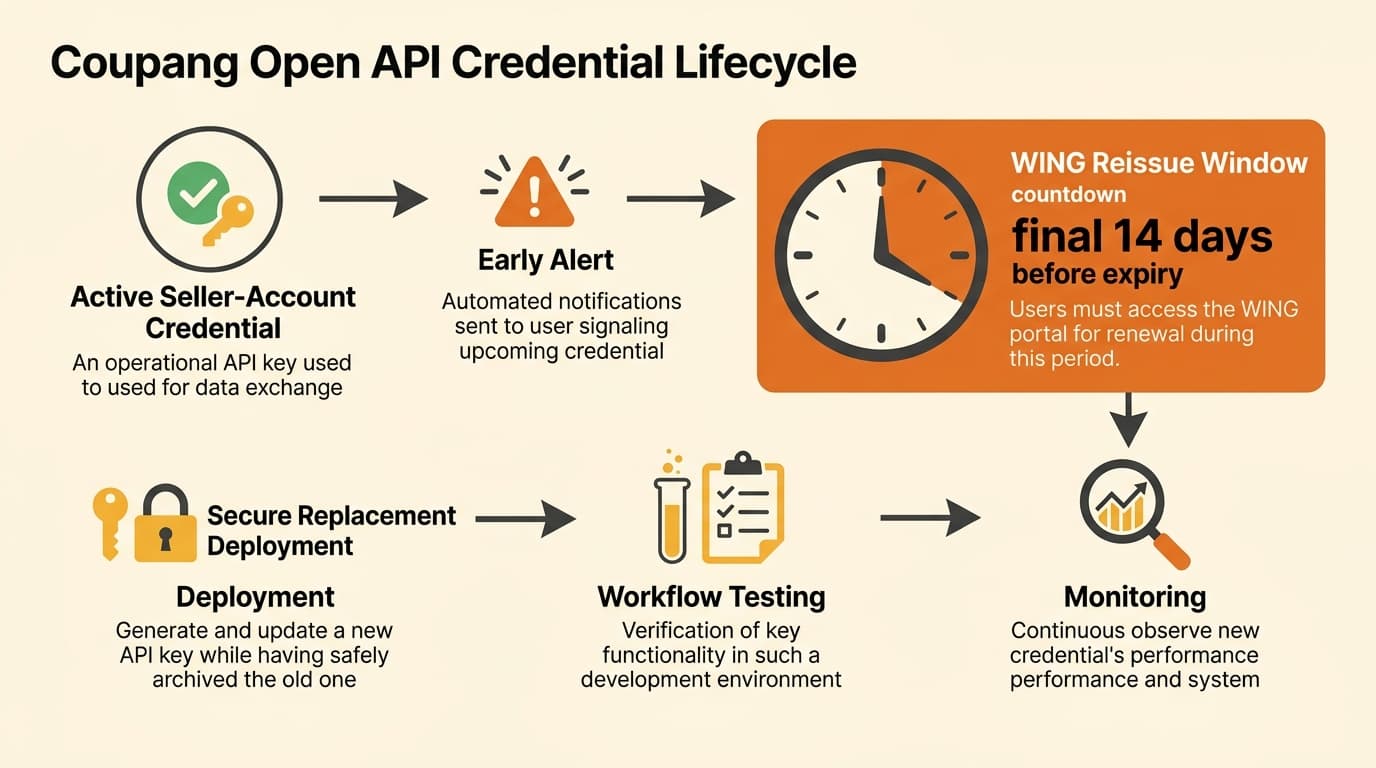
Coupang’s current official FAQ says the reissue control becomes available only during the final 14 days before expiry. Treat that as a planning constraint, not as a deadline to discover who owns the account. Set an alert before that window, confirm the responsible WING user and backup, and make sure the deployment path is ready before reissue is available.
The exact WING labels or screen layout can change, so verify the current process in Coupang’s official Open API developer documentation and the WING seller console. The operational conclusion does not depend on a particular button name: the connector cannot replace the accountable account owner.
A useful ownership record contains at least:
- The seller account and the person responsible for WING action.
- A backup owner who can act if the primary owner is unavailable.
- The systems and environments that consume the credentials.
- The alert destination and the person responsible for acknowledging it.
- The person who can deploy the replacement and the person who validates the critical workflows.
Do not confuse a named owner with a shared password. The goal is clear accountability and controlled access, not a credential copied into a team chat or a spreadsheet. The owner must be able to perform the WING action; the integration team must be able to deploy the result without exposing the secret unnecessarily.
Rotate credentials as an operational cutover
A reissue is not complete when WING shows the replacement. Update every consumer, test the dependent workflows, and confirm that monitoring is healthy. Treat the change as a cutover:
- Inventory every consumer. List the production connector, scheduled jobs, ERP or warehouse connections, scripts, staging environments, and any other service that might use the seller-account credentials. If an old integration is not on the list, it can keep failing after the cutover or create confusion about which system is active.
- Name the WING owner and the deployer. The person who can reissue the credentials and the person who can change the integration configuration may be different. Assign both roles before the final 14 days before expiry, and document a backup for each.
- Prepare the change window. Identify the catalog, order, inventory, and settlement jobs that must be checked. Decide which jobs can be paused briefly, which can be tested safely, and who watches them during the change. Do not schedule the cutover at the same time as an unrelated platform or warehouse change if you can avoid it.
- Complete the WING action. When the account is eligible, the accountable owner follows Coupang’s current WING process for issuance or reissue. The integration team should not treat a request sent to an API endpoint as an alternative.
- Store and distribute the replacement securely. Put the new value in the approved secret-management path, not in source code, tickets, or unencrypted notes. Update each consumer through its normal deployment process. Do not assume the previous credential will remain usable or that every service reads the same configuration.
- Test the workflows that matter. Confirm authenticated behavior for the operations the connector actually runs: for example, catalog handling, order retrieval, inventory updates, and settlement data. A health check that only reaches one endpoint is not enough if four separate jobs depend on the connection.
- Confirm monitoring and close the change. Check that failures generate an alert, that the alert reaches the named owner, and that logs identify the affected consumer and outbound path without exposing the secret. Record the completed date, systems updated, test results, and the recovery steps used.
This sequence is useful even when a third party operates the connector. It tells the brand what to request from that operator: a consumer inventory, a rotation runbook, evidence of workflow testing, and a clear handoff if WING intervention is required.
A common failure is a partial cutover. The main connector is updated, but a settlement job or a small inventory script still uses the old value. The result looks like an intermittent Coupang problem when it is actually an incomplete credential deployment. A consumer inventory prevents the integration from being treated as one indivisible box.
A 403 is a diagnosis problem, not an expiry verdict
HTTP 403 does not automatically mean that the Coupang API key has expired. Coupang’s official guidance also identifies blocked server IPs and temporary restrictions associated with abnormal or repeated error traffic. Those causes require different actions, so blindly reissuing the key—or repeatedly retrying the same request—can lengthen the incident.
A 403 is a signal to investigate the credential, the network identity, and the request pattern together. Stop an aggressive retry loop before changing credentials.
Use a controlled triage sequence:
- Capture the event. Record the time, affected consumer, endpoint, request type, response, and actual outbound IP. Keep secrets out of the incident record. The outbound IP matters because the service making the request may not be the server a team member assumes it is.
- Reduce repeated traffic. Pause or back off the failing job according to the integration’s incident procedure. Repeated abnormal errors can lead to temporary restrictions, and more traffic does not prove that the key is valid.
- Check the account-side state. Have the WING owner verify the credential’s status and expiry information. If reissue is required and the account is within the documented window, follow the WING process rather than trying to solve it through the API.
- Check the network path. Confirm which public IP the connector uses and whether that IP has changed, is shared unexpectedly, or is identified in Coupang’s guidance as blocked. A credential replacement does not fix a blocked egress path.
- Scope the failure. Compare affected consumers and workflows. If one service fails while another succeeds, investigate that service’s secret and network configuration before treating the seller account as a whole as unavailable.
- Recover deliberately. After the cause is understood, update the credential or network configuration, run the critical workflow tests, and keep monitoring active. Do not change the key, the IP, and the retry policy simultaneously without recording what changed.
The point is not to make the connector diagnose every Coupang-side decision. The point is to prevent the first 403 from triggering an untracked sequence of retries and credential changes. A useful connector makes the evidence visible and routes the account-level action to the person who can perform it in WING.

Use credential ownership as the build-versus-buy test
The right question is not whether a connector has an automatic renewal button. It is whether the chosen operating model covers the work the Open API cannot perform. A custom integration owns that work internally. A software vendor or managed operator may support it, but the responsibilities still need named owners and a fallback.
| Responsibility | What a custom build must provide | What to ask when evaluating a connector or operator |
|---|---|---|
| WING authority | A named owner with the necessary seller-console access and a backup | Who performs issuance or reissue in WING, and what happens if that person is unavailable? |
| Expiry planning | An alert schedule that starts before the final 14 days before expiry | Does the system alert a named person, or does it only fail after the credential stops working? |
| Secure cutover | A secrets path and deployment process for every consumer | How is a replacement propagated, and how is exposure of the raw credential limited? |
| Outbound IP control | A known, documented egress path and a change procedure | Can the operator identify the actual outbound IP and explain what happens if it is blocked? |
| Error handling | Backoff, logs, 403 classification, and incident alerts | Does the integration stop retry storms and distinguish credential, IP, and temporary-restriction signals? |
| Workflow validation | Tests for the actual catalog, order, inventory, and settlement jobs | What gets tested after rotation, and who signs off that the connection is usable? |
| Recovery and exit | A written runbook and access to the configuration needed to recover | If the relationship or connector fails, can the brand’s team take over the WING and deployment steps? |
Be precise when someone says the key is handled automatically. That phrase can mean several different things:
- The system counts down to an expiry date.
- The system alerts a human to take action in WING.
- The system updates a stored secret after a human performs the WING action.
- The system retries failed requests.
- The system claims to perform the reissue itself.
Those are not equivalent. The Open API does not provide a path for the connector to issue or reissue the seller-account credentials. A useful proposal should say which steps remain in WING, who owns them, and how the replacement moves into production.
For procurement, ask to see the rotation and 403 recovery runbooks before signing off. You do not need the vendor to hand over a secret or expose an internal security design. You need enough detail to answer four questions: Who acts? What changes? How is it tested? What happens if the first recovery attempt fails?
This is the real build-versus-buy boundary. Buying a connector can reduce the amount of code your team maintains. It does not eliminate the seller-console dependency, and it should not hide that dependency behind the phrase low-touch integration.
Common questions about Coupang API key renewal
Can a connector request a new Coupang Open API key through an API endpoint?
No. The connector can use the current seller-account credentials and automate business data calls, but documented issuance and reissue happen in WING.
Can the connector monitor the expiry date?
It can schedule alerts or surface failed calls if its design and available data support that function. Monitoring is useful, but it does not grant the WING access needed for the account-side action.
When should the owner prepare for reissue?
Prepare before the final 14 days before expiry. Coupang’s current official FAQ says the reissue control becomes available only during that final window, so ownership, deployment, and testing should not begin there.
Does an HTTP 403 prove that the key has expired?
No. Check credential state alongside the actual outbound IP and request behavior. Coupang’s official guidance also points to blocked server IPs and temporary restrictions caused by abnormal or repeated error traffic.
What should a Western brand put in its connector requirements?
Require a named WING owner and backup, expiry alerts, secure secret deployment, stable outbound-IP management, 403 monitoring with controlled retries, workflow tests, and a recovery runbook. If a vendor cannot explain who acts in WING, the integration is not fully operated yet.
Review your Korea integration operating model
If you are assessing a Coupang connector or planning a local Korea launch, contact Kontactic to discuss the account, credential, and operational responsibilities that need to be assigned before automation goes live.
About the author
Korean and global e-commerce operators with 15+ years of cross-border experience, led by CEO Isaac Lee — KOTRA-certified consultant and official lecturer for Seoul City and the Korea Customs Service. We run Korea market entry for Western brands every day; this blog documents what we learn in the field.
More about Kontactic →Related Articles
Korea Food Import Declaration: File Every Shipment
Korea food import declaration rules apply to one shipment only, so MFDS requires a new declaration for every reorder and later checks may delay stock in Korea.
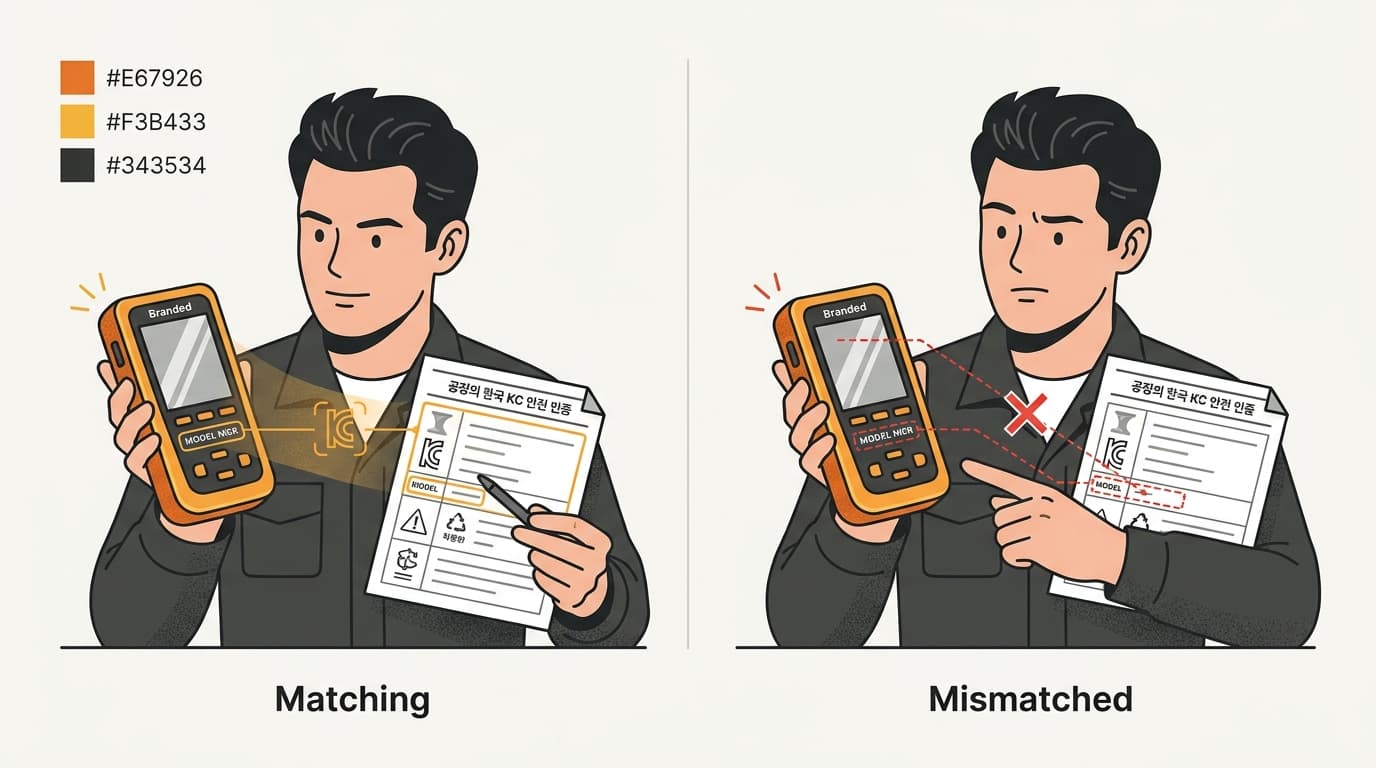
Can a Factory's KC Certificate Cover Your Brand?
Factory KC paperwork covers your private-label product only when the approved model, factory, and version match. Wireless products need a separate RRA check.

Can You Reject a Coupang Exchange? Only Two Reasons
Coupang exchange rejection is limited to SOLDOUT or WITHDRAW. Learn when each code applies—and what to do when a seller simply prefers a refund instead.