
MFDS Review in Korea: Imported Cosmetics Explained
No—ordinary imported cosmetics outside Korea’s statutory functional categories usually do not undergo a product-by-product MFDS review. Products in a functional category, such as UV protection, skin whitening, or wrinkle improvement, must complete the applicable MFDS examination or qualifying report before manufacture or import for sale. Both routes also require a Korean responsible cosmetics seller, safety and ingredient compliance, Korean labeling, and import records.
The legal fork is ordinary versus functional cosmetics
Imported origin is not the deciding variable. The first question is whether Korean law places the product inside a statutory functional category.
For an ordinary (non-functional) cosmetic, Korea generally does not require an MFDS functional-cosmetics examination for each imported product. The product still needs to meet the ordinary cosmetics framework before it is sold. For a functional cosmetic, the pre-market path adds an applicable MFDS examination or, where the product qualifies, a report that must be completed before manufacture or import for sale.
That makes “MFDS review” too broad a question. The useful question is: Which Korean route applies to this product, and has that route been completed?
| Pre-market question | Ordinary, non-functional cosmetic | Functional cosmetic |
|---|---|---|
| Product-by-product functional-cosmetics review | Not normally required | Applicable MFDS examination or qualifying report is required |
| Korean classification | Outside the statutory functional categories | Within a statutory functional category |
| Shared controls | Responsible cosmetics seller, safety and ingredient rules, Korean labeling, quality and import records | The same shared controls, plus completion of the applicable functional route |
The distinction is about classification, not a promise that one product type is unregulated. An ordinary cosmetic can still be kept from lawful launch by a Korean labeling, ingredient, seller, or import problem. A functional cosmetic can have a complete foreign-market file and still be on the wrong Korean pre-market path.
The legal baseline is the Korean Cosmetics Act on the Korean Law Information Center. Use current MFDS guidance and notices to check how the statutory categories and procedures apply to the product in front of you. Administrative summaries and old launch checklists should not replace the current law and MFDS materials.

What makes a product functional in Korea?
The classification checkpoint comes before translation, packaging, and import planning. Korea looks at the product’s Korean purpose and presentation, not only what the brand calls it in the United States or Europe.
Functional cosmetics are cosmetics that fall within Korea’s statutory functional categories. Recognized examples include products for UV protection, skin whitening, and wrinkle improvement; these products follow the applicable MFDS examination or qualifying report route before manufacture or import for sale.
A product can sit on the ordinary-cosmetics shelf in its home market and still need the Korean functional route. A sunscreen presented for UV protection is the clearest example. The same issue can arise when a serum, cream, or other beauty product is presented for skin whitening or wrinkle improvement. The fact that the product is legally sold as a cosmetic elsewhere does not decide its Korean classification.
Read the product as a Korean buyer and regulator would encounter it. Review the formula, intended use, Korean product name, packaging, claims, and marketplace copy together. This is not a rule that every descriptive phrase automatically creates a functional product. It is a reason not to classify from an English SKU name or a home-market category alone.
For example, a brand should not finalize a Korean label or marketplace description first and ask the compliance question later. If the presentation moves the product into a statutory functional category, the route-specific evidence and manufacturer information may no longer match the artwork. That is why a whitening-serum classification check belongs before Korean creative is locked.
A US FDA status, EU cosmetic compliance or notification, and home-market “ordinary cosmetic” classification do not substitute for Korea’s functional-cosmetics process. They may describe the product’s status elsewhere, but they do not answer the Korean classification question.
What the MFDS functional-cosmetics route actually changes
Once a product is classified as functional, the question is not simply whether it is imported. The question becomes which pre-market procedure applies.
The applicable route may be an MFDS examination or, if the product is eligible, a qualifying report. Those are not interchangeable labels. Eligibility for a report should be confirmed against the product and current MFDS requirements; do not assume that every functional product can use the report route.
The file also needs to be built for the Korean route. At a minimum, the working plan should align the product’s formula, manufacturer information, and efficacy materials with the function being claimed or presented. The evidence package depends on the product and its function. A foreign test report or home-market notification does not automatically clear the product in Korea.
This timing matters. The functional route must be complete before the product is manufactured or imported for sale in Korea. Do not let a shipment date, a finished Korean label, or a Coupang launch schedule become the event that exposes an unresolved classification. The route should be decided while the formula, evidence file, Korean artwork, and commercial inventory plan can still be changed.
In practice, the best internal question is not “Has MFDS approved this cosmetic somewhere?” It is “What Korean statutory function, if any, does this product have, and what evidence does that route require?” That wording keeps the team focused on the decision that controls the launch.
Ordinary cosmetics still need a Korean compliance file
“No functional-cosmetics review” does not mean “free sale.” It means the product is outside that particular product-by-product MFDS gate. An ordinary imported cosmetic still needs a Korean compliance file that supports lawful import and sale.
The shared controls include:
- A registered Korean responsible cosmetics seller. The product needs a Korean party registered for the responsible cosmetics seller role. A foreign brand’s home-market registration or an overseas manufacturer does not replace this Korean role. Read more about the responsible Korean cosmetics seller role before assigning responsibilities.
- Safety and restricted-ingredient review. The formula must be checked against Korean requirements, not only the rules in the United States or European Union. The Korean cosmetic ingredient rules are relevant even when the product is not functional.
- Mandatory Korean labeling. A compliant foreign label or English packaging is not a substitute for the required Korean product information. The Korean-language label requirements should be resolved before production and import.
- Quality and import records. Keep the manufacturer, product, quality, and import records required for the product and the responsible seller’s compliance process. The exact record set can vary with the product and route; do not assume that a product review decision covers every operational record.
- Customs and import documentation. The product still has to follow the applicable import process. For the customs side, use the Korea Customs Service English site as the primary reference. Customs documentation should be treated as part of the import file, not as proof that the Korean cosmetics classification and labeling work is complete.
These obligations apply to both sides of the fork. Functional cosmetics add a pre-market examination or qualifying report; ordinary cosmetics do not thereby become exempt from the responsible seller, safety, labeling, record, and import requirements.

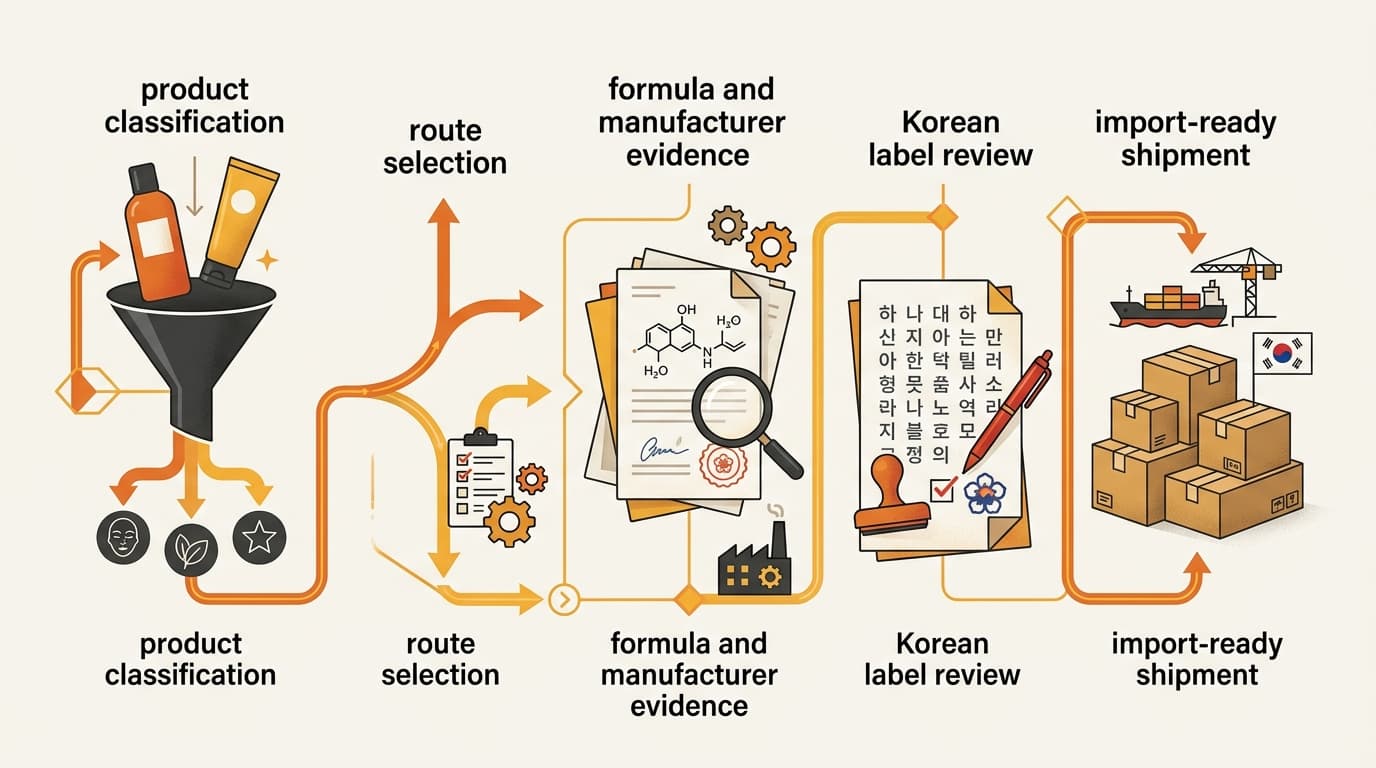
A practical pre-market sequence for any importer
Use this order for each product before you commit Korean packaging or commercial inventory. It applies whether the goods are for e-commerce, a distributor shipment, or a retail event, and whether or not the brand has prior cross-border sales.
- Classify the Korean purpose and presentation. Identify what the product is meant to do in Korea and how the formula, name, packaging, claims, and marketplace content present it. Record whether it sits inside a statutory functional category.
- Resolve the classification before final artwork. Do not translate or design Korean content around an ordinary-cosmetic assumption while UV protection, skin whitening, wrinkle improvement, or another regulated function is still possible. Recheck the product’s intended use and evidence needs.
- Select the route. If it is ordinary, follow the ordinary cosmetics compliance path. If it is functional, determine whether the applicable MFDS examination or a qualifying report is required and whether the product is eligible for the report route.
- Build the route-specific file. Align the formula, manufacturer information, and efficacy materials with the Korean function and procedure. Foreign-market documents do not replace the applicable Korean process.
- Complete the shared controls. Confirm the registered Korean responsible cosmetics seller, Korean safety and restricted-ingredient position, mandatory Korean label, quality and import records, and customs documentation.
- Import and sell only after the applicable requirements are complete. For functional products, that includes completion of the required examination or qualifying report before commercial manufacture or import for sale. For ordinary products, it still means the shared Korean cosmetics and import controls are ready before inventory moves.
Ask “Which Korean pre-market route applies?” before asking “Is this product approved?” The first question produces a classification decision; the second can hide the difference between an ordinary cosmetic, a functional cosmetics examination, and a qualifying report.
This sequence applies whether the goods are for e-commerce, a distributor shipment, or a retail event, and whether the brand has prior cross-border sales or is sending goods to Korea for the first time. The goal is not to redo every foreign-market assessment. It is to prevent a Korean formula, label, evidence package, and shipment from being built around the wrong legal category.
Common questions about MFDS review for imported cosmetics
Does every imported cosmetic need an MFDS product review?
No. Ordinary imported cosmetics generally do not need a product-by-product MFDS functional-cosmetics examination. They still need the Korean responsible seller, safety, ingredient, labeling, quality-record, and import controls that apply outside the functional route.
Can a sunscreen that is legal in the US or EU enter Korea as an ordinary cosmetic?
Not automatically. A product presented for UV protection can fall within Korea’s functional-cosmetics category, so the Korean classification and applicable MFDS examination or qualifying report should be resolved before commercial import.
Can FDA status, EU compliance, or an EU notification replace the Korean process?
No. Those are foreign-market statuses. They do not replace the Korean functional-cosmetics examination or qualifying report when a product falls into a Korean statutory functional category. They also do not remove the shared Korean labeling or import obligations.
If the product is ordinary, can the brand skip a Korean responsible cosmetics seller?
No. The absence of a functional-cosmetics review does not remove the requirement for a registered Korean responsible cosmetics seller or the other ordinary-cosmetics controls.
Can commercial stock be imported while the MFDS examination or report is pending?
Do not plan commercial inventory for sale on that assumption. The applicable functional route must be complete before the product is manufactured or imported for sale; resolve the classification and evidence file before shipment.
Where should a brand verify the current rule?
Start with the Cosmetics Act on law.go.kr and current MFDS guidance. Use the Korea Customs Service for the customs side. If the current text or product-specific facts are unclear, treat the classification as unresolved rather than assuming that home-market cosmetic status carries over.
Check the Korean route before you ship
If you are unsure whether a cosmetic belongs on Korea’s ordinary or functional path, contact Kontactic to review the product facts and launch sequence before Korean artwork or commercial inventory is finalized.
About the author
Korean and global e-commerce operators with 15+ years of cross-border experience, led by CEO Isaac Lee — KOTRA-certified consultant and official lecturer for Seoul City and the Korea Customs Service. We run Korea market entry for overseas brands every day; this blog records what we learn in the field.
Meet the Kontactic team →Related Articles

Can Coupang Buyers Pay Two Charges With Free Shipping?
On Coupang, free shipping can still leave the buyer paying two return charges: the original delivery cost and the cost of sending the parcel back to the seller.
Coupang Product IDs: One ID Cannot Cover Every Variant
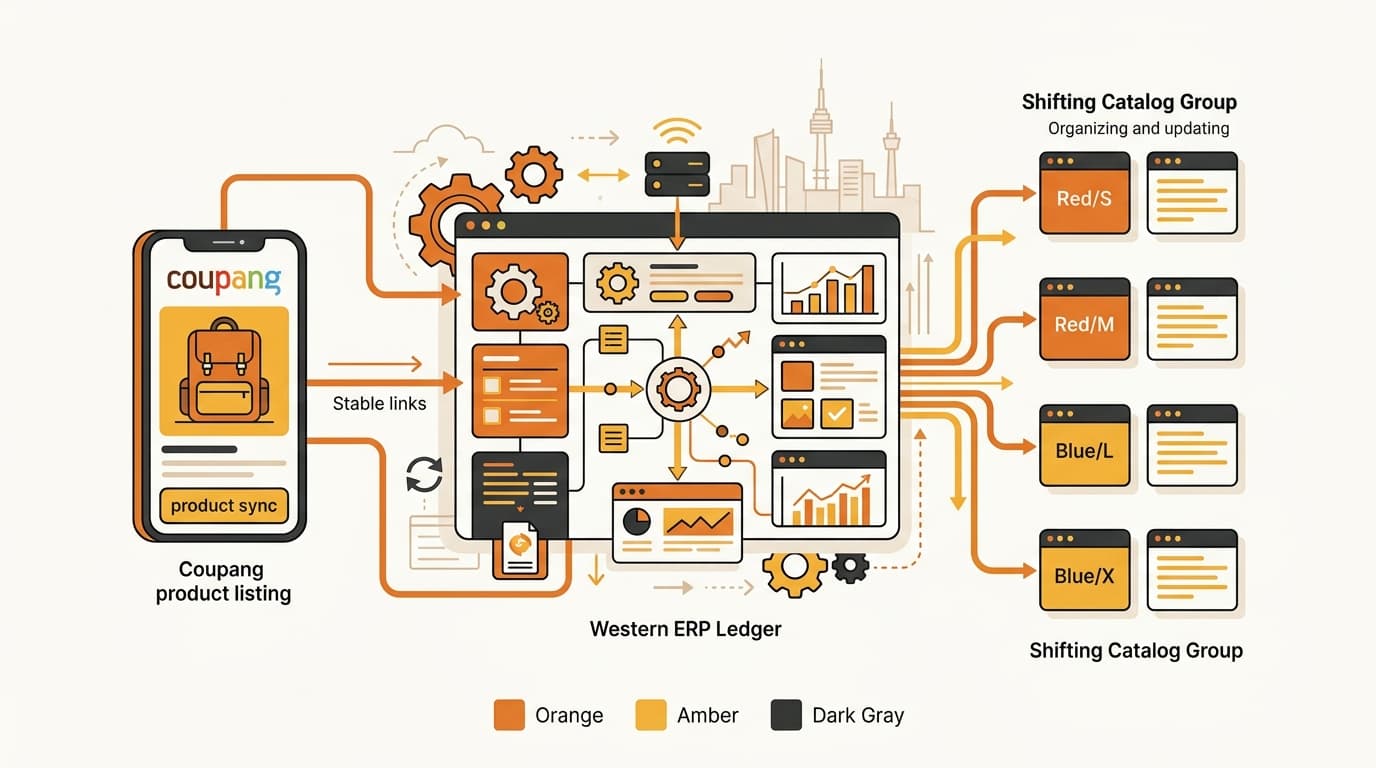
One Coupang product ID cannot cover every ERP variant; keep your brand SKU as the main key and map listing, option, edit, and order values to each SKU.

Coupang Rocket Growth Stock: Can an ERP Set It via API?
An ERP cannot set Coupang Rocket Growth stock through the Open API; replenishment starts when Coupang physically receives a new inbound shipment of stock.