Korean Cosmetics Responsible Seller: Who Takes the Role
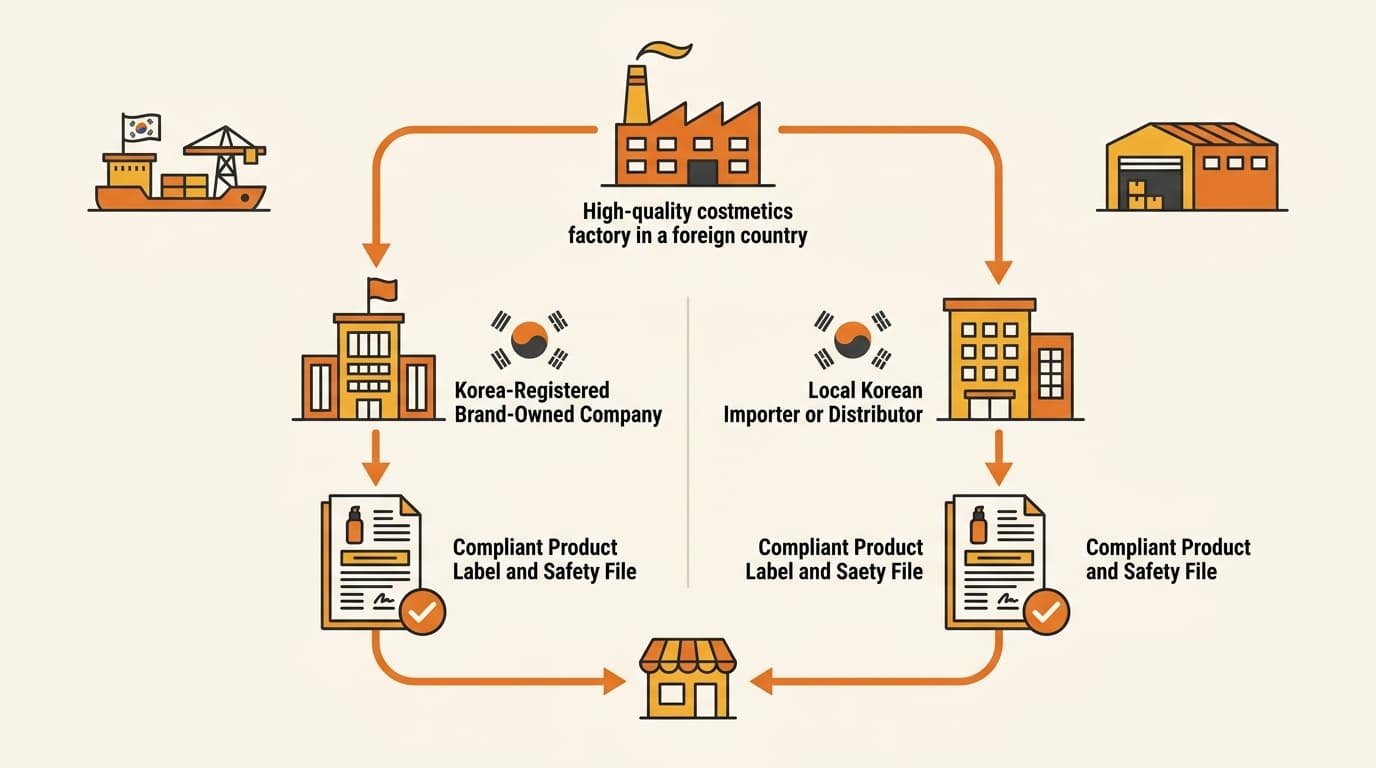
Imported cosmetics need a Korea-registered business acting as the cosmetics responsible seller (화장품책임판매업자). The business can be the brand’s own Korea-registered company or a registered Korean importer or distributor that accepts the role.
Before the first commercial import, choose the Korean business that will take the role. Name each party correctly on the label, import papers, and marketplace details.
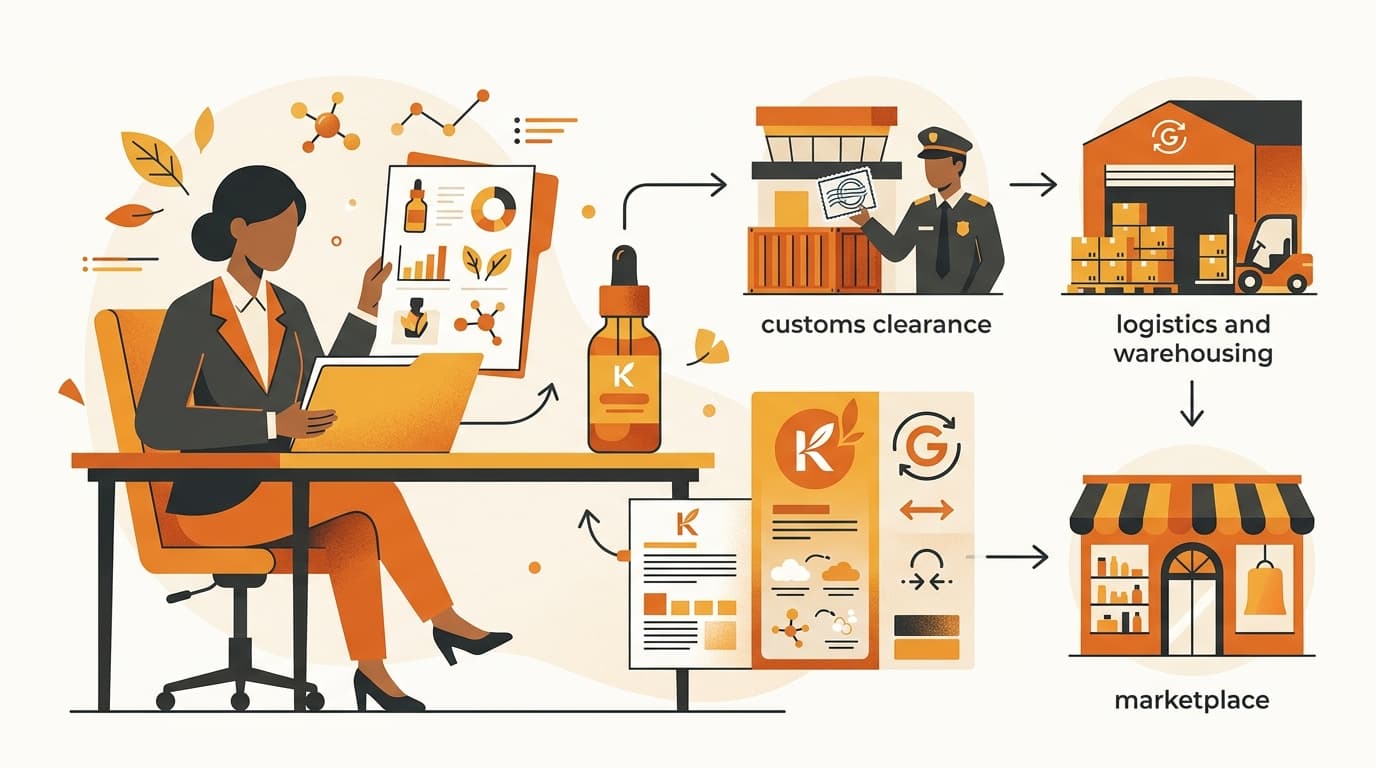
Imagine a US skincare brand sending a face serum to Korea. Customs may clear the shipment, a warehouse may receive it, and a marketplace page may show it. None of those events creates the required responsible seller.
A cosmetics responsible seller (화장품책임판매업자) is the Korea-registered business that places imported cosmetics on the Korean market. It checks the formula, Korean label, and product claims, and handles safety complaints, withdrawals, and recalls.
What the Korean cosmetics responsible seller does
This is a business role under Korea’s Cosmetics Act. It is not a one-time customs filing, a shipping service, a warehouse address, or a Coupang setting.
The responsible seller’s work starts before sale and continues after a buyer receives the product. It must keep the product’s quality and safety work in order. In practical terms, that means the business should:
- Check the full formula and ingredient list against Korean cosmetics rules.
- Check the required Korean label and the product’s claims to buyers.
- Keep the product, formula, ingredient, manufacturer, and manufacturing information needed for checks.
- Handle safety complaints and serious bad reactions.
- Take product withdrawal or recall action when required.
Consider a buyer who reports a serious skin reaction after using the serum. The responsible seller must know which formula and manufacturing information applies. It must also know how to handle the complaint and any required follow-up. A warehouse can show where the remaining units are stored, but storage alone does not make the warehouse responsible for the product.
Why customs, shipping, storage, and a marketplace are not enough
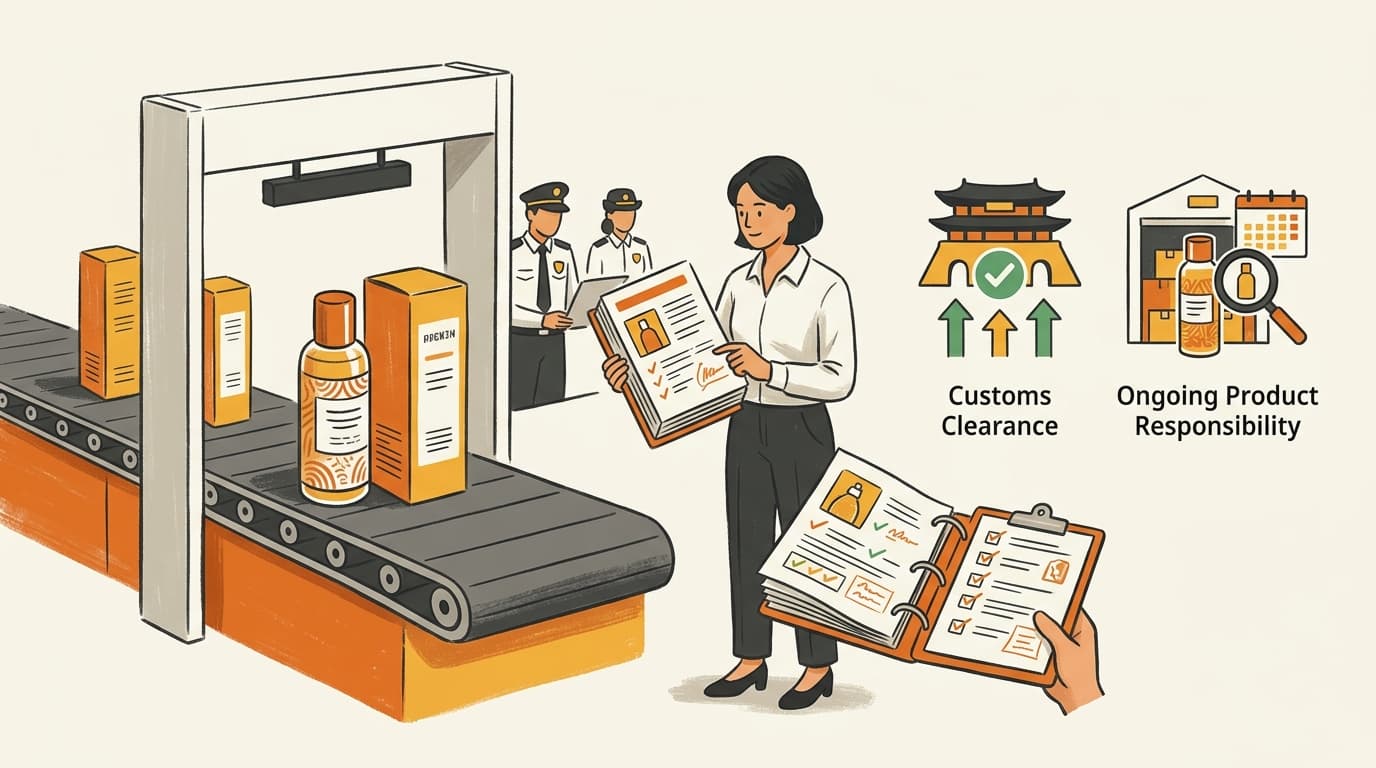
Several companies may touch the same shipment. Their jobs do not automatically become the cosmetics responsible seller role.
| Party | What it may do | Why that is not automatically the responsible seller role |
|---|---|---|
| Overseas brand | Owns the brand and supplies product information | Being the brand owner abroad does not make it the Korea-registered business responsible for selling the product |
| Factory | Makes the cosmetic | Manufacturing is different from placing the product on the Korean market |
| Freight forwarder or customs broker | Moves cargo or files customs paperwork | Filing customs papers is not the same as registering with the Ministry of Food and Drug Safety (MFDS) as the cosmetics responsible seller |
| Warehouse or fulfillment provider | Stores, picks, or packs stock | Storage and packing do not carry the product’s quality and safety duties |
| Marketplace | Hosts a listing and handles marketplace orders | A live product page is not responsible-selling registration |
A customs importer and the cosmetics responsible seller may be the same Korean business. They may also be different businesses. A customs broker that files a declaration is not automatically the responsible seller. Confirm each role instead of putting one company name into every field.
For the separate customs question, see What is an Importer of Record in Korea?. That role explains who handles import clearance. It does not remove the need to identify the registered cosmetics responsible seller.
Who can take the role in Korea?
There are two practical structures.
The brand’s own Korea-registered company. A foreign brand can operate through its own Korea-registered company. That company can take the responsible seller role after confirming its required MFDS registration and a designated person who handles its cosmetics duties. It must then be ready to review product information, support the Korean label, and handle product safety follow-up.
A Korean importer or distributor. A Korean importer or distributor can take the role if it is registered for it and accepts the importing and selling duties. Calling a company a distributor in a contract is not enough. The company must actually be registered for the role.
The agreement should name who receives the formula and manufacturing information. It should also name who checks the Korean label and product claims, receives safety complaints, and coordinates a withdrawal or recall. The agreement cannot replace the required registration.
Here is the difference in practice. A US skincare brand with a Korean subsidiary can name that Korean company as the responsible seller. If the brand uses a local importer instead, the local importer can take the role if it has the registration and accepts the duties. In either structure, the US parent, the overseas factory, and the warehouse do not replace the Korea-registered business.
What the Korean label and sales details must identify
Required Korean labeling must identify the responsible seller’s legal name and address. This information is not replaced by the foreign brand name, factory name, customs broker name, or warehouse address alone.
Before you print packaging or upload a product page, check each place where a party is named:
- Korean label: show the legal name and address of the registered cosmetics responsible seller.
- Import papers: identify the actual importing business and other parties accurately.
- Marketplace seller details: describe the real seller arrangement rather than copying the overseas brand’s details without review.
- Product file: keep the formula, ingredients, manufacturer information, and claims connected to the product being sold.
A marketplace page can appear online while the responsible seller is missing or misidentified. That page does not fix the label or create the registration. The package, import papers, and sales details should tell the same factual story about which Korean business has accepted the role.
For the packaging side, see Why Your Cosmetic Needs a Korean Label Even If It’s Registered. The label is not only a translation exercise. It names the Korean business tied to the product’s sale and safety duties.
Does general or functional cosmetic status change the answer?
No. Calling a product a general cosmetic does not remove the need for a Korea-registered cosmetics responsible seller. Calling it a functional cosmetic does not replace that business role either.
Product classification can add separate MFDS steps. Handle these as separate checks. First identify the Korea-registered responsible seller. Then confirm whether the product’s classification adds MFDS requirements before sale.
For the separate review question, see MFDS Review in Korea: Imported Cosmetics Explained. A product’s classification does not turn a factory, broker, warehouse, or marketplace into the responsible seller.
What to do before the first commercial import
Complete these checks before the first shipment intended for Korean sale:
- Choose the responsible business. Decide whether the role will sit with your own Korea-registered company or with a Korean importer or distributor.
- Confirm the registration. Confirm that the chosen business has the required MFDS registration and a designated person who handles its cosmetics duties.
- Send complete product information. Give that business the full formula, ingredient information, manufacturing information, and product claims.
- Review the Korean requirements. Check the formula, ingredients, Korean label, and product claims. Confirm whether the product’s classification adds separate MFDS steps.
- Put the correct party on the label. Use the responsible seller’s legal name and address in the required Korean labeling.
- Align the commercial paperwork. Make the import papers and marketplace seller details accurately identify each party and match the real arrangement.
- Set the safety response before launch. Decide how the responsible seller will receive complaints and serious bad-reaction reports, and how it will handle withdrawal or recall action when required.
Do not use customs clearance as the final check. A box can enter Korea while the responsible seller is still missing or named incorrectly. Fix the party, registration, product information, and label before commercial sale.

Use primary sources to check the requirement. Search the current Cosmetics Act (화장품법) on law.go.kr. Then check the official Ministry of Food and Drug Safety, MFDS (식약처) guidance for current responsible-selling registration, designated-person, labeling, and product-classification requirements.
Use Korea Customs Service guidance for the customs side. Customs clearance answers an import question; it does not prove that the business named for cosmetics responsibility is properly registered. If a marketplace has its own seller-onboarding rules, those rules may control the account, but they do not replace the Cosmetics Act or MFDS requirements.
Common questions about Korea’s cosmetics responsible seller
Can the overseas brand be named alone on the Korean package?
No. Imported cosmetics need a Korea-registered business acting as the responsible seller. The foreign brand or factory name alone does not replace that business’s legal name and address in the required Korean labeling.
Can a customs broker take the role?
Only if the broker is also registered for the cosmetics responsible-selling role and accepts the importing and selling duties. Filing customs paperwork alone is not enough.
Can a warehouse or Coupang seller account cover the requirement?
No. Storage, fulfillment, and a marketplace listing do not create MFDS responsible-selling registration. The seller details must accurately show the real parties and arrangement.
Does calling the product a general cosmetic avoid the requirement?
No. General and functional classification do not remove the responsible seller requirement. Functional classification may add separate MFDS steps, but it does not replace the registered Korean business.
Can my Korean subsidiary take the role instead of a local importer?
Yes, if it is a Korea-registered business with the required MFDS responsible-selling registration and a designated person who handles its cosmetics duties. It must then handle the product duties and appear correctly on the Korean label and related import papers.
Check the responsible seller before you ship
If you are choosing between your own Korea-registered company and a local importer or distributor, contact Kontactic to review the role, label, and pre-import steps.
About the author
Korean and global e-commerce operators with 15+ years of cross-border experience, led by CEO Isaac Lee — KOTRA-certified consultant and official lecturer for Seoul City and the Korea Customs Service. We run Korea market entry for overseas brands every day; this blog records what we learn in the field.
More about Kontactic →Related Articles
Korea Food Import Declaration: File Every Shipment
Korea food import declaration rules apply to one shipment only, so MFDS requires a new declaration for every reorder and later checks may delay stock in Korea.
Can a Factory's KC Certificate Cover Your Brand?
Factory KC paperwork covers your private-label product only when the approved model, factory, and version match. Wireless products need a separate RRA check.

Can You Reject a Coupang Exchange? Only Two Reasons
Coupang exchange rejection is limited to SOLDOUT or WITHDRAW. Learn when each code applies—and what to do when a seller simply prefers a refund instead.