
Is Your Vitamin Gummy "Food" or a Health Functional Food in Korea?
Your vitamin gummy is a Health Functional Food (건강기능식품) in Korea if it contains an ingredient on the MFDS recognized functional-ingredient list and you sell it with a functionality claim — otherwise it is general food (일반식품). Format does not decide this. Ingredients and claims do, and that single fork sets your testing, labeling, timeline, and legal liability before your first sale.
For Western supplement, protein, and functional-beverage brands, this is the classification question to answer before anything else — before freight, before Coupang, before your Korean product page. The same gummy can be a low-friction general food or a tightly controlled Health Functional Food depending on what is inside it and how you describe it. Get the line wrong and the product is either held at customs or exposed to false-advertising penalties.
Korea's two food regimes, in plain English
Korea's Ministry of Food and Drug Safety (MFDS, 식약처) governs ingestible products under two distinct legal tracks.
General food (일반식품) falls under the Food Sanitation Act and, for imports specifically, the Special Act on Imported Food Safety Control. This covers ordinary foods and beverages — snacks, drinks, condiments, protein powders sold as ordinary food, and gummies with no recognized functional ingredient and no functionality claim.
Health Functional Food (건강기능식품) falls under its own dedicated statute, the Health Functional Food Act. This is a separate, heavier regime built specifically for products that deliver a recognized physiological function through recognized functional ingredients — probiotics, omega-3, red ginseng, vitamins and minerals marketed for function, and other listed functional raw materials.
Both tracks sit under the same regulator, but they are not the same paperwork, the same testing, or the same liability. Treating one as the other is the most common — and most expensive — assumption Western brands make.
Health Functional Food (건강기능식품) is a legally defined category in Korea, not a marketing label. It applies only to products made with MFDS-recognized functional ingredients that carry approved functionality claims, and it is regulated under its own act — separate from the general Food Sanitation Act that covers ordinary food.

What actually pushes a product across the line
Two triggers move a product from general food into Health Functional Food, and either one can be enough.
The first trigger is ingredients. If your product contains a functional raw material that MFDS recognizes and lists — probiotics, omega-3, and other approved functional ingredients — you are on notice that the product may belong in the Health Functional Food regime. MFDS maintains a database of recognized functional ingredients, and mapping your formulation against it is the first concrete step of classification.
The second trigger is claims. If you market the product with a functionality claim — language that says it supports, improves, or maintains a bodily function — you are making a Health Functional Food claim, whether or not you intended to. In Korea, claims are not decoration; they are a regulatory input.
The important nuance: these two triggers interact. A product built on recognized functional ingredients and sold with a functionality claim is squarely a Health Functional Food. A gummy with no recognized functional ingredient and no functionality claim is general food. The messy middle — where brands get caught — is a general food that carries functionality language it is not entitled to make.
Format is a distraction. A gummy, a powder, a shot, a capsule, a drink — Korea classifies all of them by ingredient and claim, not by shape. "It's just a gummy" is not a classification.
Why your marketing copy alone can re-classify you
This is the part Western brands underestimate: you can trigger the heavier regime — or a violation — with words alone, even if your formulation is ordinary.
Marketing a general food with health-functionality language can be treated as a general food "disguised" as a Health Functional Food. That is a labeling-and-advertising problem under the Act on Labeling and Advertising of Foods, and it does not require any functional ingredient to be present. The claim itself is the violation.
Push further into drug-like territory — language implying the product treats, prevents, or cures a condition — and you move into a different exposure entirely: misrepresentation as medicine. A food (functional or not) that talks like a drug invites regulatory action regardless of how the product is classified.
“In Korea, your claims are part of your product's legal identity. The same gummy with two different back-of-pack sentences can sit in two different regulatory regimes.”
Isaac Lee — CEO, Kontactic
The practical takeaway: audit your copy before you audit anything else. Every on-pack line, every Coupang product page sentence, and every ad creative is a potential classification input. This is one reason a localized Korean product page is a compliance surface, not just a design job — the claims you carry over from your home market may not be legal in Korean.
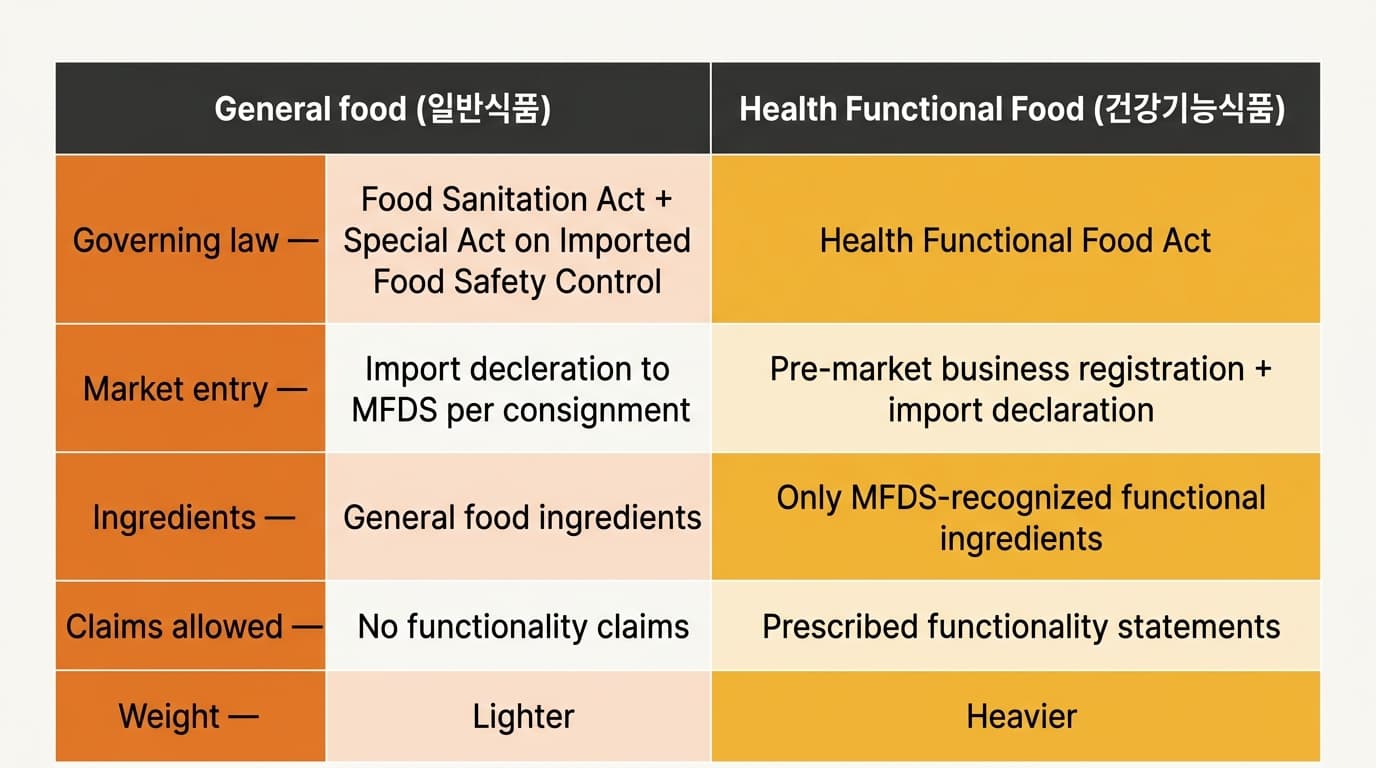
The two import paths, side by side
The reason classification matters is that the two regimes lead to genuinely different import processes. Here is the qualitative comparison — the exact procedures and fees depend on your product and are set by MFDS, so confirm the current requirements before you commit.
General food (일반식품):
- Governed by the Food Sanitation Act and, for imports, the Special Act on Imported Food Safety Control.
- Every consignment requires an import declaration to MFDS; there is no "just ship it" route even here.
- Consignments may be subject to inspection and testing at import.
- Requires compliant Korean-language labeling before sale.
- No functionality claims permitted.
Health Functional Food (건강기능식품):
- Governed by the Health Functional Food Act.
- Requires pre-market business registration before you can import and sell — a step general food does not carry.
- Only MFDS-recognized functional ingredients may be used.
- Mandatory Korean labeling with prescribed functionality and caution statements.
- Import declaration flows through the MFDS channels specific to Health Functional Food.
The Health Functional Food path is qualitatively more onerous at nearly every step: pre-registration instead of a per-consignment declaration alone, a closed list of permitted ingredients, and prescribed label language you cannot freely write yourself. If your product genuinely belongs there, budget for it. If it does not — and many supplement-style products can be sold as general food when the claims are handled correctly — do not accidentally opt into the heavier regime through careless copy. This classification decision is where a Korea supplement entry timeline of roughly 5–8 months either starts on the right foot or gets derailed.
Even "general food" is not ship-freely
A classification of general food is lighter, not free. Every imported food consignment still requires an import declaration to MFDS, may be pulled for inspection or laboratory testing, and cannot be sold without compliant Korean-language labeling. The Special Act on Imported Food Safety Control exists precisely to put a control layer on ordinary imported food.
So the real difference between the two paths is not "regulated vs. unregulated." It is "declaration-and-labeling" versus "pre-registration, restricted ingredients, prescribed claims, and declaration-and-labeling." Both require a compliant Korean operation to execute. Neither works from an overseas warehouse alone once you go local — which is part of the broader picture of what Korea treats as a licensed import category.
Who carries the liability: the importer of record
Here is the point that changes how you structure the whole entry: Korea places declaration, testing, and labeling responsibility on the domestic importer and seller — not on the foreign brand.
The importer of record is the party MFDS holds responsible for the import declaration, for the accuracy of the Korean labeling, and for the compliance of the product it brought in. Your status as an overseas company does not shield you, and it does not transfer the obligation offshore. Someone with a legal presence in Korea has to accept the role — which is why the Importer of Record is a foundational decision, not a shipping detail, for any food or supplement brand.
This is also why classification cannot be an afterthought. Whoever acts as your importer of record is signing up for the specific regime your product falls under. If the product is a Health Functional Food, that party is accepting the pre-registration and prescribed-labeling obligations of the Health Functional Food Act. If it is general food carrying an illegal functionality claim, that party is exposed to the labeling-and-advertising violation. The classification you land on defines the liability someone in Korea is legally accepting on your behalf. It is worth reading how tax, VAT, and returns stack on top of that role for supplement brands specifically.

A self-check you can run before you commit
You can get a defensible first read on your own classification in an afternoon. It will not replace confirmation from MFDS or a Korean regulatory specialist, but it will tell you which regime you are heading into.
- List every ingredient in your formulation, using the actual raw-material names, not marketing names.
- Map each ingredient against the MFDS recognized functional-ingredient database. If a recognized functional ingredient is present, flag it — the Health Functional Food regime is now in play.
- Audit every claim — on-pack, on your intended Coupang product page, and in ad copy — for functionality language ("supports," "improves," "helps maintain") and for any drug-like language ("treats," "prevents," "cures").
- Combine the two results. Recognized functional ingredient plus a functionality claim points to Health Functional Food. No functional ingredient and no functionality claim points to general food. A functionality claim with no supporting basis points to a labeling-and-advertising problem you must fix before launch.
- Confirm against primary sources. Cross-check the governing acts on Korea's official law portal (law.go.kr) and the current guidance from MFDS (식약처), and remember that customs treatment ultimately runs through the Korea Customs Service on the exact declaration your importer files.
If steps 2 and 3 both come back clean, you are most likely a general food — still subject to import declaration and Korean labeling, but on the lighter path. If either comes back hot, you are either in the Health Functional Food regime or one careless sentence away from a violation. Either way, you now know which path you are on before you ship.
Common questions
Does the product format — gummy, powder, drink, capsule — affect classification? No. Korea classifies by ingredients and claims, not by physical form. The same gummy can be general food or Health Functional Food depending on what is in it and how it is marketed.
Can a product with no functional ingredients still get flagged? Yes. Marketing an ordinary food with functionality or drug-like claims can be treated as a labeling-and-advertising violation, or as misrepresentation as medicine — with no functional ingredient required to be present.
Is general food classification a free pass at customs? No. General food still requires an import declaration to MFDS, may be inspected or tested, and needs compliant Korean-language labeling before sale.
Does my overseas status protect me from liability? No. Korea places declaration, testing, and labeling responsibility on the domestic importer and seller. You need a party in Korea willing to legally accept the importer-of-record role for your specific regime. If you are still weighing paths, our Korea market entry decision guide for supplement brands walks through the options.
Not sure which regime your product falls under?
Kontactic screens supplement and functional-food formulations against Korea's general-food and Health Functional Food rules before you ship. Talk to us about your product and your claims.
About the author
Korean and global e-commerce operators with 15+ years of cross-border experience, led by CEO Isaac Lee — KOTRA-certified consultant and official lecturer for Seoul City and the Korea Customs Service. We run Korea market entry for Western brands every day; this blog documents what we learn in the field.
More about Kontactic →Related Articles

Korean Importer Registration: Why a POA Is Not Enough
A power of attorney cannot establish Korean importer registration; corporate-authority proof and Korean importer records are still required for the filing.

Can You Delay Korea Import Duty on Consignment Stock?
No. Korea import duty and import VAT are normally assessed when consignment stock is cleared for domestic circulation, not when a Korean customer buys one unit.

Children’s Product KC: Does “Ages 13+” Avoid the Rules?
No. In Korea, “Ages 13+” is only one factor; design, intended use, packaging, and child-directed marketing can still trigger children’s-product KC rules.