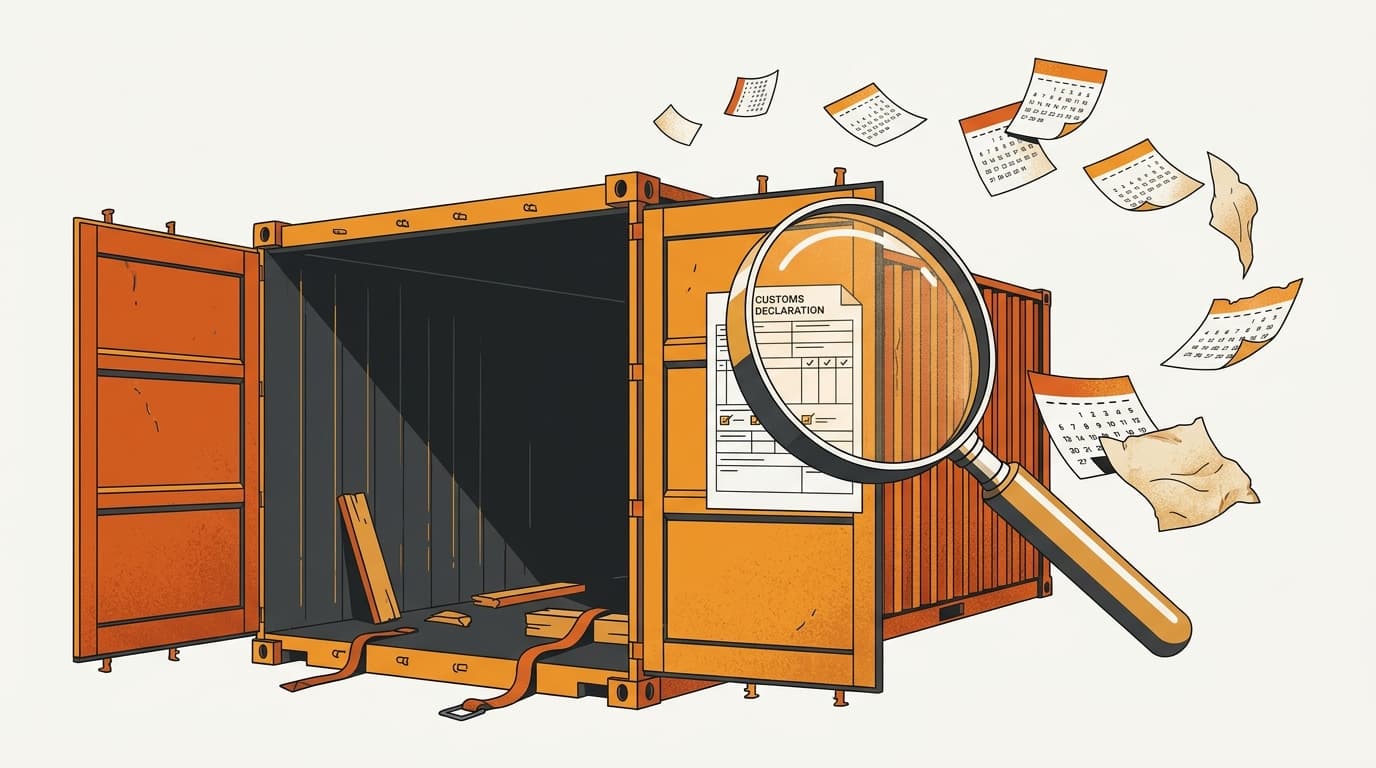
Is Korean Customs Duty Final Once Your Shipment Clears?
No. Once your shipment clears Korean customs, the duty you paid is not a final verdict — it is a provisional number the Korea Customs Service (관세청) can review and correct later. Korea runs an importer self-assessment model: at clearance, your importer of record declares the dutiable value and the HS classification, Customs collects on that declaration, and only afterward does Customs verify whether the number was right. If a later review finds you underpaid, it issues a corrected assessment — plus additional charges — and it can do so years after the goods have cleared and sold.
That single fact reshapes how a foreign brand should budget landed cost. Duty is not a one-time gate you pass and forget. It is a position you have to be able to defend for years, backed by the invoices, agreements, and origin certificates that supported it.
Clearance is collection, not a final judgment
The gap most brands miss is the difference between paying duty and settling duty. When cargo lands, your importer of record files a declaration stating the dutiable value and the tariff line, Customs releases the goods, and duty and the 10% import VAT are paid. It feels final. Your product is on the shelf and selling.
But under self-assessment, that declaration is your claim, not Customs' finding. Customs does not audit every entry at the border — that would stop trade. Instead it clears on the declared figures and reserves the right to check them afterward, through post-clearance verification. The number on your clearance receipt tells you what you paid. It does not tell you what you owed.
The practical consequence: a shipment can clear cleanly, sell out over a season, and still be sitting on an open duty position. If the declared value was too low or the tariff line was wrong, that position is unresolved until either you correct it or Customs does.
Importer self-assessment means the importer declares the dutiable value and HS classification, Customs collects on that declaration at clearance, and Customs verifies the accuracy afterward. Clearance is provisional collection — not a final ruling on how much duty you actually owed.
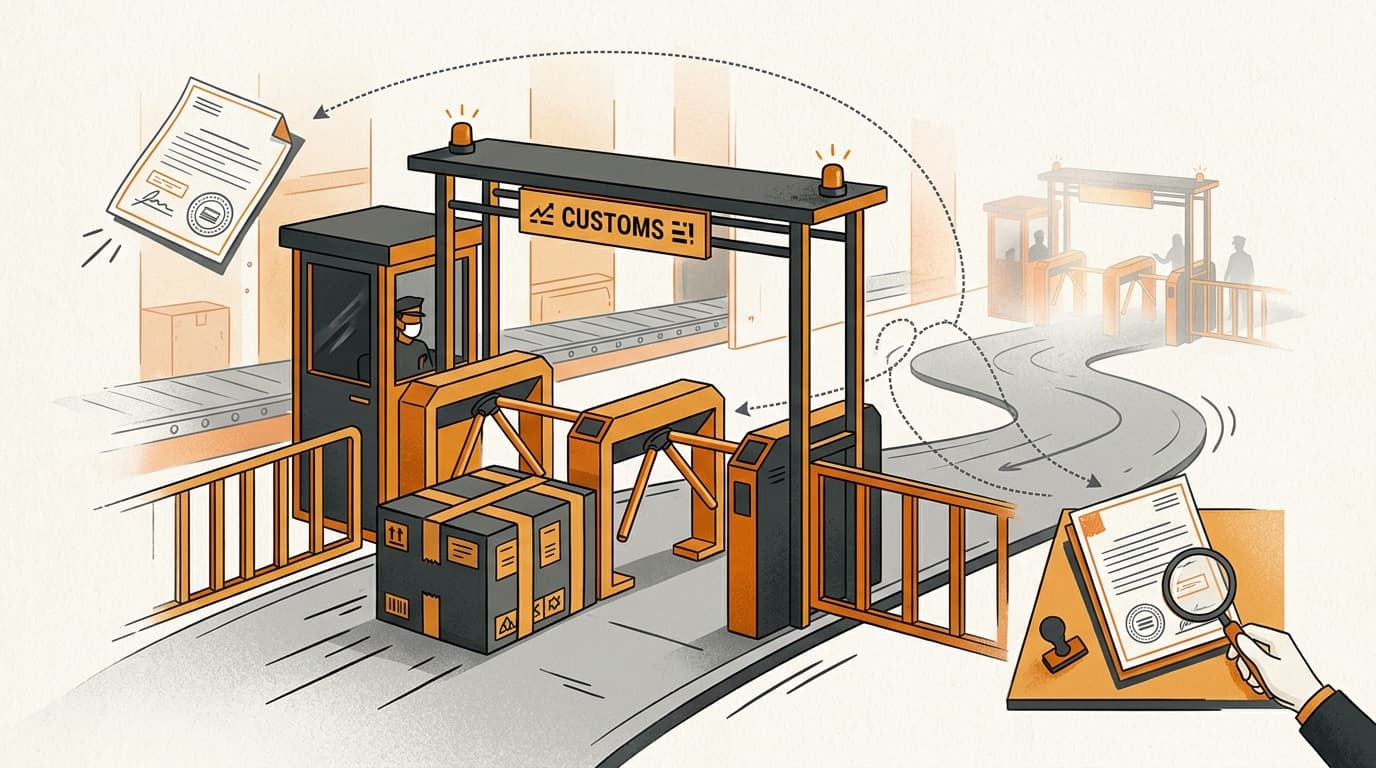
How far back can Customs reassess?
After the goods clear, the Korea Customs Service can reassess within a statutory lookback window — a period measured in years, not weeks. We are deliberately not quoting a fixed number here, because the applicable period varies with the circumstances (an ordinary correction and a case involving evasion are not treated the same), and the statute is the thing to check, not a blog post. The point to internalize is the order of magnitude: this reaches back across multiple years, well past the point where your inventory from that shipment is gone.
If you want the governing text, the customs statutes are published on Korea's national law portal, law.go.kr, and the Korea Customs Service publishes its own guidance on post-clearance review. When a specific window matters to a real filing, confirm it against those primary sources or with a licensed Korean customs broker — the period can turn on facts specific to your entry.
What this means operationally is simple and uncomfortable: a duty exposure created today does not expire when the shipment sells. It can surface a year or two later, attached to a batch you have long since forgotten, at a moment you did not budget for.
What actually triggers a correction
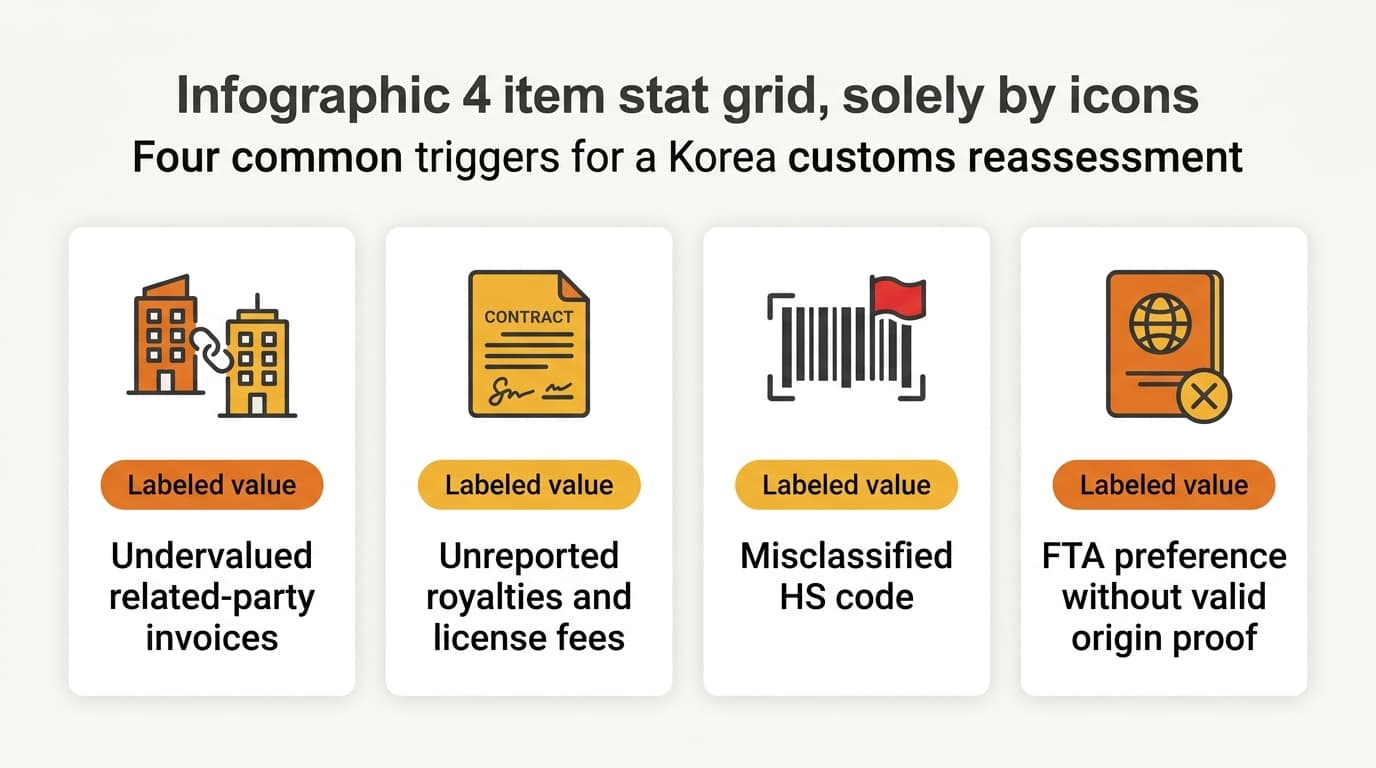
Reassessments are not random. They cluster around a handful of well-understood valuation and classification errors — most of them baked into the paperwork long before the goods reach the port. The four most common triggers for a foreign brand:
- Undervalued related-party invoices. When a parent sells to its own Korean subsidiary, the invoice price is not automatically an arm's-length dutiable value. If Customs concludes the intercompany price was understated, it reassesses on a corrected value.
- Unreported royalties and license fees. Royalties or license fees tied to the imported goods can be dutiable — they may have to be added to the declared value. Leaving them out understates duty and is a frequent audit finding.
- Misclassified HS code. Putting goods in a tariff line with a lower rate — whether by mistake or optimism — understates the duty owed. A later review moves them to the correct line and bills the difference.
- FTA preference without valid origin proof. Claiming a preferential rate you cannot later substantiate is disallowed on review, and the full non-preferential duty is reassessed retroactively.
Notice what these have in common: none of them are visible on the clearance receipt. They live in the underlying documents — the intercompany invoice, the license agreement, the classification decision, the certificate of origin. Customs can question any of them after the fact.
FTA preference is the one to watch
The FTA case deserves its own note because it is the easiest to get wrong and the most retroactive when it goes wrong. Claiming a KORUS or Korea–EU preferential rate is not a discount you simply select; it is a claim that obligates you to hold valid proof of origin and produce it if asked. If a later review asks and you cannot produce it, the preference is disallowed and the full duty is reassessed as if you had never qualified — after you already priced and sold the product at the lower-duty margin.
This is why the origin claim and the origin evidence have to be treated as one thing. We cover the mechanics of qualifying in whether the KORUS or Korea–EU FTA cuts your import duty to zero; the record-keeping half of that obligation is what a post-clearance review tests.
A correction costs more than paying right the first time
A reassessment is rarely just the duty gap. The correction typically carries additional charges on the underpayment, so fixing it after the fact costs more than declaring correctly at clearance would have. The exact charges depend on the case, but the direction is reliable: the later it surfaces, the more it costs.
There is one meaningful lever here. A voluntary self-correction — where you identify the error and amend the declaration before Customs acts — is generally treated more favorably than the same error found on audit. In practice that turns your document trail into a live tool, not a dead archive: if you review your own entries and catch an undervaluation or a shaky FTA claim early, you are in a far better position than if Customs finds it for you.
“Clearance tells you what you paid. It does not tell you what you owed — and in Korea, those can be different numbers for years.”
Isaac Lee — CEO, Kontactic
Who actually pays — and why the IoR matters after clearance
The reassessment lands on the legal importer of record, the declarant on the customs filing. Not your overseas factory. Not your freight forwarder. The entity whose name is on the declaration is the one Customs bills.
For a foreign brand, that has a specific consequence. If your own Korean entity is the importer of record, the exposure sits on your Korean books. If a local partner files as your importer of record, that partner is the legal declarant — so the reassessment reaches them first, which makes the terms of that arrangement, and the accuracy of what gets declared on your behalf, matter well beyond the initial clearance. This is part of why the choice of who acts as importer of record is not just a launch-day decision; it defines who carries the operating costs and liability when you sell in Korea, and it is a live question every time cargo enters, as we cover in who the importer of record is when you sell on Coupang.
Because duty is assessed on CIF value — goods plus freight and insurance — the number you declare is also the number you have to defend. If you are still modeling that base, our breakdown of how Korea import duty is assessed on CIF value, not your invoice is the place to start; a post-clearance review is essentially Customs re-checking that CIF figure years later.

What this changes in your landed-cost model
Two things. First, stop treating the duty paid at landing as your final duty cost. It is your provisional cost. Build your model knowing a correction — with added charges — is possible for years, and price with enough margin that a reassessment on one batch does not erase the profit on the whole season.
Second, keep the evidence retrievable. The clearance receipt is not the record that matters on a post-clearance review; the supporting documents are. Specifically, keep these defensible and findable for the full lookback window:
- The commercial invoice and, for related-party sales, whatever supports the price as arm's-length.
- Any royalty or license agreements tied to the imported goods.
- The HS classification rationale for each SKU.
- The certificate of origin behind every FTA preference you claimed.
If you cannot pull the right document on request, the practical outcome is the same as not having it — the declaration position it supported is at risk.
Common questions
Once my shipment clears Korean customs, is the duty amount final? No. Korea uses importer self-assessment, so clearance is provisional collection on your declared figures. The Korea Customs Service can review and reassess after the goods clear and sell.
How many years back can Customs reassess? It is a multi-year statutory window that varies by the circumstances of the entry — for example, ordinary corrections and cases involving evasion are treated differently. Check the current period on law.go.kr or with the Korea Customs Service rather than relying on a fixed number.
Who pays a reassessment — us, the factory, or the forwarder? The importer of record, the legal declarant on the customs filing. Not the overseas factory and not the freight forwarder.
Is a reassessment just the unpaid duty? Usually more. It typically adds charges on the underpayment, so a later correction costs more than declaring correctly at clearance. A voluntary self-correction before Customs acts is generally treated more favorably.
Does an FTA preference make my duty final? No — it does the opposite if you cannot back it up. A preferential rate you cannot substantiate on review is disallowed and the full duty is reassessed retroactively, so the origin evidence has to be kept as carefully as the claim itself.
Planning your Korea landed cost the right way?
Talk to Kontactic about how declared value, HS classification, and FTA origin evidence should be handled so a post-clearance review doesn't surprise your margins years later.
About the author
Korean and global e-commerce operators with 15+ years of cross-border experience, led by CEO Isaac Lee — KOTRA-certified consultant and official lecturer for Seoul City and the Korea Customs Service. We run Korea market entry for Western brands every day; this blog documents what we learn in the field.
More about Kontactic →Related Articles
Korean Importer Registration: Why a POA Is Not Enough
A power of attorney cannot establish Korean importer registration; corporate-authority proof and Korean importer records are still required for the filing.
Can You Delay Korea Import Duty on Consignment Stock?
No. Korea import duty and import VAT are normally assessed when consignment stock is cleared for domestic circulation, not when a Korean customer buys one unit.

Children’s Product KC: Does “Ages 13+” Avoid the Rules?
No. In Korea, “Ages 13+” is only one factor; design, intended use, packaging, and child-directed marketing can still trigger children’s-product KC rules.