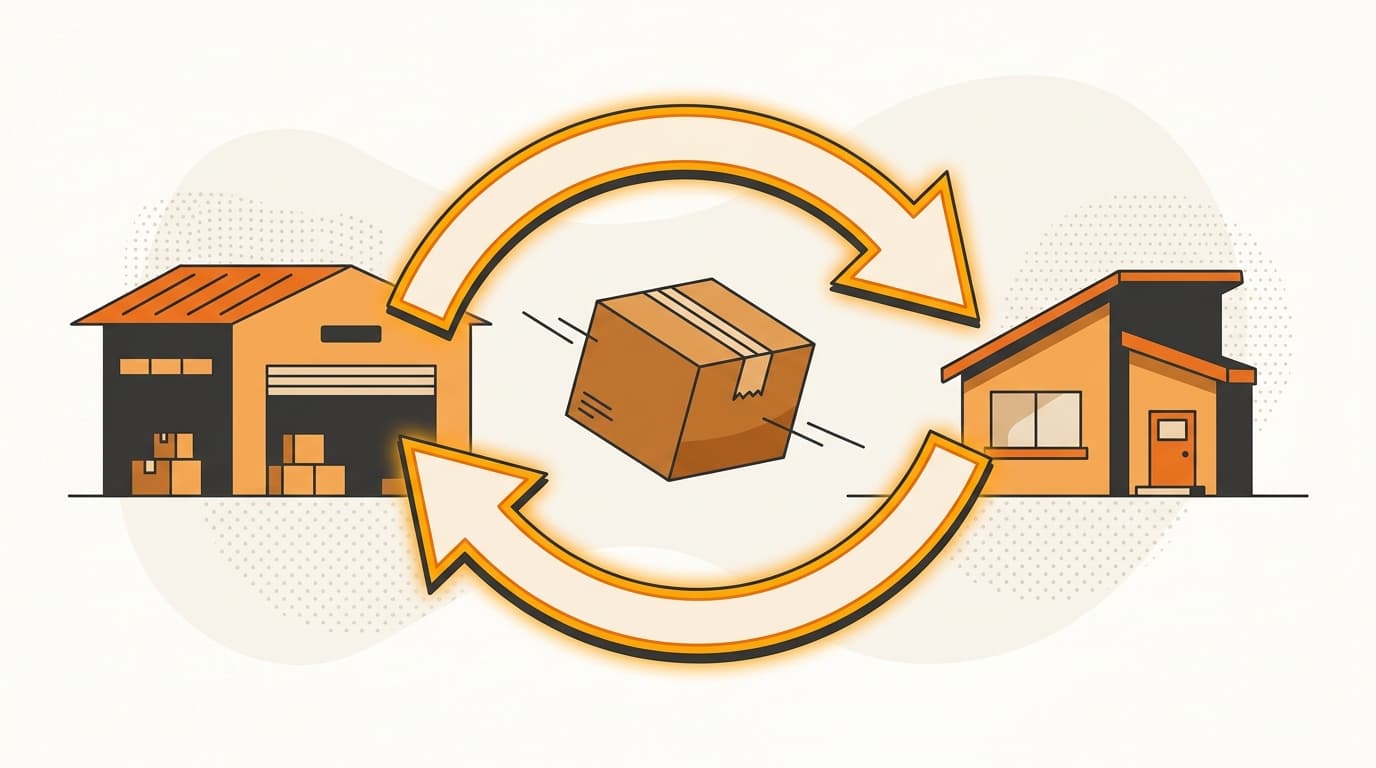
Coupang Ship-After-Cancel: Who Pays Return Shipping?
If a Korean customer cancels after you have already shipped, you — the seller — pay both legs of shipping: the outbound cost to send it and the return cost to bring it back. Coupang's return-processing rules assign the full round-trip return shipping cost to the seller when goods ship despite a visible stop-shipment request. The liability hinges on one moment: whether the product left after the cancellation was visible in your feed.
That single order can therefore generate two shipping charges, both billed to the seller. It is not a footnote. It is a line item that belongs in your Coupang margin model.
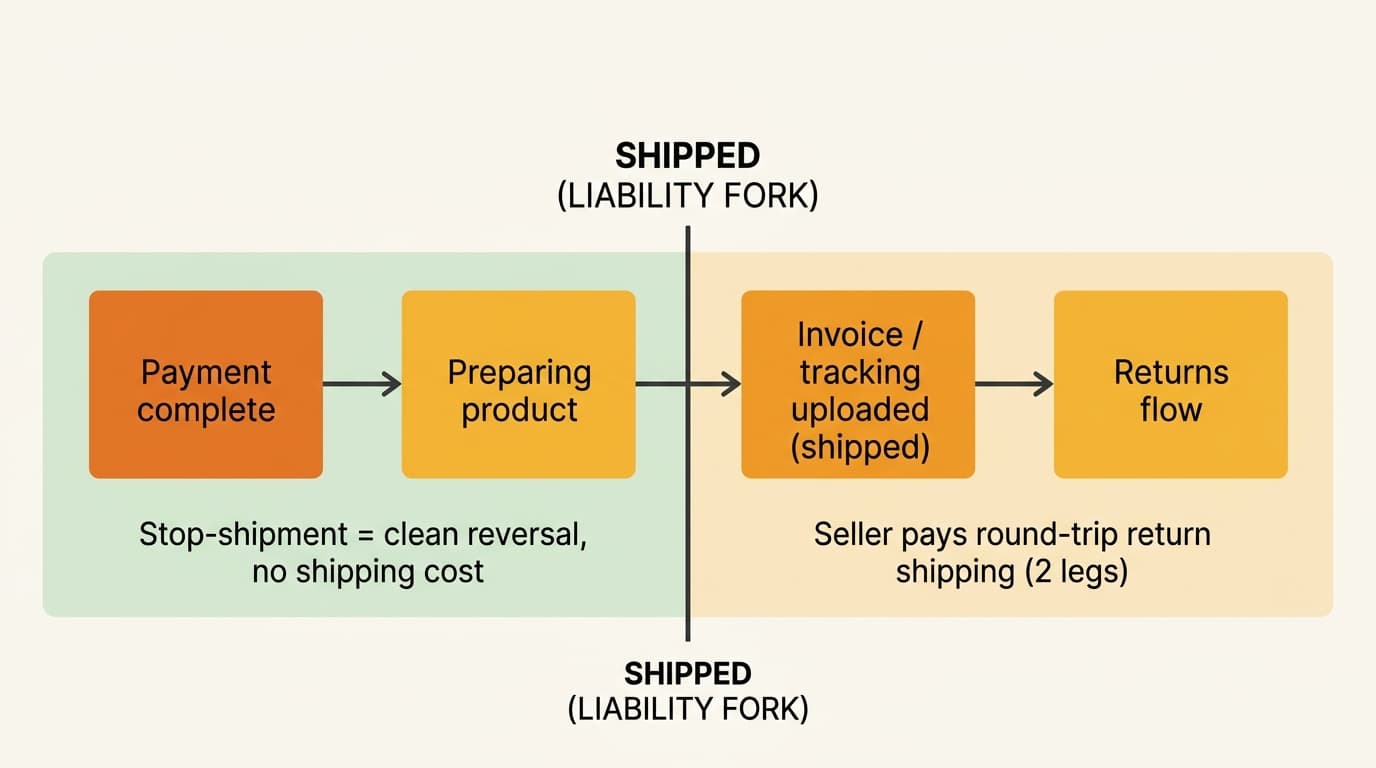
The dividing line is order status, not intent
Coupang treats a customer cancellation completely differently depending on where the order sits in its lifecycle. The fault rule does not ask who was right. It asks whether the goods were still in your control when the stop request arrived.
While an order is in payment complete or preparing product status, a customer cancellation is clean. You process the stop-shipment, the order reverses, and no shipping is incurred because nothing left the warehouse. This is the free reversal that most brands assume applies to every cancellation.
The moment you upload tracking (the invoice number) and the product ships, the order leaves the cancellation path entirely. It moves into the returns flow. Now the customer's "I want to cancel" becomes a return, and a return has a shipping bill attached to it. Coupang's own return-processing documentation states the consequence plainly: if the customer requested a stop-shipment (release stop) and you shipped anyway, the round-trip return shipping cost is yours.
Stop-shipment (release stop): a customer's request to halt an order before it leaves the seller's control. Honor it while the order is in payment-complete or preparing-product status and there is no shipping cost. Ship after it is visible, and Coupang's return rules put the full outbound-plus-return shipping on the seller.
The uncomfortable part for foreign brands: the rule keys off timing and visibility, not fairness. If the stop request was visible in your order feed and the box still went out the door, the liability is yours — regardless of whether your team saw it, meant well, or was simply an hour behind.
This is a race condition, and your SLA is the referee
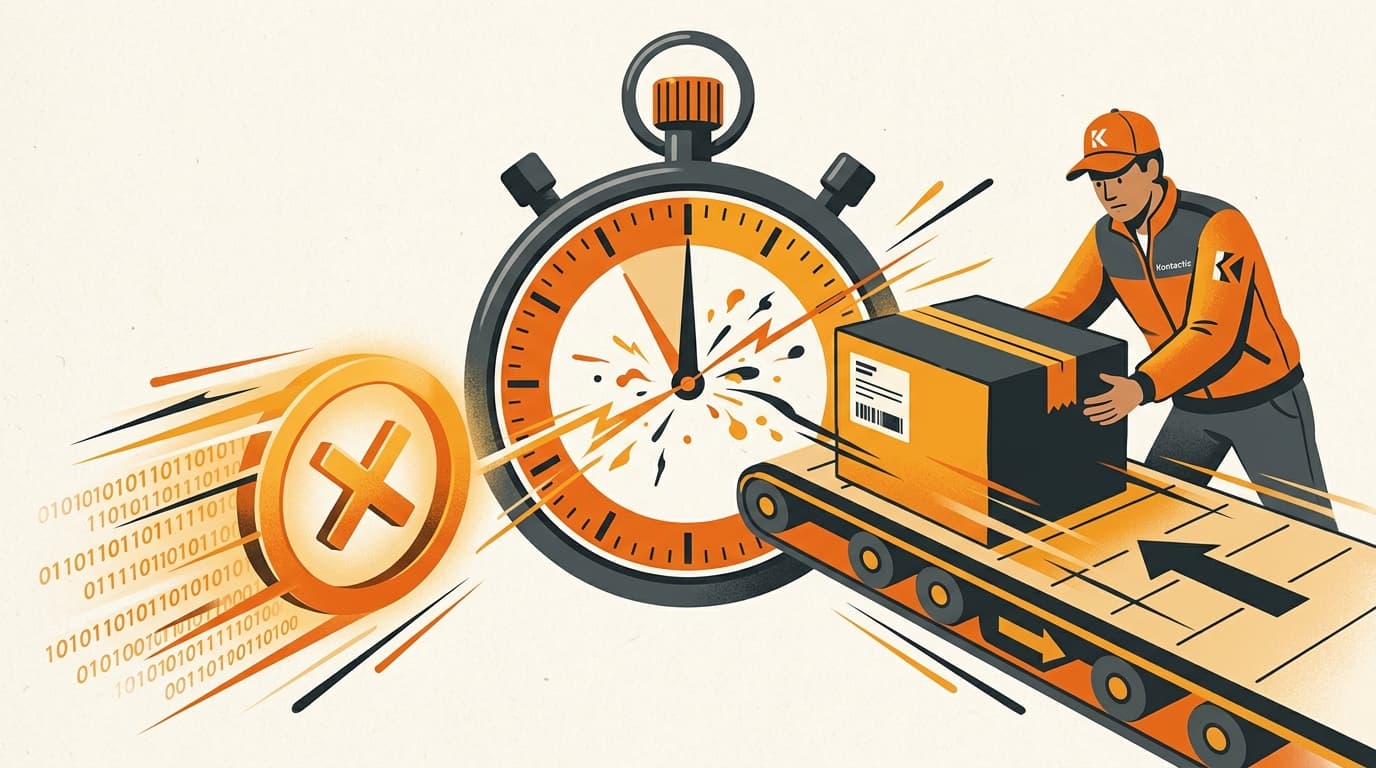
In practice, the reason this rule bites is speed. A cancellation request and your warehouse's dispatch can land within the same few hours — sometimes the same few minutes. The deciding factor is not policy interpretation. It is how quickly your fulfillment process checks for stop-shipment and return requests before it releases a box.
Think of it as two clocks running against each other. One is the customer's cancellation, hitting your order feed. The other is your pick-pack-dispatch cycle, moving the same order toward the courier. Whichever finishes first decides who pays.
That makes this a genuinely operational problem, not a compliance one. A brand with a tight cancellation-check step — one that re-scans the order state at the moment of dispatch — will rarely ship into a live stop request. A brand that batches its label printing in the morning and dispatches in the afternoon without a second check will occasionally ship orders that were cancelled at 11 a.m., and it will eat the round trip every time.
The practical fix is a rule, not a hope:
- Set an internal SLA for how fast you act on cancellation and stop-shipment notices — measured in hours, not days.
- Re-check order status at the last controllable step before the courier takes the package, so a cancellation that arrived mid-cycle still gets caught.
- Treat any ship-after-cancel event as a tracked exception, so you can see how often it actually happens rather than guessing.
Because the cost timing tracks so closely to your own dispatch cadence, this is exactly the kind of thing a midday check-in on your Korea accounts is meant to catch — a live cancellation sitting against an order that has not yet shipped is a problem you can still fix for free if you see it in time.
It plays out differently under Rocket Growth vs. seller-fulfilled
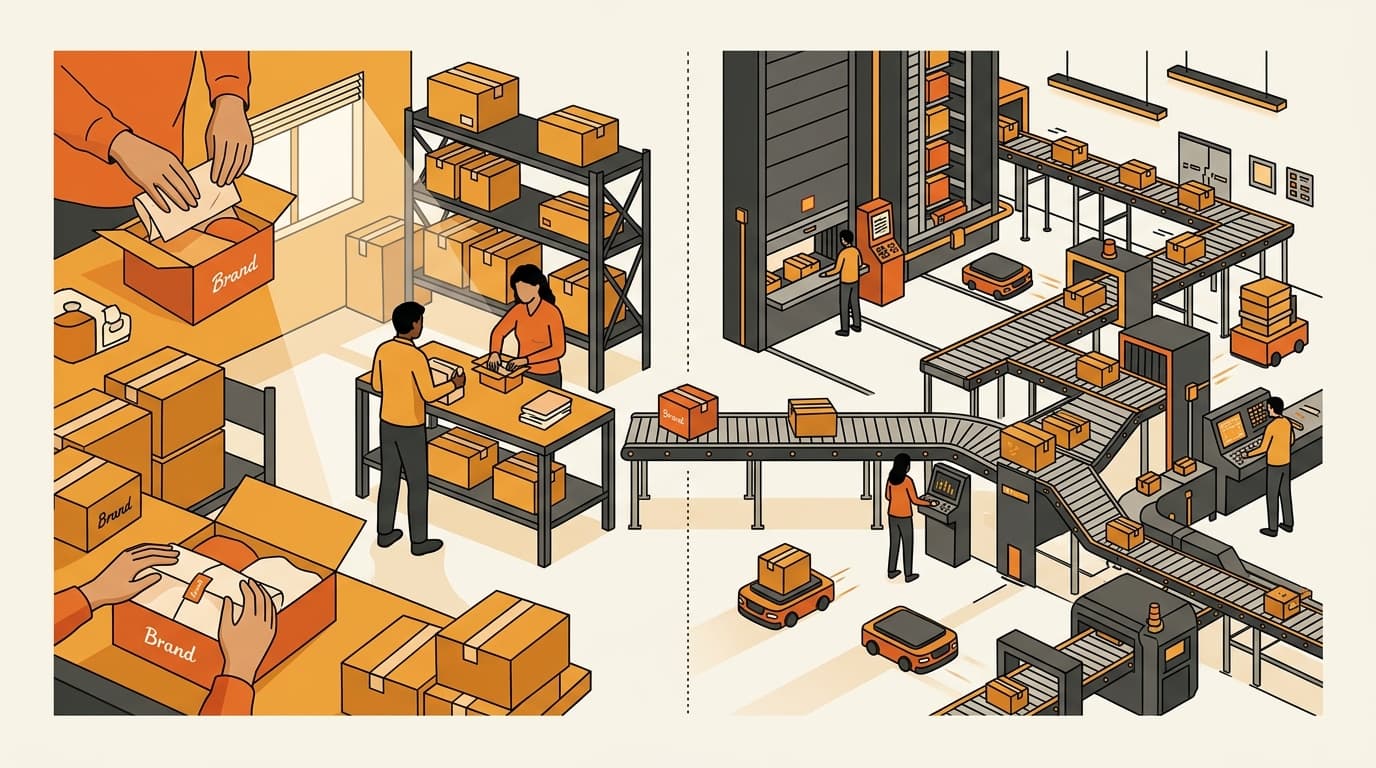
Which fulfillment model a SKU runs on changes who is physically holding the timing risk — so you have to know the model before you can model the cost.
Under seller-fulfilled shipping, your own operations bear this window directly. Your team receives the order, your team sees (or misses) the stop request, and your team releases the box. Every second of the race is yours to manage, and every ship-after-cancel charge lands because of something your process did or did not do in time.
Under Rocket Growth (로켓그로스), the physical handling sits inside Coupang's warehouse. Coupang stores and ships the inventory, and the customer-facing return, pickup, and refund run through Coupang's own process — a boundary we have written about in who handles returns under Coupang Rocket Growth. The timing race between cancellation and dispatch is no longer happening in your warehouse. That does not make returns free — return handling fees and the returned unit's disposition still come back to you — but the specific ship-after-a-visible-stop-request liability is a different exposure than it is when your team is the one pushing boxes out the door.
The takeaway is not "Rocket Growth is safer." It is that these are two distinct risk profiles, and mixing them in one margin model without labeling which SKU runs which way will give you a number you cannot trust.
Do not model one blended "return cost" across a catalog that mixes seller-fulfilled and Rocket Growth SKUs. The ship-after-cancel double-shipping risk concentrates on the seller-fulfilled side, where your dispatch cadence is the variable. Split the assumption by fulfillment model.
How to put this in your margin model
Stop treating a cancellation as always-free. Most Coupang margin models budget outbound shipping plus a flat return-rate allowance, and they quietly assume every cancellation is a costless reversal. It isn't. A subset of your returns will carry both shipping legs because the order shipped after a stop request was visible.
Don't guess a percentage. Instead, set a small placeholder allowance and replace it with actual data after one quarter of trading. Add a small explicit line for double-shipping returns, tag every ship-after-cancel event as it happens, and swap the placeholder for your measured rate once you have a quarter of history. If your cancellation-handling SLA is tight, that rate should be low and you will have proof it is low. If it is loose, the number will tell you exactly how much your dispatch cadence is costing you.
Two related timing rules interact with this one and are worth modeling alongside it. First, Coupang recognizes revenue on delivery completion, not payment, and a return can reverse a sale after it ships — so a ship-after-cancel order can both cost you shipping and fail to book as revenue. Second, Coupang has repeatedly changed the economics of returns and return fees, which means the numbers you plug in are not static — revisit them when policy shifts.
Common questions
If the customer cancels before I upload tracking, do I pay anything? No. While the order is in payment complete or preparing product status, you process the stop-shipment and it reverses cleanly. Nothing has shipped, so no shipping cost is incurred.
What exactly moves the order out of "cancellable" and into "returns"? Uploading the tracking/invoice number and the product shipping. Once the goods are in transit, the customer's cancellation is handled as a return, and return shipping rules apply.
Why is the round trip charged to me if I didn't see the cancellation in time? Coupang's return-processing rule keys off whether goods were released after the stop request was visible — not off intent or who was "right." Slow cancellation handling converts directly into shipping liability.
Does this apply to Rocket Growth SKUs the same way? Not identically. Under Rocket Growth the physical dispatch and customer-facing returns run through Coupang's warehouse, so the specific ship-after-a-visible-stop-request race is not happening in your operation. Return handling fees and unit disposition still come back to you.
Where can I verify the rule? Check Coupang's official seller and developer documentation for its return-processing (반품) flow, and read it against Korea's Act on Consumer Protection in Electronic Commerce (전자상거래법) on law.go.kr, which governs cancellation and return rights for online purchases.
Model your Coupang return costs before you scale spend
If you are mapping Coupang margins for a Korean launch and want the ship-after-cancel window built into the model correctly, talk to Kontactic.
About the author
Korean and global e-commerce operators with 15+ years of cross-border experience, led by CEO Isaac Lee — KOTRA-certified consultant and official lecturer for Seoul City and the Korea Customs Service. We run Korea market entry for Western brands every day; this blog documents what we learn in the field.
More about Kontactic →Related Articles

Children’s Product KC: Does “Ages 13+” Avoid the Rules?
No. In Korea, “Ages 13+” is only one factor; design, intended use, packaging, and child-directed marketing can still trigger children’s-product KC rules.

Korean KC for a Detachable Device Charger: Not Automatic
Does Korean KC cover a detachable charger? Not automatically. The final bundle and adapter evidence must match the Korean commercial SKU before import.
Can Coupang Handle Every Korean Buyer Inquiry? No—Seller Duties
Coupang may handle platform and fulfillment contacts, but sellers still own product questions, cancellations, returns, exchanges, and order exceptions.