
Korea De Minimis: What the USD 150 Threshold Means
Korea lets a personal-use import in without customs duty or import VAT when the goods cost USD 150 or less — USD 200 for most goods shipped from the US. Above the line, duty and 10% VAT are charged on the whole value, not just the part over the line.
That is the short answer. The longer answer — the one that matters if you are deciding how to sell a foreign brand into Korea in 2026 — is that the line works differently from what most guides say, and it only applies while your Korean buyers import for themselves. Once you import in bulk to sell locally, it no longer applies.
What Korea's de minimis threshold actually covers
The threshold covers goods a person in Korea imports for their own use — typically what a Korean consumer receives after buying from a foreign website, or from a brand selling through Coupang's cross-border program, Coupang Global Fulfillment (CGF). The buyer is the importer: the courier or customs broker clears the parcel in the buyer's name, using their personal customs code (개인통관고유부호).
The details that trip brands up:
- USD 150, or USD 200 from the US. Under the Korea–US free trade agreement, goods shipped from the US that go through list clearance (목록통관, the simplified route most express parcels use) are duty-free up to USD 200. Goods that need a full import declaration — health supplements and medicines, for example — use USD 150 even when they come from the US.
- The goods' price, not the shipping. The line is judged on what the buyer paid for the goods, including any sales tax and domestic shipping in the seller's country. International shipping to Korea is not counted. If the parcel goes over the line, though, duty and VAT are charged on the full value plus the international shipping.
- Not strictly per parcel. Since November 2022, parcels are no longer added together just because they arrive on the same day. But goods bought from the same seller on the same day are added together, and so is everything that travels under one waybill — for example, two orders a forwarder packs into one box. Splitting one order into several parcels does not keep each parcel under the line.
- Quantity limits and banned goods still apply. Some products have their own personal-use limits — health supplements, for example, are limited to six bottles — and some cannot be imported at all.
- Bulk and B2B imports do not use this threshold at all. The moment you ship a pallet to your own Korean entity or to a 3PL, you are in formal customs clearance with duties, VAT, and HS-code-driven scrutiny.
Don't confuse it with the traveler allowance
Search results often mix the de minimis line with the allowance for travelers. They are different rules. A traveler arriving in Korea can bring in goods worth up to USD 800 duty-free, with separate allowances for alcohol, tobacco and perfume. That allowance is about luggage, not parcels.
If you are a brand looking at cross-border sales into Korea, only the parcel line matters: USD 150, or USD 200 for list-cleared goods from the US.
Why the threshold matters less than founders think
The de minimis question comes up early because it shapes the unit economics of low-priced products. The reasoning sounds clean: keep each order under USD 150, and your buyer pays no duty and no 10% VAT.
In our experience, three things complicate this plan.
First, orders add up. Two items a buyer orders from you on the same day are judged together, and a forwarder that packs two orders into one box puts them under one waybill. Price the basket, not just the item.
Second, delivery speed matters as much as duty. Korean shoppers are used to next-day delivery through Coupang's Rocket Delivery. A typical cross-border parcel from the US or Europe takes a week or more. Coupang Global Fulfillment narrows that gap — orders reach Korean buyers in 3–5 days — but it is still not next-day.
Third, the rules are moving globally. The US ended its USD 800 de minimis exemption in August 2025, and other major economies are reviewing their low-value parcel rules. Korea has not announced a change to its USD 150 line, but duty-free entry alone is not a pricing strategy to build a business on.
For a brand with steady volume, local fulfillment on Coupang Rocket Growth often costs less per order even with duty and VAT included — we ran the numbers in Local vs Cross-Border Korea Fulfillment: Cost Math.
What changes when you go local
Once you import in bulk to a Korean entity and fulfill domestically, the de minimis question disappears entirely. You are no longer shipping parcels to consumers. You are a formal importer.
That changes the operating model in five concrete ways:
- You pay 10% VAT on import, but you also reclaim it as input VAT when you file. A cash-flow effect, not a margin effect.
- Customs duty applies at the rate for your product's HS code. Rates vary widely by product, and a free trade agreement between Korea and your country of origin can bring them to zero. Check the HS code.
- KC Certification (KC 인증) becomes mandatory for any product in a regulated category — small appliances, electronics, kids' goods, certain home goods. This is the largest single thing foreign brands underestimate. We covered the practical sequencing in KC Certification and Coupang: A Korean Entity?.
- Rocket Growth (로켓그로스) becomes available. Coupang's 3PL handles warehousing, last-mile, and returns. The returns operation in particular is what cross-border brands cannot replicate — Korean shoppers return often, and a foreign return address kills conversion.
- You need a real Product Detail Page in Korean. This is the gap most de minimis articles never close, and it is the single highest-leverage item on the list.
The de minimis threshold is a checkout-stage question. Whether a Korean consumer will buy in the first place is a Product Detail Page question. Most foreign brands lose the second battle long before customs becomes relevant.
The Korean-language PDP is the real conversion lever
A Coupang Product Detail Page is not a translated Shopify page. It is a roughly 20,000-pixel-tall visual asset — closer to a long-form landing page than a product listing — built for mobile-first Korean readers who skim vertically and decide in seconds.
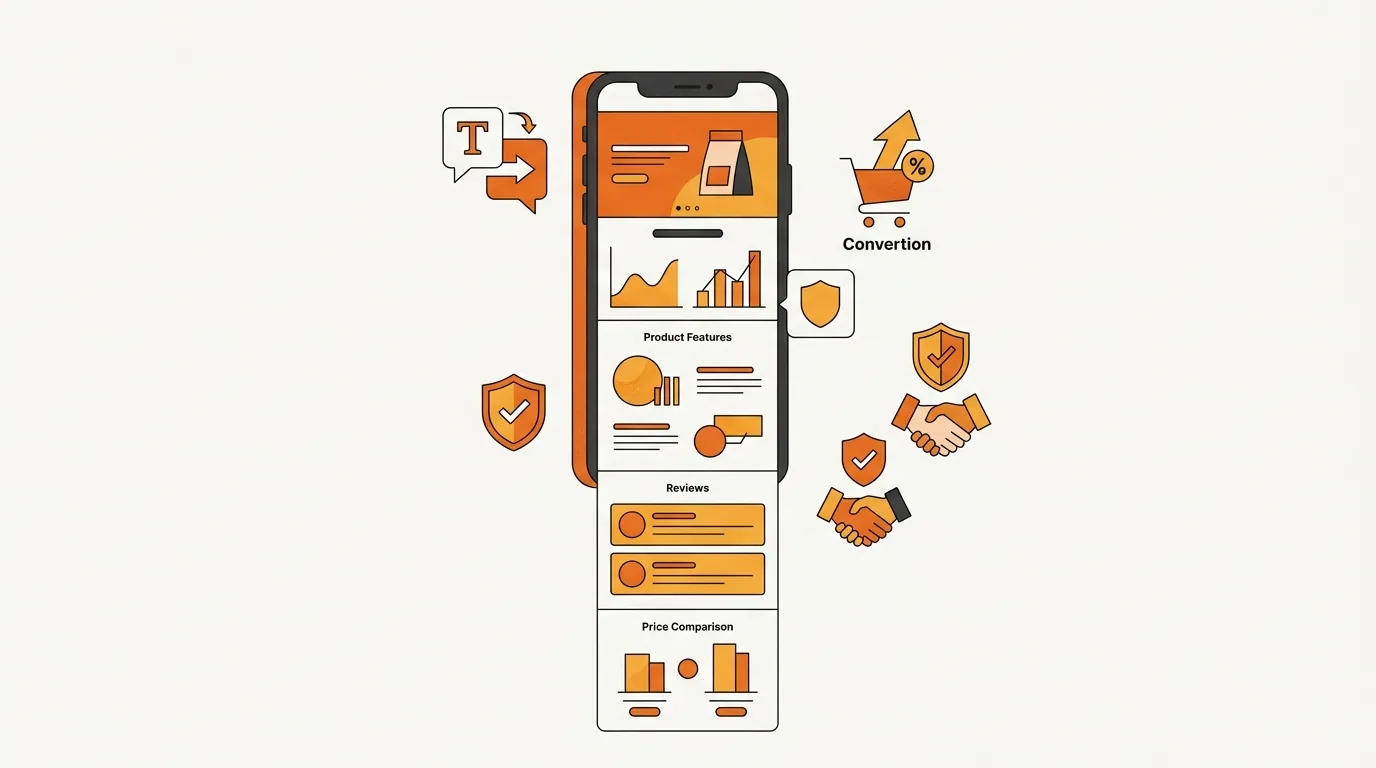
The components Korean shoppers expect on a PDP:
- A Korean-language hero block that names the use case, not just the product
- Comparison shots, lifestyle imagery, and size references in cm and Korean units
- Trust signals: KC certification badge if applicable, MFDS notification number for cosmetics, country of origin
- Q&A-anticipating sections that resolve objections before the review section is reached
- Local CS contact and return policy stated explicitly
A machine-translated PDP loses on every one of these. It reads as foreign, it does not answer the questions a Korean shopper has, and it leaves Coupang's PDP scoring (which influences placement) underweight.
“Brands ask us about de minimis when they should be asking about PDP conversion. One is a 10% line item. The other is the difference between selling and not selling.”
Kontactic — Operations team
KC certification and timeline: what you can do fast vs. what you cannot
Brands looking at the USD 150 threshold often hope to use cross-border as a way to skip certification. That works only while your buyers import for their own use. Certification rules are written for goods sold in Korea, not for a consumer's personal import.
The moment you import in bulk for local sale, KC certification is non-negotiable for in-scope categories. Practical points worth knowing in advance:
- Electrical safety KC for products with a Korean plug — full certification, Korean lab testing, sample submission. Plan 6–12 weeks.
- EMC-only requirements for USB- and battery-powered devices — sometimes a foreign EMC report can support a Korean Declaration of Conformity. We wrote up the specifics in KC Certification for USB and Battery-Powered Devices.
- Cosmetics and HFF — handled by MFDS, not KC. Different timeline, different filings.
- KCS for security products — single government lab, no appeals process. Pre-test before you apply.
Here is the realistic split for a brand that walked in this morning asking about the USD 150 threshold.
Fast (weeks):
- Sell cross-border with each buyer's basket under the line (USD 150, or USD 200 for most goods from the US) — from your own site, ideally shipping DDP (see DDP vs DAP When Selling to Korean Consumers for why this matters at checkout), or through Coupang Global Fulfillment (CGF) if you ship from the US, Europe, Japan, mainland China or Hong Kong
- Watch which products and price points Korean buyers actually pick
Slower (months):
- Korean entity setup and corporate bank account
- KC certification or MFDS registration where applicable
- Coupang seller account, Rocket Growth onboarding, and inventory inbound
- A real Korean-language PDP built for Coupang's format
- Local CS and returns handling
Neither track is the "right" first step. Cross-border is a full way to sell in Korea, not just a test, and the de minimis line is what keeps it cheap for your buyers. Local is how you get next-day delivery, local returns and the full Korean storefront. Some brands start cross-border and go local later if they choose; a brand that already has Korean demand or partners can go local from day one. The framing in Rocket Growth vs. Cross-Border Selling in Korea and the broader point in Why Cross-Border Orders Understate Your Korea Market Opportunity go deeper.
So what should you do?
If you are reading this because you want to know whether to keep your products under USD 150 to clear duty-free in Korea: yes, that line exists, and it works for personal-use imports — from your own site or through Coupang's cross-border program. Price the basket, not the item, and remember that the line is judged on the goods, not the shipping.
But duty is rarely what decides whether Koreans buy. The structural advantage in Korea is being available on Coupang with fast delivery, a Korean-language PDP and easy returns. Cross-border gets you part of the way; going local — your own entity, KC where applicable, and a real localized storefront — gets you the rest. Which route fits depends on your products and your plans, not on a fixed order.
Planning how to sell in Korea?
We help foreign brands sell in Korea — cross-border on Coupang through Coupang Global Fulfillment (CGF) for brands shipping from the US, Europe, Japan, mainland China or Hong Kong, or locally on their own Korean entity with entity setup, KC certification, Korean PDPs and operations under one roof. Tell us where you are and we'll map the realistic path.
글쓴이 소개
15년 이상 크로스보더 이커머스를 운영해 온 한국·글로벌 커머스 전문가들입니다. 이이삭(Isaac Lee) 대표는 KOTRA 인증 컨설턴트이자 서울특별시와 관세청의 공식 강연자입니다. 저희는 매일 해외 브랜드의 한국 진출을 직접 운영하며, 이 블로그에 현장에서 배운 것을 기록합니다.
컨택틱 팀 만나 보기 →관련 글
Korean Import Duty and VAT: Which Price Counts?
Korean import duty and VAT normally use the parent-company price, not Coupang’s retail price; freight, insurance, and some royalties can change the tax due.
What Happens to Unsold Stock After a Korea Pop-Up Store?
After a Korea pop-up, unsold stock must be sold locally, returned, re-exported, or disposed of at the brand’s cost. Choose the route before the event.
Can One Korean Importer Sell to Several Buyers?
Yes—one Korean importer can clear a shipment and resell it to several Korean buyers. Set the seller, tax invoice, labels, and compliance roles before it ships.