
Coupang Settlement Periods: How Kontactic Reconciles
A Coupang payout is not the close. Kontactic Seller Center reconciles each period against allocation status and bank evidence. Confirmed matches count as received, while late corrections, bank differences, FX residuals, and reason-specific adjustments remain visible.
Settlement close is the point at which a marketplace period is reconciled against its allocations, bank evidence, and remaining differences. A payout or released balance alone does not close it.
Why a payout total is not a close
A payout record can show a nominal settlement total or a released balance. That is useful, but it does not show whether the amount was allocated correctly or the expected amount arrived in the bank. It also does not show whether a later correction changed the period.
For a Western brand moving from cross-border demand to a Korean operation, the distinction is practical. Finance and operations need to see:
- which settlement period the record belongs to;
- which allocation matches are confirmed and which are still proposed;
- whether the released balance agrees with bank-record evidence;
- whether a receipt is short or missing;
- whether a foreign-exchange conversion left a residual difference; and
- whether a late correction or carry-forward changed the period after it was completed.
Without those distinctions, a team can mistake a proposed allocation for received cash or read a rounded settlement total as fully reconciled. The Coupang settlement timelines question is about when a settlement is expected; the close question is whether the period is supported, allocated, and explainable.
Completed periods are controlled records
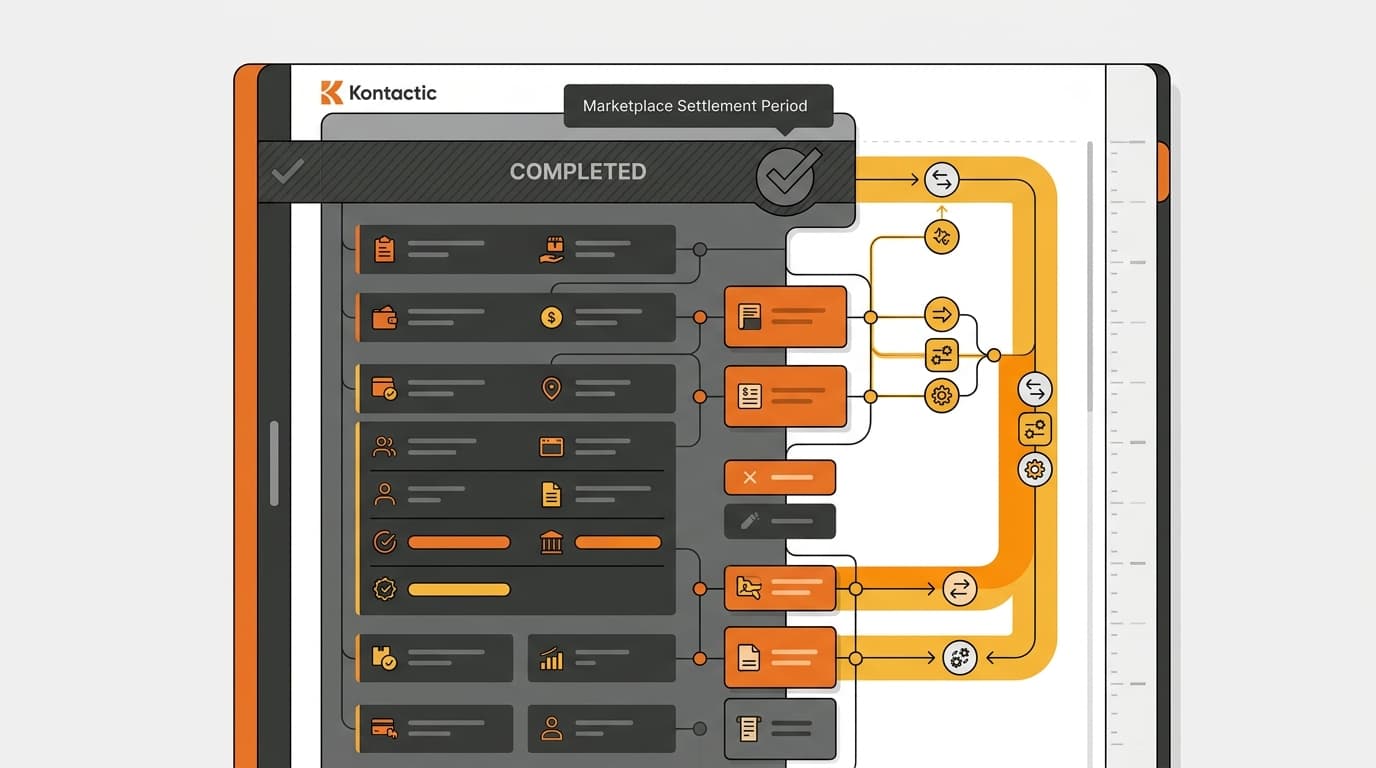
The first control is the period boundary. Completed settlement periods are treated as controlled records rather than as rows that can be silently rewritten whenever a new file or correction appears.
That does not mean a late correction is ignored. It means the correction or carry-forward follows an explicit path. The original completed period remains interpretable, while the later item is visible as a subsequent correction or carry-forward instead of appearing as an unexplained change to history.
This matters when a finance team has already reviewed or reported a period. If the historical amount changes without an explanation, the reviewer has to reconstruct the close from old exports, revised exports, and bank records. A controlled record keeps the original close and the later change conceptually separate.
The useful principle is controlled history, not frozen error. A completed period can still have a later adjustment; the operational record should show that the adjustment happened and why it belongs in the reconciliation path.
Confirmed allocations are the only received cash
The second control is the difference between a confirmed allocation and a proposed match. Only confirmed allocation matches count as received. Proposed matches remain visible as open items, so cash reporting does not overstate what has actually been reconciled.
That distinction is easy to lose when a settlement total looks plausible. A proposed match may be the best current candidate for connecting a settlement amount to a bank record, but it is not the same as a confirmed match. Keeping it open preserves the uncertainty instead of converting it into a received-cash figure.
Bank-record evidence adds another necessary check. It helps identify a short or missing receipt that a nominal settlement total could hide. The platform-side amount and the bank-side evidence therefore answer different parts of the close: one describes the settlement record, while the other helps establish what arrived.
| Reconciliation state | Treatment in the close | Operational meaning |
|---|---|---|
| Confirmed allocation match | Counts as received | The settlement amount has a confirmed allocation match. |
| Proposed match | Remains visible as an open item | The candidate allocation has not been confirmed and should not inflate received cash. |
| Short or missing receipt identified through bank evidence | Remains an exception to review | The nominal settlement total does not by itself explain the bank-side result. |
Do not report proposed matches as received. Keep them visible as open items until the allocation is confirmed; otherwise the settlement close can overstate cash.
This is the difference between logging a payment and reconciling one. A payment log can say that a settlement exists. A reconciliation record also says whether the allocation is confirmed, whether the bank evidence supports it, and what remains unresolved.

FX differences and adjustments need their own explanation
Settlement records become difficult to review when foreign-exchange conversions and small residual differences are compressed into one rounded total. Kontactic surfaces those differences as reconcilable items instead of allowing them to disappear into the total.
The point is not that every difference signals an error. The point is that a difference should remain visible long enough for a reviewer to understand it. When a settlement crosses currencies, the conversion can leave an amount that needs to be reconciled. Hiding that residual makes the statement look cleaner while making the close harder to explain.
Reason-specific adjustment lines provide the second part of that explanation. They replace opaque catch-all categories with a consistent statement structure. A reviewer can distinguish the normal settlement amount, the adjustment, and the reason attached to it.
That structure helps answer the questions a close actually creates:
- Is the difference tied to a foreign-exchange conversion?
- Is it a bank-side receipt variance?
- Is it a late correction or carry-forward?
- Is it still open, or has it been reconciled?
A consistent statement does not remove the need for review. It gives the review a stable shape. The same categories of difference remain visible from one period to the next rather than being absorbed into a catch-all line that must be decoded later.

Settlement rules are tested before live adoption
Settlement rules can change how periods are matched, allocated, or adjusted. A rule that appears reasonable in isolation may produce a different result when applied to records that have already been reviewed. Kontactic compares settlement rules against historical periods before live adoption so the change can be tested and explained.
Historical comparison gives the team a reference point. Historical comparison shows how a proposed rule behaves against prior settlement periods. It also shows whether the rule changes an allocation or introduces a residual or adjustment that needs review.
This is separate from rewriting completed records. The historical periods remain controlled records. Their purpose in the comparison is to test the proposed rule before it becomes part of the live reconciliation process.
The operational benefit is straightforward: a rule change becomes a reviewable decision rather than an unexplained change in future statements. Finance can ask what changed, operations can see where the change appears, and both teams can distinguish a new rule from a late correction to an old period.
A practical settlement-close sequence
A period-aware close can be reviewed as a short sequence:
- Set the period boundary. Identify the settlement period and whether it is still open or completed.
- Protect completed history. Treat completed periods as controlled records rather than silently replacing their contents.
- Review allocation status. Separate confirmed matches from proposed matches, and keep proposed items open.
- Compare against bank evidence. Use the bank record to identify a short or missing receipt that the nominal settlement total may not show.
- Explain differences. Keep foreign-exchange residuals and reason-specific adjustment lines visible in the statement structure.
- Handle later changes explicitly. Route late corrections and carry-forwards through an identifiable path, and compare changed settlement rules against historical periods before live adoption.
The output is not merely a list of payouts. It is a record that distinguishes what was received, what remains open, what changed after completion, and why the final statement differs from a simple platform total.
The useful close is explainable. A reviewer should be able to tell what was received, what is open, what changed later, and why the reconciled amount differs from the nominal settlement record.
Common questions about Coupang settlement reconciliation
Is a Coupang payout the same as a closed settlement period?
No. A payout or released balance is an input to the close; the period is not fully reconciled until allocations, bank evidence, differences, and later changes are handled.
Do proposed allocation matches count as received?
No. Only confirmed allocation matches count as received. Proposed matches remain visible as open items so cash reporting does not overstate receipts.
What happens when a correction arrives after a period is completed?
The completed period remains a controlled record. The late correction or carry-forward follows an explicit path instead of silently changing the original history.
Why keep foreign-exchange residuals visible?
Because a conversion or receipt difference can be real even when it is small. Surfacing it as a reconcilable item is more useful than hiding it inside a rounded total.
Why compare settlement rules with historical periods first?
The comparison makes a proposed rule change testable before live adoption. It shows how the rule would affect prior records without rewriting those completed periods.
Make your Korea settlement close explainable
If payout records, bank evidence, and later corrections are difficult to reconcile, contact Kontactic to discuss a period-aware operational record for your Korea marketplace activity.
About the author
Korean and global e-commerce operators with 15+ years of cross-border experience, led by CEO Isaac Lee — KOTRA-certified consultant and official lecturer for Seoul City and the Korea Customs Service. We run Korea market entry for Western brands every day; this blog documents what we learn in the field.
More about Kontactic →Related Articles

Korean Entity Administration: What Happens After Setup?
Incorporation is the start for a Korean entity. See how Kontactic Seller Center stages renewal reminders and routes local-tax and import-license document work.

Korea Launch Roadmap: Kontactic’s Brand-Specific Plan
A Korea launch roadmap should reflect the brand, while Kontactic Seller Center turns scope, evidence, dependencies, and progress into one shared plan.

How Does Kontactic Protect Coupang Catalogs When Sync Fails?
When Coupang connectivity fails, Kontactic separates shared incidents from seller-level issues and protects the live catalog from incomplete inventory updates.